
It's the first time in the history of the world.
Just now, the two biggest gold-holders of Anthropic are stepping on the brakes at the same time.
It's the night before Anthropic is set to go on sale.
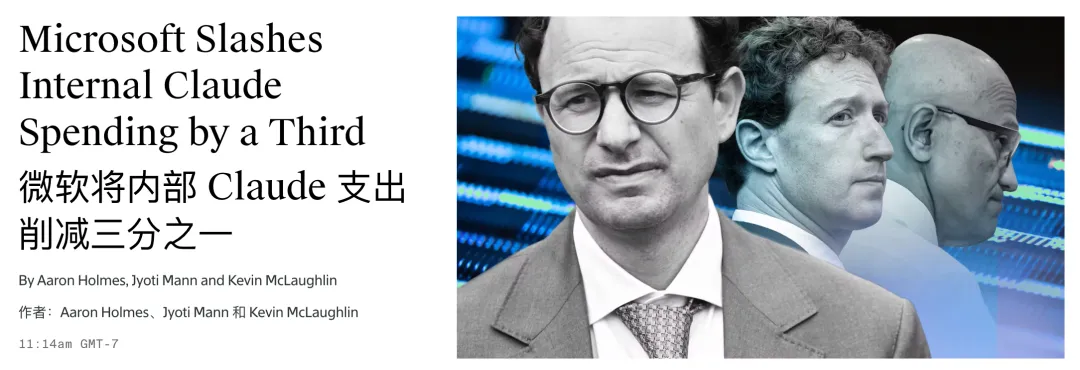
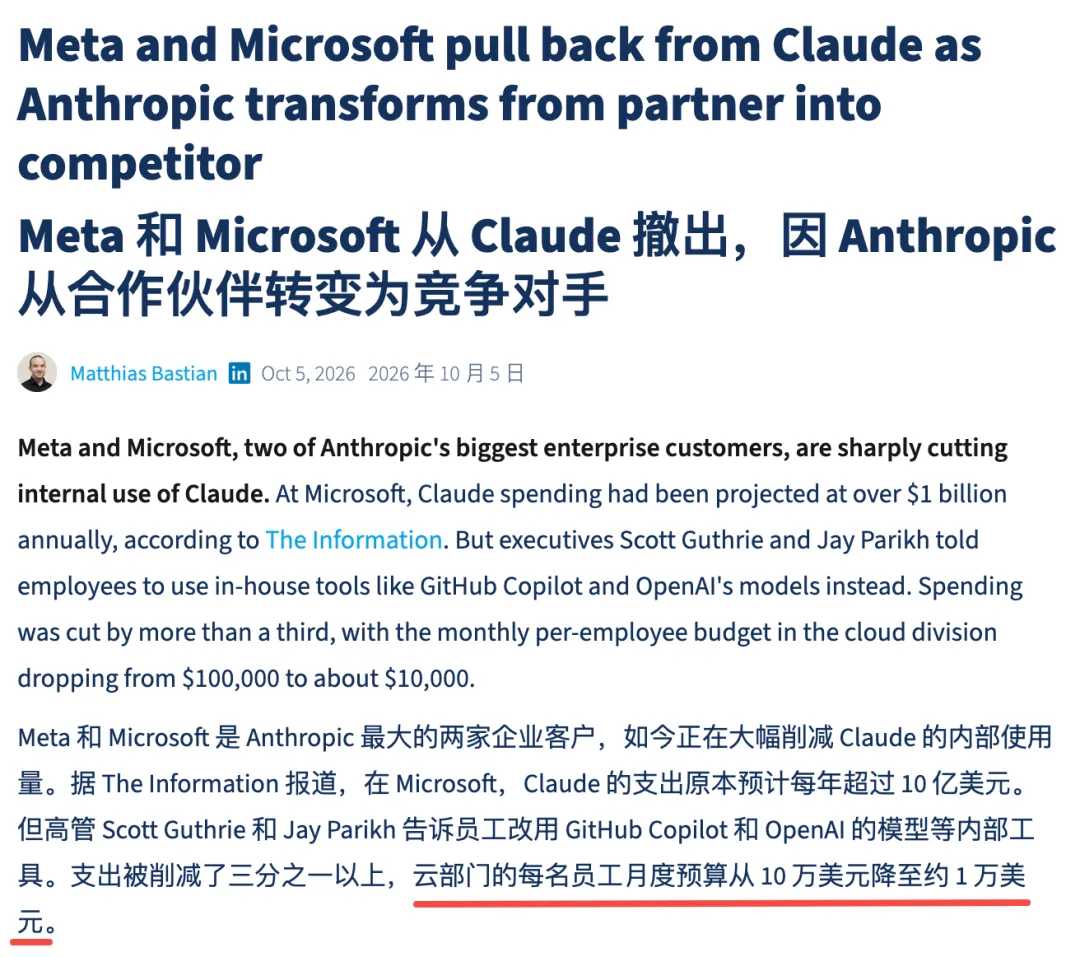
According to The Information, Microsoft's internal budget, which was expected to exceed $1 billion for Claude this year, has been cut by more than a third.
On the Meta side, the number of employees using Claude Code internally dropped directly from about 60,000 to about 30,000.Back and forth.。
What's even more magical is that by halving the number of users, Meta has spent more than $105 million on Claude Code over the past 28 days.
What is Claude's biggest problem?
It's not bad. It's the opposite.It's very useful.。
The more you use it, the more money you burn.Last December, Microsoft released Claude Code to thousands of engineers in the experience and equipment sector.
No one promoted it, no one mobilized it, and it burned on its own power. In the first few months, Token's consumption directly doubled.
Each engineer's monthly Token costs between $500 and $2000, and the entire team burns millions of dollars together.
Microsoft Cloud and AI chief Scott Guthrie and CEO Jay Parikh can't sit down and talk directly: less Claude, more GitHub Copilot and their own models.
According to The Decoder, Claude's monthly contribution to the cloud sector has dropped from $100,000 to about $10,000 per month.
By May 2026, Microsoft had canceled most of its Claude Code licenses, requiring them to be fully relocated by the end of the fiscal year on June 30.
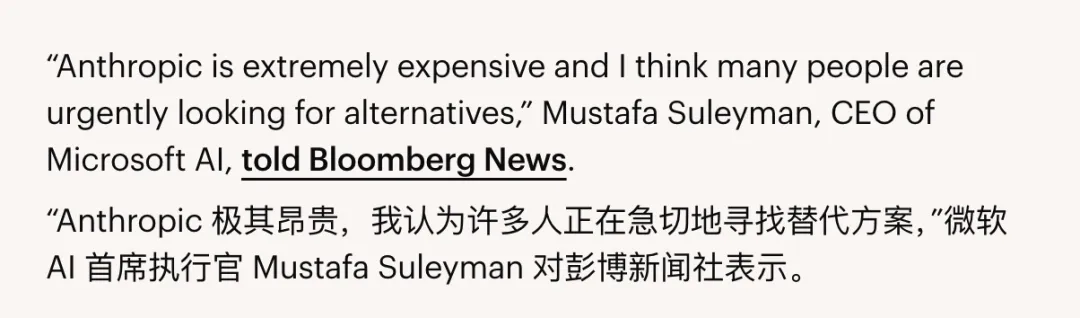
According to Microsoft AI CEO Suleiman, Anthropic's program is "extremely expensive", with the goal of significantly reducing it until it is completely eliminated.
Look at Meta again.
The previous 10% of layoffs could only explain the loss of a part of the employee's user base, largely because Meta created an alternative.
Internal programming tool MetaCode has more than 30,000 users, and Muse Code, which began external testing in August this year, has more than 6,000 users.
Meta's self-developed Muse Spark model progressed so fast that it largely overcame Claude's needs directly.
Meta has a sign called 'Claudeonomics' within its employees, which has burned 60 trillion tokens for 30 days. That's the equivalent of a lot of internal code and data coming back and forth through someone else's servers every day.
What kind of factory can tolerate this?
This is the dead end of Token billing.
When you talk, you ask a question and answer a question, and the traffic is limited. But the Agent model is different, it reads code itself, runs tests, changes and changes, and so on and so forth for hours, and the flow rate keeps changing.
The more you use it, the more expensive it is. The more expensive it is, the more you want to make it.
It's not just about money, it's about time.
Anthropic filed a secret S-1 filing with the SEC in June this year, according to a September public offering: Two unnamed clients together accounted for about 25 percent of revenue.
The market speculates that the two companies are Microsoft and Meta.
At the pace previously reported, Anthropic is set to launch an official tour in the middle of this month, to kick off Nasdaq.
A company is preparing to convince investors that a quarter of its revenue may come from two customers who tend to shrink at the same time at this point in time.
And there's a more patient flaw: Microsoft is saving money on Claude, and Anthropic is spending a lot of money on the Microsoft cloud.
The tender shows that there are approximately $31.4 billion worth of irrevocable infrastructure procurement commitments between Anthropic and Microsoft.
This picture is a bit of a blur.
How partners turn into opponentsA deeper logic is the transformation of identity.
A year ago, people used Anthropic as a marketing tool: models are tools that anyone can buy and use.
But it's not the same now. Claude Code can write his own code, change documents, run processes, Claude Cowork is becoming more and more like an alternative to Office, and Office is Microsoft's destiny.
Meta, on the other hand, wants to use Muse as a service to sell to a business, and it doesn't matter if they bid on it and pay off it to their opponent.
According to reports, Meta also wants to restrict Anthropic's access to home training data.
The stronger the model, the closer it is to the core business of the customer. The closer it is to the core business, the more insecure customers are about handing it over to outsiders.
The wind is not just blowing on these two people.
In July, Ali discontinued the use of Claude Code and resumed the development of Qoder. In September, United, Palantir, Booz Allen also tightened their use, preferring to use their own Nemotron when dealing with proprietary information.
There are costs, there is data security, there is anti-distillation.
But the direction is the same:The most important thing about the code is that the giant has to hold it in his hands.
Anthropic, of course, isn't complaining, and it's responding.
Fable 5.1, which was released in early September, had a fixed base price, but the cost of caching readings dropped by 75 percent, typical workloads were around 25 percent cheaper overall, and high-agent recycling was 45 percent cheaper at most.
At the same time, Anthropic has also adjusted its controversial data retention policy to allow companies to retain data on their own infrastructure in an attempt to rescue customers who are scared off by security concerns.
But the problem is that lower prices can only mitigate the contradictions and not solve them fundamentally. The giants are not only disgusted, but more concerned that this supplier is becoming their competitor.
AI programming enters the accounting ageIn the past two years, the AI industry has been fighting over who's model is stronger, and who's agent can live longer independently.
Now the CFO starts asking another question:How much does each line of code cost?
That's how Microsoft got there. Claude Code used to double his own usage, and the bills went up. Then they got most of the licenses back.
Engineers love to use it, and they've been on a budget.
The answer to this question is that the market is being cut into two layers: enough, cheap, controllable models that eat up a lot of everyday life; the strongest models that leave only a fraction of the hardest.
For the entire ASI competition, this is a cruel reminder that the brightest lights are not strong enough and should be used.
The ability curve and the cost curve of AI are racing. The ability to run faster, the cost can't go down, and it can only stay in a small budget team. Who makes intelligence cheap enough, who can really get into the everyday life of every engineer.