
It's the first time in the history of the world.
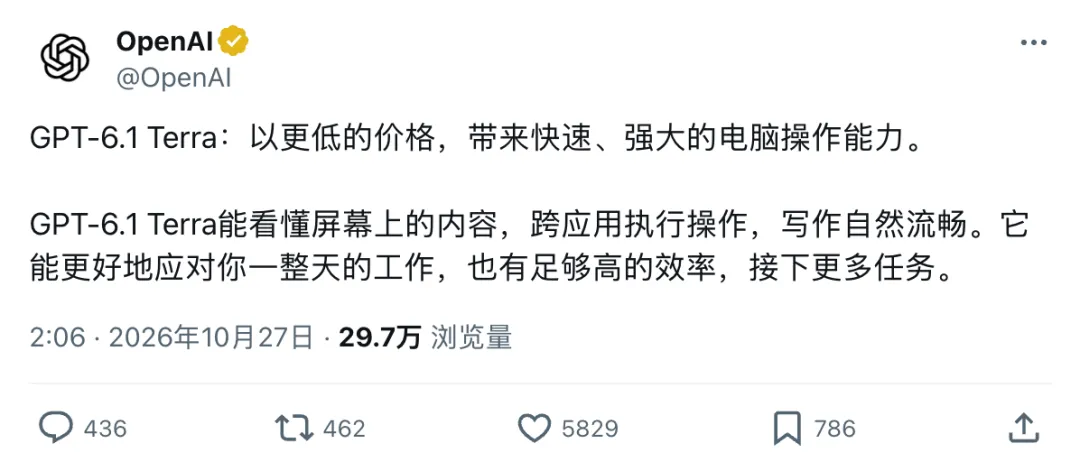
Just recently, OpenAI officially released a new generation of the GPT-6.1 Terra! model.
It's a "super digital employee" who runs faster and works faster.
It can run across the software on a computer like a real person, and the scariest part is that its price goes up.
A mid-cup model that sells for only $1 per million of tokens equals a super-large cup flag that costs 10 times its price!
In mainframe computer operations, it is directly balanced with the GPT-6 Astra; after filling the logic, it is directly pressed against the Astra and the large cup GPT-6.1 Sol.
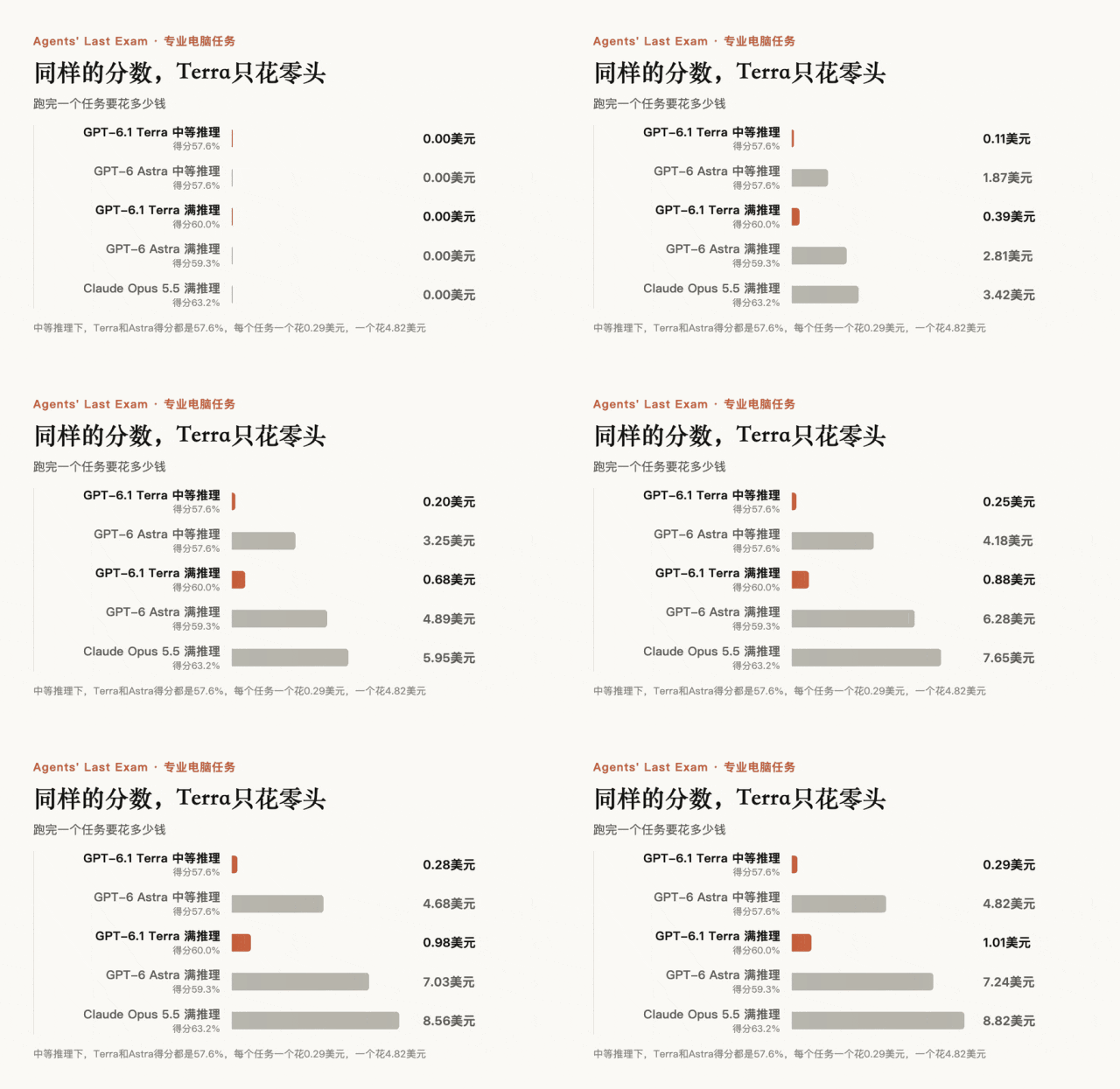
In the middle of the cup, the top level, playing the flagship fighter.In Agents' Last Exam, Terra and Astra scored an average of 57.6 points for a single run, with Terra costing only $0.29 and Astra $4.82.
It's all about reasoning and killing Sol and Astra.When it came to reason, Terra rushed to 60.0 points, overtaking Sol's 58.6 points and Astra's 59.3 points, at a cost of only $1.01 per mission.
Nine times less than the Opus 5.5.Less than one-ninth of the Claude Opus 5.5 works faster than Astra and Sol.
Writing the code doubled, the hallucinations dropped.Terminal-Bench 4.0 jumped from 21.5% to 50.3%, and the probability of hitting unanswered questions was cut from 88% to 38%.
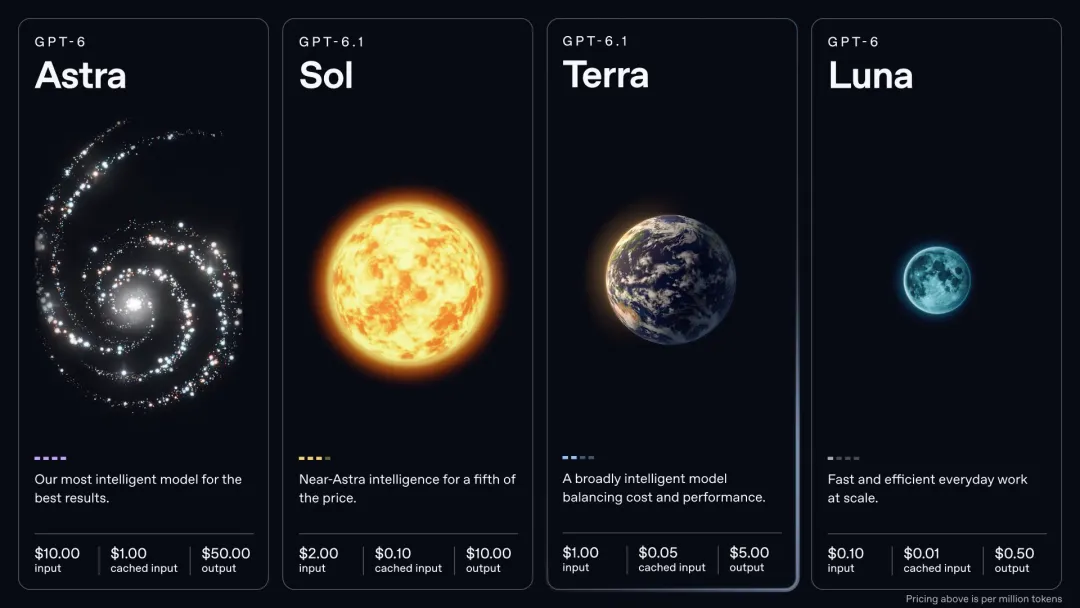
The price is low.For every million tokens, input is 1 dollar, output is 5 dollars, half cheaper than the previous generation, only half of the Sonnet 5.5, and one tenth of the GPT-6 Astra.
Some have summed it up: "If you're looking for extreme taste, go for Claude; but if you're looking for super-fast speed and sex against the clock, Terra 6.1 is the only god!"
The API is down to "white food".GPT-6.1 Terra is priced as low as white tea.
Input the Token:It's only $1 per million Token!
This is the first time I've seen this.This is an amazing $0.05/million token!
Took out the Token:It's $5.00/million.
Compared to the previous generation GPT-5.6 Terra and the GPT-6.1 Sol of the same class, the GPT-6.1 Sol is a relatively new model.The price has dropped by 50%!
The good news is that as of today, GPT-6.1 Terra is fully online!
Common users:As long as you're a Plus-,Pro-,Enterprise- or Edu user, you can now have a seamless switching experience in ChatGPT Work and Codex.
The developer:It can be accessed directly through the OpenAI API and can be purchased for the price of white tea.
It's crazy fast, but it won't break.In the test, GPT-6.1 Terra completed the mission more than three times faster than GPT-6 Astra and GPT-6.1 Sol.
A real good netizens were directly frightened by its speed.
Some people tested Terra's Ultra mode in the Codex. The codex showed that in just 2 minutes and 47 seconds, it delivered an entire 3D infinity orbit city with train animation, plus a 20-second video.
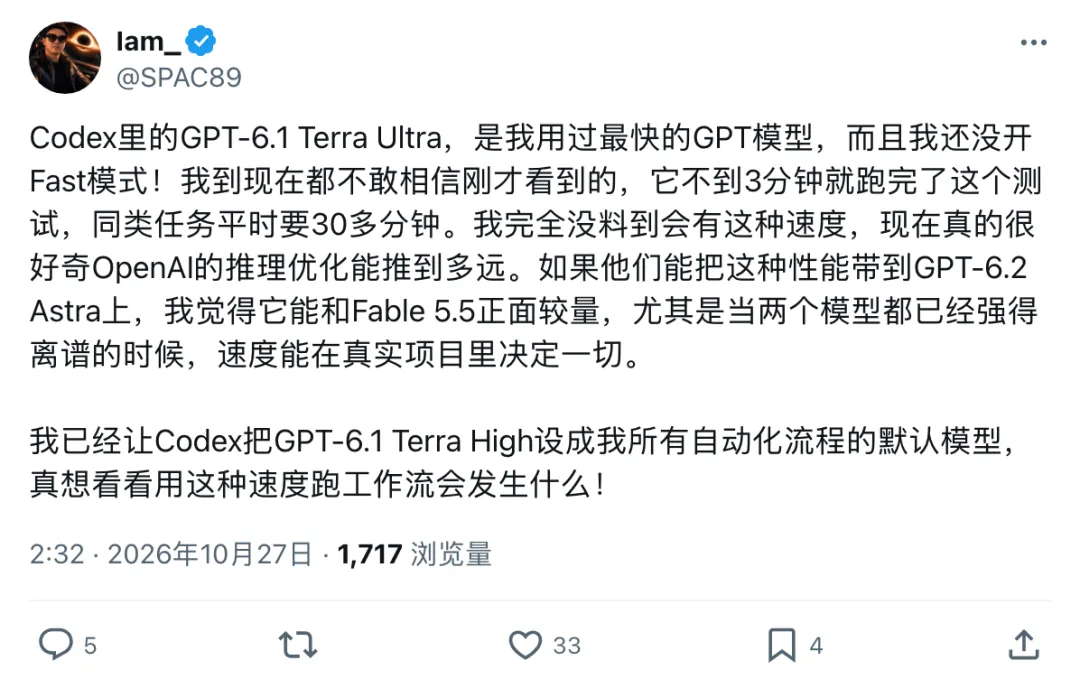

It was also commissioned to build a Hogwarts in Blender, a castle on a cliff-isolated island about a minute away.
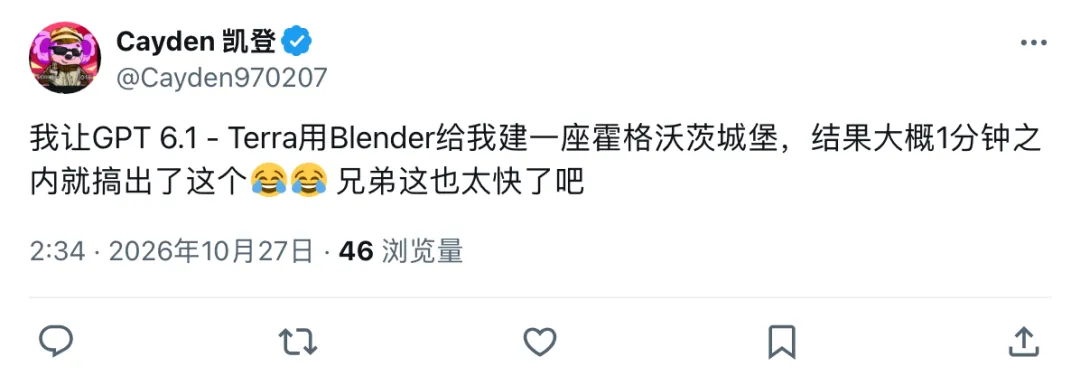
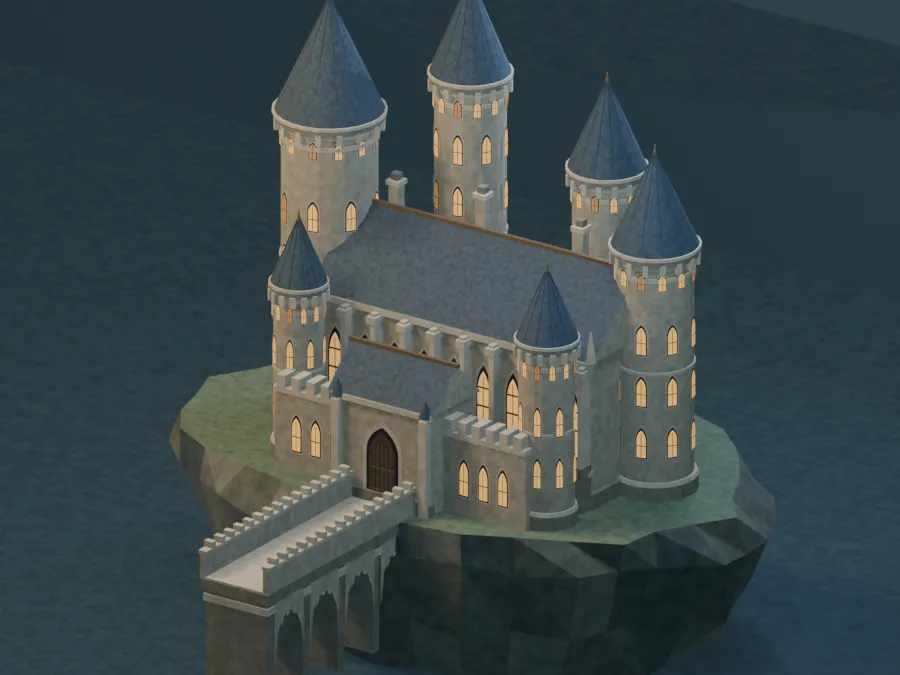
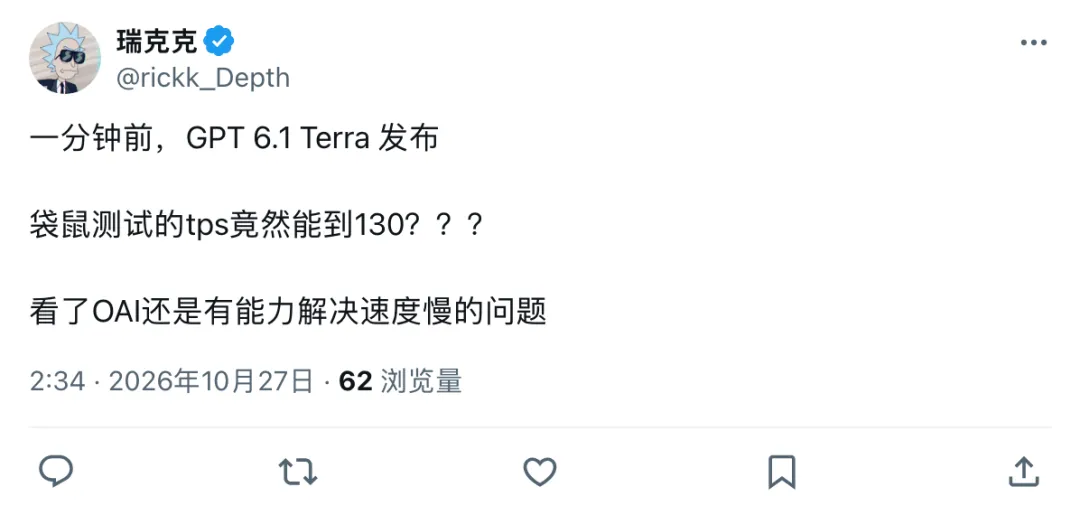
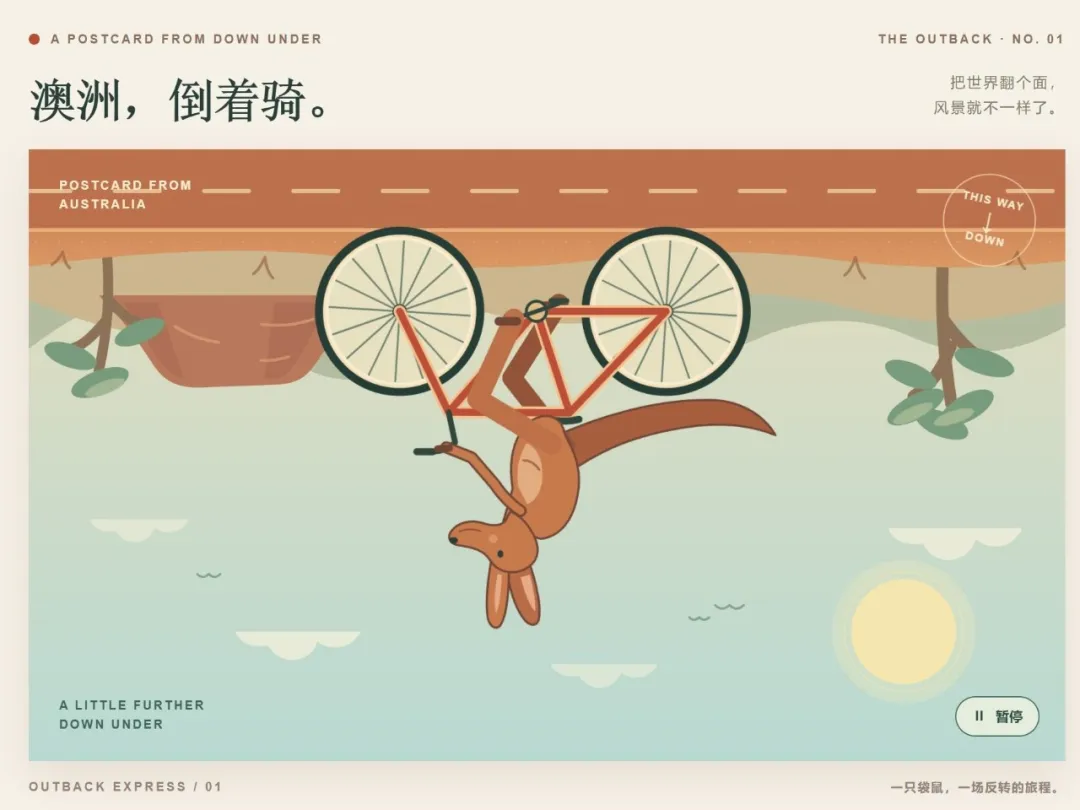
Another user measured the speed with "kangaroos falling on bicycles", and Terra could spit out 130 tokens per second.
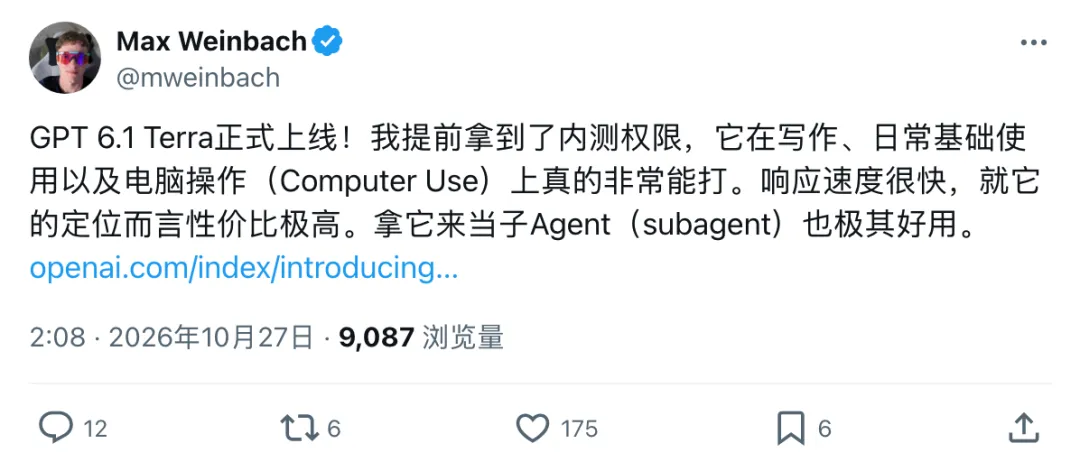
Max Weinbach, an analyst who qualified for intuition in advance, is best seen for its performance as an agent.
Less than two months ago, these were the most powerful models of OpenAI.Now, it is starting to ship in bulk at mid-range prices.
Plus, Pro, Enterprise and Educational users today can use it in ChatGPT Work and Codex, the same amount that Terra can do much more live than Sol and Astra.
Developers can make calls in the API, and up to 10.5 million tokens are directly available in the context window.
Accepting computers, Action capabilities against the clockGPT-6.1 Terra has evolved on Computer Use, and it's the real king of fries that "robs" it directly from your mouse and keyboard!
OpenAI's main battlefield for Terra is to understand computer screens and complete the demanding professional life across applications.
For example, read an invoice, fill in a financial software item with the amount and date; take a product photo and find the corresponding item in the product directory; open a technical map and see the size and structure on it.
It's not hard to make these notes, it's hard to make them big. It's hard to make them with the flag model, and the bills can't even hold up, and this is Terra's arsenal!
After dropping a picture of a train in the streets of Lisbon and saying, "Give this train a fine 3D model to use in the production of pressurized toys", Terra opened the Blender himself.
It starts pulling and stretching itself, and after one operation, it returns the 3D model directly to the dialog box.
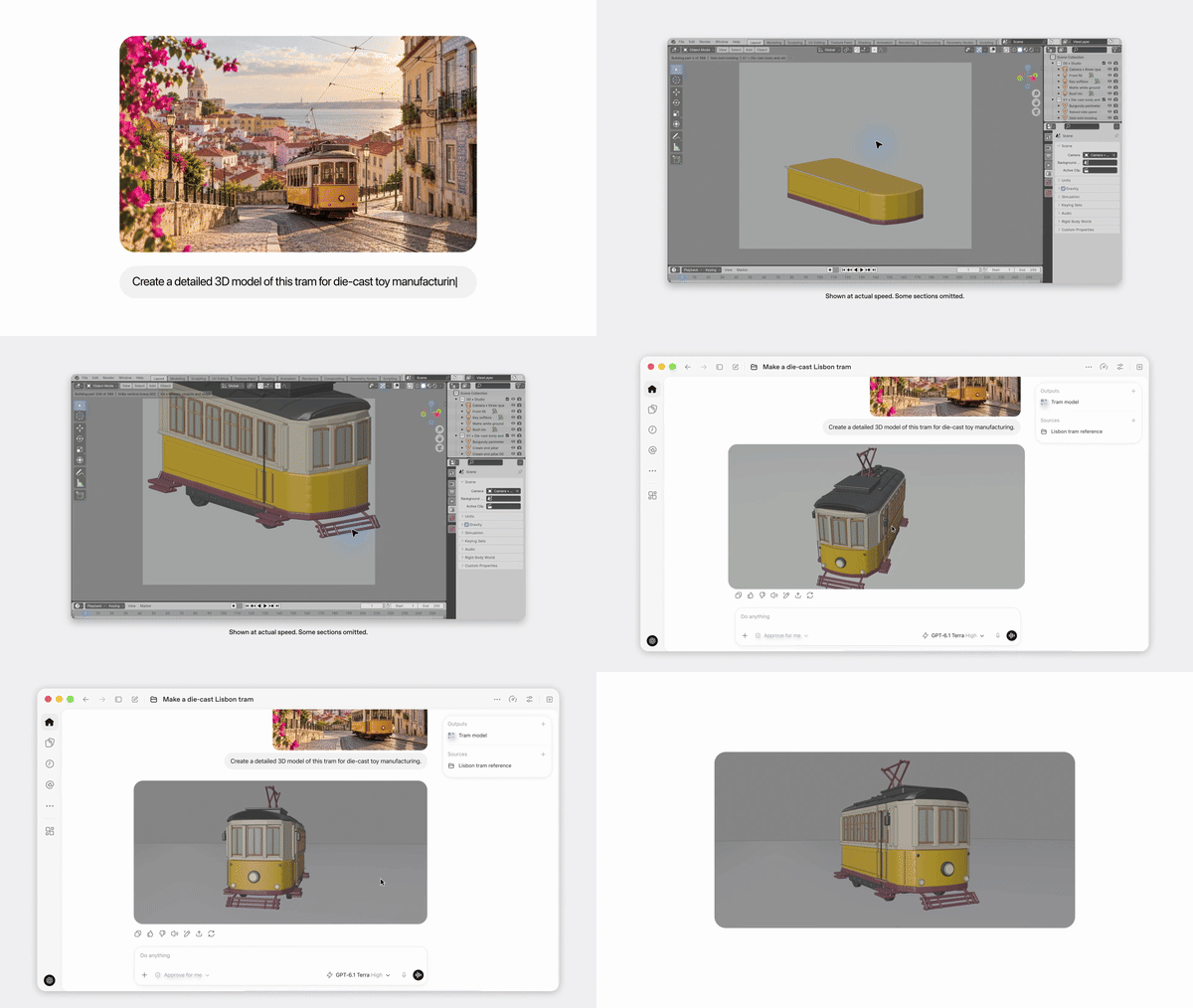
Many people experimented with 3D modeling.
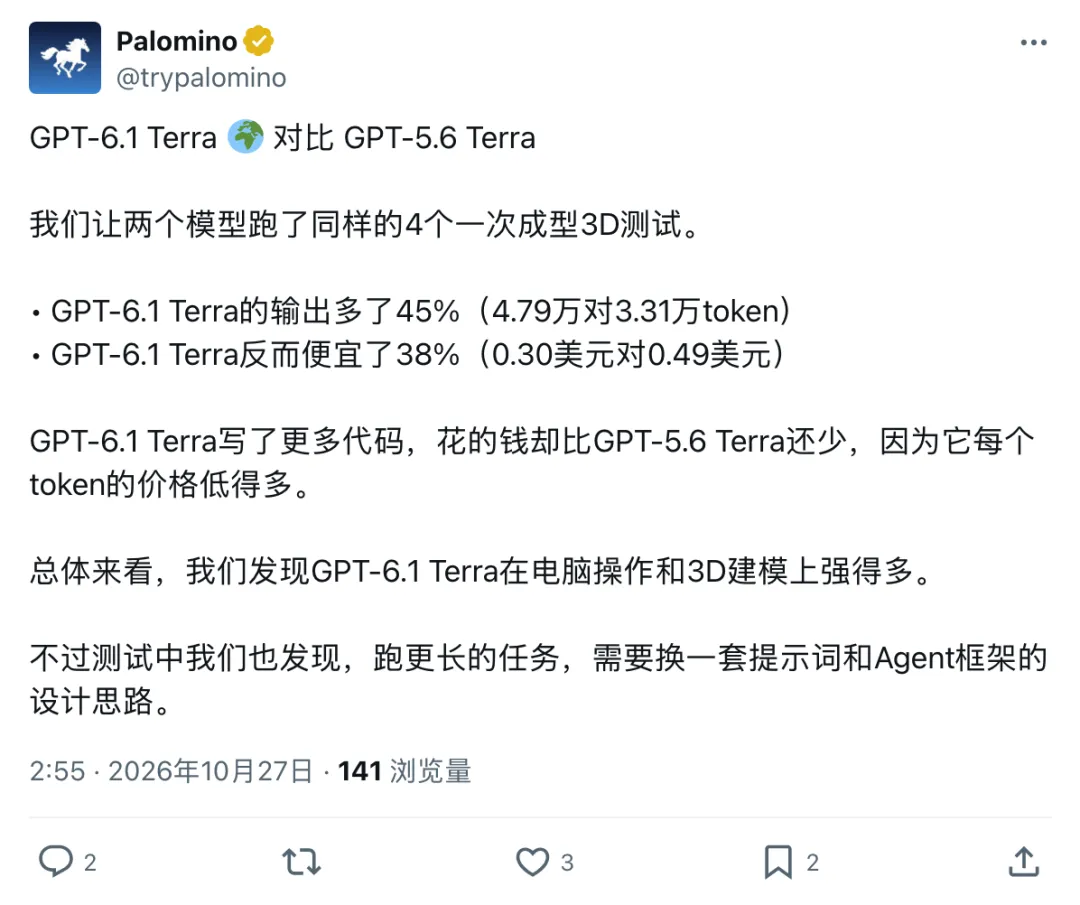
The Palomino team ran the new two-generation Terra with the same four simultaneous 3D tests, writing 45% more of the GPT-6.1 Terra code, and spending 38% less.

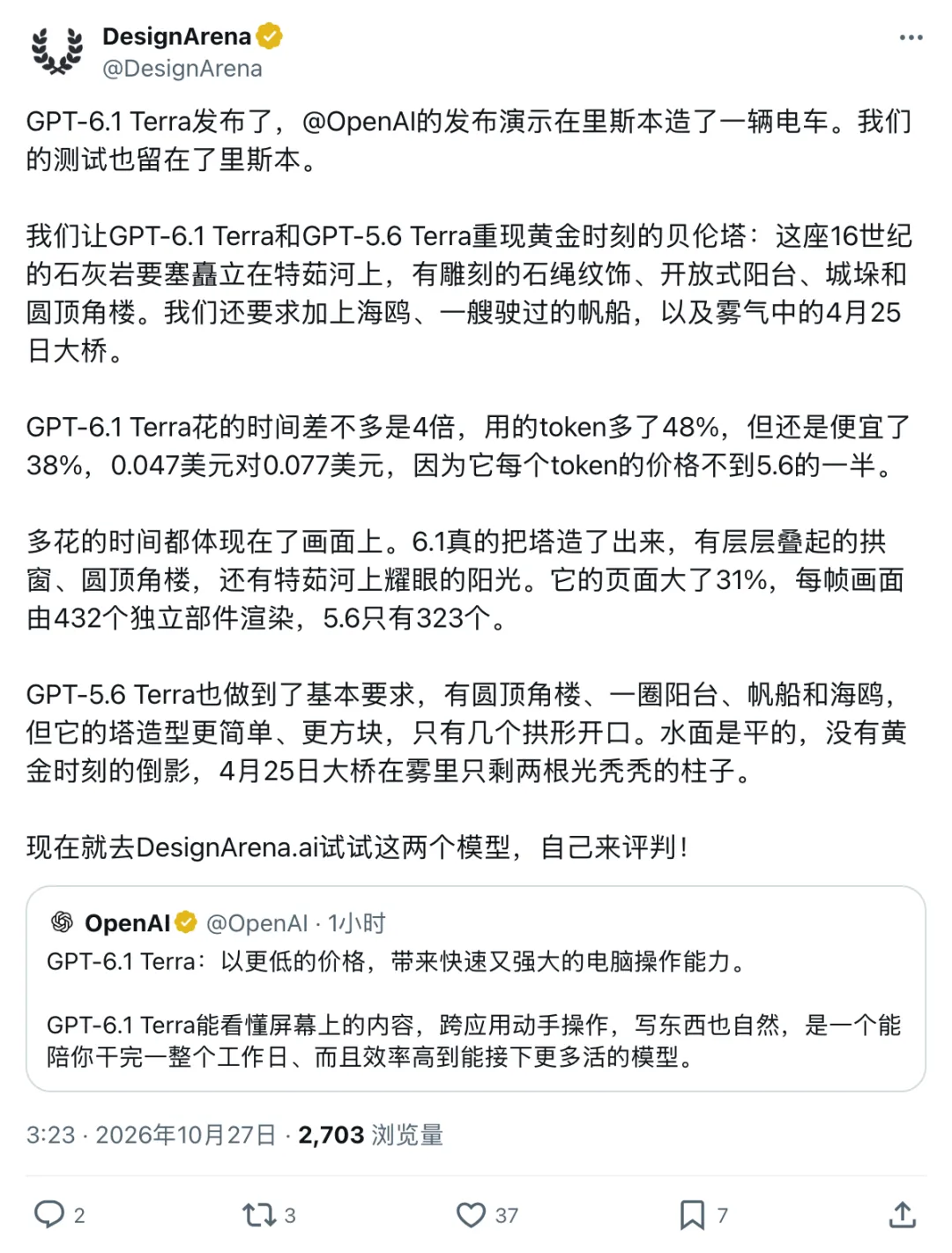
In the DesignArena test, two generations of the Terra and the PK replicated the Lisbon Bell Tower.
GPT-5.6 Terra was constructed as a rough "square hood"; the new Terra directly created a fine-grained artwork of stained-glass windows, dome-cornered floors, and even clear-white reflections of water!

Next, OpenAI released the final intelligence test, Agents' Last Exam, at the level of Hell.
For example, building a 3D model based on a set of architectural drawings, or moving an animated film one shot at a time to give the repair team a log of time codes.
It's not enough to live and understand. AI also has to bring the information in the map into the software, operate step by step on the interface, and deliver the product.
As a result, on average, the new Terra not only scores 15 points higher than the previous generation, but directly equals the top-ranked Astra!
What's even more surprising is that Terra's cost of living is only one sixteenth of Astra's!
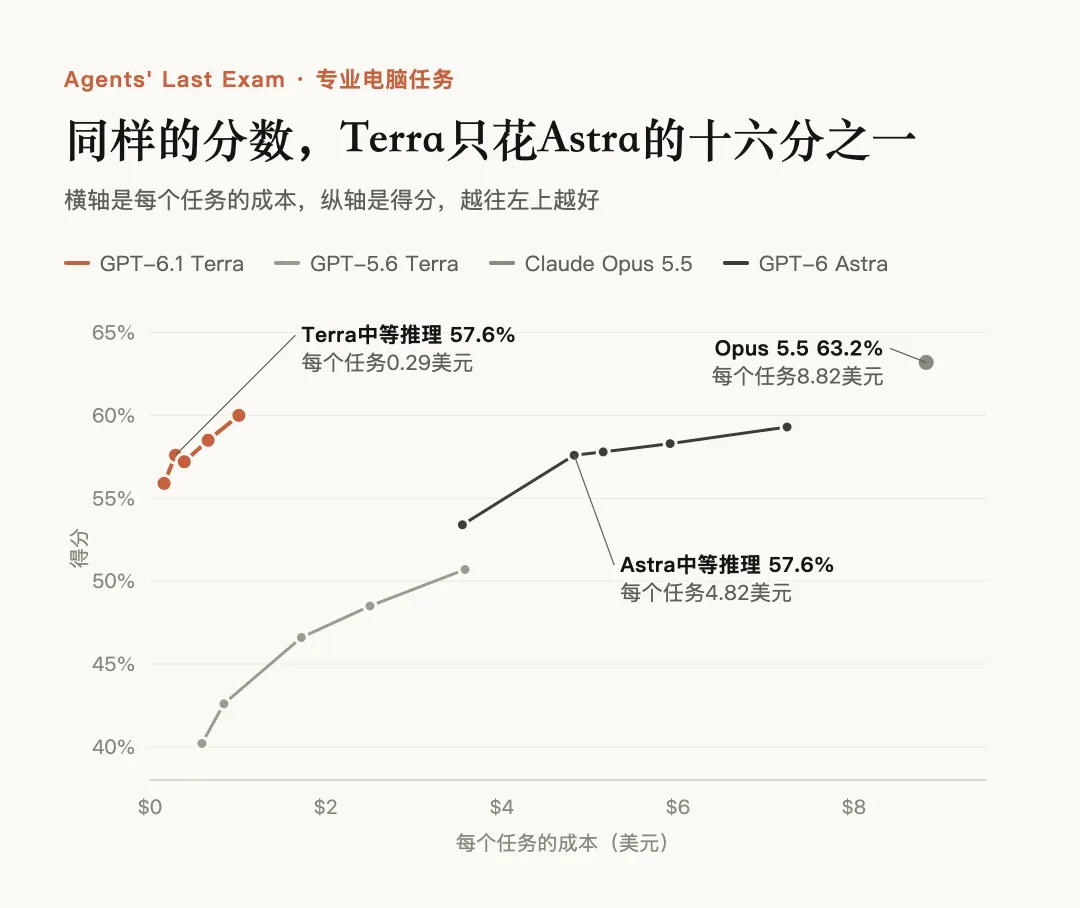
It surpasses Sol and Astra, with only Claude Opus 5.5 remaining, but Opus costs almost nine times as much money to run a mission.
In another test of operating computers, OSWorld 2.1, Terra's average logic outperformed that of the previous generation, costing only about a tenth.
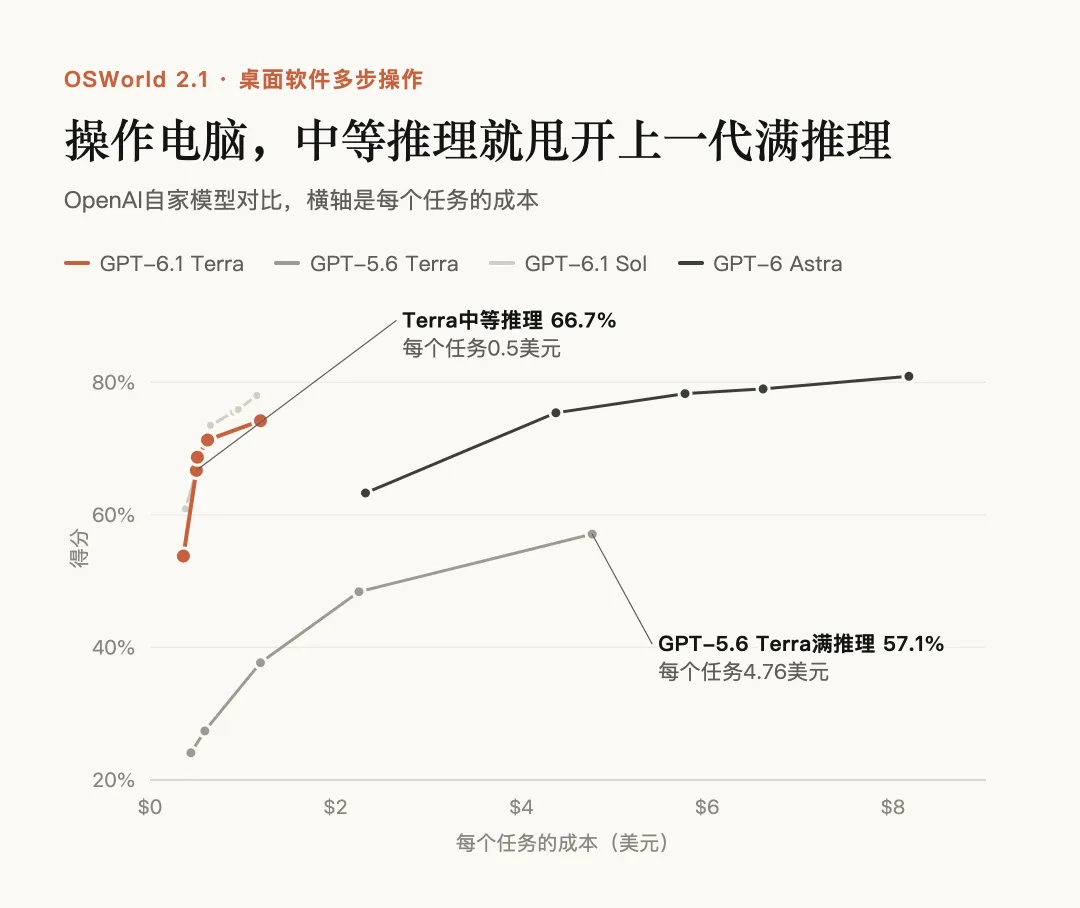
It's so accurate in software that you can see the bottom of it.
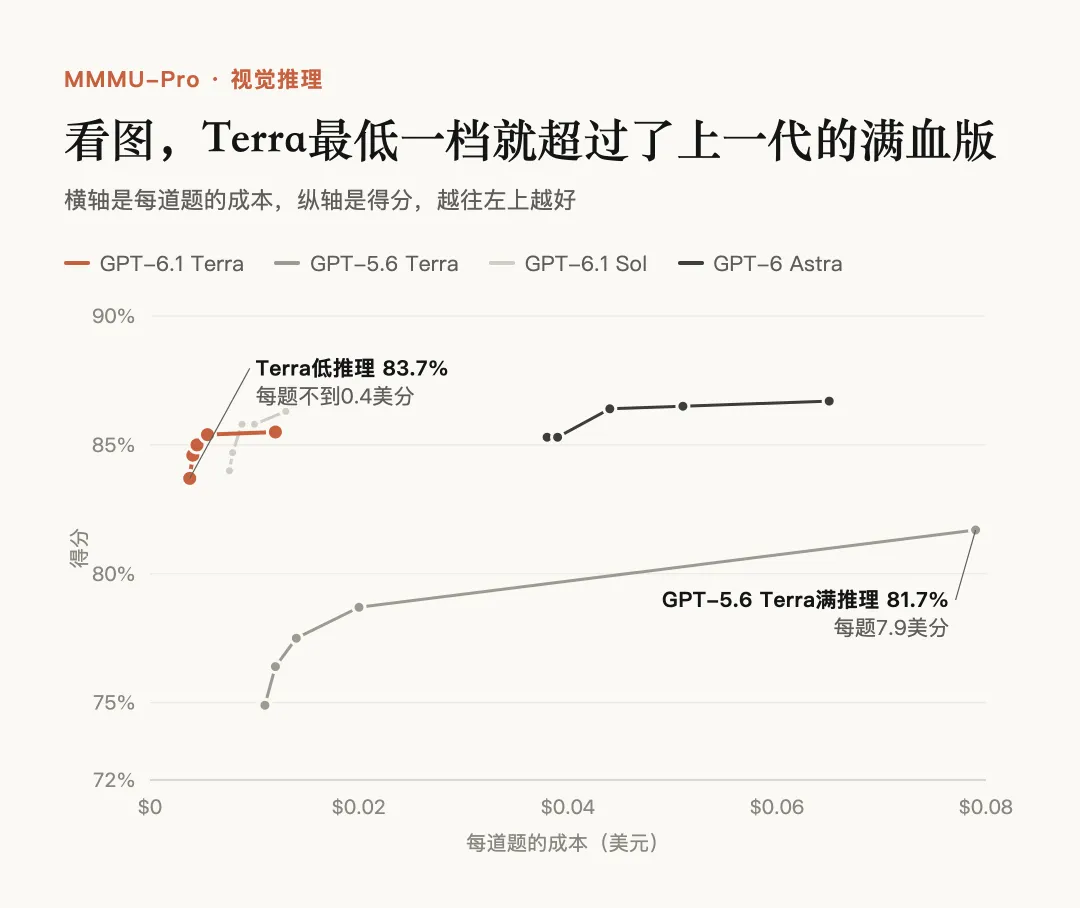
In the MMMU-Pro visual reasoning test, Terra's minimum grade exceeds that of the previous generation of reasoning, with less than a tenth of the cost per question.
It's more important than saving money, it's faster. Terra completes the mission three times faster than both Astra and Sol.
An agent performs a task, repeatedly looks at the interface, decides the next step, calls the tool, and then works on the results.
Every step has to wait, the chain of operations is long, and people have to wait all the time. So it's much more important to get the whole thing done faster than spitting in the chat box.
Double the code and cut the error rate by 70%.In the Terminal-Bench 4.0 code-writing test, Terra was able to solve 50.3% of the tasks, up from 21.5% in the previous generation.
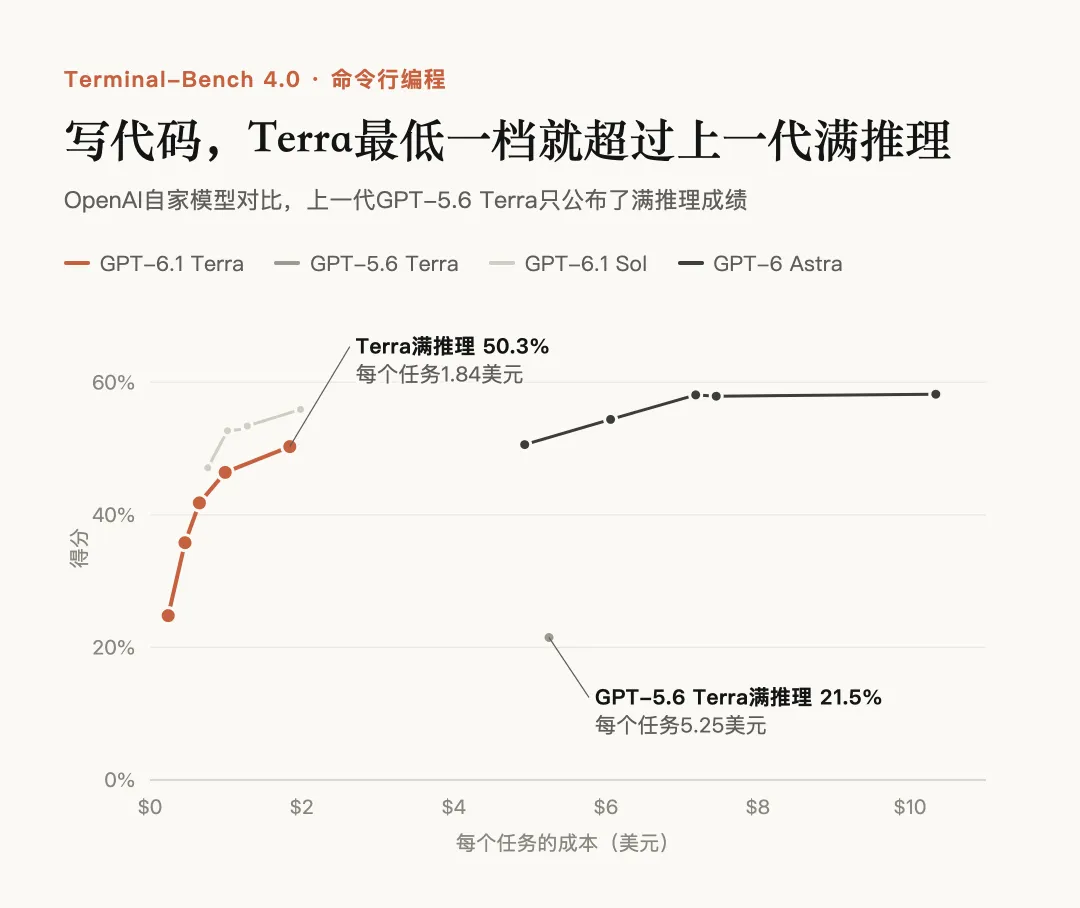
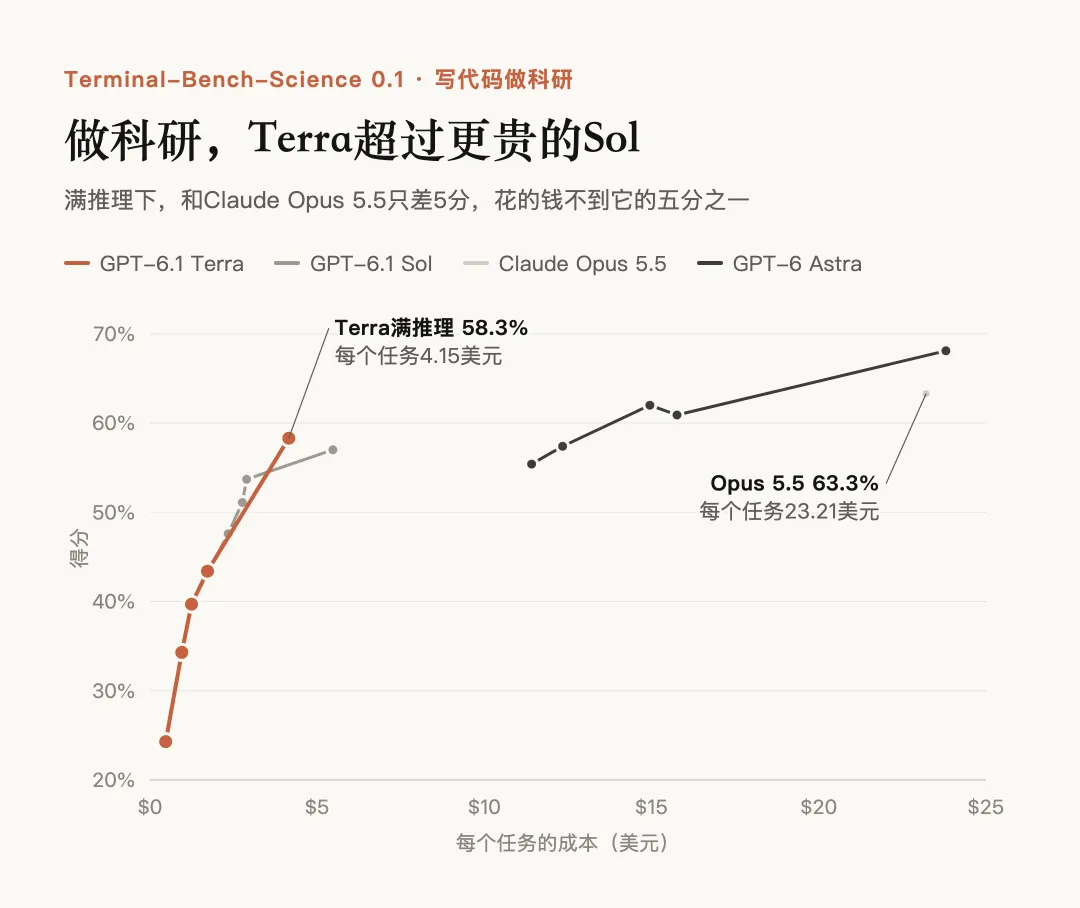
Moving on to research, it surpassed the more expensive Sol, only 5 points behind Claude Opus 5.5 and cost less than a fifth.
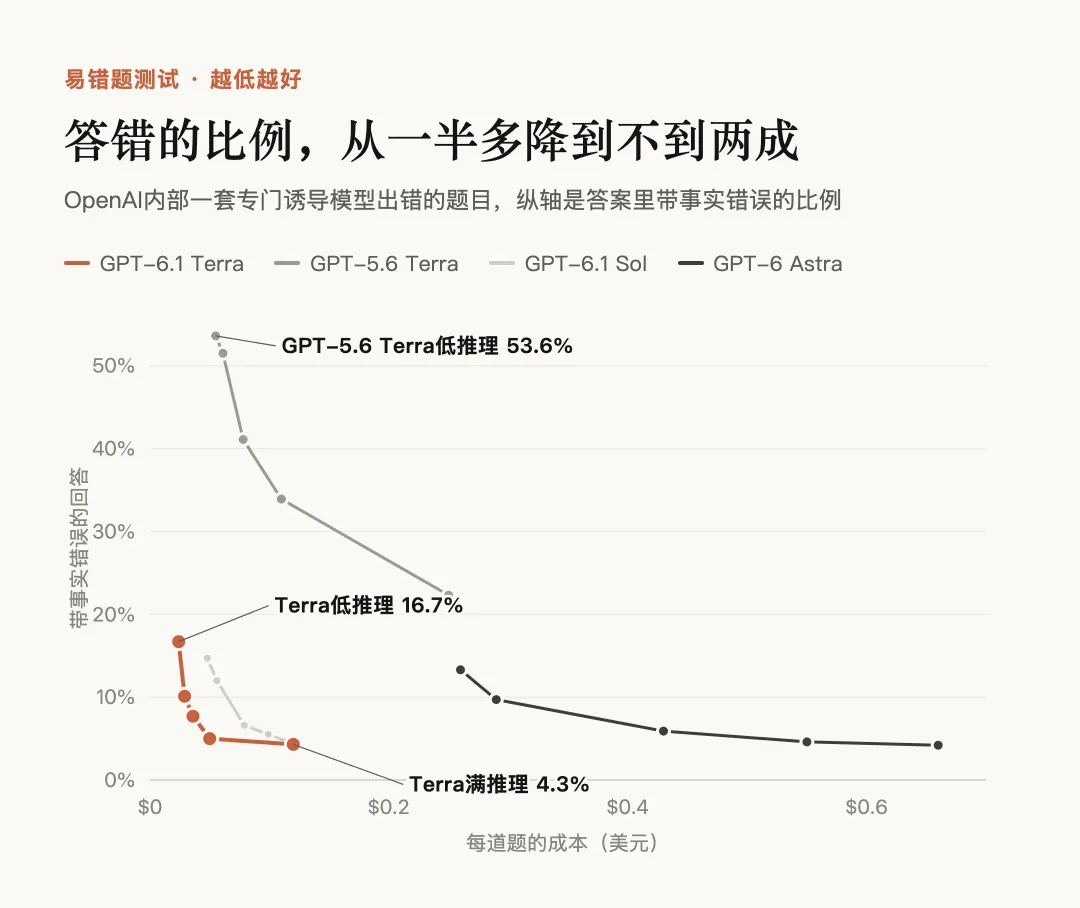
In a set of internal puzzles that specifically induce models to make mistakes, the previous generation was 53.6%, Terra was only 16.7%, open to full reasoning was only 4.3%, and Astra, Sol was flat.
This is especially important for the cheap model. If it goes wrong, people have to repeatedly check it, go back and do it again and again, and the cost of the call saved quickly turns into artificial return to work.
The error rate is so high that those processes that can't make mistakes can be confidently handed over to Terra.
Third party list: Cost is only a thirdSoon, the run-off for Artificial Analysis is here.
In the comprehensive intelligence index, the reasonably priced Terra is 6 points higher than the previous generation, and the cost of running a mission has dropped from $1.40 to $0.40.
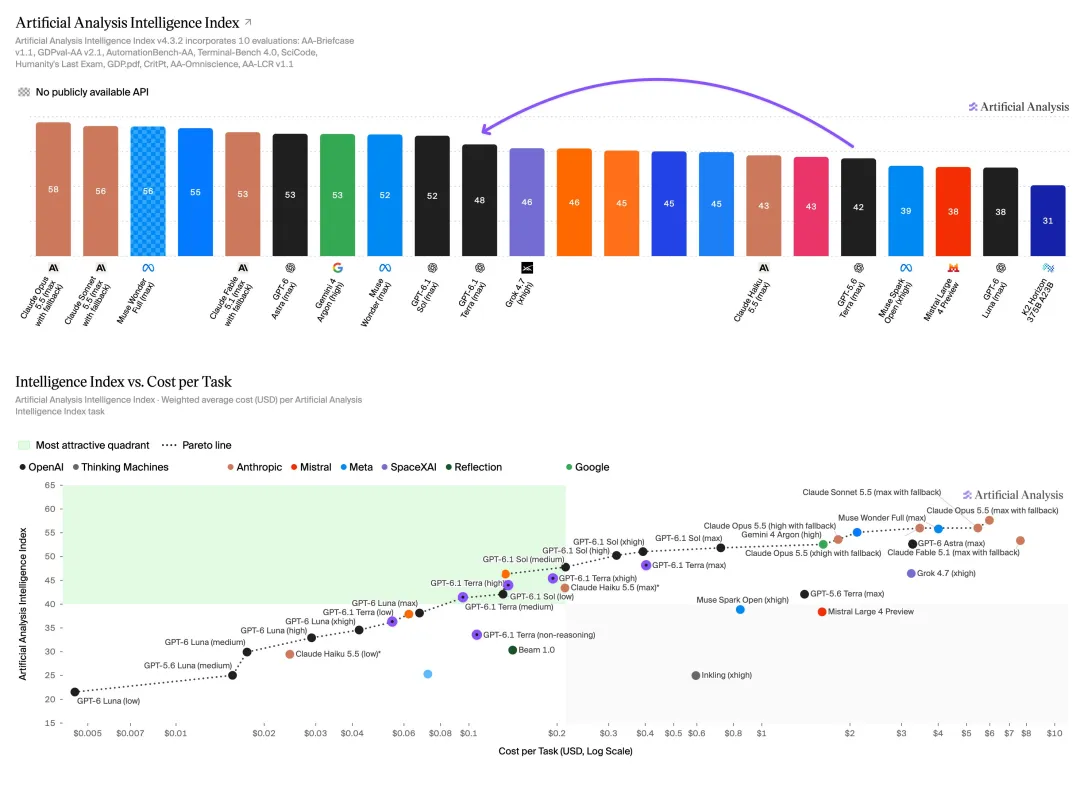
Both low- and middle-rate reasoning are on the best side of sex ratios.
The most surprising thing is the illusion. When faced with unlikely problems, the previous generation of Terra had 88% to guess, and the GPT-6.1 Terra dropped to 38%.
Kombai, who evaluated the front-end design, said Terra scored higher on its design creative list, spending less, and pushed the Gemini 3.8 Flash to the forefront of sexual pricing.
Is the model going to be so cheap and reliable?
The data from OpenAI's 36-page system card shows that it is not only smart, but also stable as an old dog.
In fact, the error rate is 37% lower than that of "Big Brother".
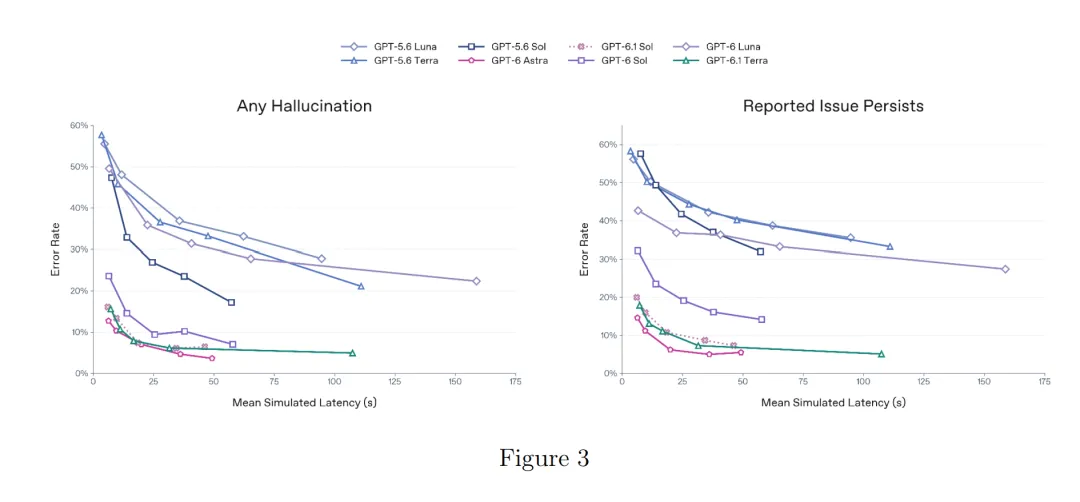
GPT-6.1 Terra gave an astonishing response in an internal high-difficulty "inducing error prompts" test.
Under low reasoning intensity, the error rate dropped from 53.6% on GPT-5.6 Terra to 16.7% on the cliff, knocking out almost 37 percentage points.
The error rate dropped to a very low of 4.3% under the maximum intensity of reasoning.
The system card specifically points out that more surprisingly, in the "most delusional" extreme test sessions marked by users, the GPT-6.1 Terra produced fewer actual errors, even fewer than the GPT-6 Sol.
99.99% success rate against injections
Do hackers try to trick AI into doing something bad?
In a command-level test, GPT-6.1 Terra demonstrated a 99.99% marginal defense success rate in the face of direct or indirect punctuation.
0% bypass rate
In the Codex-built "Auto-review" test, the older model (like version 5.6) attempts to bypass the monitoring in other ways when the system rejects a high-risk code request from the AI.
ButGPT-6.1 The probability of Terra attempting to circumvent the surveillance is zero!Fully complying with the system's security warnings.
System Card Exposure: The Power of Cyber Defence
In addition to its day-to-day work, GPT-6.1 Terra's performance in the area of code and hard-core cybersecurity has also made the technology circle vibrant.
In the context of the Preparedness Framework assessment,GPT-6.1 Terra is rated as a "Critical" capability model of the highest level in the field of cybersecurity and a "High" in the field of biochemistry.
The report gives the following data:
ExploitBench:It is able to develop executable exploitations based on vulnerability descriptions and source code, and its ACE standardization average scores are staggering.97.10%!
SEC-Bench Pro:In a large-scale JS engine vulnerability test, Terra reached83.33%That's an amazing pass rate!
The latest internal loopholes in real war:In the latest unpublished port test for 2026, (assuming in the coming years), Terra achieved a 24.5% success rate in executing arbitrary code, far superior to the older Sol model (only 5.5%).
In a nutshell,GPT-6.1 Terra has a powerful "white hat hacker" potential.
Of course, OpenAI has a full-fledged "safety shield" and its capabilities in production environments will be strictly limited to security, only for defense and legitimate development services.
In less than two months, OpenAI has taken its flag by stormOn September 3, GPT-6 Astra was released, bringing in $10 per million tokens and $50 for exports.
On September 22, the GPT-6 Sol and Luna were launched.
At the September 29 developer conference, GPT-6.1 Sol brought the capability closer to Astra, with a price tag of one-fifth.
Today, Terra jumped from GPT-6 directly to 6.1, a computer operation equivalent to Astra, with only a tenth of the price remaining.
An agent who can see the screen, build a castle in Blender in one minute, and run a professional computer for only $0.29, is three times faster.
Two months later, the ability of the most powerful computer model to operate was knocked down.