It's a really hot day.
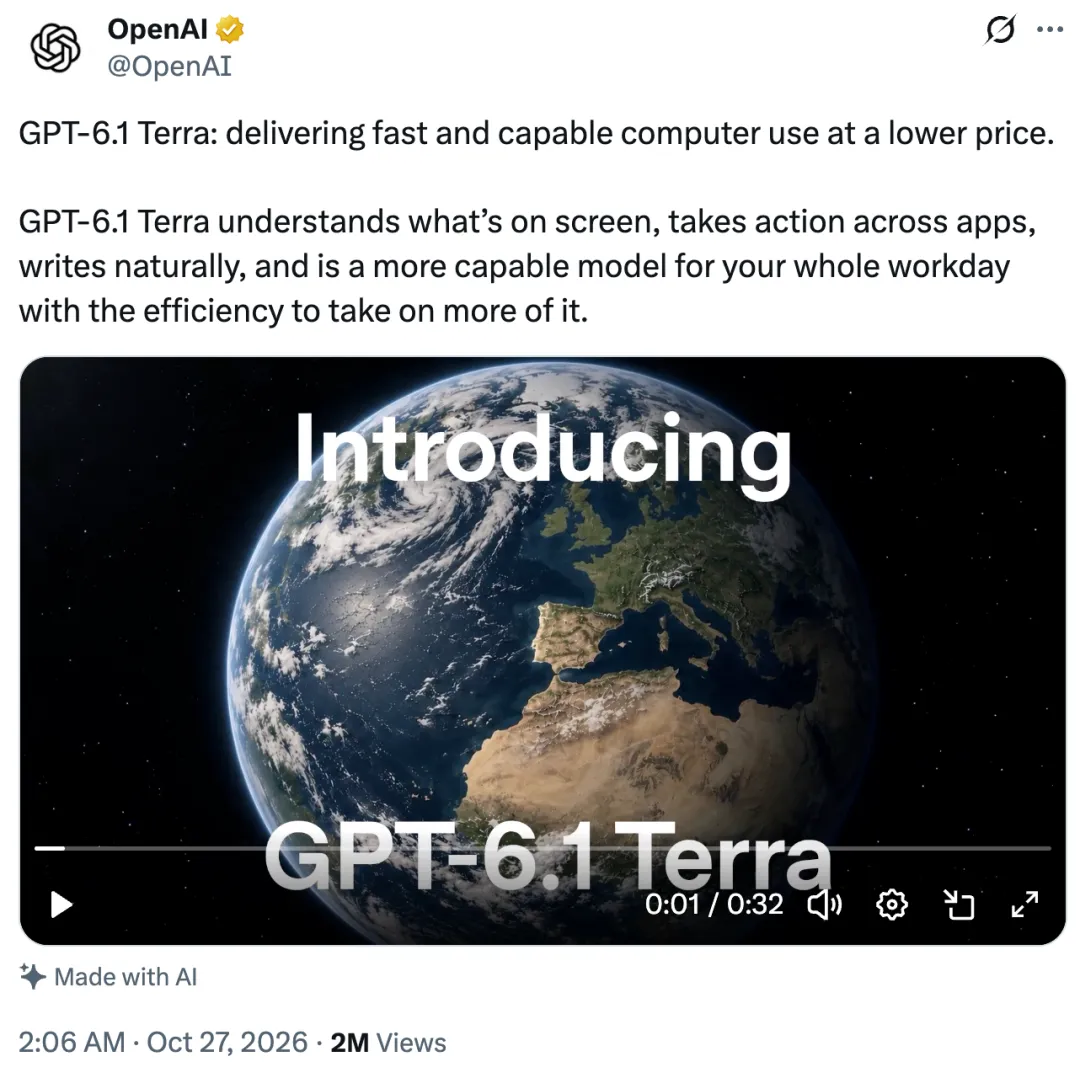
On the other hand, Anthropic filed an IPO and OpenAI released the latest model GPT-6.1 Terra.
It is positioned "at a lower price, offering faster, more powerful computing capabilities", combining fine visual reasoning, precise computing capabilities with clearer, more natural writing performance.
Sam Altman has excitedly stated that "GPT-6.1 Terra will usher in a new era of computer operations".
Compared to GPT-5.6 Terra, GPT-6.1 Terra's capabilities are significantly improved, particularly in handling communication and computer operations tasks in everyday work, from drafting proposals, interpreting technical drawings, to filling out forms and clipping videos.
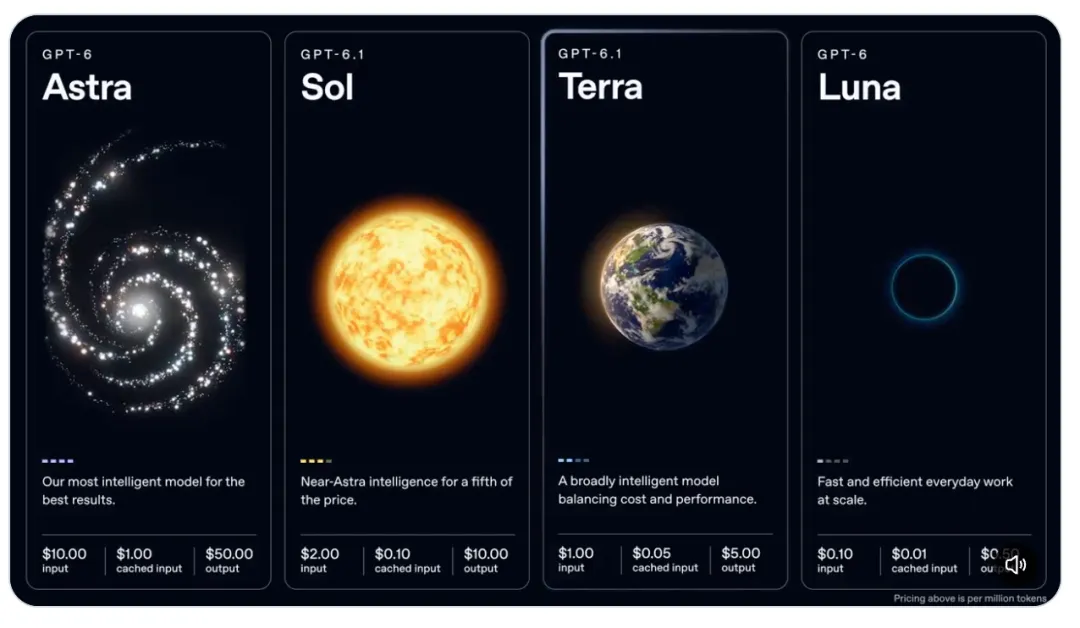
Terra continues to expand its model range to provide users with a better combination of speed, capability, and price. Its standard API pricing is as follows:
Input Token: $1 per million
Cached Input Token: $0.05 per million
Output Token: $5 million each
The standard API costs 50% less than GPT-5.6 Terra and GPT-6.1 Sol. This allows developers to automatically process large amounts of work at a lower cost, such as reading receipts and entering relevant information into accounting software.
As of today, all Plus, Pro, Enterprise and Edu users can use GPT-6.1 Terra in ChatGPT Work and Codex. Developers can also call the model through the OpenAI API, with the model ID being gpt-6.1-terra.
And, in ChatGPT Work and Codex, using GPT-6.1 Terra can also make your package quantity play a bigger role. The same quantity can be used to complete more tasks than GPT-5.6 Terra; the number of tasks that can be completed is much higher compared to GPT-6.1 Sol or GPT-6 Astra.
From visual understanding to practical operation
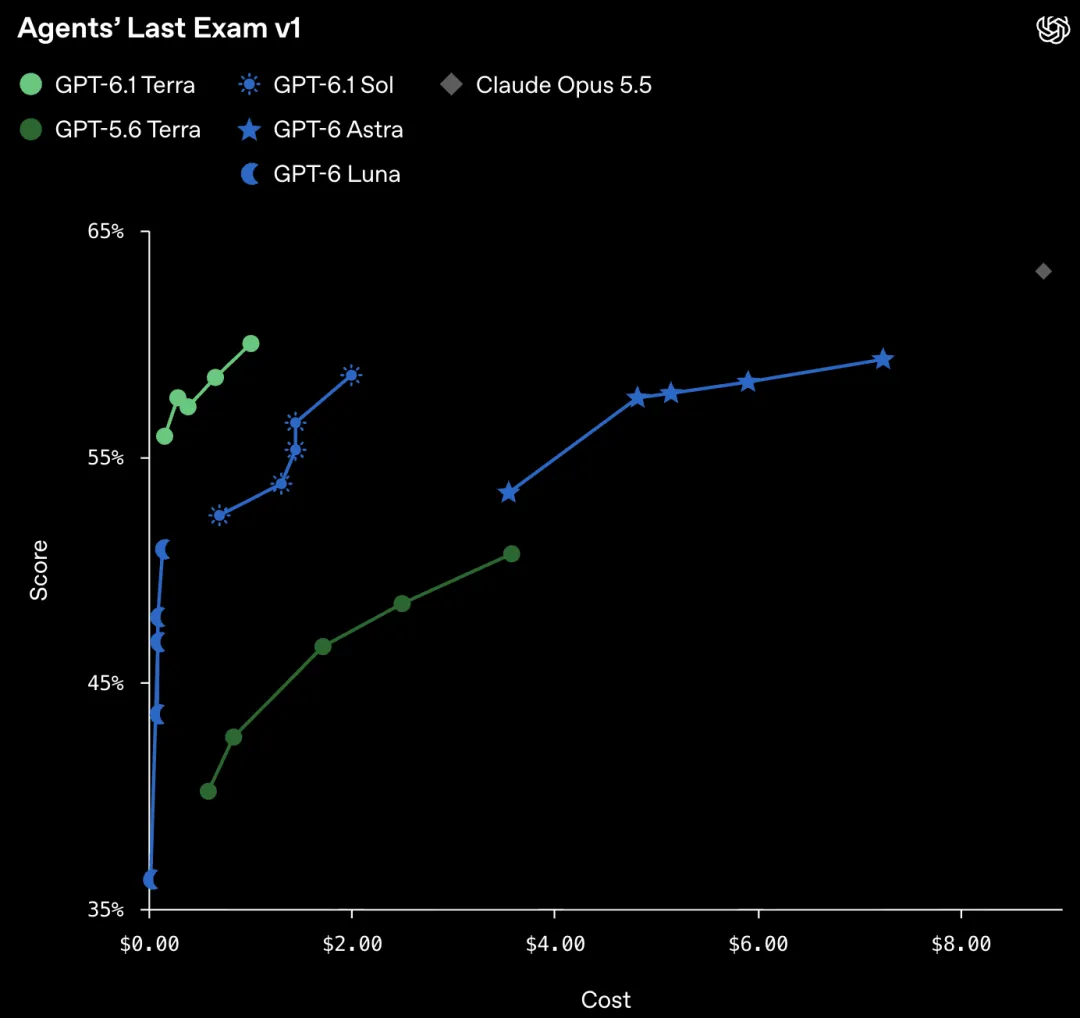
OpenAI uses the Agents' Last Exam benchmark test to evaluate the computational capabilities of GPT-6.1 Terra. The benchmark covers a variety of professional tasks, such as creating 3D models based on building drawings, and scanning animated videos on a shot-by-shot basis to record timeline codes for the repair team.
Under the moderate intensity of reasoning, the GPT-6.1 Terra scored 15 percentage points higher than the GPT-5.6 Terra, costing only about a third of the latter. Even when compared to the GPT-6 Astra, it did not perform as well, but the price of each token was only one tenth of the latter.
At the highest rational intensity, Terra's Token utilization efficiency is more than three times that of Claude Opus 5.5, and the price of each Token is only a quarter of the latter, so the cost of completing the same task can be reduced to about nine percent.
Terra also runs much faster, completing missions at three times the speed of GPT-6 Astra and GPT-6.1 Sol.
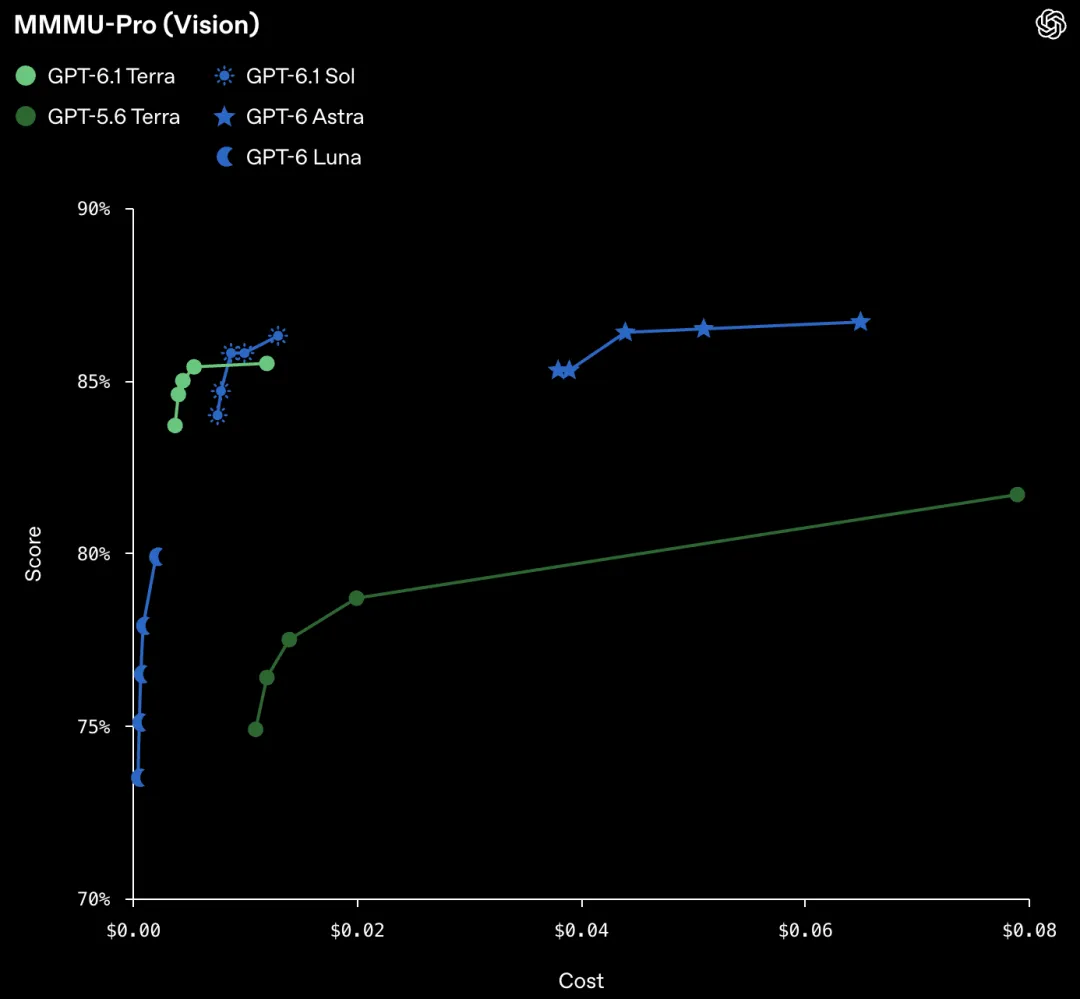
On the visual reasoning benchmark MMMU-Pro, the GPT-6.1 Terra outperformed the GPT-5.6 Terra in all reasoning intensity settings. Its scores are even close to GPT-6 Astra and GPT-6.1 Sol, the most powerful front-end models capable of OpenAI, but much lower in cost.
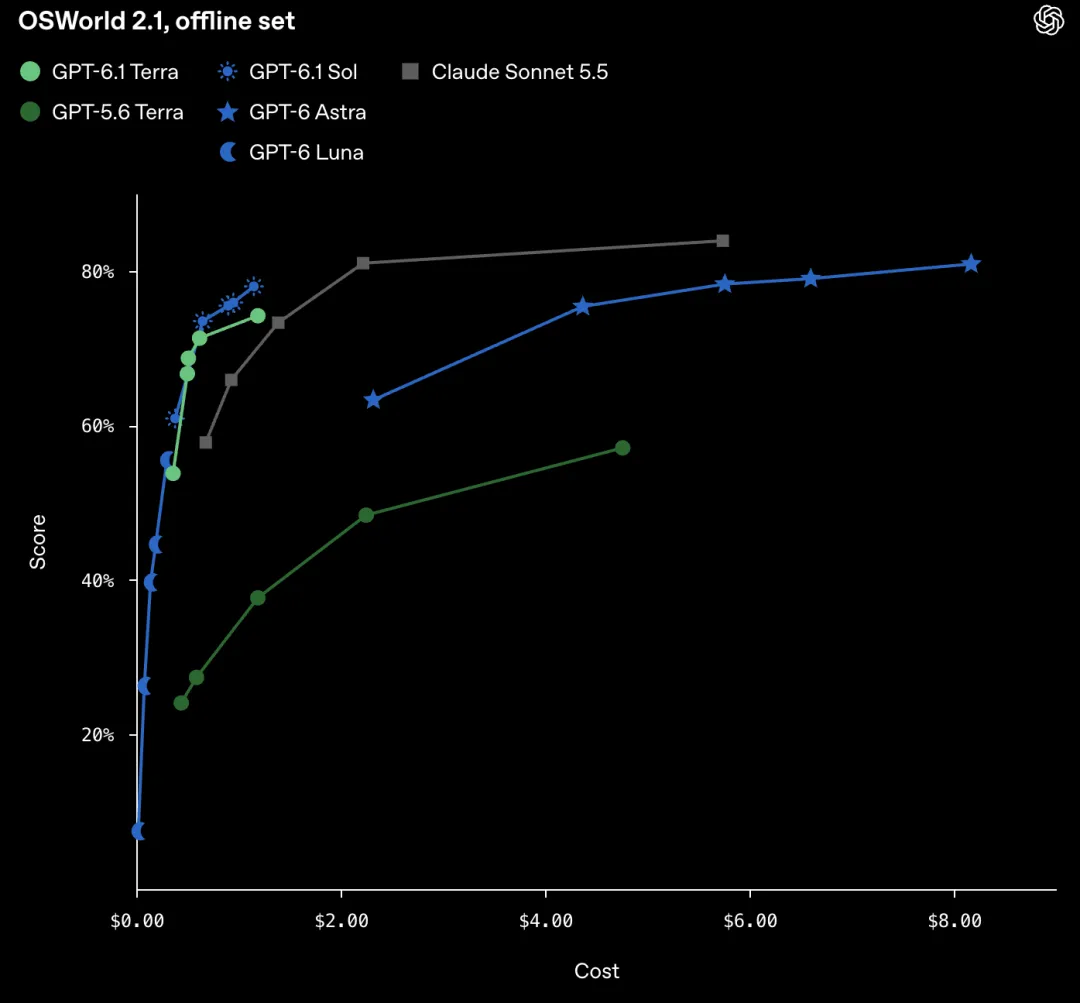
OSWorld 2.1 is used to test whether AI intelligent agents can operate desktop applications by completing multi-step tasks, such as creating 3D models based on technical drawings. Under moderate reasoning intensity, GPT-6.1 Terra has outperformed GPT-5.6 Terra's best performance, while the cost of each task is much lower.
Significantly improved accuracy and programming
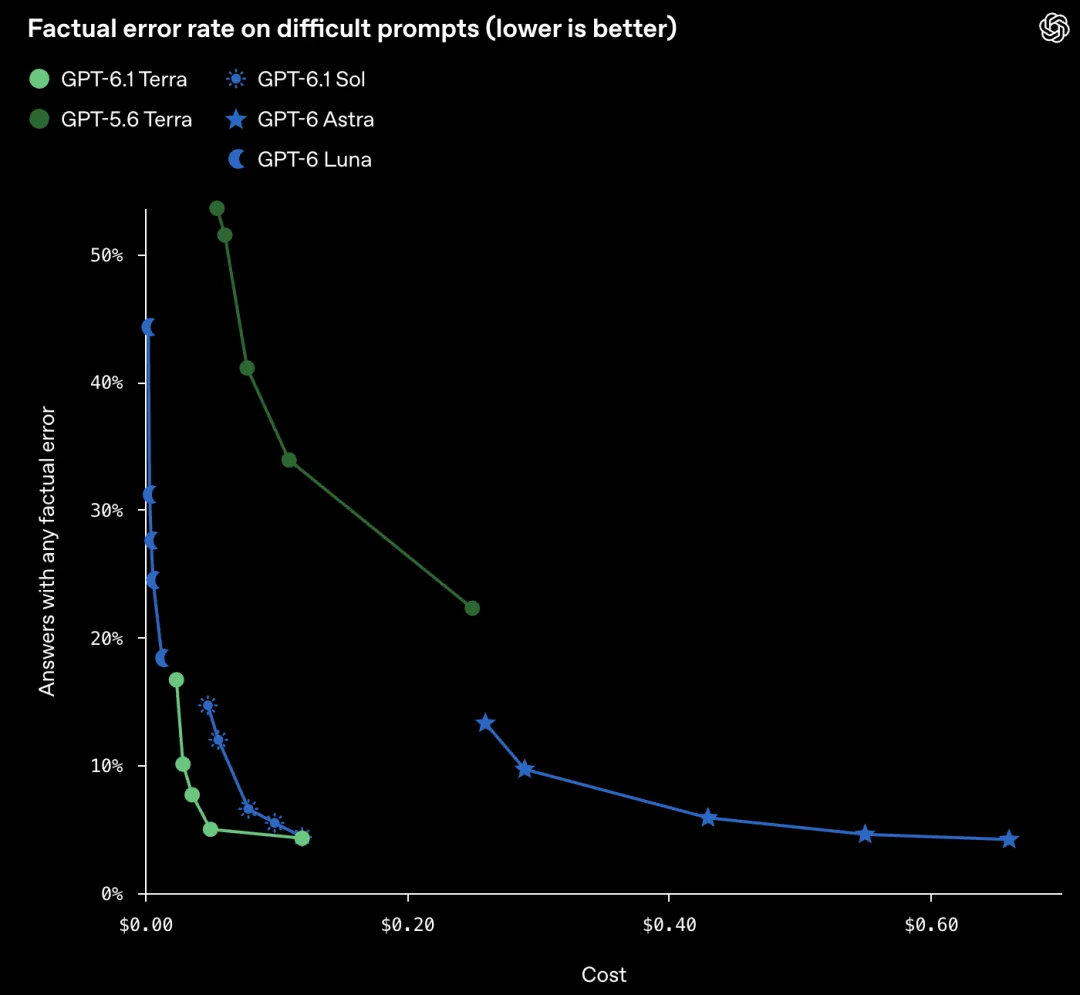
This year, OpenAI has put a lot of effort into reducing the illusions and factual errors that model generates.
GPT-6.1 Terra's error rate dropped from 53.6% to 16.7% from GPT-5.6 Terra in its internally designed, error-inducing pronoun benchmark test, under low reasoning intensity, to nearly 37 percentage points.
Under the highest intensity of reasoning, the error rate dropped by 18 percentage points to 4.3%, very close to the GPT-6 Astra and GPT-6.1 Sol error rates.
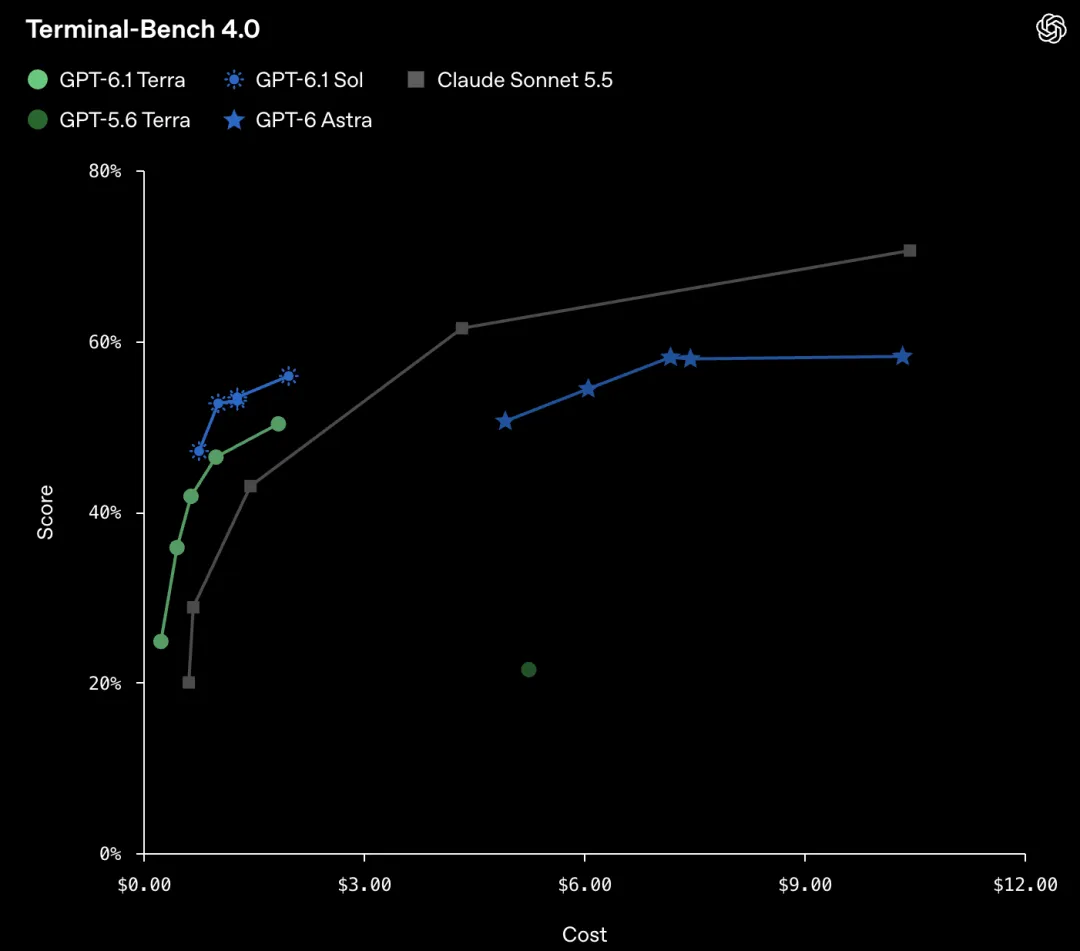
GPT-6.1 Terra's software engineering capabilities are also significantly improved compared to GPT-5.6 Terra.
Terminal-Bench 4.0 is used to test the ability of programming smartphones to solve problems through command lines, such as fixing layouts that deviate when a page is loaded. Under the highest intensity of reasoning, GPT-6.1 Terra can solve 50.3% of the tasks, more than twice the 21.5% score of GPT-5.6 Terra that has been published. For the most complex programming tasks, GPT-6.1 Sol and GPT-6 Astra are still the best options.
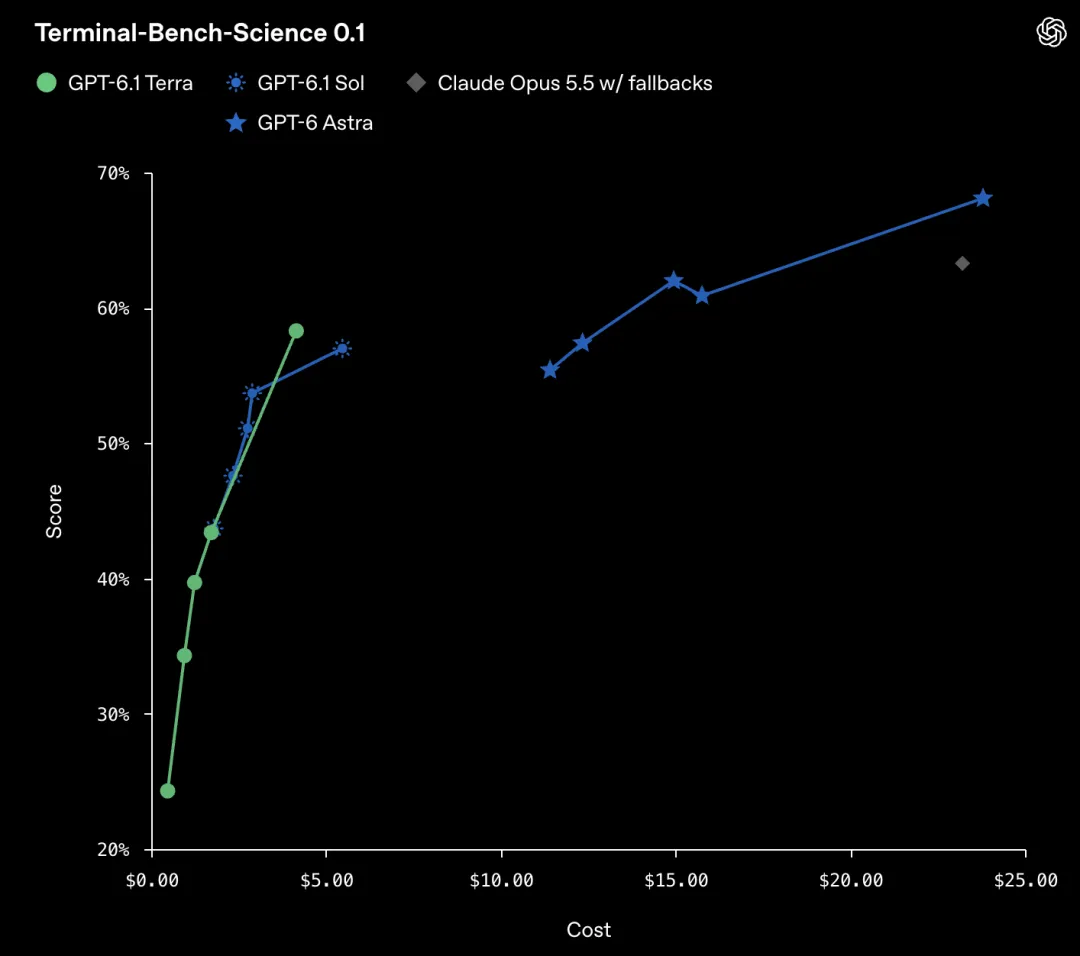
Terminal-Bench-Science 0.1 is used to test whether an intelligent organism can complete scientific research tasks by writing and running code, such as tracking cell division processes in delayed photographic video.
Under the highest reasoning intensity, the GPT-6.1 Terra outperformed the GPT-6.1 Sol, while costing less. Compared to the Opus 5.5, its scoring gap is less than 5 percentage points, while estimated cost is less than one-fifth of the latter.
Safety and coordination
While making powerful AI more efficient and easier to use, we are continuously training, testing and improving our security mechanisms.
According to the Preparedness Framework of OpenAI, GPT-6.1 Terra has reached a "Critical" capability threshold in the field of cybersecurity while retaining the security safeguards developed for the GPT-6 Astra.
GPT-6.1 Terra also inherited the alignment improvements of the GPT-6 series. As compared to GPT-5.6 Terra, GPT-6.1 Terra is more likely to limit operations to the user's designated range and inform users of their own limitations and possible obstacles.
The GPT-6.1 Terra also demonstrated strong resistance in the Injection Test, which was able to withstand attacks by those who attempted to divert the model from the user's original task by malicious instructions.
For details of the model, see Model Card:
Address of the model card:
Address of the blog:
© THE