It's the first time in the history of the world.
What is Musk's "space lease" at this level?
On October 20, SpaceX released its three-quarter earnings report: total revenue of $14.6 billion, up 161% from the storm!
The company posted a net profit of $4.4 billion for the first time since it went public.
The company's launch business, which earned $1.77 billion, earned only 6% of the company's earnings, while operating losses were less than $7 million.
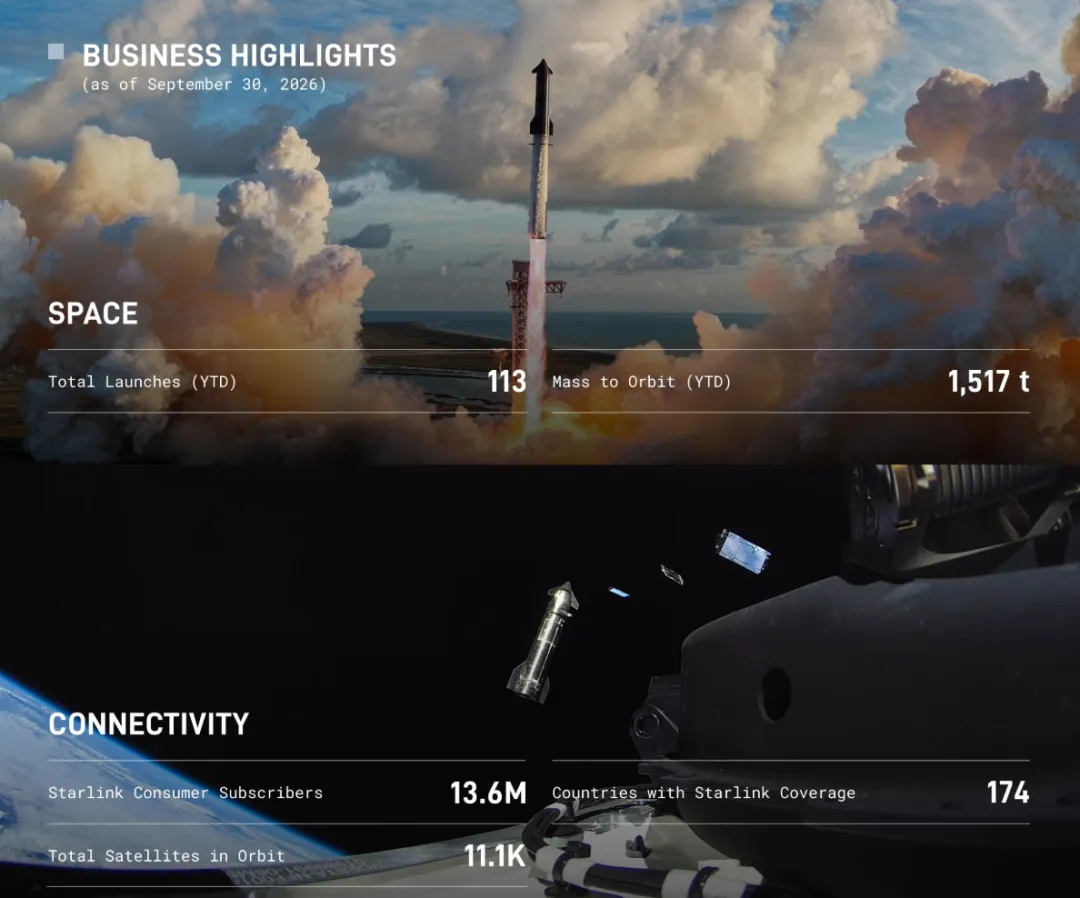
Connecting a lot of people to the internet has led to a large portion of the group's operating profits. About 85% of the group's operating profits come from this business line called "connection".
Revenue was $52.5 billion in the third quarter, up 69 percent; Starlink's subscribers surged to 13.6 million, a net increase of 1.6 million in one quarter, with $69 a month in monthly revenue; and 22 million monthly users of Starlink Mobile with mobile phones, up 37 percent.
More importantly, profits.
Although Super Intelligence is SpaceX's highest-grossing business, the most profitable company is Connectivity.
In the third quarter, connectivity generated $2.37 billion in operating profit, contributing about 85 percent of SpaceX's operating profit!
In a conference call, Musk said that connected businesses have a clear path to reaching hundreds of billions of dollars in annual revenue.
Note that these are not "potential markets" on PPT in the third quarter, but are real inputs.
Musk obviously wanted to put the net directly into the phones of ordinary people.
On October 6, the FCC approved SpaceX's deployment and operation of up to 150,000 new-generation mobile direct-to-satellite satellites (part of the conditional approval), but enough to clear Starlink Mobile of key regulatory hurdles. Supported by the spectrum that SpaceX purchased from EchoStar, the transaction has expanded from its initial $17 billion to about $20 billion.
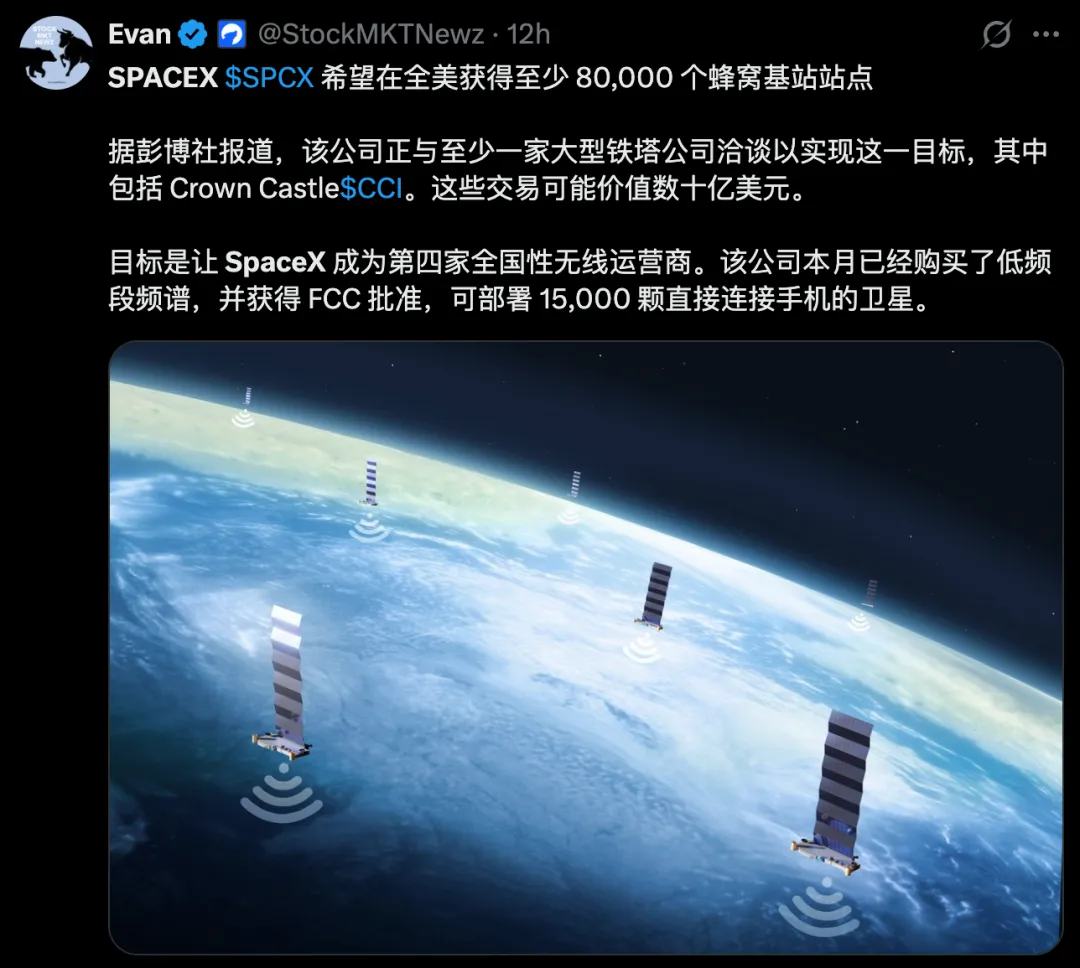
SpaceX's goal is to achieve a single-user peak of 150Mbps for ordinary mobile telephony satellites. President Gwynne Shotwell said at a conference call in August that with new satellites and a new spectrum, the capability of the entire mobile telephony system is expected to be improved by about 100 times.
The direction is very clear:The industrial focus of the satellite Internet is shifting from "heaven" to "ground", from "launch" to "terminal access".
Cell phones connect to satellites, just a corner of an icebergMobile direct-to-satellite is the easiest to understand application entry, but the real market is much bigger than a mobile phone.
Think of the scenarios that are not covered by ground stations: ocean ships, deep mountain mines, offshore oil fields, polar exploration, civil aviation aircraft, low-flying aircraft, emergency rescue, border patrol.
China's ground cell network covers more than 95% of the population, but the country's land area coverage is far from as high.
For the first time, the ITU International Telecommunication Union (ITU) has incorporated "non-ground networks" into the widespread connectivity scenario, and added three new indicators for "coverage/expanding connectivity/network resilience" to upgrade the satellite Internet from "supplementary coverage" to the "widespread in-connection" baseline to become a native component of the 6G space, space and maritime integration architecture.
This means that the satellite Internet is not a "back-up network" for mobile phones, but is becoming the next generation of 6G communications infrastructure covering mobile phones, cars, ships, low-flying aircraft, industrial equipment, and emergency terminals.

SpaceX's own accounting firm, SpaceX, has just made a mark on the verdict.
In its IPO, it split the $1.6 trillion potential market for connectivity business into two parts: approximately $740 billion in mobile phones and about $870 billion in satellite bandwidth.
So the real meaning of a mobile phone is not how big it is, but that it's the first time ordinary people have seen "satellite connectivity".
Once the entrance is opened, the bandwidth chips, communication modules and terminal programs for mobile phones will flow along this path to cars, ships and low-flying aircraft.
It's not the end of the line, it's the point of explosion.
A chip that we use every day but rarely see.There's one thing that needs to be spoken out separately.Band-band chips。
Calling, browsing videos, texting, and the band-band chips on mobile phones are silent when users enjoy high-speed network connectivity services.
It is responsible for processing wireless signals, running communications protocols, completing data transmissions, and is the core of the terminal's stable communications connection.
But when it comes to satellite communications, the rules of the game have completely changed.
The low-orbit satellites fly 500 to 1,200 kilometers above the ground to approach the first cosmic speed.
The first is three hard questions that make communication engineers headaches:
One is the massive Doppler frequency shift. Satellite high-speed movement causes signal frequency deviations that can reach tens of times the range of traditional cellular communications.
The signal back and forth path is much larger than the ground base station scene.
Third, there is a huge loss of path. The phone's power to send signals to satellites hundreds of kilometers away is extremely tight.
This means that you can't simply move a ground cell chip to a satellite scene.
One example illustrates the problem: this year at MWC, Qualcomm released a new generation of X105 chips that integrated NR-NTN functionality.
However, at the time of its official release, the feature will be disabled by default. According to various industry analyses, it is not that Qualcomm doesn't want to use it, but that the globally uncommercialized NR-NTN satellite network will be adapted to Qualcomm for full testing.
The chips were made, but there was no real environment in the sky to verify the run.
It is not difficult to make a chip, but it is difficult to complete a complete verification of the orbit from the laboratory to the satellite.
Key pillars of connecting satellite networks to terminal devicesIn the entire satellite Internet industry chain, the end-side ribbon chips are a special feature.
End-to-end tape chips have a high design complexity and must be pre-adapted to the downstream industrial chain.
Because it's the only thing that requires Doppler frequency compensation, dynamic link management, satellite switching, long-range adaptation, protocol pump operation and power consumption controls, all integrated into a chip the size of a nail cap to process signals synchronization in real time in microseconds.
The construction of the Chinese low-orbit satellite Internet requires a domestic bandwidth chip as an end-to-end connection base. The logic is simple: constellations, star-based stations, terminals and communication protocols need to be adapted, coordinated and verified within the same system.
You can't use a chip that's optimized for the American chains of stars to pick up a Chinese low-orbit satellite star.
This is where the Semiconductor is stationed.
Founded in 2020 and headquartered in Shanghai, STS started with 5G eMBB high-speed high-bandwidth bandwidth chips with a 100% success rate.
This year, three loans, valued at over $1 billion, have been disclosed.
STS Semiconductor has been deeply involved in the construction of China's major low-orbit satellite Internet constellations, starting with the first high-definition video call in the lab in 2023, completing ground-based outdoor testing in 2024, and completing the world's first high-definition video communication verification of mobile phones based on the 3GPP 5G NTN standard by 2025.
Links need to carry more information from newsletters to videos, with higher requirements for bandwidth, latency and continuous transmission capabilities. This verification provides the basis for subsequent terminal development and business verification.
Of course, once a call is successful, the distance to the consumer can be used at any time, and the continuous testing, product certification and service improvement.
The STS semiconductor is a key choice for ASIC pathways.
Although the route's R&D costs are higher and cycles longer, ASIC can significantly reduce costs, power consumption and chip area, which is a must for consumer terminals such as mobile phones and cars that are extremely sensitive to size and power consumption.
From day one, it was aimed at commercial scale, not laboratory demonstration.
More importantly, satellites are usually only available for a few minutes a day in the overhead window for orbital verification. The engineering experience and real data accumulated during each orbital test is extremely valuable.
This year-on-year accumulation of verification constitutes a second time barrier beyond technical barriers. The latter, even with the same technical capabilities, will need to go through the same long verification cycle again.
The layout of the STS semiconductor also extends along the chip to modules and terminal solutions.
Using the CS7620 platform and its CM7620 modules, equipment manufacturers can use existing communications capabilities and reference schemes to reduce underlying integration work and accelerate product development. The company also offers IP licensing and custom development for mobile phones, automobiles, ships and industrial equipment to suit the needs of different customers.
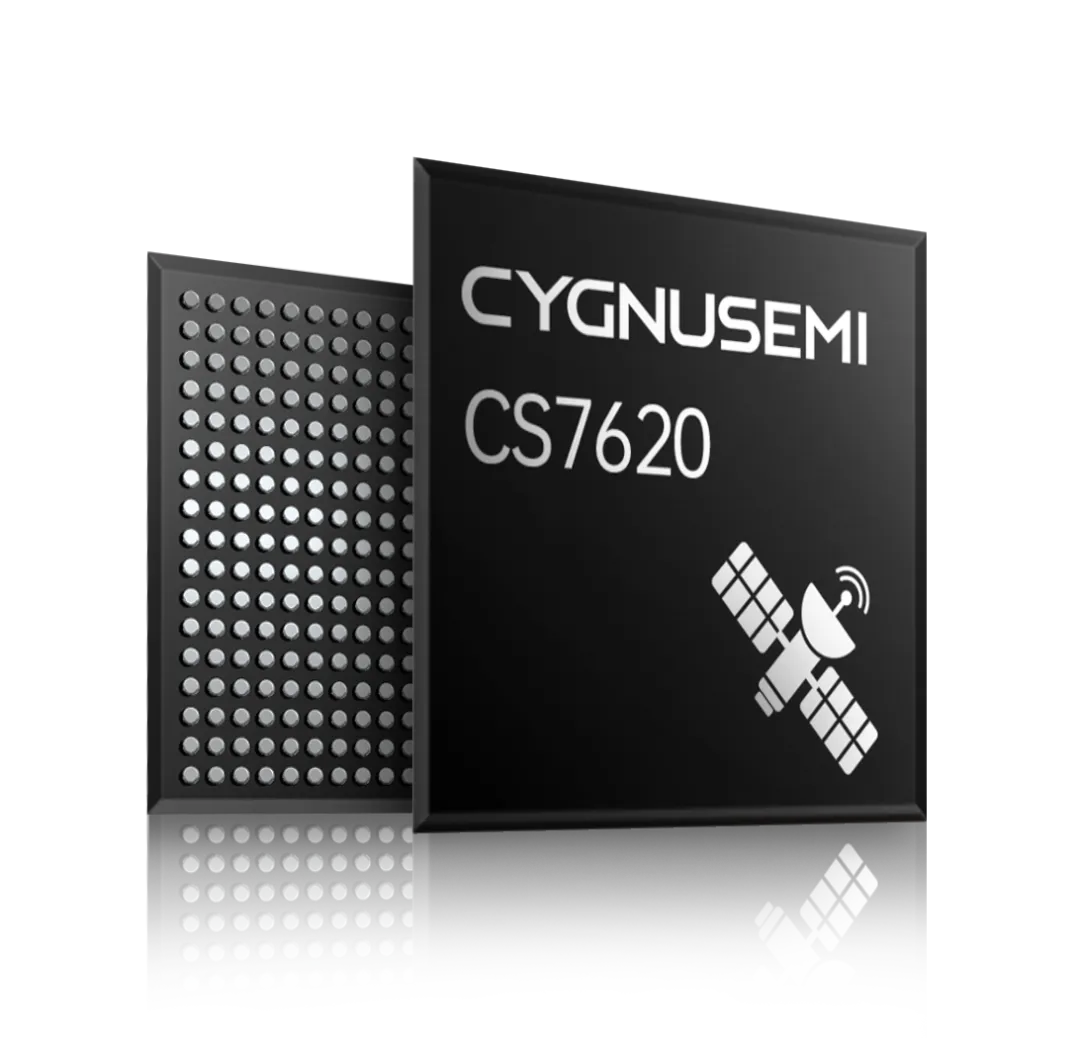
Behind this is the complete self-development capability of communication algorithms, protocol software, and SoC design, as well as the continuous engineering build-up associated with satellite networks and terminal manufacturers. Stars Semiconductor is also involved in the pre-development and development of 6G-related standards.
The chips, modules and terminal protocols are linked together, making the STS semiconductor an end-to-end connection platform between satellite networks and multi-terminals.
Industrial routes are more verifiable than many "front-end" tracks.A question worth thinking about for investors is that, unlike many of the cutting-edge technologies that are still awaiting product delivery and revenue verification, the industrialization path of the satellite Internet is relatively clear.
Rocket launches→ Constellation network→ Standard adaptation→ Terminal certification→ Verification in orbit→ Service opened→
In addition to a clear 6G commercial timeline, the first 6G version is frozen in 2029, and the first to be commercially available in 2030, each step has a clear time node and a visible sign of progress.
Its commercialization is not based on a single explosive product that explodes suddenly, but continues with the gradual introduction of a new generation of communication network infrastructure.
SpaceX's IPO is the best proof: Starlink's revenue growth curve is essentially a steady rise in the number of users by ARPU value.
From a global perspective, there is a very limited number of end-to-end band players on the track. Companies with consumer-grade broadband satellite terminal bands with full-fledged R&D capabilities can be counted around the world.
China's domestic market also has a natural demand for differentiation, and the large-scale construction of low-orbit constellations requires not only the launch of satellites into the sky, but also the access of domestic industrial systems to end-side ribbon research and engineering verification by domestic chip manufacturers.
STS Semiconductor has established a strategic partnership with ZTE Communications this year, and the National Commercial Space Innovation Consortium has included it as its first member to be selected by the Ministry of Industry and Communications as a member of the working group of the 6G promotion organization IMT 2030.
The signals are superimposed on each other, pointing to the same judgment:At the industrial turning point of the satellite Internet from "Doesn't There Be a Star" to "Terminals Can't Access", ribbon chips are becoming a key entry point for value creation.
Nail-sized chip, the gateway to satellite internetA chip the size of a nail covers contains the code for the next generation of communication infrastructure.
When SpaceX told the world that "connection is real business" with a public offering, and when China's national network constellation, the Kylan constellation, accelerated into orbit at a rate of several dozen per month, a sub-class of Longitude 10B was steadily picked up by the grid.
The focus of the industry has shifted irreversibly from the sky to the ground.
From satellite group networks to terminal access, a whole new industrial chain covering satellite networks, bandwidth chips, communication modules, terminal devices and industrial applications is forming.
And at the bottom of this chain, the ribbon chip that connects the sky and the earth, is the key to deciding "who can use the satellite network".