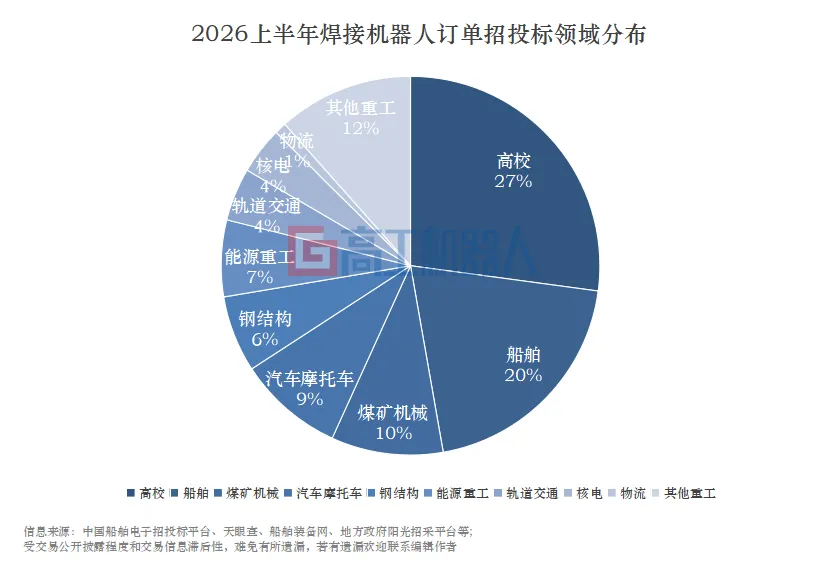
 Tender orders for welding robots in domestic shipping in the first half of 2026 (slide up)
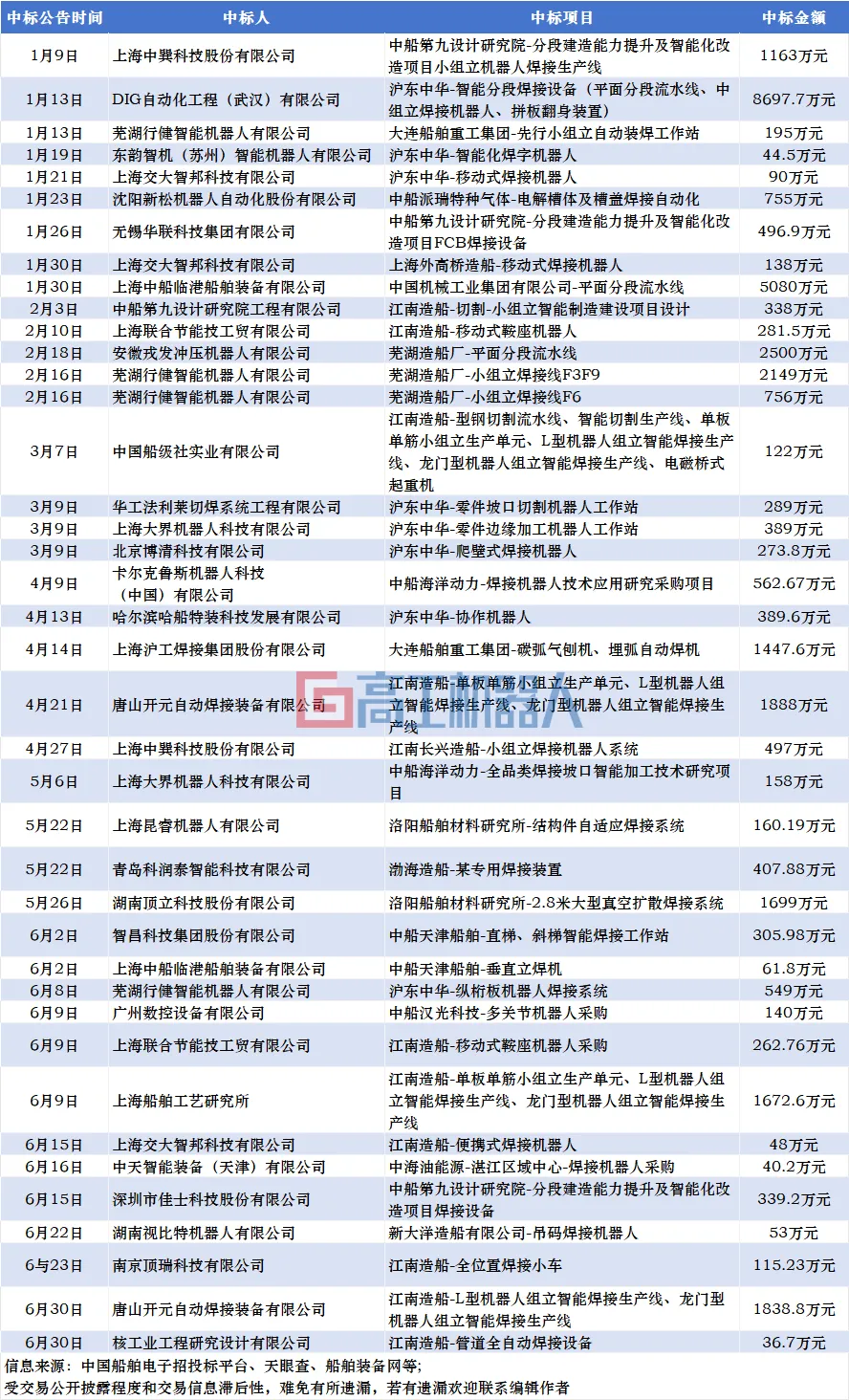
(Public information compiled, if there is any incompleteness, please correct)
Shipyard processes evolve, demand for improvements surges
Smart welding robot products are generated
The core process of shipbuilding relies entirely on artificial craftsmanship, while welding is also one of the key components of shipbuilding. A multi-ton ship with a length of welding can reach tens of thousands of meters, according to data from journals such as the IEEE, welding accounts for about 40% of total shipbuilding work and costs about 30%-50% of total cost.
At the same time, the shipbuilding industry's processes have long jumped out of the simple structure of bulk ships, such as complex pipelines, irregular segments, narrow-layer welding, and the precision of welding, as well as the practical experience of welding. The structure and state of construction of the ship is changing every day, and traditional fixed programming industrial robots are difficult to adapt to changing conditions.
In the field of shipping, lightweight, flexible and intelligent welding equipment is the market's biggest resource.
In the first half of the year, a number of enterprises, including Foo Robot, New Era, Ascension Weeks, China-based robotics, Neolithic robots, Sino-Japanese Neolithic, Concentrated Artificial Intelligence, Kuchawa robots, Vibet robots, Intelligent Technology, and others, have introduced new intelligent welding robots for shipping.
For example, Foo Robotics, CGI and others have released collaborative welding robotics workstations based on AI+3D vision-free demonstration systems; and Visual Vision, Visual Bit Robotics and others have released physically intelligent welding robots in narrow spaces for ship repair and other areas, including quadruped welding robots, mobile AGV welding robots, and two-legged welding humanoid robots.
These new forms and brand names differ, but they show some typical commonalities: the robot's new body is generally lightweight; the maximum arm span is extended to nearly 2 meters; some collaborative robots are attached to a joint-powered smooth tractor; the door or track can be extended for multi-axis movement; and optional 3D vision-free welding systems.
At this year's Exhibition in Essen, FARO robots showcased a range of eye-hand-brain synchronous screens and externally scalable connectivity smart body screens, including mixed circuit screens based on the AIRLab smart-brain screens, long-range screens, and mobile-orbit ship screens.
Among them, the AIRLab mobile-orbit ship welding program, which is geared towards large warehouses, hulls and port structures, accompanied by lightweight mobile tracks and lift brackets, can be flexibly moved to different welding areas, greatly expanding the range of welding operations.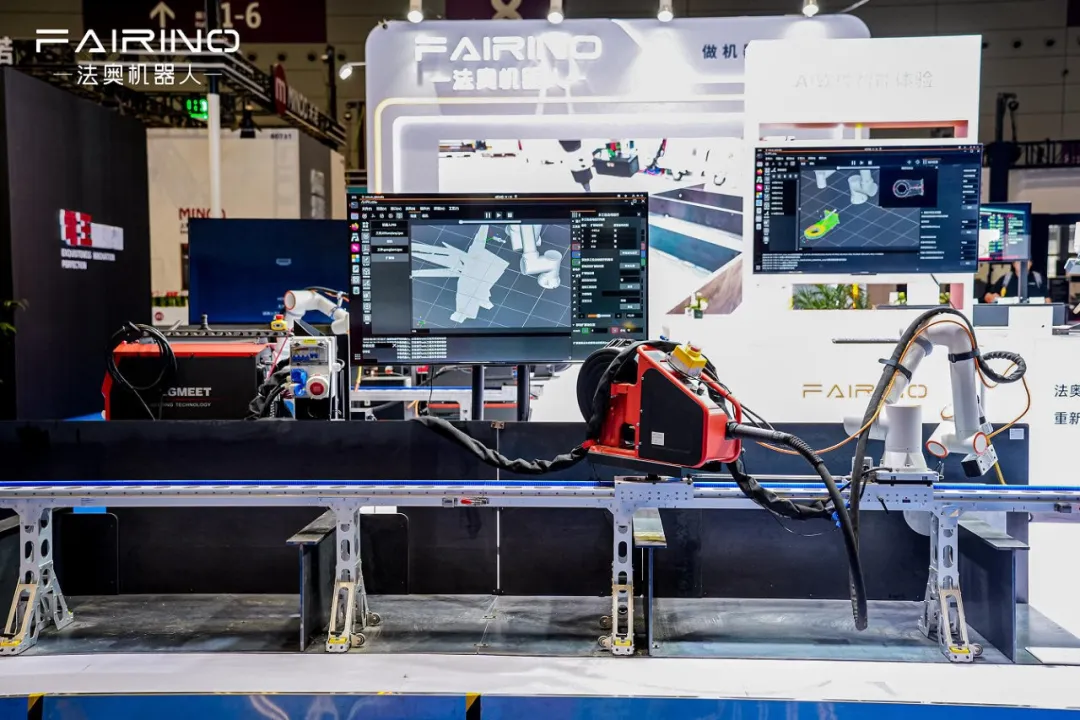
In addition to the external expansion kit, the collaborative robot body designed for welding is only 10.5 kg lightweight, with a magnetic suction substrate, which can be installed instantly, with the end J6 axle joints supporting ± 360° all-round rotation, allowing sufficient welding operation adaptation for the narrow space of the vessel.
The emergence of new products is just the beginning, and the shipping industry is still the typical high-end threshold, which really determines the industry ceiling, who can steadily run the equipment efficiently in complex shipbuilding scenarios.
The central test of this logic lies first and foremost in the complexity of the work in the construction of ships, the minimum degree of standardization and the most direct impact on the efficiency of the output of the segment.
The group stage became a training ground for soldiers
Who can cross the threshold of technology and application?
According to the statistical analysis of tender information disclosed publicly by the shipyards in the first half of the year, the group's segmented welding machine artificial stations, long-gate smart welding robot production lines have become an urgent need in shipbuilding orders. Like Jiangnan Shipbuilding, Yangtze Shipbuilding, China Shipbuilding, Ninth Ward, Great Lakes Ship Rebuilding, Jiangnan Shipbuilding, and others have released millions or tens of millions of tender needs.
Although the demand is hot, there is still a big gap between welding technology and application welding in front of welding system integrators and manufacturers.
There are a large number of complex angle brackets in group component welding, where the position of the bracket is narrow, the angle of inclination is large, and there are more visual shields. For welding equipment, the detection of bracket vision, robotic collision avoidance, and the coherence of the welding process are all huge challenges.
Faced with challenges, the four logical frameworks that underpin AI perception, decision-making, execution, and digitalization form the backbone of AI welding technology. High-tech robots understand that at the core level of AI welding control systems, the current AI welding industry produces two technologies:
One class is rule-based drive, which is based on predetermined process rules, geometry, motion and control logic, and is based on proprietary systems of torque identification, path planning, parameter matching, etc., with relatively high technical maturity and strong landing stability.
Another category is the emerging technology routes based on weld data driven welds, similar to the technical paradigm of large-body intelligent models, which generate end-to-end welding decisions through mass welding scenarios, processes, and artificial pre-training data.
Currently, there are a number of companies on the market that are launching products around two technological routes: an offline programming connection control system combined with traditional map models to import + visual recognition, and a free demonstration intelligent processing platform based on AI pre-trained + 3D vision + cross-process tasks, which can be studied in depth based on expert process databases, and automatically adjusted inverted angles with gesture adaptation, achieving automatic avoidance of obstacles and continuous connection.
For example, the AIRLab mobile-orbit mixed-flow welding program, designed specifically for a variety of small-scale welding production slow, programming modulation complex, workplace scheduling inflexibility, and other pain points. The program features lightweight mobile-orbiting systems that allow collaborative robots to flexibly cover multiple workplaces, the AIRLab platform + vision system portfolio truly understands welding, completes the process of automatically switching from model libraries to photos, completes the mass production of different structural materials, model programming is replicable, and can truly recognize a weld, connect a weld.
In the first half of this year, a small group of enterprises such as Jiangnan Chong Xing Shipbuilding, China Ship Ninth Design Institute, and others set up a welding production line tender and procurement project, earning tens of millions of yuan of orders.
In the field of ship welding, China Sewing Technology has mastered technical systems such as adaptive welding systems, AI visual welding models, the entire operation process without the need for programming demonstrations, without the need to import models or drawings information, the adaptive welding system can start line laser camera scanning with a single click, the camera follows the shutter to complete the scanning and cloud modeling of ship segment workpieces, automatically extract welding coordinates sent to welding robots, and the welding location automatically extract recognition rate exceeds 99%.
The system matches a variety of welding processes based on the type of weld and the results, automatically generates a channel layout, the entire welding process can be completed automatically without any artificial intervention, and also supports self-defining rule parameters through visualized graphical user interfaces.
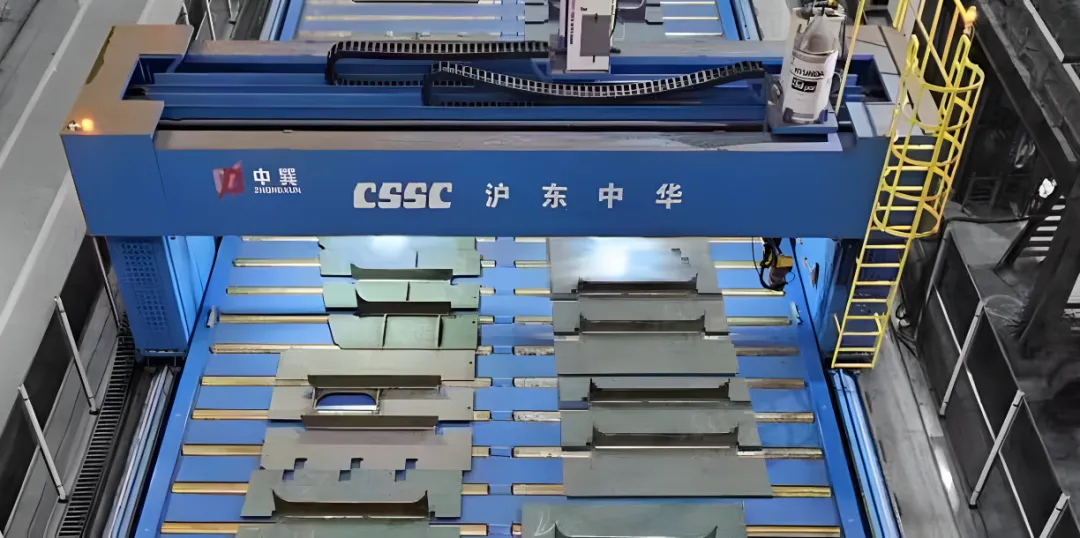
The team builds a welding robot production line, image source: Zhengzhou Technology
Currently, the ZTE/ZTE assembly welding system has been widely used in the smart robot production line of China Oil Group, ZTE Shipping Group, ZTE Far Shipping and other benchmark customers, through consistency verification under complex working conditions.
In addition, for some long-shaped wall panel group welding connections, the industry has seen the development of multi-machine welding system in collaboration with the four-machine, eight-machine welding system. The eight-machine welding group in collaboration with the Chinese ship Huangpu-Weng Shu recently developed the eight-machine welding line welding system in collaboration with the Chinese ship, based on pure vision technology, autonomously scanning modeling, planning paths, tracking corrections, achieving a single-use eight-machine welding system, cumulative welding work of more than 100 meters, enhancing the production capacity of the ship segment, will increase the automation of the welding line segment of the small group to 25%.
In the face of the narrow space and complex components in the shipyards, mobile welding capabilities are essential. Such as full-position welding minivans, portable welding robots, mobile orbital welding collaboration robots, slide welding workstations, crawler-like robots with mobile capabilities, have become the flagship of shipbuilding bidding projects, such as Dongguan China, Jiangnan Shipbuilding Shipbuilding Shipbuilding Shipbuilding Shipbuilding Shipbuilding Shipbuilding Shipbuilding Shipbuilding Shipbuilding Shipbuilding Shipbuilding Shipbuilding Shipbuilding Shipbuilding Shipbuilding Shipbuilding Shipbuilding Shipbuilding Shipbuilding Shipbuilding Shipbuilding Shipbuilding Shipbuilding Shipbuilding Shipbuilding Shipbuilding Shipbuilding Shipbuilding Shipbuilding Shipbuilding Shipbuilding Shipbuilding Shipbuilding Shipbuilding Shipbuilding Shipbuilding Shipbuilding Shipbuilding Shipbuilding Shipbuilding Shipbuilding Shipbuilding Shipbuilding Shipbuilding Shipbuilding Shipbuilding Shipbuilding Shipbuilding Shipbuilding Shipbuilding Shipbuilding Shipbuilding Shipbuilding Shipbuilding Shipbuilding Shipbuilding Shipbuilding Shipbuilding Shipbuilding Shipbuilding Shipbuilding Shipbuilding Shipbuilding Shipbuilding Shipbuilding Shipbuilding Shipbuilding Shipbuilding Shipbuilding Shipbuilding.
This means that lightweight, externally multi-axis jointly controlled collaborative robots will enjoy the fastest first wave of advantages of the need for portable, easy-to-operate and reliable intelligent equipment upgrades in ship welding workshops.
For problems such as the difficulty of large-scale welding mobility in the maritime sector, China has targeted the introduction of a collaborative robotic intelligent arc welding system alongside robots. The system is centered on collaborative welding robots alongside China, with high-efficiency mobile welding as a highlight, highly integrated, and digitized first-line welding expertise, reconstructing the process of welding large-scale robots, achieving 4-6 minutes of extreme rapid deployment, 30-40 minutes of continuous stable welding.
In real-world welding workplaces such as ship's workshops, robots along the Chinese coast are not only able to synchronize with all kinds of mobile tools such as removable lifting poles, skid tracks, magnetic suction basins, welding tool pickups, achieve topographical infinite expansion, cover the entire workshop with a set of systems, and have full terrain, window holes, sliding propulsion, etc. capabilities; they can also be closely combined with MiniMES to collect full-scale operations management data and welding processing data, laying the foundation for digital and intelligent welding.
(Practical application of customer experience in the field of robotic welding in China)
Currently, Chinese welding robots have fully landed terminal customers in shipping areas such as Jiangsu, Guangzhou, Fujian, and Shandong, and one welding worker at a shipyard in Nanjing can operate four welding robots simultaneously, significantly improving efficiency.
In addition, in the field of robotic welding, China also has 1.8 m ultra-long arm-length welding robots, single-man brake/brace lightweight welding robots, as well as features such as ultra-high precision, ultra-soft tractor display, multi-axis connectivity, automatic brake tracking and ease of use, which adds new strength to the flexibility and automated transformation upgrades of shipping and marine industries.
It's not hard to see that in the rigid skeletal scenes of the group's welding of these ships, product reliability, application adaptability, and process richness constitute a rigorous barrier to entry, but also the rapid transformation of the underlying technologies in the robotics industry chain, bringing to the surface enterprises with truly sophisticated process integration and innovative technology capabilities.
Whether it's the rule-driven, scenic-priority resilient, the data-driven tech-savvy, or the technological explorers who continue to make breakthroughs in differential paths such as multi-machine collaboration, mobile welding, welding-free programming scenario coverage, they are responding in their own ways to the shipyards' extreme pursuit of efficiency and quality.
If we take the vision a little further from the current technological approach, we will find that the end of smart welding is far more than a one-stop-scenario automation replacement for welding when the digital wave in the shipbuilding industry coincides with the global wave of AI innovation, and a deeper industrial change is underway.
From a single point of connection to a complete reconstruction of the whole scene
The future of shipbuilding is on the way
Through interactions with welding equipment integrators and terminal factories, high-tech robots have found that the shipyard boom is not a short-term venture, green fuel ships, intelligent shipping, high-end marine equipment are the long-term mainstays of development, complex pipelines for new energy vessels, intelligent control systems for welding standardization, high-precision requirements for continuous upgrades, and simple artificial models are difficult to sustain supporting large-scale shipbuilding deliveries in the coming years.
The industry is slowly forming a consensus that smart is not simply a substitute for workers, but a rebuilding of shipyard welding production models.
The future of smart ship welding will cover the entire scenery of small, medium-sized assembly, assembly, mounting, boarding, shipbuilding, etc., while the vast process of intelligent shipbuilding is not just welding, but through physical AI, digital embroidery and simulation technology, covering the multi-point process from welding to coating, transportation, from ship segmentation to assembly.
A number of companies have implemented this technology to rebuild ship processes using AI technology. Korea Modern, Japan Kawasaki Heavy Industries and others have partnered with Intelligent platforms such as Inwayeda to build the next generation of AI shipbuilding systems for the future.
For example, Kawasaki Heavy Industries will provide shipbuilding site data, process experience and robotics technology, while Ingrid will provide physical AI technologies such as Omniverse, Isaac, Cosmos, Metropolis and Jetson.
The system can generate robot movement paths in advance to check if the robot will collide with the hull, scaffold or other equipment. Engineers can also test different gestures of operation and construction order in virtual environments, deploy the robot to real-world scenarios such as welding, painting, inspection and material transportation, thus forming a loop of simulation, training, construction, inspection and feedback.
From virtual simulation modeling, digital embroidery workshops, to automated generation and real-time modeling processes based on AI models, the layout of these international giants has already shown that the competition for ship welding is leaping from single-engine automation to factory intelligence.
Looking back at the domestic market, on the one hand, domestic shipyards and equipment enterprises have made rapid breakthroughs in single-point scenarios, saving momentum on differentiation paths such as small-scale mobile welding, non-exhibition flexible processing, and achieving upgraded coverage at the rate of automation; on the other hand, many vision manufacturers and smart enterprises have already been deploying turbines through turbine vision perception-process data-model training-algorithms to build an intelligent platform for manufacturing processes such as welding, cutting, grinding and spraying.
High-tech robots have noticed that these technologies, such as Vision Intelligence, Vision Bit Robot, Medium-Bit Technology, Sensitive Technology, etc., are providing a complete set of intelligent sensing circuits for welding, cutting, grinding, surveying, and other scenarios in shipbuilding through self-development and vision programs, including sensor recognition, autonomous guidance, dynamic tracking, adaptive adjustment, and quality-testing circuits.
For example, the RVC-M2600-V2 version of this technology, released this year, is a 3D camera dedicated to metal processing complex processes. The camera depth covers 0.4m-1.5m, achieves dual-field coverage of small-to-medium detail and large-to-medium workpiece contours, has a line-scan frequency of up to 400 FPS, and is capable of high-speed capture of aluminum and aluminum pools. The thickness and volume of the M2600-V2 series of cameras is further reduced compared to the original products, such as the M2600-V2 series of cameras, the protection level reaches IP67, has anti-tanning/anti-shock certification, supports fast-change protection lenses within 3S, and is able to cope with complex and harsh conditions such as welding, cutting, grinding and grinding.
It can be seen from the innovative performance of some columns of domestic enterprises that visual perception technology is not only the starting point for the execution of robotic tasks, but has gradually moved through the closed loop of robots performing real-time correction of biases, post-mission quality testing, manufacturing equipment operation and other tasks, which will raise shipbuilding intelligence to new heights.
She wrote at the end:
A new round of the global shipbuilding competition has begun, with domestic shipyards having the world's largest application scenario, the richest process data, the most urgent upgrading needs, the three superimposed, constituting an unparalleled training ground. When the entire process of welding, cutting, grinding, spraying and other processes are intelligently implemented, Chinese shipbuilding is expected to complete the transformation of the quality from lead shaft to lead shaft in aluminum technology.
When smart shipbuilding's heat orders are simultaneously faced with harsh technical challenges, the line will be tough and long for welding robotics enterprises. When a weld is accurately identified by a 3D camera, a welding process parameter instruction is automatically tuned by an AI system, and a machine arm raises the gun in milliseconds to respond quickly to the giant wheels' artificial leaps, it starts from here.