
It's the first time in the history of the world.
Currently, China is at a critical historical juncture from a "Manufacturing Power" to an "Intelligent Power", where industrial software such as CAE simulation, fluid dynamics computing, electromagnetic EDA, etc. is the central bridge to this historical turning point.
From weather forecasts, seismic surveys, to electromagnetic simulation, to material simulation, every breakthrough in modern industry and cutting-edge scientific research has come from large-scale high-performance computing (HPC) software.
In recent years, domestic industrial software has made rapid progress in algorithmic functionality and physical modeling, accelerating the realization of autonomous controls. However, when these software are really put into the cutting-edge landscape of aerospace, chip design, and energy exploration, it's becoming more and more popular.This is often the case with a core bottleneck: "running slowly".。
In the bottom of these industrial software, there's a lot to be done.Stencil (template calculation)It is the most basic and the most consuming computing model. Due to its extreme consumption of display bandwidth, if the code and hardware architecture are not adapted to the extreme, then advanced GPU chips will also fall into the performance of the original "dry" data.
In the past, it often took a few high-performance computing (HPC) experts to analyze and configure the software and manually fine-tune the code, taking days to weeks, so that software applications that could be optimized per person per year were typically no more than 20 tons in front of the huge demand for industrial software optimization.
The AI Agent era, a decades-old industrial software performance optimization lock, is being broken by a major Chinese model company.
Today, the OpenBMB open-source community officially launched and open-source the world's first Stencil-optimized "Automatic Research+Automatic Deployment" closed-loop AI system.ForgeStencilIn just one week, 100+ real industrial and scientific computing software re-engineered and optimized automatically, with the help of zero human experts.
This is the first major AI-compiled model pre-training framework for ForgeTrain (which is 10 percent faster than the Megatron in the UK) to be launched in May.Forge Engineering (forge engineering)Another important technological achievement in the development of a new paradigm of software engineering is the latest effort by front-end intelligence in the direction of autonomous evolution of AI.
Throughout the entire process, humans only need to provide the optimized application source, and the entire process is taken over by ForgeStencil, from automatically analyzing real applications, locating hotspot functions, forging kernels, to completing algorithm replacements, validating correctness and integrating native applications, with no human experts involved in any step in optimization decisions, for the first time ever.From the idea of optimization to the application-free deployment, it's fully automated.。
Not only does ForgeStencil demonstrate the potential to duplicate the physical capabilities of drying without additional hardware investment, but it goes further into the core demands of China's current manufacturing upgrades:Using computing power to replace manpower, press the acceleration key to self-evolution for domestic industrial software.
Open source links:
Double-Agent DrivingHuman intervention, the world's firstWhat is ForgeStencil to optimize for?
Stencil (Modular Computing) is one of the most widely distributed core computing models in industrial software and scientific computing, with the core performing the same local operations on each point on the rule grid and its fixed neighbors.
Whether it's atmospheric dynamics, seismic wave propagation, electromagnetic field evolution, or fluid dynamics and phase simulation, the underlying calculations can be grouped into the same operation: using a combination of add-ons to neighbouring grid points, repeatedly updating the entire grid grid, or Stencil. These computations are densely stored, dominated by memory bandwidth, and often take up most of the running time of the entire application.
In Stencil's computing, the biggest challenge was the enormous amount of data: the program needed to read and write bulk data repeatedly, routes had to be grounded once the design was unreasonable, GPUs had to be grounded, and so on. One underlying step slowed down, and the entire application slowed down.
In the past, it was often the hard work of a handful of high-performance computing (HPC) experts to get Stencil out of the hardware speeds. They had to understand algorithms and applications and adjust code according to the size of the data and GPU. Changing an application, or even a chip, may have to rework the original program. Faced with the huge demand for industrial and scientific computing software optimization, this one-to-one reliance on expert optimization is difficult to scale.
The emergence of Forge Stencil broke this deadlock.
The ForgeStencil system consists of Kernel Agent and App Agent, which combined complete the complete loop from calculator optimization to application deployment, surpassing all previous automated tuning tools.
Kernel Agent focuses on the optimization of underlying arithmetic, making it infinitely closer to the physical limits of hardware.
It will target different types of Stencil, different grid shapes and computational accuracies, automatically generate a large number of candidate kernels, test a variety of data reading methods, thread scheduling strategies and computational structures, and come up with the fastest algorithms in a row through compilation, operation, and performance feedback.
In algorithm testing, ForgeStencil compared with the best open-source algorithms on the market today (including well-known frameworks such as Halide, Devo, EBISU, DRStencil, FlashFFTStencil, etc.) on the same hardware, demonstrating strong technical advantages:
- At the same precision (fp32), an acceleration ratio of 2.35× on a geometric average is obtained;
- Mixed accuracy (fp16) read and write with an additional 1.95 x acceleration;
- Even on the hardest-recognized "variable coefficient Stencil" in the entire Shape, the geometrical average acceleration is still 1.34x below the optimum baseline.
However, one underlying arithmetic runs fast and does not mean that the entire large industrial software can be directly accelerated. In real scientific research and industrial production code, the code in the Stencil cycle is often very complex, often overwritten with multi-physical conjunctions, and accuracy and data formats cannot be directly applied to existing standard arithmetic libraries. If a package is selected directly from existing arithmetic libraries, the software will inevitably fail or cannot be compiled.
The App Agent is responsible for engineering deployments, and the key to solving is from calculator speed to application speed.
App Agent's approach is to create software for each application individually: locate performance hotspots, build the application's own GPU baseline, create candidate optimization, test and timing the application itself, and then integrate the original application.
At the framework level, the App Agent looks for opportunities to integrate the arithmetic and extracts the optimized Stencil arithmetic. The Kernel Agent is responsible for optimizing the specific arithmetic, and its previously established arithmetic matrix is used as a knowledge base for subsequent development.
In close collaboration with Kernel Agent and App Agent, ForgeStencil has successfully completed its intelligent evolution from "automatic code generation" to "automatic research optimization", from "local algorithm acceleration" to "real application deployment".Fully Zero Artificial Intervention。
One week to optimize 100+ real appsBeyond Human ExpertsDriven by a dual-agent closed loop, ForgeStencil compresses the optimization of individual real industrial software and scientific computing applications from days, weeks to hours.
According to statistics, ForgeStencil was completed in a week.100+ automated optimization of real industrial and scientific computing applications, complete zero artificial intervention, R&D throughput has been upgraded to 1-2 quantitative levels, with R&D efficiency far exceeding that of human experts.

ForgeStencil performance efficiency chart
In addition, AI optimization has another technological advantage over human expert optimization, namely:
The experiences of human experts are all in their own minds and difficult to share with others; but ForgeStencil has a large pool of parallel Agent-sharing knowledge that can be shared in real time and can be accessed by anyone.Collective synchronous evolution of intelligence。

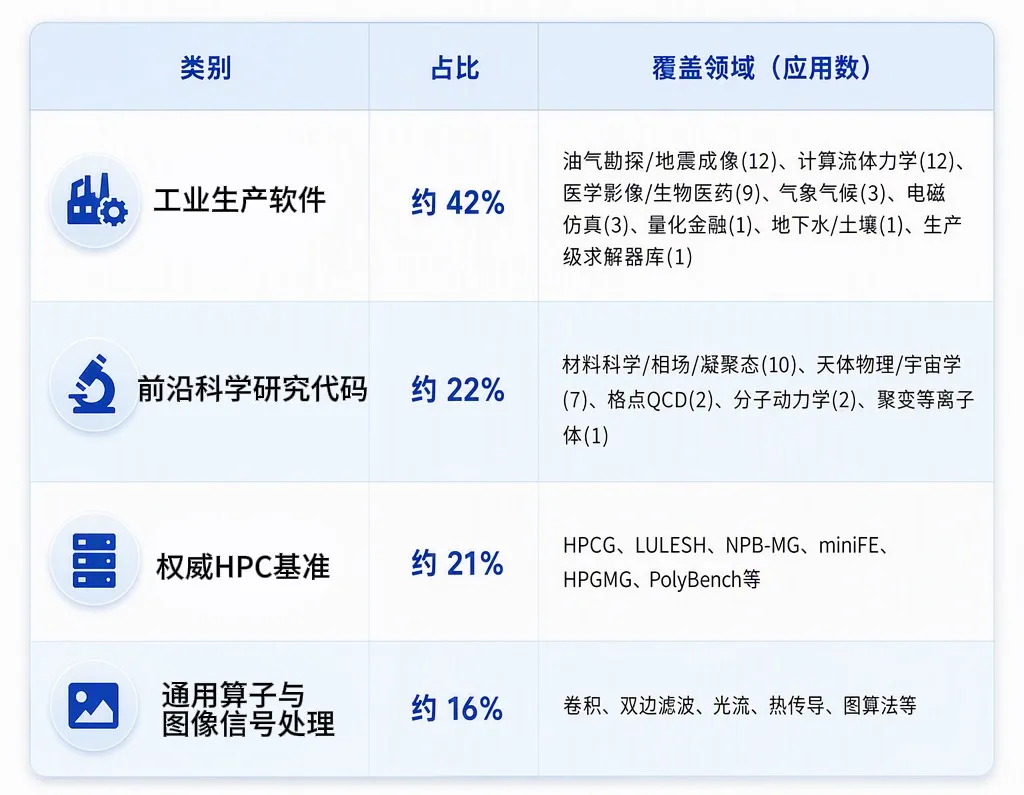
In the world of HPC, all software R&D paradigms must undergo rigorous testing of real industrial scenarios and real production codes. Among the 100+ software that ForgeStencil automatically optimizes,About 42% directly correspond to real physical industrial production scenarios。
To illustrate more intuitively the contribution of ForgeStencil to modern industrial manufacturing upgrades, we have analyzed in depth two of the most representative scenarios of high-technology domestically produced heavyweights:
Attack the mathematical heart of General CAE software:It's going to accelerate 3.86 times.In research and development in aerospace, automotive manufacturing and high-end equipment, CAE (computer-aided engineering) software is the absolute core. Whether it's computing the wing force of an aircraft or the metal shapeshifting that occurs when a car crashes, its underlying mathematical essence lies in solving large partial differential equations.
Led by Lawrence Livermore National Laboratory (LLNL) in the United States, hypre is one of the most widely relied upon numerical databases in industrial simulation solvers worldwide. The high and low efficiency of hypre solving directly determines the overall performance of CAE software.
Without the intervention of any human expert, ForgeStencil automatically runs into hyper-complex source code.3.86×The real end-to-end acceleration!
That's the equivalent ofThe calculation of CAE solvers without adding a penny to the cost of hardwareThe speed has improved significantly.
Re-constructing an electromagnetic simulation of the general base:FDTD (Acceleration 2.47 x)From radar exploration, antenna design, to electromagnetic compatibility analysis, the FDTD algorithm based on the Yee grid is the most widely used digital dashboard in the field of electromagnetic simulation.
In order to accurately simulate microscopic physical boundaries, the FDTD algorithm is full of complex boundary condition processing, medium attribute switching, and underlying Stencil updates are extremely difficult to optimize at the hardware level.
ForgeStencil directly took over this electromagnetic simulation base. Eventually, the application was achieved in standard measurement cases.2.47×This is the real acceleration.Electromagnetic simulation cycles are cut in halfThe R&D efficiency of domestic reconnaissance radar designs has been substantially restructured.
In addition, ForgeStencil has achieved a stunning acceleration in more real industrial software:Minisweep nuclear reactor neutronsThe acceleration of the computation is 5.78 times.RTM oil and gas seismic imagingIn the field of medical imaging, non-Deskart MRI reconstruction achieves a 2.45× acceleration, and DBT digital breast fracture imaging against projection achieves a 1.63× acceleration...
At the end of May, when Forge Engineering was released for the first time, Facewall Smart made an ambitious judgement:Once AI researches and builds AI faster than humans, the development of AI will no longer be completely limited to the number of experts, but may depend more on the computing and automation systems that can be deployed.
ForgeTrain was the first verification of this judgment in a large model infrastructure; today, ForgeStencil brings the same possibilities to industrial and scientific computing.
When the same set of Forge Engineering is able to continuously cross the software space, it is really worthwhile to look at a new way of producing software code that can be forged by AI on the spot according to specific needs, engineering experience can flow continuously between agents, and the software infrastructure can therefore be transformed from a one-time human writing, long-term maintenance fixed assets that can generate on demand, continuous optimization and constantly evolving productivity.
ForgeStencil transforms the optimization of Stencil templates into automated execution, sustainable accumulation, and scalable engineering capabilities. In the short term, it can help store software to quickly release software dividends; in the long term, it allows algorithm design and hardware performance to be gradually unraveled, allowing engineers and scientists to focus more on models, physical problems, and algorithmic innovation rather than being held back by performance-optimized details.
ForgeStencil attempts to add that it is an important part of domestic industrial software moving toward "performance autonomy": breaking software performance optimization's dependence on a small number of HPC experts, allowing industrial computing software to continue to evolve for specific applications and hardware.
This efficiency advantage will eventually be transmitted to the manufacturing research and development chain. Engineering simulation is faster, and the design team can verify more projects; earthquake imaging is faster, energy exploration can shorten the computational cycle; medical reconstruction is faster, and imaging equipment can improve processing efficiency.
It does not directly replace engineers or scientists, but rather accelerates the underlying software that supports design, verification, analysis, and computing, enabling AI to enter the manufacturing industry faster and become its essential digital infrastructure.
Industrial software is the "brain" of manufacturing. When the speed of the brain is no longer limited to scarce expert resources, China's manufacturing upgrades will have a truly scalable technological base.