
It's the first time in the history of the world.
This time, Claude really broke the AI programming list!
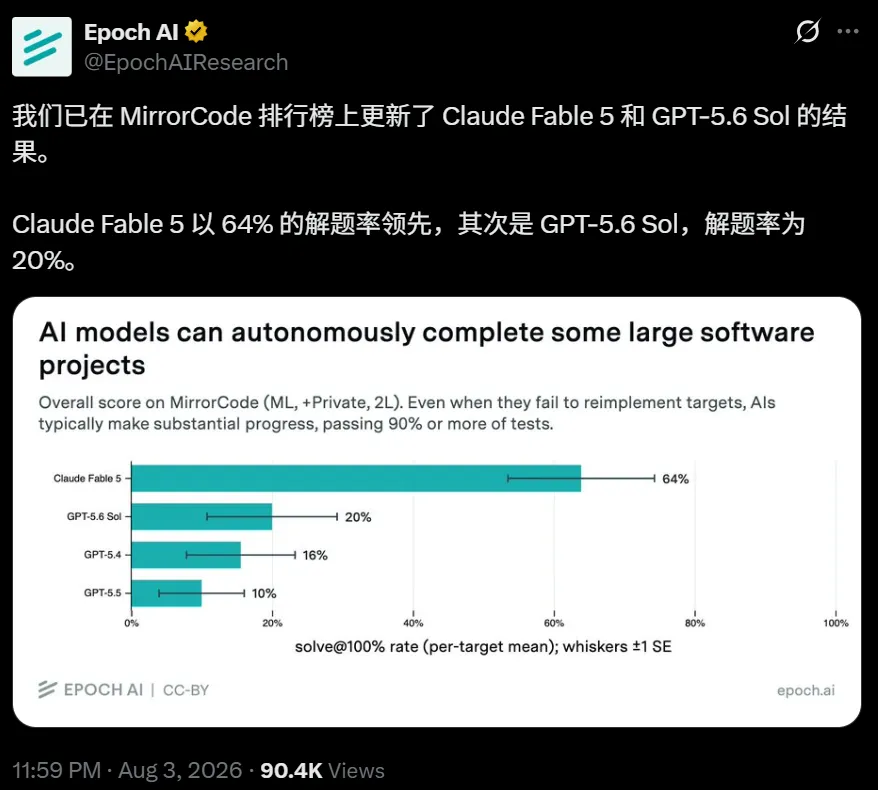
On the newly updated MirrorCode list, Claude Fable 5 once again climbed to the top with an absolute success rate of 64%.
Follow closely behind the GPT-5.6 Sol, scoring only a third of it!
The fourth-placed GPT-5.5 was even worse. Not only did it score only 10%, but it was even rubbed on the ground by its home opponent GPT-5.4.
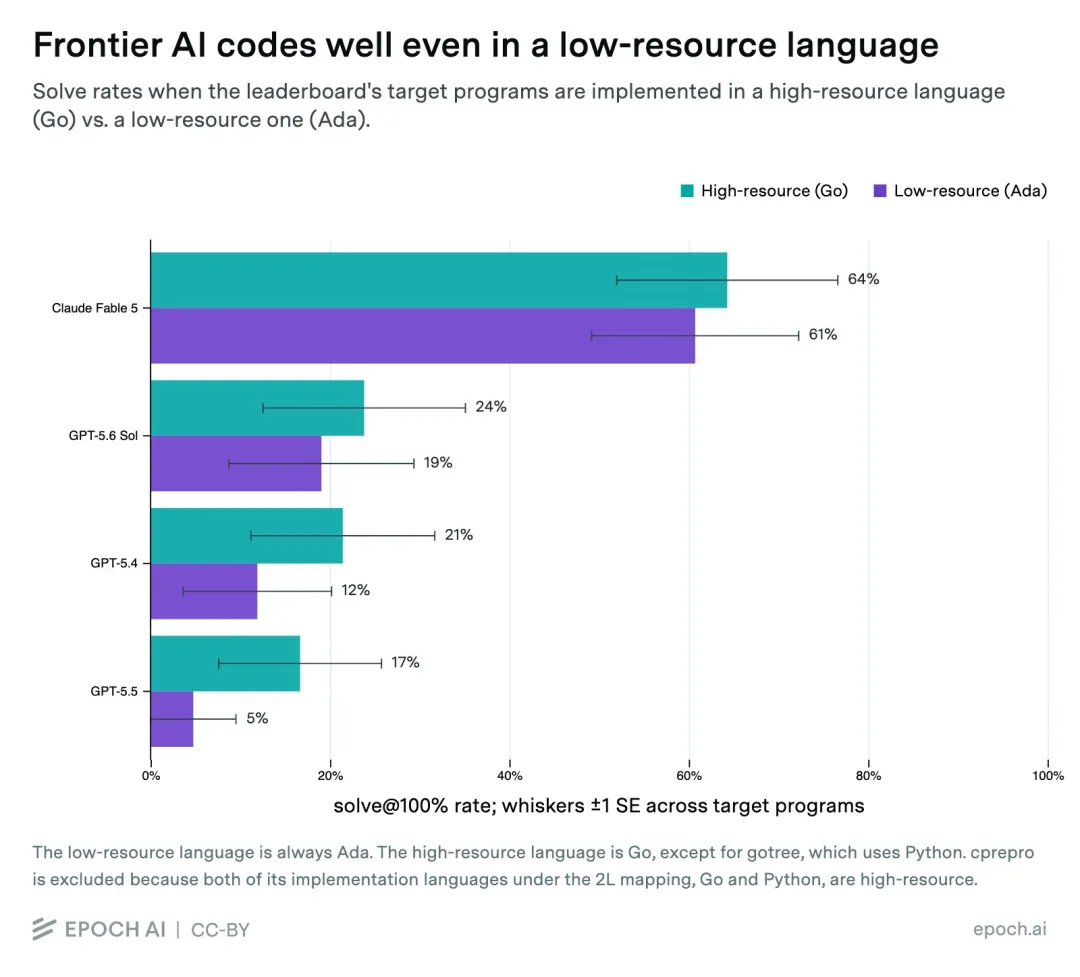
More surprisingly, Fable 5 has a resolution rate of 64% when it comes to high-resource languages such as Go; compared to Ada, it still stands at 61%.
In the open source world, Python's content is about 230 times that of Ada.
But in Fable 5, the score dropped by only 3 percentage points.
That's funny.
If the model relies mainly on the grammar and common writing of memory-hottest languages, then the results should decrease after Ada.
And now the results point to another possible outcome.
The strongest models have moved away from specific content and started to learn how to build a complete software project from scratch.
Card died on 100% of the line.10 billion token limits testSpecifically, the full MirrorCode contains 25 target programs covering areas such as Unix tools, interpreters, data queries, bioinformatics, cryptography, and compression tools.
Here, the model is placed in an isolated environment, with no Internet, no access to the original project source code, and no third-party downloads. It can only get high-level documentation, a portion of visible testing, and a repeatable original program.
The next step is to continuously input data into the original program, observe the internal logic of the output guessing, and write a new program that is consistent with the behavior.
The latest list includes 15 Medium and Large targets. Each target uses two implementing languages and each language runs three times.
Furthermore, the completion rate of visible and hidden tests must reach 100% before passing, and 99.9% do not pass.
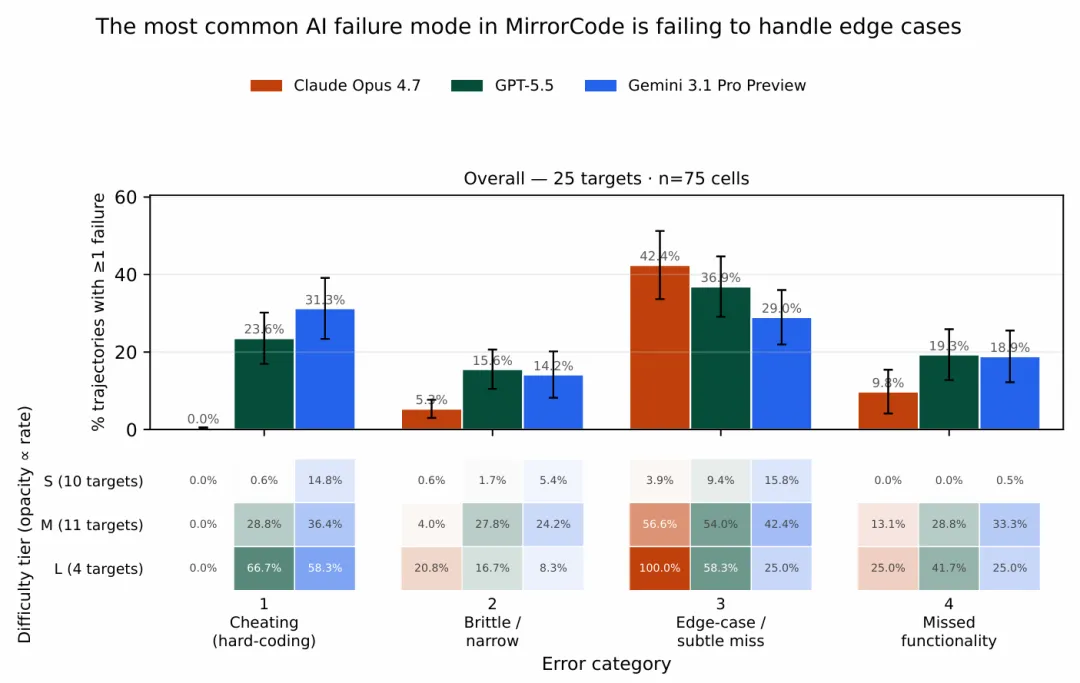
As long as one edge case is missed, the entire run is still calculated as a failure.
In order to force the model to fill the last gaps, MirrorCode pushed the single budget to 10 billion tokens, allowing for a maximum of seven consecutive days.
One of the most costly tasks in the paper was even more exaggerated: the model ran for 19 consecutive days, costing $2,600 at a time.
During these 19 days, the model repeatedly runs the original program, compares the results, complements the functionality, and then runs the test again.
The whole process is more like a few days of deliberation rather than one generation.
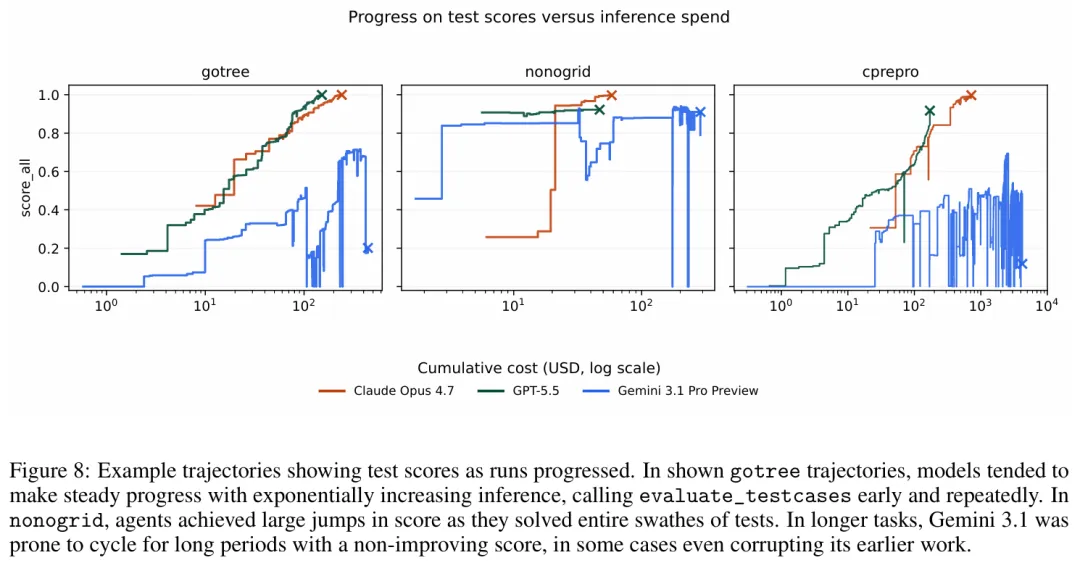
Gotree is the most intuitive example.
This bioinformatics tool originally had about 16,000 lines of Go code and more than 40 commands.
Claude Opus 4.7 took 14 hours and $251 to complete, passing 2,000 of the 2001 tests with 99.95% completeness.
Although it missed a cold gate boundary marked by a processing date and was blocked by a 100% shutdown line in MirrorCode, it has squeezed the workload originally calculated weekly into tens of hours of torque.
Epoch estimates that without AI, it would take at least 2 to 17 weeks for human engineers to complete the same task.
In the food desert, Fable 5 dropped only 3 points.The MirrorCode paper has been used as a reference for StarCoder's public training mix.
Python accounts for about 8%, Ada is only 0.034, and the former is about 230 times the latter.
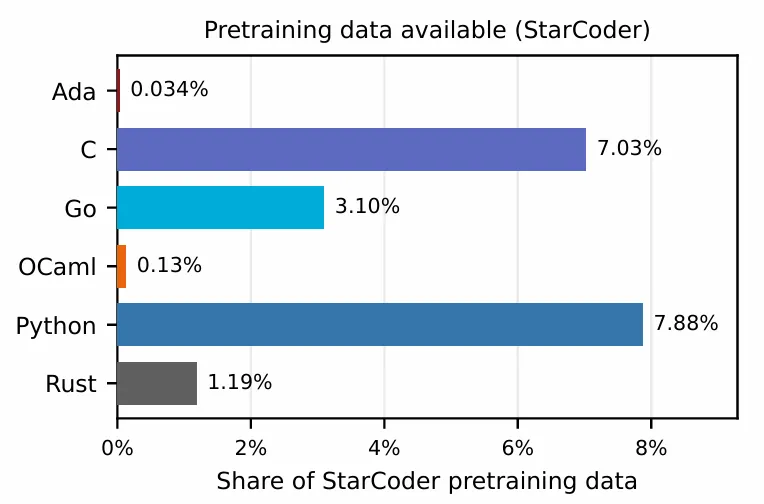
Of course, we can't know exactly how much Ada code the closed-source model has seen. But as an open ecological reference, how scarce Ada is is is intuitive enough.
It is primarily used in aerospace, defense, and other security-critical systems. Regardless of the size of the community, the number of tutorials, or open source projects, it is far from comparable to Python, JavaScript, or Go.
Fable 5 is obviously not translating the Go code into Ada.
It's more like figuring out how the original program works, then changing a language and recreating the same behavior.
In comparison, other models are not as stable.
GPT-5.6 Sol dropped from 24% to 19%, GPT-5.4 dropped from 21% to 12% and GPT-5.5 dropped from 17% to 5%.
Give the whole project to AI
Today, Cursor has enabled hundreds of Agents to collaborate for nearly a week, writing more than a million lines of browser code from scratch across 1,000 files.
Anthropic enabled 16 Claude Agents to run nearly 2,000 sessions in parallel, eventually building a 100,000-line C compiler that could compile the Linux 6.9 kernel.
Of the individual Codex user samples disclosed by OpenAI as of May, 70.2% have submitted at least one projected human workload task of more than one hour; 25.6% have submitted tasks of more than eight hours.
People are giving units of AI that are going from a piece of code, a bug, to an afternoon, a week, or even an entire project.
64% of MirrorCode is a quantification of this "project-level assignment".
It explains that as long as the goal is clear enough that the results can be automatically accepted, the front-end model can be done independently as part of large software.
For everyone who is handing over their work to AI, change is just around the corner.
First you have to look at it and write every bit of code, and then you are more likely to check it only at the key nodes to see if it is running.
The code is getting cheaper.
And those who can make the problem clear and understand the results will be more and more valuable.