
It's the first time in the history of the world.
The results of the 10th Fields Awards, and the AI demonstration process is open to the public!
Today, OpenAI released a 62-page "core manuscript" detailing the full launch of GPT.
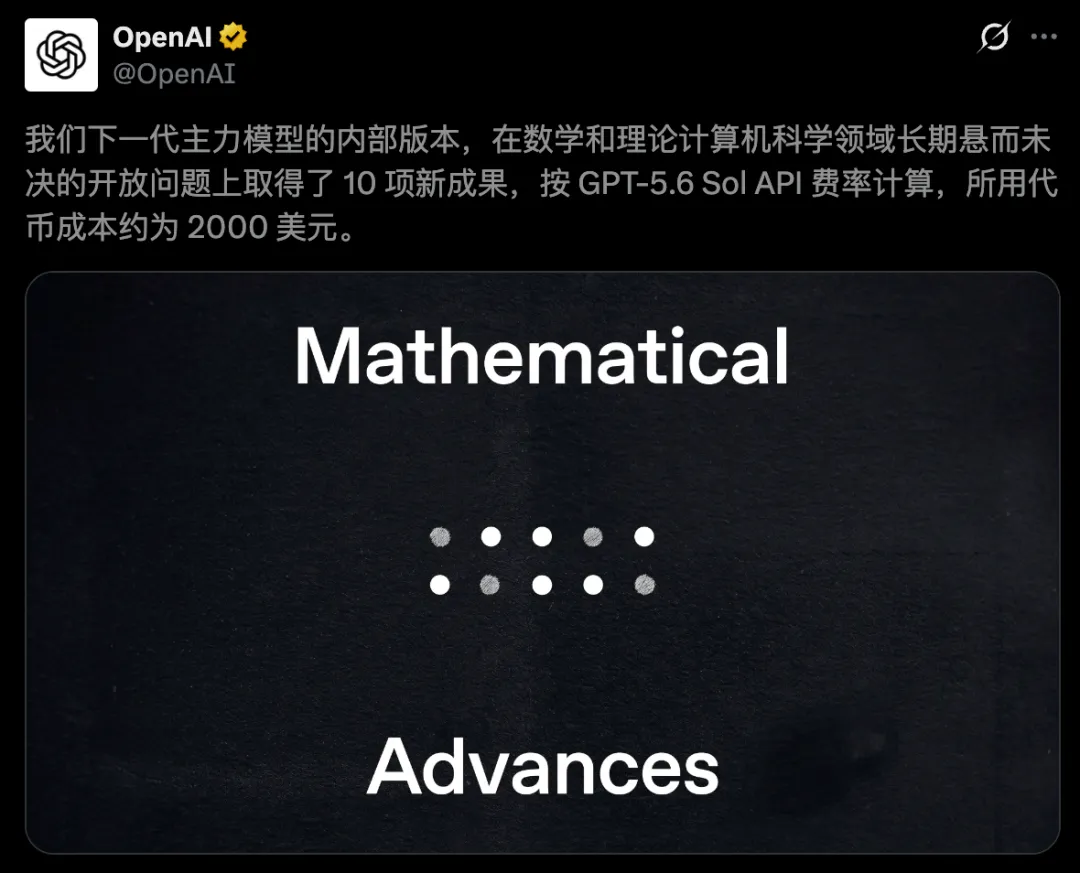
The official "seal" finally completes this amazing breakthrough, which is the "next generation dominance model".
According to the GPT-5.6 Sol API billing standard, the cost of burning all tokens is only $2000.
AI proved that once the manuscript came out, the entire web was lit again.
Everyone was blindly guessing, "This is definitely the legendary GPT-6!" and some were even amazed that $2,000 unlocked ten historic achievements.

 GPT solves the problems of the 10th centuryOnly $2000
Two days ago, an OpenAI intern posted a blog post about the next-generation model Astra tackling the top 10 mathematical problems.
A list chart came out and shocked everyone.
It covers high-dimensional spherical stacking, binary codes and spherical codes, group theory, Connes rigidity conjecture, the boundary of the arithmetic circuit, quantum parallel repetition, recent vector problems, Ehrhart volume conjecture, multicolored Ramsey numbers, and extreme graph theory.
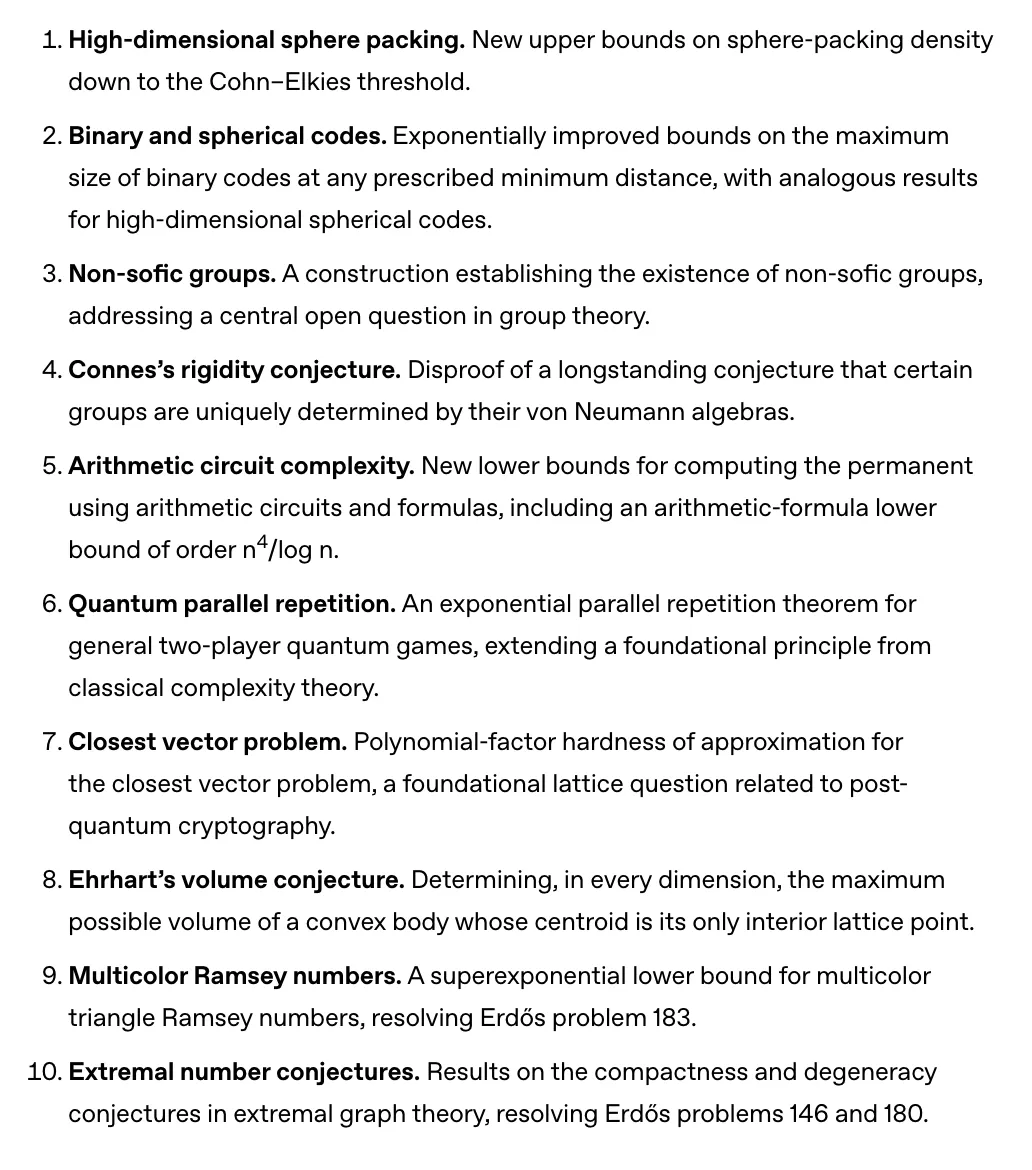
At the time, the official blog posted a 249-page collection of papers and a complete set of Lean 4 formalized certificates.
But until today, a 62-page manuscript called How the Ideas Came Together has been officially released.

It's the door.
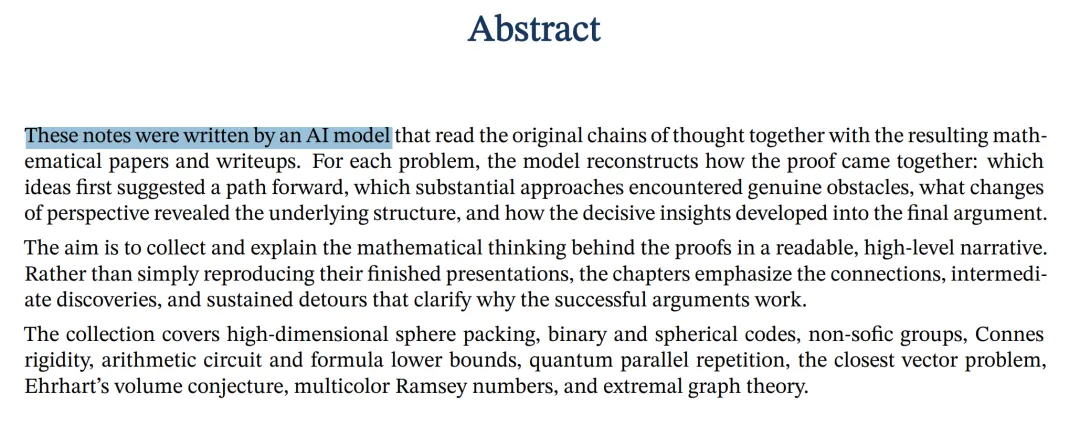
Its "abstract" is only a small section, but the amount of information is staggering.
This note was written independently by an AI model, and the OpenAI team is completely uninvolved.
AI reads the original CoT, as well as the mathematical paper in the final text, and then reconfigures four things for each problem:
What ideas initially pointed to a viable path;
What seemingly fractional approaches hit the real obstacles?
What kind of perspective change exposes the underlying structure?
In the end, a decisive insight into what constitutes the completion of the argument.
 Internet hot topic problemsHigh-volume bodies pile up, nobody moves for 46 years
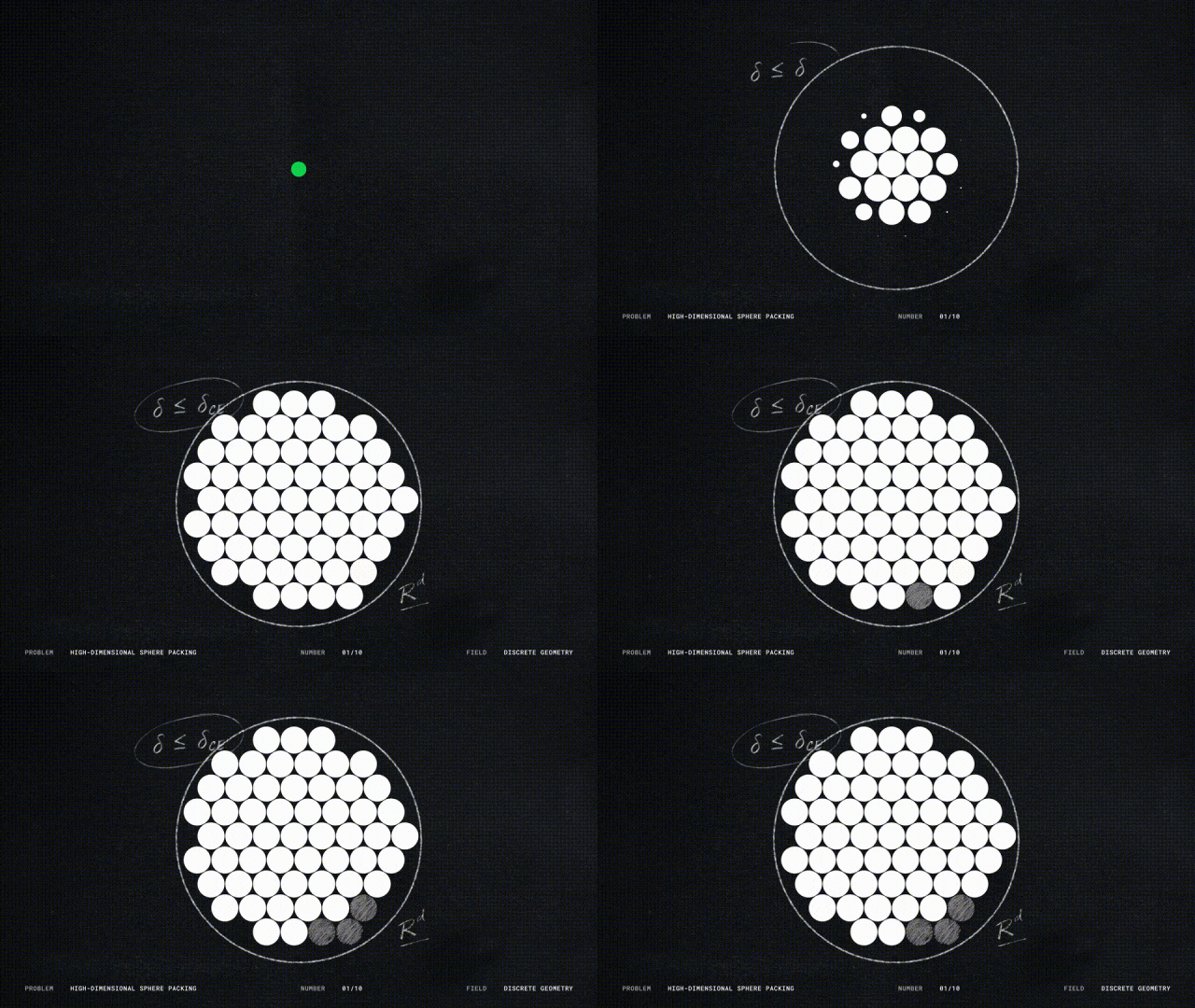
Of the ten topics, the highest focus of the entire network is the accumulation of high-dimensional objects.
Given the name "high and deep", the question itself is actually simple: put a bunch of balls in a box that is as big as it can be filled with as much as possible.
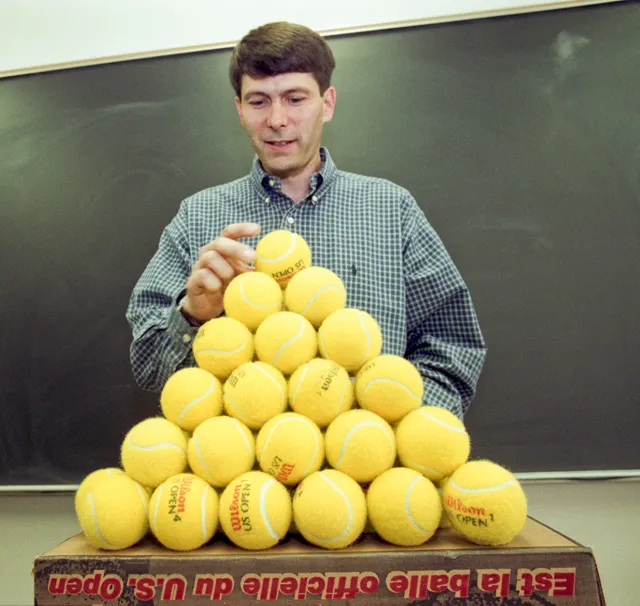
The answer to three-dimensional space has been around for a long time, and it's the "sandbox" stack on a fruit stand.
But in a few hundred and thousands of dimensions, humans can only give one "upper limit" to a maximum of what is impossible to exceed.
This upper-order index, at 0.5991, has not progressed substantially in 46 years since 1978.
Astra, on the other hand, pushes it directly to 0.6044005442916776954..., where the density is written as 2^-(0.6044...+o(1)) d.
The question is, how did it get started?
First, in the course of the project, Astra identified the limitations of the Cohn-Ellen Elkies linear planning method itself.
The original idea of AI was to estimate the negative mass of a function using Cauchy's Schwarz, and to do so in half a day, only reaching a radius of√d/√2√π.
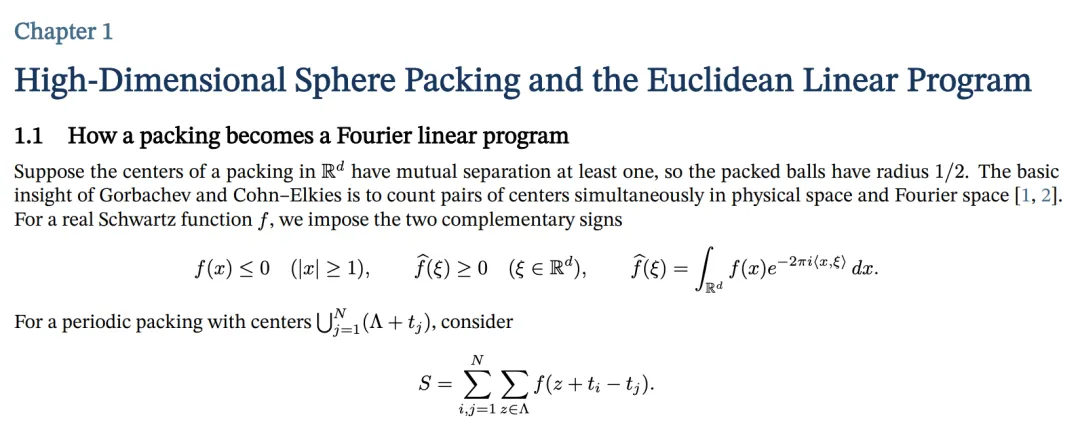
After being stuck, it gave a judgment: the barrier is not that the constant is not optimized, but that the global parameter cannot remember where the negative mass falls.
So Astra decided to change her point of view: reuse.Mellin changes, additions and measurements.
But why is it?
Because for a radial function, the helium transform is essentially a Hankel transform, its nucleus depends only on the spatial radius and frequency radius of the radius.Multiplication。
On the side of Melin, this turned into an extremely simple operation:Reflection, plus an apparent phase.
And here's another great thing: the phase factor that grows constantly on the real axis is equal to 1.You can't see anything on the real axis.。
But when it repeats a plane extension, it carries precisely the part of the high-dimensional information that is lost unequally.
When pushed to the limit, the coordinate measurement converges into a logistic density, and its numerical precision is equal to the digamma function, and the result is log (π/2).
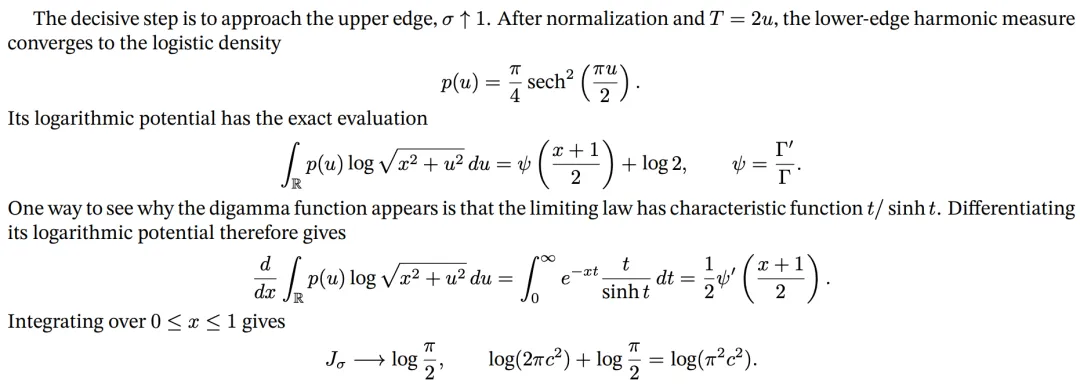
1/π is the threshold, and that's where it comes from.
There is one particular detail that shows that it knows what it is doing:
The total mass of the harmonic measurement is 1−σ)/2.Not one.The manuscript specifically writes:It's too early to convert this nucleus to probability density and it will change the index constants.
The bottom line is to construct a function that actually reaches it.
Gauss gives the right lumbar symmetry, but the position of the point is incorrect.
The method is to multiply the shape of a pair, allowing the point to move without disrupting symmetry. After filling the available barrier, an "ideal contour" is obtained.
Its focal point moves points toWallis multiplied byIt is equal to −1/2) log −π/2.
This number moves the Gaussian radius 1√2π exactly.1/π。
The predicted radius of the lower boundary, and the radius that constitutes the upper boundary, are right here.
The manuscript also contains a very specific detail:
When constructing an auxiliary function, a positive block of resistance is required at a distance.
And this patch.It has to be added to a whole area, not to a single point, becauseAdding a single point would impact the resonance frequency.
Non-sofic groups, the difficulty points are "more" and "one".The second hot topic is "non-sofic groups" that have not been created for 27 years.
Thomas Bloom, a mathematician at the University of Manchester, said, "In constructing class results, this is more important than previous unit distances to speculative counterexamples".
The concept of the "sofic group" was proposed by the Nobel Prize-winning Russian mathematician Mikhail Gromov in 1999.
In Hebrew, sofic means "limited".
In a nutshell, if a group is sofic, the question is this:
Could this infinitely large, abstract structure be approximated by a set of "limited shovels big enough"?
Astra gives an explicit construct in which the answer is that there exists an infinite, finite "non-sofic group".
The most valuable part of the manuscript is that it clearly describes the place where it really stuck.
Kun's theorem gives many expansion diagrams, while Kun's Thom's theorem requires one.
The gap between "two" and "one" is the central difficulty of the whole chapter.
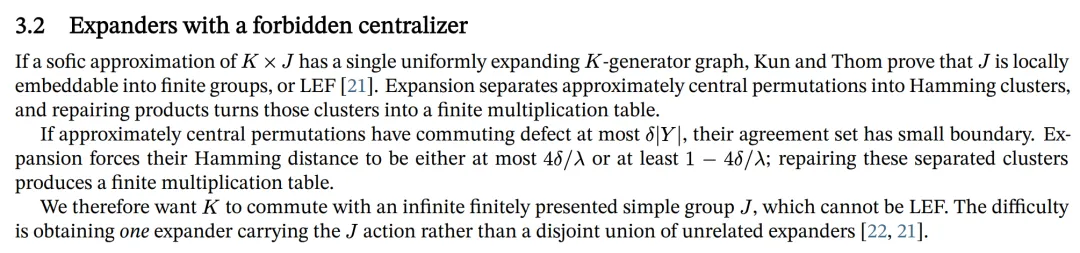
AI calls this "the crucial mismatch".
It gives a particularly concise example of why you can't just pick one:
On two completely identical Q's plus Q's plus Q's, the "swap the two" operation acts as the K's expansion.Accurate exchangesOh, but it is.Do not keep any portion。
In other words, those "approximate-centered things" can jump back and forth between fractions and you can't catch them at all.
This is the first time I've heard of this.To directly convert the property (T) to a mixture. This requires an average set of lazy or inverse segments, since a dual graph can have a spectrum near −1, even though it has a Kazhdan gap at 1.
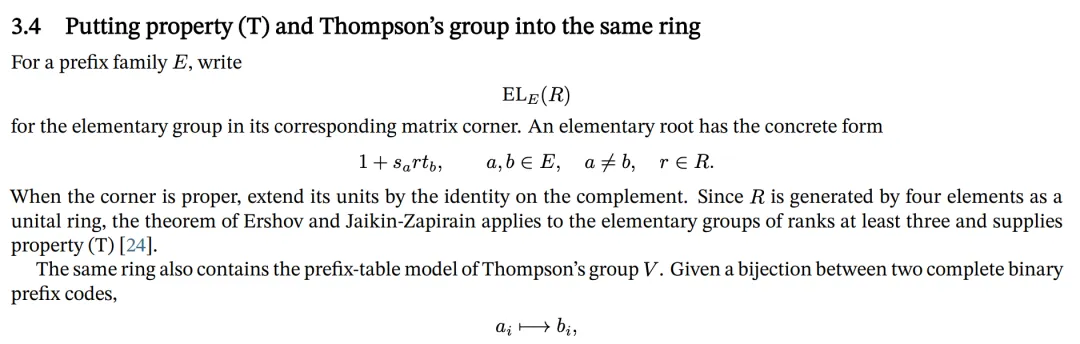
The correction of averages does fix this spectral problem, butIt's hard to say exactly which dose to choose.。
To do this, Astra first tried a version of the solution: to take the size of the component as a pair in a randomly distributed grid box and then convert it into a boundary-medium comparison.
But this path failed, and experience summed up AI:
If the mean is always a finite monochrome function of the distribution scale, it can never be the infinite scale itself.
Therefore, the final version was rewritten with this "essential principle".
Take a top-weighted median of m_A for each environmental expansion fraction A, and then define
f(x) = M(x) / (M(x) + m_A)
M is the fractional scale. This f is always between 0 and 1, and 1/2 happens to be the middle number on each A.

The advantage of this f is that it turns an uncontrolled quantity into a controlled quantity.
The key is that the generating element is to change the position of the valve, not to increase or decrease, so that the total change in a circle must be zero; and that each step is compressed at most one point and both sides can be ignored.
Then cut to a height, using expansion on one side of the small one, two sides of the other:F is almost everywhere equal to 1/2.。
This means that all the blocks in the same range are scored almost the same size, so that they can be numbered one by one.
At the end of the day, there's a small area left.
Astra's treatment is counterintuitive: pick one pieceAs big as possibleThe whole bad area is thrown away just because it picks up the biggest piece, which in turn proves that it is small enough to be ignored.
Gromov's question was answered 27 years later.
The remaining eight issues of the AI verification process can be consulted by interested partners:
"Strange" is coming, counting down the clock.The first time the manuscript was made public, OpenAI reinforcement master Mo Bavarian posted a lengthy post.
In the beginning of the first sentence, it was a "super-reality" moment.
In 2021, he and his OpenAI team released a GSM8K data set containing 8,500 elementary school mathematics applications, simple to complete in just two to eight steps.
In the GPT-2/3 era, AI did not do well even in elementary school mathematics, and drafting emails was barely enough.
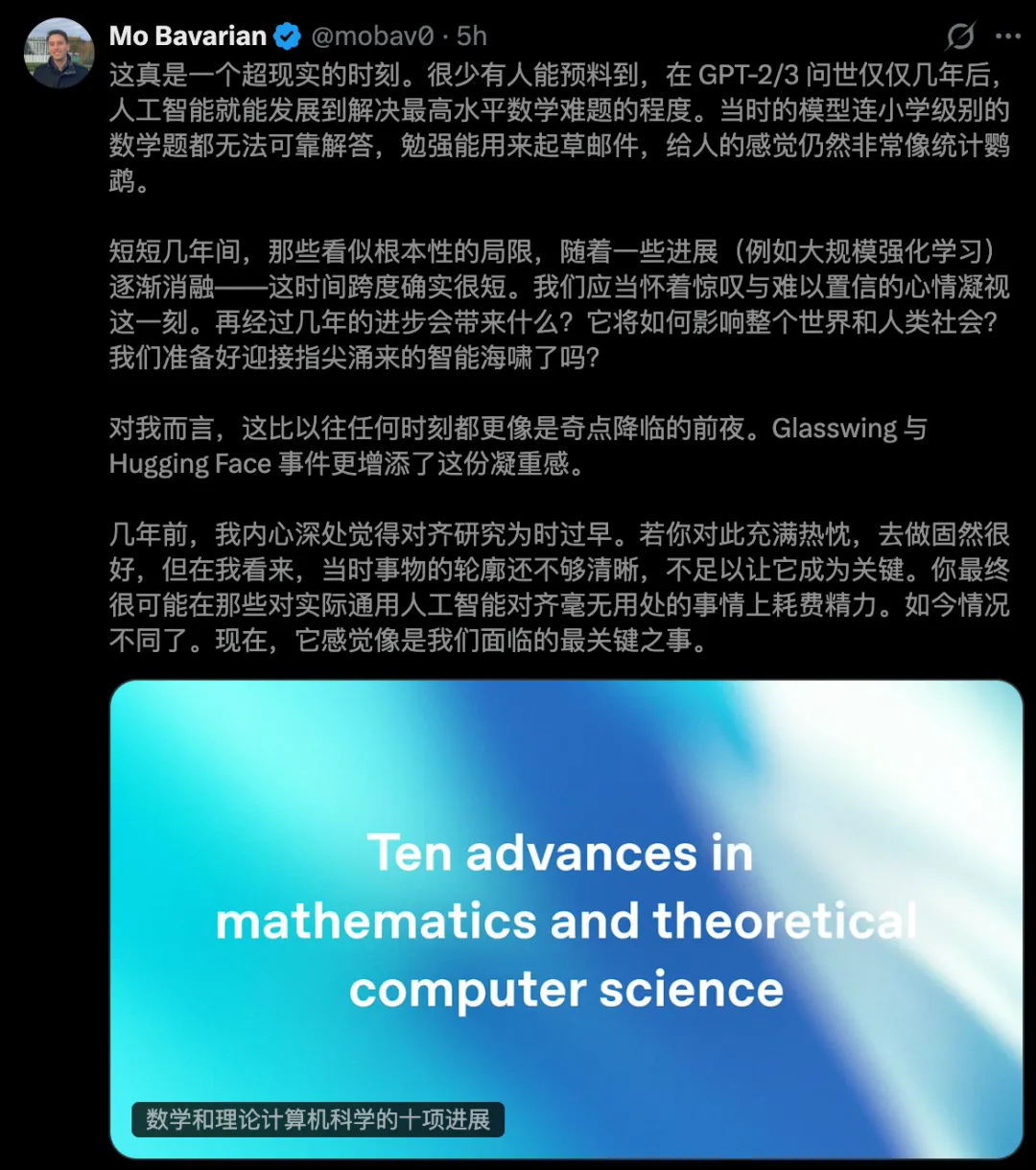
However, in just a few years, the massive R.L. madness has advanced, and the seemingly insurmountable "technical dead ends" have been shattered one by one.
This time span is incredibly short.
Mo Bavarian says, "For me, this moment is more like the night before than ever".
A few years ago, AI was still struggling in primary school applications.
Today, the $2,000 Token can be used to exchange for 10 possible answers to the history of mathematics.
"The Night Before Christmas" may not be that far away.