It's the first time in the history of the world.
During the holidays, when friends are flying flags, traveling and eating, Huawei chooses to throw out a bunch of heavy products on National Day.
The Huawei Mate 90 series is officially launched with a new generation of silicon chips, along with the Samsung 7!
There's a lot to talk about at the launch, but one detail sheds light on an exclusive app called "Touch the Little Pumpkin".
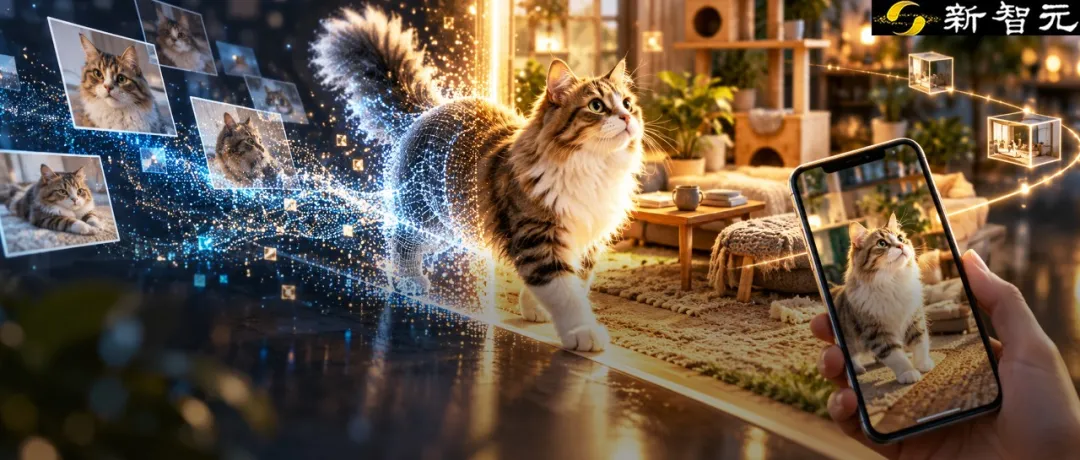
You take out your cell phone, take some photos of your cat, and upload them.
A few seconds later, there's another "cat" on your phone.
It's not a 3D model cat that can only rotate a circle, it's just a spatial structure, it can move, it can look at it from any angle, and you approach it and it's a 4D digital cat that's still waving its tail.
You can turn it around, and it's there, on your phone screen, like it's real.
Are you listening to some science fiction?
This is the first time a 4D model of the world has really run into a mobile app.
The technology behind this is MoWorld, which has become the world's leading company in advancing 4D world models to industrial applications.
A photo of a world that "walks in".In the past, we used to say that AI can generate images, for example, if you give a word to Midjourney, it gives you a picture.
Later, the AI was able to generate video, and the Soras began to create dynamic images. But in essence, it was also a video tape whose perspective was chosen, and it didn't change, so you can't go past to see what happened behind the building.
And what MoWorld does is turn a photo into a world that you can "go into". Or, more technically, re-create a 4D model of the original world, which is a 4D space from the beginning.
You give it a few photos taken on a regular cell phone, or even a few videos taken by hand. MoWorld doesn't simply "copy" images, but rather understands where the spatial structure behind these images is, how far away is the table from the lens, and how long is the portion of the table that is attached to the back?
Then, based on this understanding of space, it expands the image of the plane into a three-dimensional space. You can go back and forth in this space, turn around and see angles and areas that are not directly shown in the photo.
That's the really great technical underpinning behind this little app called "Touch Little Chicks".
If you upload a few photos of a cat, MoWorld first understands the three-dimensional structure of the cat and actually calculates the cat's spatial structure, hair texture, body proportions from a limited perspective.
Then it understands what the cat is doing.
Well, when you switch to the side viewpoint, the movement of the tail is continuous, consistent with spatial logic. When you turn around behind the cat, the cat will not suddenly cling to it.
This is the so-called "4D" three-dimensional space plus the dimensions of time and change.
Models not only know where objects are, how long they are, how they should look from different angles, but they also know how objects are moving, how their movements are continuously presented from different angles, and how the scene changes over time.
In a more intuitive metaphor: previous AI generated content was "show you a movie", while MoWorld generated content was "a movie theater you can go to".
One of the best examples of this is the so-called "bullet time" effect.
It's like Neo hiding a bullet from a classic footage in a hacking empire: the model recovers scenes and spatial relationships of objects based on a small number of images, generating a continuous, stable round-up view from different angles.
The difference is that it doesn't require dozens of cameras, just a few cell phone photos.
Not just pets:Applied landings are the real shielding riversOne of the most noteworthy aspects of MoWorld technology is that it is just one of the consumer-grade entrances to MoWorld, which has been simultaneously promoted across multiple industry lines, with several collaborative projects entering the technical verification and implementation phase.
Video and games.In the traditional process of filmmaking, a scene has to go through several long links of modeling, posters, lighting, animation, etc.
MoWorld is able to use forward-looking scenes to build cyclically significant compression, quickly generate scene assets, support free-flow mirrors, weather switching, and object editing.
Climate change
One scene can generate multiple story-oriented versions, and the cost of lens previews and proof-of-concept drops sharply.
In the gaming industry, asset rendering capacity of more than 500 FPS and high latency of mobile terminals are expected to reduce the reliance of the interactive world on high-end graphics cards.

4D modeling of indoor space
It's about being physically intelligent.In the past, training a robot to grasp, avoid obstacles, move, and repeatedly try to make mistakes in real environments required equipment loss, site costs, and the safety hazards of people injured in collisions.
MoWorld's digital simulation training ground allows robots to perform all exercises in virtual space, with collisions and errors resulting in only virtual losses, supporting high-frequency replay inversions.
After adding physical properties, robots can also experience gravity, collision feedback and object interaction in a simulated environment.
Autonomous driving。MoWorld can customize road environments, traffic participants, and the movement of objects in 3D space, especially for generating long-tail scenarios that are expensive, risky, and difficult to retrieve in reality. For example, rain, snow, crater surfaces, emergencies. 3D/4D assets can be easily customised, replicated, and retransmitted to improve the production efficiency of training data.

Autonomous driving training scene
It's the birth of industrial numbers.In scenarios such as factory production lines, mines, MoWorld can rapidly transform real environments into spatial assets for equipment layout adjustment, program previews, remote training and anomalous scenario simulation.
There is no longer a need to repeat artificial modeling, and the conversion of real-world scenarios to simulated data is significantly improved.

Mining modeling
Urban and rural planning and literature.Virtual tours, immersive content production, program demonstrations, space reconstruction, which previously required a large amount of man-made construction work, MoWorld can accelerate with algorithms.

Reconstruction of the tourist scene
MoWorld's value is not simply "pictures better" or "higher yields", but in its ability to produce high-quality, reproducible 3D/4D spatial assets in a low-cost way that allow them to be used repeatedly in real-world industrial systems.
It is a bridge from "technical capacity" to "industrial efficiency".
It's the end of cloud collaboration:How did 600 million parameters fit into a cell phone?These industrial applications can be unlocked without leaving one premise: MoWorld can run, can run.
You may ask: how many hundred GPUs do you have to burn in a data center to run this level of AI? What's a joke?
It's not entirely true that the phone is computing, and there's a link to the end-of-the-cloud collaboration behind it: the photos are uploaded to the cloud, and the spread model on the NPU is upgraded to a high-quality 3D Gaussian model.
MoWorld 2.0-Flash, with about 600 million parameters, was then developed by MagicCore Technologies, which, after quantum cutting and calculation adaptation, ran directly on the chipset of the Mate 90.
National computing training, cloud generation, edge rendering.
It's easy to say and hard to do.
Plugging a world model into a mobile phone on a large server isn't as simple as compressing packaging.
The algorithm needs to be adapted to the aluminum architecture, to quantify its effectiveness and to reduce its cost, delay, power consumption, and heating are all hard bones.
But doing so has a very practical benefit: saving money.
Part of the computing moved to mobile phones, with cloud loadings dropping, and operating costs decreasing. For an application aimed at the average consumer, this determines whether it can be rolled out on a large scale.
Another noteworthy detail is that the entire link runs from start to finish on state hardware.
Training with a lifting NPU, cloud reasoning with a lifting platform, end-to-end running chip.
This route makes MoWorld's reasoning cost only 30% of the same imported GPU solution. A 70% reduction is the real premise that the world model can scale landings.
It's not just looking at the truth: it's starting to understand physics.In addition to running, MoWorld is continuing to push the tech ceiling.
If it could only produce realistic 3D scenes, it would be an advanced modeling tool. What really made it fit the four words "world model" was that it began to understand the laws of physics.
When MoWorld 1.0 was released in July this year, it featured a "fast" NPU with a maximum of about 50 FPS of real-time interaction.
By the end of September, several key skills had been compromised:
Physical properties come in -- gravity, elasticity, rigidity, extreme force -- and these real-world rules are explicitly incorporated into the model.
One foot on a football, the ball rolls along the ground and bounces; one touches the grass and the grass swings; the same scene can be switched between rainy and snowy days.
The model no longer focused on "what the world looks like" and began responding to "how the world would change if it was touched".
3D/4D Gaussian's Asset rendering has surpassed 500 FPS, and the phone's end-side can run to 100 FPS. It doesn't require a high-end graphics card.
MoWorld generates not just "beautiful 3D video", but standardized 3D/4D GOS assets that can be directly imported into game engines, video production systems, digital platforms, robot training environments.
Scenes can also be changed. Added removal of objects, adjustment of location, change of weather, the same street can be changed from a clear day to a blizzard, the same video scene can be changed with tools, without having to rebuild from scratch.
When these capabilities are combined, MoWorld is closer to simulating a parallel world that follows physical laws.
And the touch of a mouse is precisely the "lightest" scene, proving one of the most "heavy" 4D models of a mouse world that anyone can run on their phone.
In the past, models of the world have floated in laboratories and papers, from Sora to Atlas, about how powerful and effective they are, but few people seriously answer the question: When can ordinary people use them?
It's the first time I've ever been in a situation like this.
MoWorld in the global coordinate system:Applying Leadership in LandingIf you put MoWorld in the global competitive landscape, its differentiation becomes clearer.
In September 2026, World Labs, founded by Li Feifei, released Atlas Shrugged, a multi-mode world model whose core capability is to create interactive 3D worlds using a small number of photos.
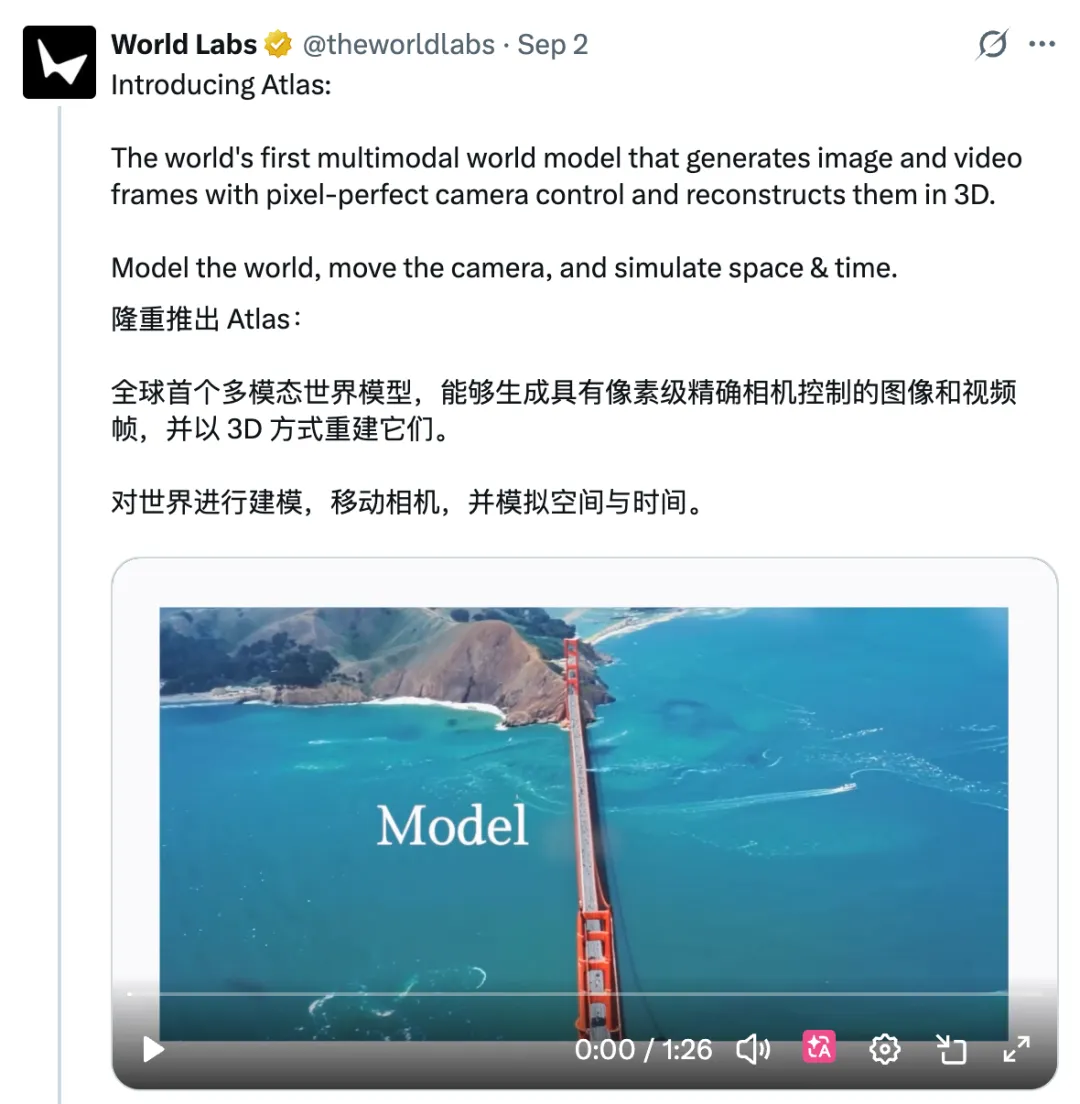
The product has generated a great deal of interest in the industry, and to some extent even marked the official entry of the world model circuit into the international mainstream.
Atlas and MoWorld have much in common: they can use a small number of ordinary photos as inputs, they can produce three-dimensional scene structures, they support free browsing and new perspective synthesis, and they use large models to complement space information beyond limited observations.
But the difference is equally significant:
4D understanding of dynamics.Atlas is currently primarily focused on the generation and understanding of static 3D space. MoWorld is already working on dynamic 4D solutions that not only understand space but also time.
Physical interaction skills.MoWorld has introduced physical properties such as gravity, elasticity, and rigidity into generating spaces, allowing objects to respond to user movements based on physical logic. Atlas now focuses more on spatial structure and multi-modal understanding.
Efficiency and cost reasoning.MoWorld has advantages in speeds and cost controls. The deployment routes of NPUs based on domestic upgrades mean that it costs only 30% of the cost of imported GPUs and has explored the ability to run on the mobile end-side.
It can be said that if Atlas represents the international benchmark of the world model in "depth understanding of space", then MoWorld's core advantage is not only in its modeling capabilities, but also in its capabilities.Applications on the ground are at the forefront——
From 4D dynamics to understanding physical interaction, from cloud to edge, from laboratories to real products and industrial processes, it has run its full course.
The Doctor and his billion-dollar journey.Finally, let's talk about the company.
Chen Chen, the founder of the company, is a post-doctoral researcher at Zhejiang University and teaches at the Chinese Academy of Engineering.
Chen Chen has published more than 50 high-level papers in top journals such as Science, Nature Photonics, IEEE TPAMI, and at top conferences such as ICCV, CVPR, ICML, SIGGRAPH.
In an interview with Central Television, he said: "The world model is more like giving a machine a brain that understands the world, that allows the machine to understand its environment, like humans, that gives the machine the ability to predict the state of the next world. It's an adventure, but behind the adventure is that we're really holding this rope in the stern of the ship, so I'm sure that since this rope is in our hands, we hope to be able to run the ship far away".
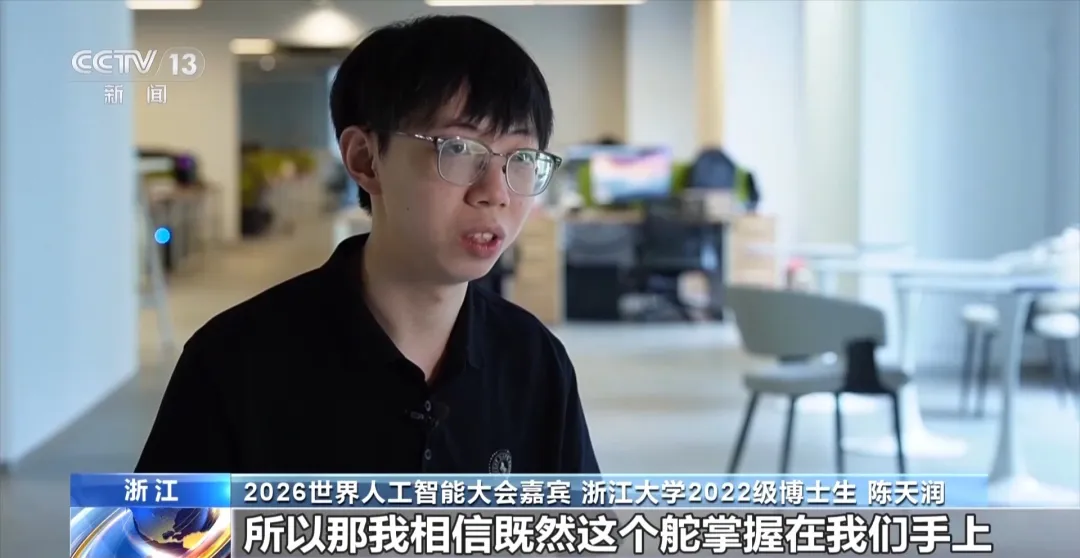
It's not an empty word.
From the end of 2025 to September 2026, the company has completed five rounds of financing in nine consecutive months, with the latest round reaching 1 billion yuan in volume, valuing the company at nearly 10 billion yuan.
Today, Huawei offers them a showcase at the Mobile World Congress.
From nationwide productivity training to a complete chain of cloud applications, MagicCore has become an infrastructure builder in the field of 4D world models.