It's the first time in the history of the world.
What about the Navistock equation of the Millennium Problem and its aftermath?
OpenAI has fallen into the trap of stealing the work of NUY mathematician Buckmaster.
But the Millennium Award has yet to be determined.The Clay Institute did not accept the results and still listed the issue as unresolved; OpenAI itself said it had no intention of claiming the Millennium Prize.
It was at this time that the Anima Anandkumar team at Caltech gave a different answer.

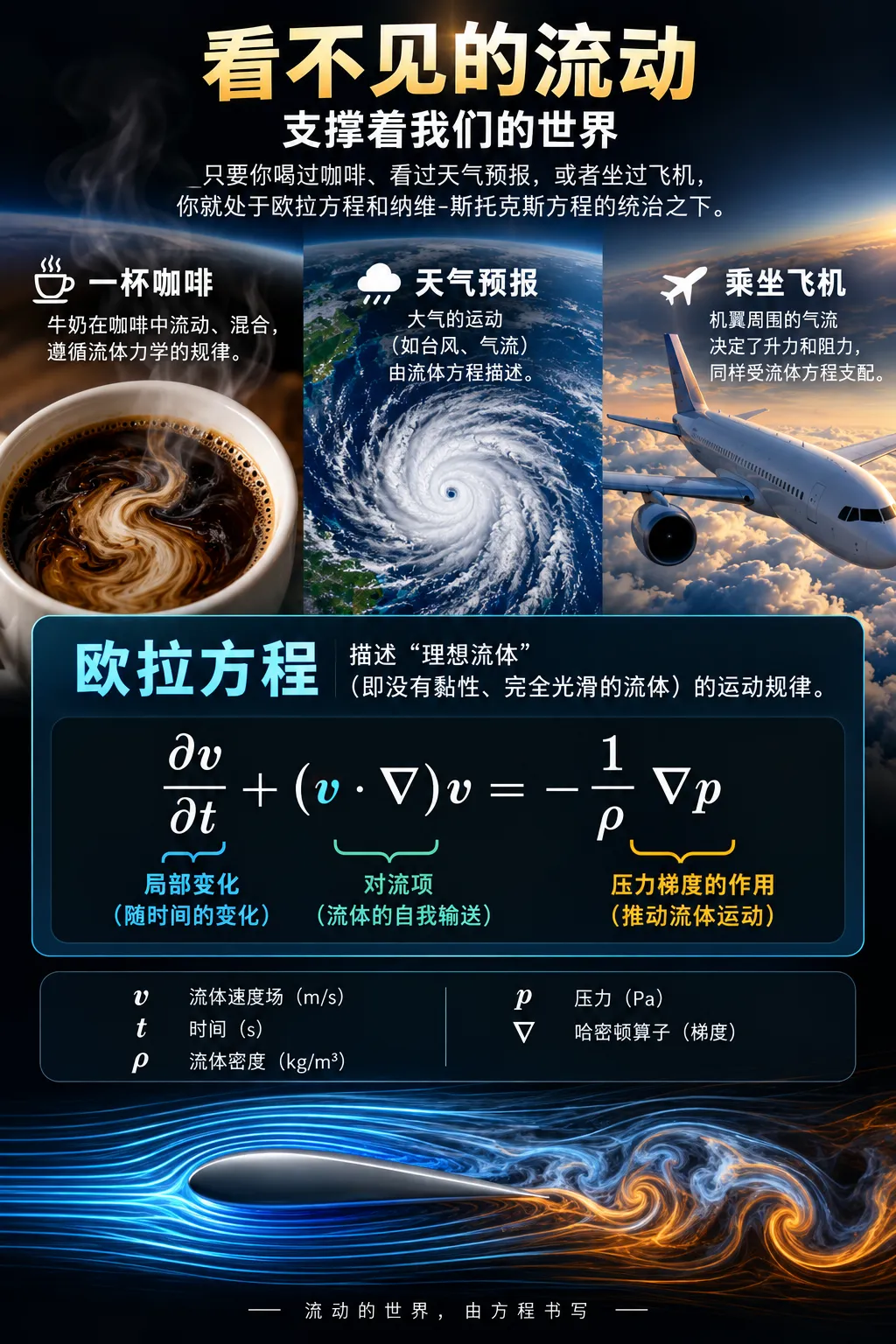
As long as you've had coffee, watched the weather forecast, or been on a plane, you're under the rule of the Eura equation and the Navier-Stokes equation -- one of the seven great mathematical problems of the millennium.
The Eura equation describes the laws of motion of the "ideal fluid" (i.e. fluid that is not elastic, completely smooth).
For over 300 years, mathematicians have been plagued by a ghostly question:What about the "Blowup"?
The so-called explosion of singularity, commonly referred to as the velocity and density of a fluid in a limited amount of time, will it increase dramatically to infinity, as if pressed by a quick-pass button?
It's like a calm glass of water that suddenly creates an endless tornado in space.
The paradox of proving or falsifying three-dimensional fluid equations is the "holy grail" of modern mathematics.
Previously, when the team at NYU and OpenAI tried to tackle this issue, adoption was a form of"Multi-scale construction by man"The route.
They are equivalent to proving that a bomb can explode, manually adding "forcing items" to the fluid, or designing complex, man-made jump scale structures.
"Forced" and "unforced" are key disciplines: forced to allow the addition of a smooth external force to "push" out of the singular, with a low degree of difficulty; unforced is a more difficult goal, evolving out of the singular on the basis of the original data itself.
Previously, Chen Liu Hou (Chen Jae-Hun) had been working on PNAS in 2025.With boundariesThe three-dimensional burst of the euro, the borders helping to trap the quirks; this kind of technology fails in free space - without borders.
But in the eyes of mathematicians, this is not "natural" enough. Can a fluid evolve into an explosion on its own in a vast, seamless three-dimensional space without any outside intervention?
In a free space with no boundaries, previouslyThere is no one.It's a natural "self-similar exploding outline".
There is neither a template for solving a closed solution nor a copy of any previous text available for an LLM.
Human intelligence has reached the blind spot of intuition. This is when the Caltech team awakens their secret weapon: the physical information neural network (PINN).
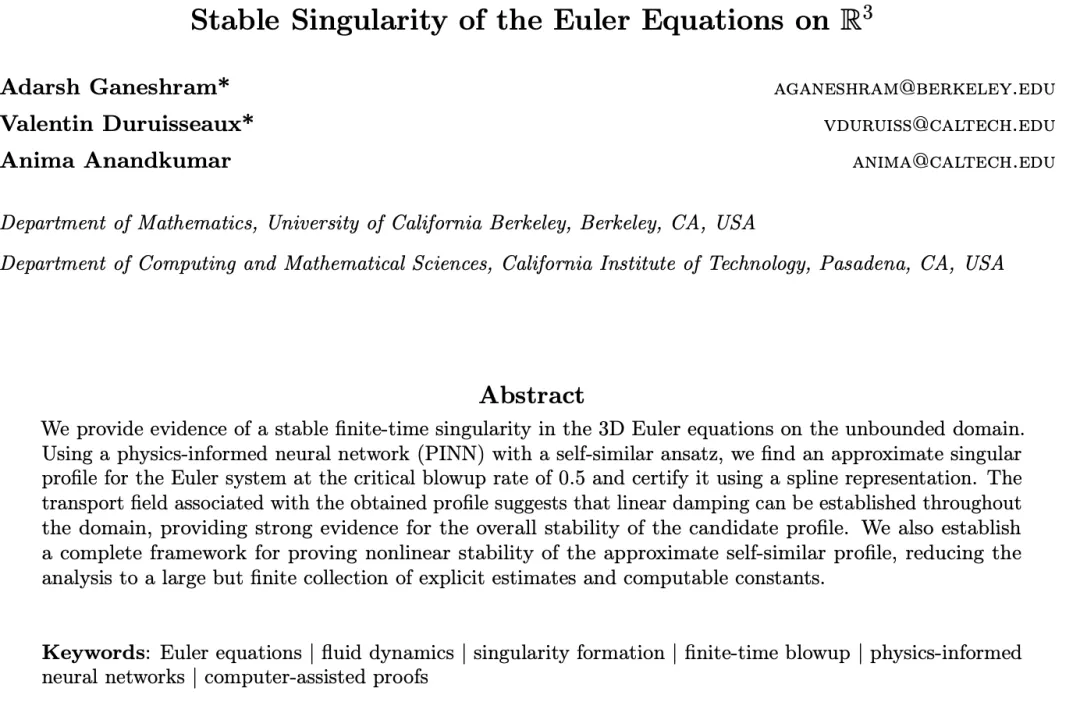
The paper:
Physical A.I.: Not by writing templates, but by "searching" through neural networks.Large-language models (LLM) excel in "science", but when faced with candidates for partial differential equations (PDE) that do not have any closed solutions, they are directly blinded.
Anima Anandkumar's team is not blinded by the enthusiasm for LLM, but is focused on AI puzzles that truly understand the laws of physics.Physical information neural network (PINN)。
However, PINN is not a panacea either.
In the past, many scholars around the world have tried to use PINN to solve the three-dimensional non-forced Eura equation, all of which have been overturned.
Why? Because neural networks are too easy to "steal".
In the optimization process, once the network encounters difficulties, it shrinks to an ordinary solution: for example, the flow rate of the entire space is equal to 0, which of course satisfies the equation, but makes no sense.
To get the PINN to work and find that odd spot hidden deep in the shadows, the Caltech team put together an incredibly fine combination punch:
Previous studies have often assumed that the blast point is a static axis symmetry shape, but this is extremely difficult to optimize. Caltech's team has incredibly cleverly given PINN more degrees of freedom to move this odd point along the z-axis as a linear wave!
While in rigorous mathematical analysis this is equivalent to a static state, this flexible setting, combined withThe parity constraints are completely relaxed by the traditional parity constraints.In an instant, the rough, unparalleled optimization landscape (Optimization Landscape) became smoothly manageable.
Ordinary Adam optimizers cut meat like a razor in front of such high-precision scientific calculations.
The team used their self-developed, efficient second-tier optimizers.SS-eSOAPIt was a slight increase in the cost of computing compared to Adam, which led to a leap in the speed and accuracy of compaction.SS-BroydenOptimizers are finely polished.
Combined with techniques such as adaptive weight loss, FP64 dual-precision floating-point operations, the team did not use mass combustion algorithms like OpenAI, but relied on the algorithm's extreme excellence, and for the first time successfully ran a bizarre candidate solution in a non-forced 3D EURO equation!
What's even more ironic is that the results of AI calculations perfectly match the predictions of mathematical bulls!
Mathematicians such as Constantin and others have theoretically predicted that the scaling exponent of Euler's equation would be a mathematical "child of heavenly selection" of 0.5.
The Caltech team did a bold test: they took the scaling index as a completely free parameter and let PINN look for it itself.PINN's optimization results have been steadily shrinking to about 0.5!
Not only that, but when they intentionally increased the weight of the convection term in the model, the index remained steadily tilted to 0.5.
At that moment, the rigors of theoretical mathematics and the agility of physical AI historically intersected at the figure of 0.5.
AI for Science New paradigm: not to replace humans, but to replace human shortcomingsThe pioneers on the night of September 7th were not only a public relations victory, they represented a deep reflection on the nature of AI by the Caltech team.
In his blog, Professor Anima Anandkumar left a deafening summary:
"Today's LLM is based on human-text training, with the goal of doing what humans are already good at, and even the ultimate goal of competing with or replacing human efforts.Building an AI that complements human capabilities。」
This is precisely what AI for Science (the AI-driven discovery of science) is doing today in the new paradigm of "mixed intelligence".
Over the past few years, the anime team has been disrupting various fields of science using these types of "neural operators":
- Meteorology: Five years ago, they trained the first high-resolution AI weather model, accelerating by tens of thousands of times, to support extreme predictions of large-scale climate mutations such as hurricanes and heatwaves.
- Medicine: Using neurotransmitters to study fluid behavior, they designed a new type of medical tube that dramatically reduced the rate of bacterial infection by 100 times.
- Quantum chemistry: solving a 60-year-old problem by skipping auxiliary orbital computation and learning the common Kohn-Sham mapping, enabling density generalization theory (DFT) to run in parallel linear time.
In this historic breakthrough of the Eura equation, we can clearly see the continuation of this philosophy:
Physical AI is not blindly seeking "alternative proof".The solution it generates is unstructured and unparallelled. It is only responsible for reaching deep, high-dimensional oceans that cannot be reached by human intuition and computation.
True strategic design and overall control remain in the hands of human creativity.
In the last two years of the big model (LLM) frenzy, we've often been caught up in an anxiety: Will AI replace scientists?
Caltech's surprising results provide the best answer:When it comes to tackling the challenges of the century at the height of human intelligence, AI will never be the end of the robbery table, but the most powerful outer brain in human analysis.
When the discovery edge of the physical neural network (PINN), with the strong shield of rigorous mathematics, coupled with the tireless computational assistance of large models, a magnificent picture of the future scientific discovery is unfolding before us.
Taotze's nighttime address is the ultimate seal of approval for this new paradigm. The singularity of the Eura equation may still be waiting for the final proof, but as humans join AI in conquering the truth of the universe, the Caltech team has carved an immortal monument!