It's the first time in the history of the world.
The whole world is using AI to do scientific research, and it may have been wrong from the beginning!
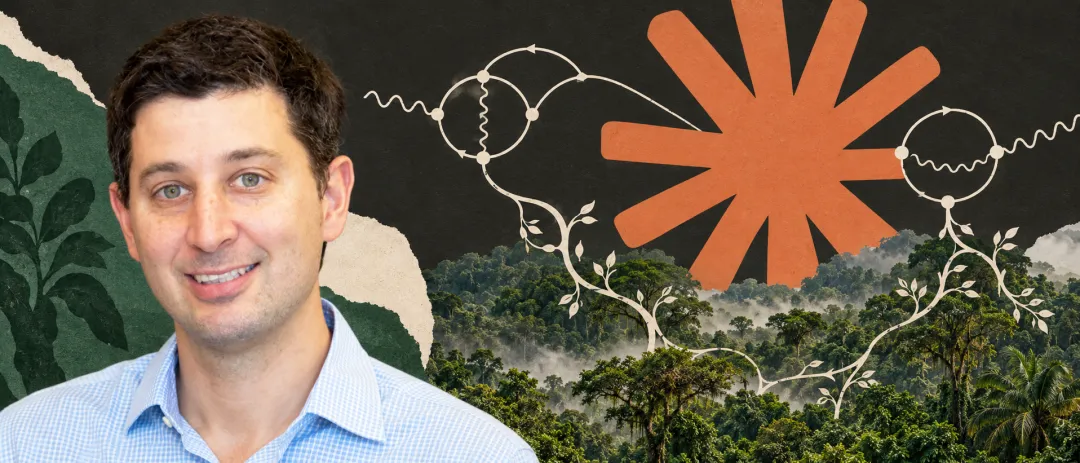
The correct posture found by Harvard physicist and quantum field instructor Matthew Schwartz is not to think of Claude as a scientist.
He left Claude with questions that he didn't have deep enough to ask himself, only choosing the questions that he was best at.
As a result, it took him several weeks to complete the calculation of the line-by-line code, and Claude ran for only 20 minutes and recovered without even thinking about it himself.
He added another question, and Claude was counting 15 Feyman points over the next few weeks.These scores have never been calculated before.
Three months later, Schwartz produced 36 original papers, from the particles in the impact machine to trees in the rainforests of Panama, spanning 18 disciplines.
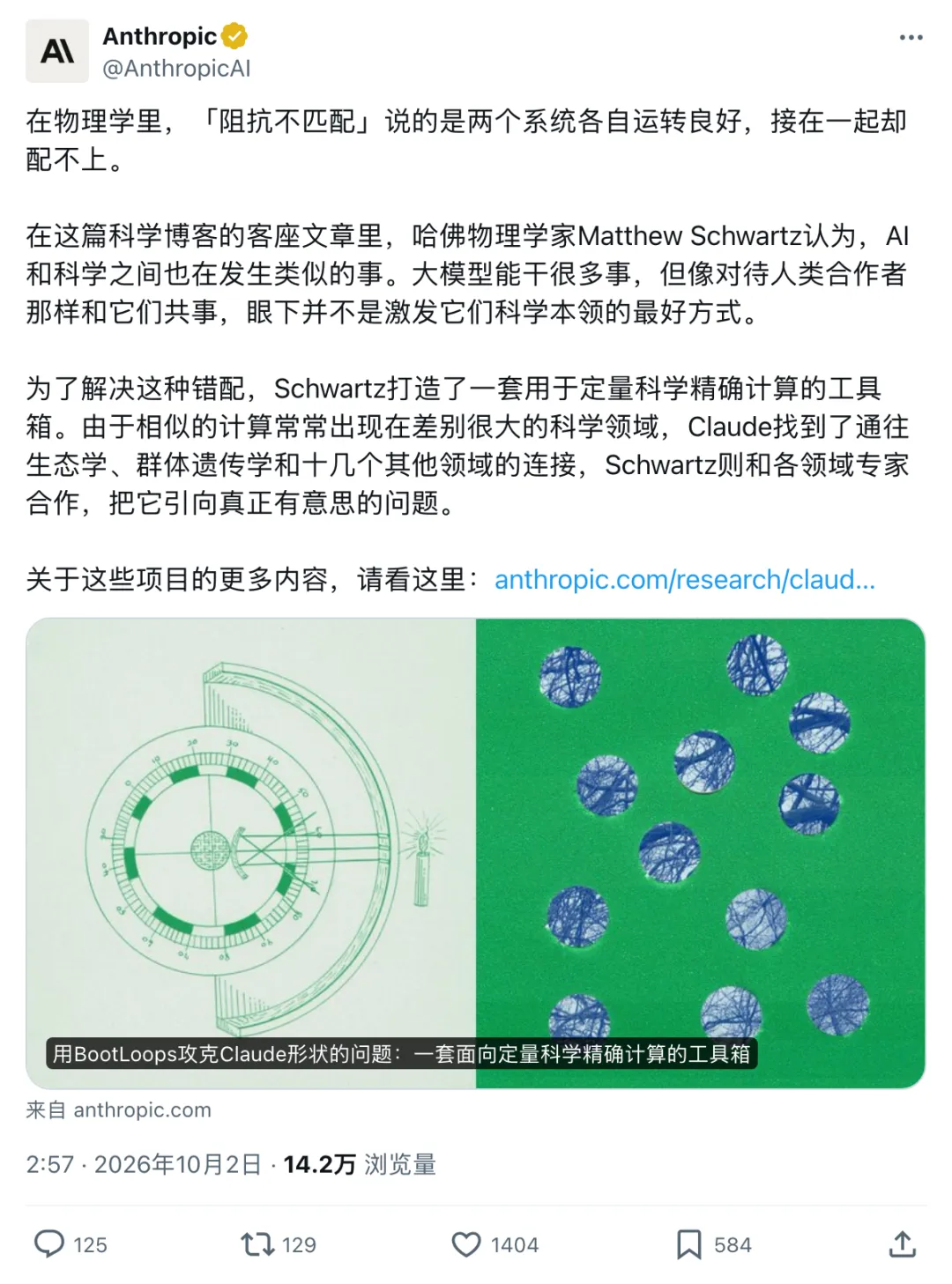
On 1 October, Anthropic posted an official science blog titled "Science in the shape of Claude".
In his statement, he argued:Today's big models are good at science, but they're not good enough for scientists.It's hard to call it a human scientist, but its reality doesn't work.
There are two ways to make AI stronger. One is to wait for giants to stack up the next generation of models in the lab, and the other is for people to get the model and find the right way to use it themselves.
A Harvard professor has unearthed Claude's greatest strength.Last December, Schwartz had Claude Opus 4.5 as his research assistant. In his words, Claude was like a capable graduate student, working 20 times faster, and the paper was finally written, but the process was exhausting.
Many scientists have had similar experiences. In the news, AI solves mathematical puzzles for a while, refreshes records for a while, uses it well, but always feels like a layer apart.
This gap, in his view, is traceable. AI news headlines mostly appear in mathematics, which is the only discipline that can fully write down the problems, the answers to which can be absolutely verified, but most science is not that long.
He borrowed a word from physics called "resistance to mismatch", which says that two systems work well together but don't fit together.
So he used it the way Claude actually did. Claude couldn't solve his deep conceptual problems, but he knew almost everything about it, writing code was hard, and reading papers and data was machine speed.
What he had to do was specially select the questions that fit these dimensions, which he called the "Claude shapes problem".
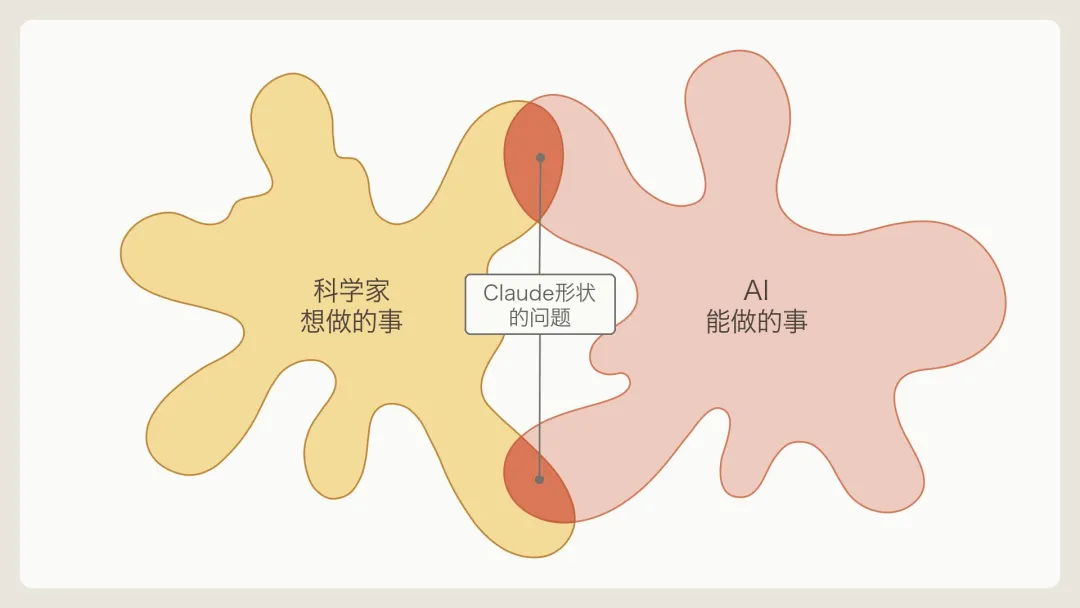
What scientists want to do and what AI can do overlap only in two small places, and that's the "Claude Shape Problem".
I'd like to ask a question and count 15 new points.The first Claude-shaped problem, he picked from the old line, called the scattering amplitude.
Physicists are trying to identify new particles from the debris of the impacting machine. But its core is the multi-dimensional quantity behind Fermanto, which is difficult to calculate enough to write a PhD thesis.
In order to circumvent these difficult points, physicists have developed a shortcut called the S-matrix bootstrap over the past 20 years.
For example, knowing where the amplitude will become infinitely large, the candidate will shrink to 20,000, plus a symmetry, and the remaining 500 will shrink to one. When constraints are not enough, calculate the amplitude to extreme accuracy at several points and nail the remaining coefficients.
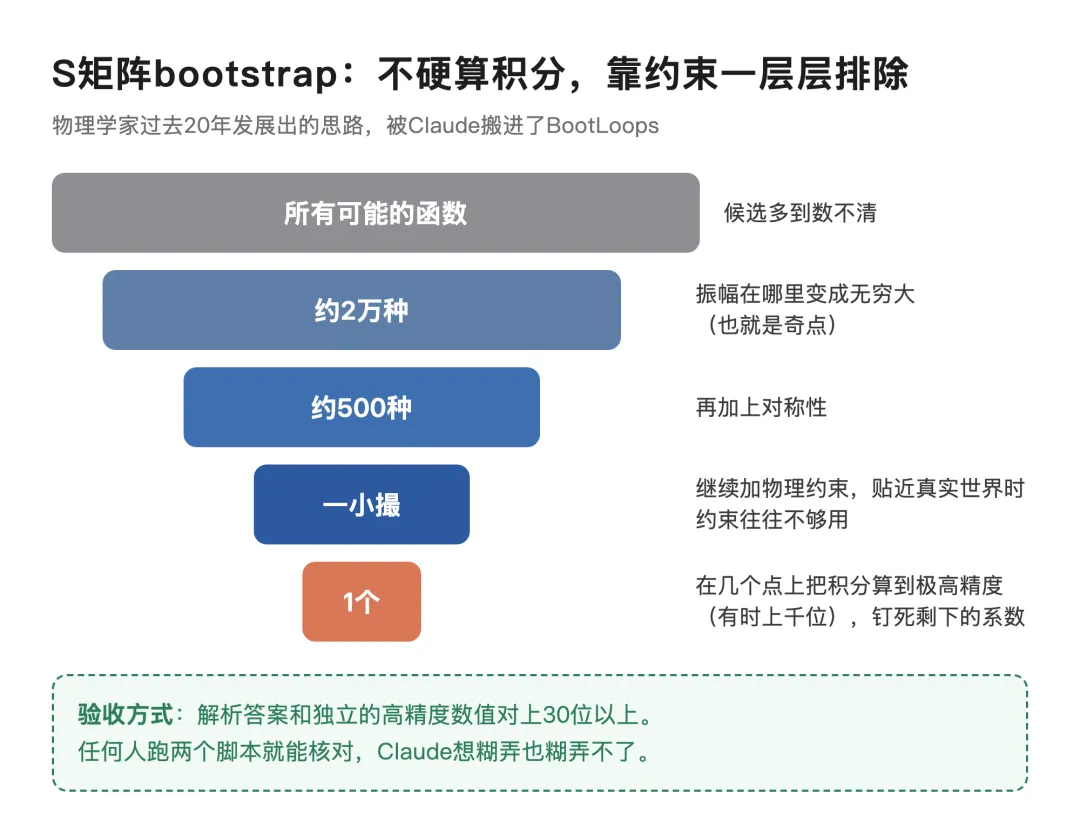
In Schwartz's view, the problem is inherently well suited to AI. First, no one can master all the math, physics and computer knowledge it requires; second, the answer can be verified, running two scripts to any number, and Claude can't be confused.
The first thing he gave Claude Fable 5 was to move the methods scattered throughout the various codes and papers into the same framework. As a result, Claude quickly restored his old results and pointed out that he had an algorithm that slowed down.
He asked Claude to find an amplitude that no one had ever calculated before, and found that it had always restricted itself to the simplest pairwise functions, so he asked a question whether the more difficult elliptical function could do the same.
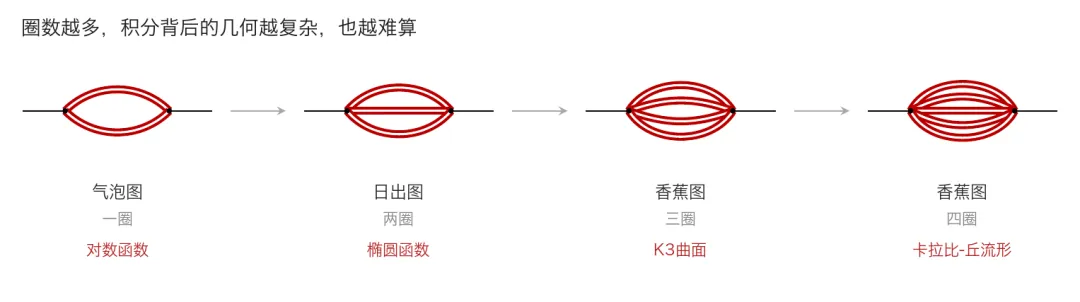
The difficulty of this question arises. The elliptical Feynman score of human complete computation is only a few, and not one has been calculated entirely on bootstrap, because the necessary knowledge is scattered among many people, who have never tried it.
Without this barrier, Claude extended the entire toolkit to elliptical functions, with most of the new software written by himself and the rest borrowed from the mathematical community.
A few weeks later, 30 points were counted from start to finish, half of which were returned to a known result.The other 15 have never been counted before.
Looking back over the past few weeks, Fable 5's ability is at its lowest, and the result is two choices, one is a verifiable, knowledge-intensive and decentralized challenge, and the other is to see that Claude is setting a limit and asking a question.
The second, more importantly, is that the previous ones never counted the points, all after questioning.
The more complete this set of tools becomes, the more Schwartz calls it BootLoops. It is a set of tools and processes outside the larger model, which are open-source and can be driven by any other model.
Two of the algorithms for the score engines were developed by a team at Peking University.
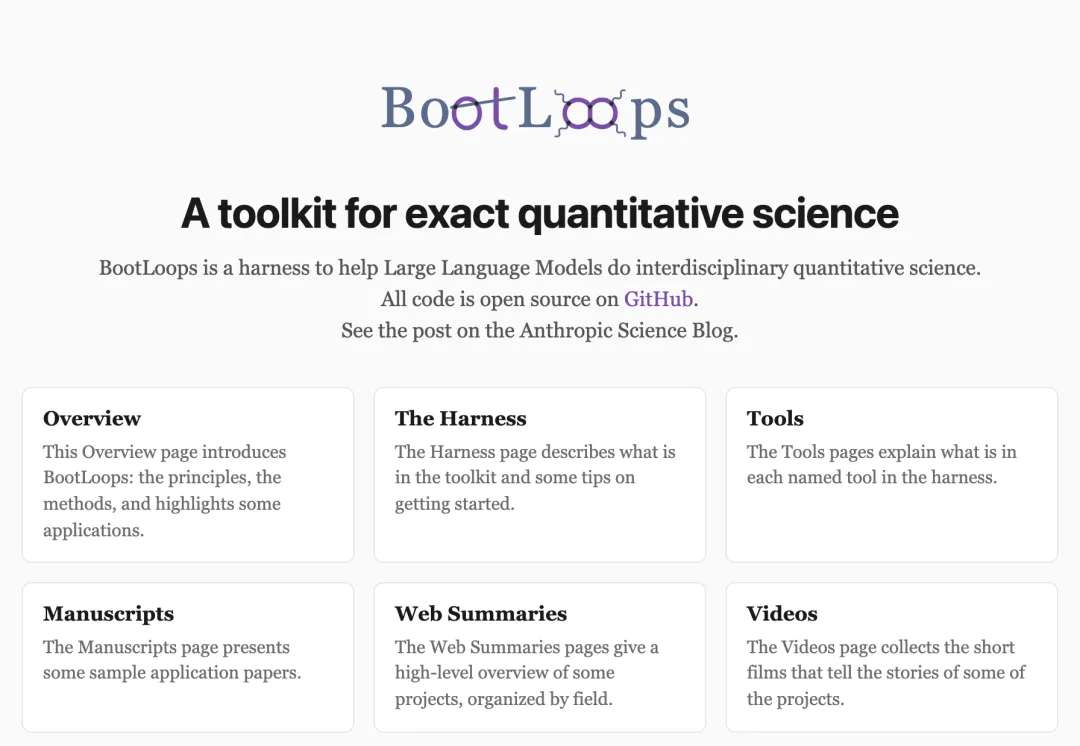
How low the threshold was, we tried it ourselves. After installing BootLoops on a Mac, we switched tasks to Claude Code with just one word.
It went through the document itself, searched for the tools, spent about $1.5 in 20 minutes, re-calculated a newly calculated score coefficient on the web, and found the closed form, and the numerical value matched up to 157 bits.
A set of scores across 18 disciplinesSchwartz originally intended to write a paper on these scores. However, there is a coincidence in science that the same equations are always repeated in different disciplines, and the use of these tools goes far beyond physics.
Claude told him that these scores also matched Bayes's evidence in group genetics.
Systems development uses DNA to calculate points for species-specific genealogies, similar to the points BootLoops originally created for Fermanthus.
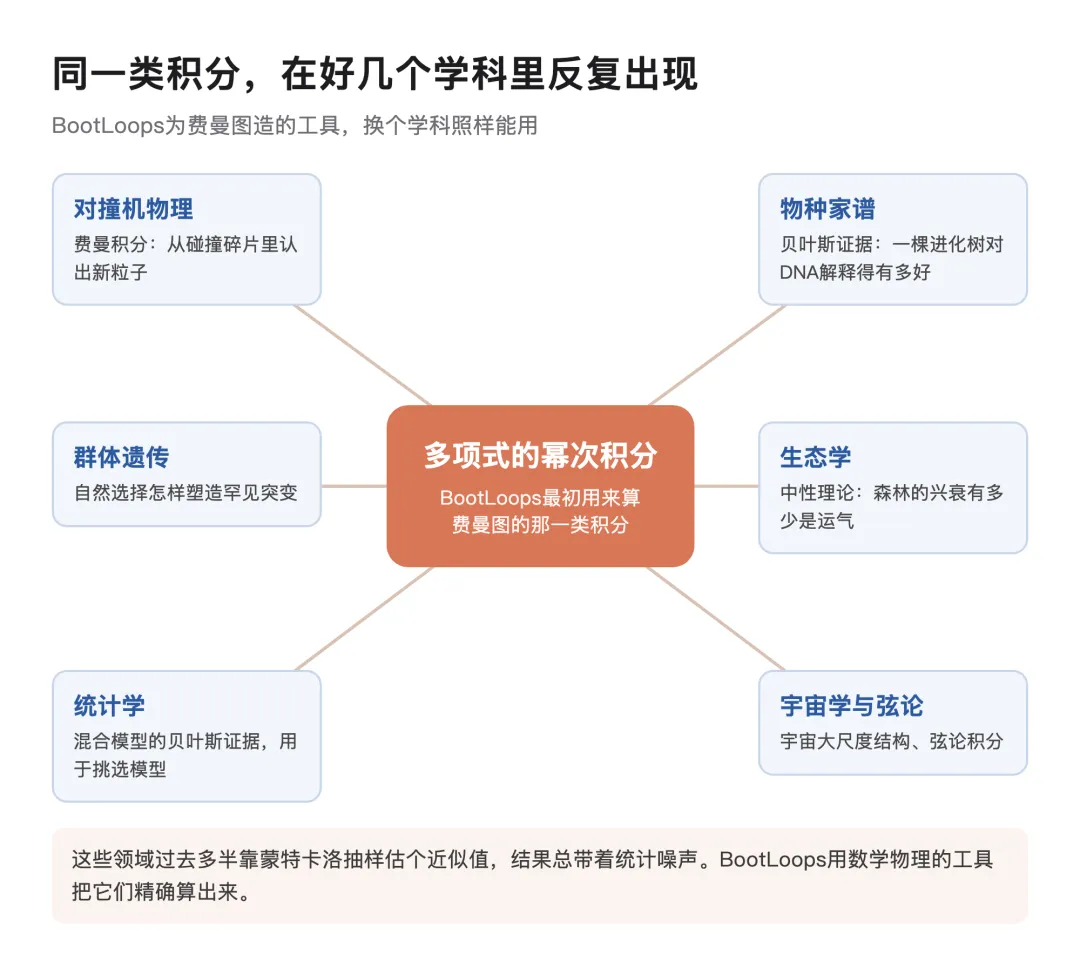
BootLoops is a scoring tool for Fairmont charts that can be used in species genealogy, group genetics, and ecology.
In order to make the toolbox more useful, he made a rule for Claude that old tools must be used and new tools must be made.
In this way, every project, even if it fails, will leave a new tool, and the more Claude does, the more he speaks in his own words, like Neo, who has just finished fueling the hacker empire.
In other words,How much the model can do depends not only on the weight, but also on the toolbox at hand.The next generation of models is waiting for the lab to release, but the toolbox is expanding every day, and the people who deal with the model can improve it themselves.
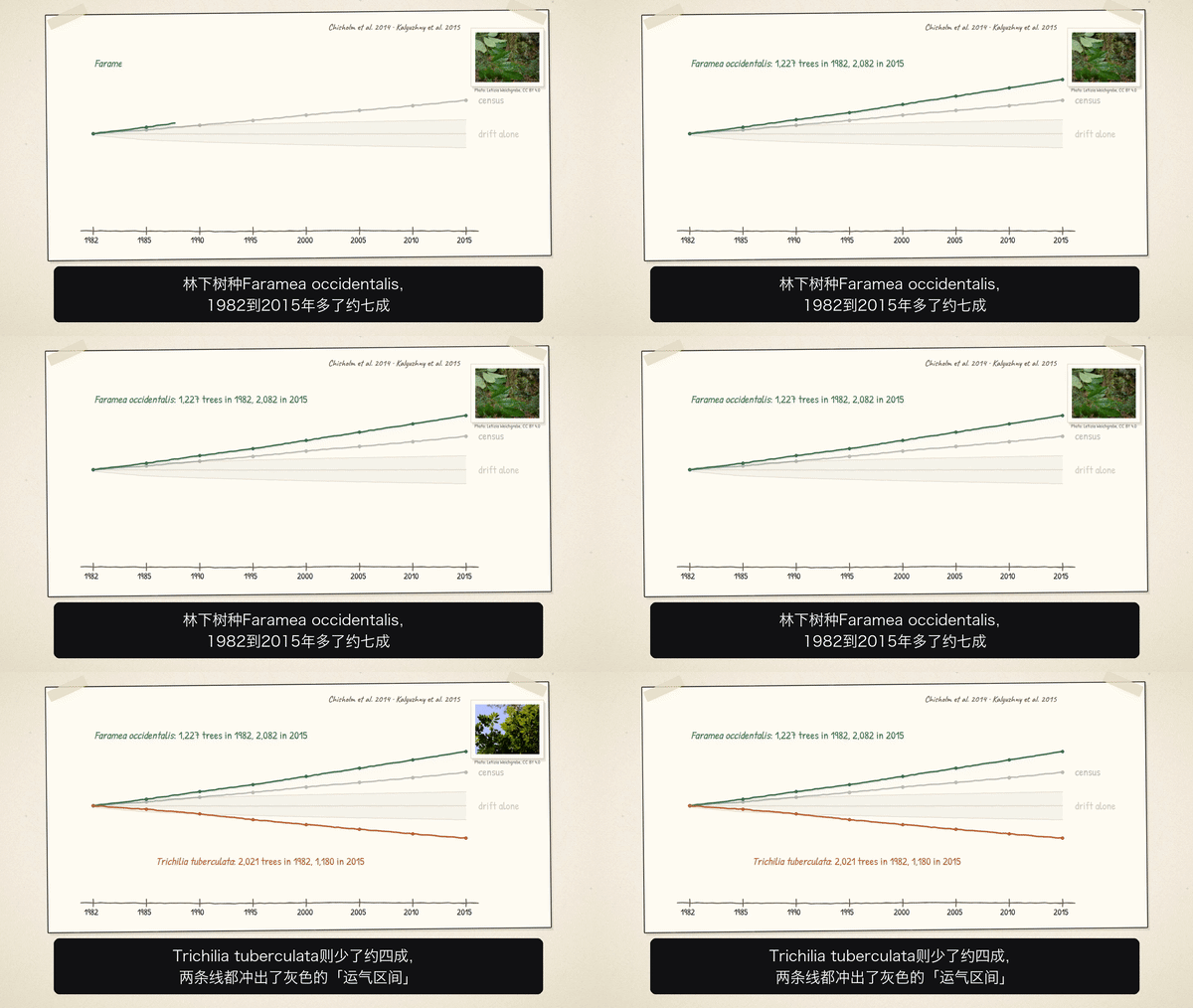
Ecology emerged first after the toolbox was introduced into other disciplines. Neutral theory suggests that the decline of species in forests may have been entirely due to luck.
After 20 years of writing the equation, no one has been able to solve it on a large scale. Claude recognized that it was a BootLoops-shaped problem and solved it.
A pair of census data from the Barrow Colorado Islands in the Panama Canal shows that the rate of change in tree composition is 4.5 times faster than the neutral theory allows, and cannot be explained by chance alone.
So he and plant biologist James O'Dwyer came up with a new model with Claude that combines the differences in life span, growth and reproduction between species and spreads to forests around the world.
Other disciplines followed suit. In group genetics, they found evidence of gene mutations in 5.7 billion adjacent mutations.
Reproductions of 4,452 papers in the top five journals in economics have been transferred to open source to be verified individually, and linguists have obtained a database of overtones covering 6,072 languages.
The last puzzle was solved by mathematician Watson's score series, which he started in 1939.
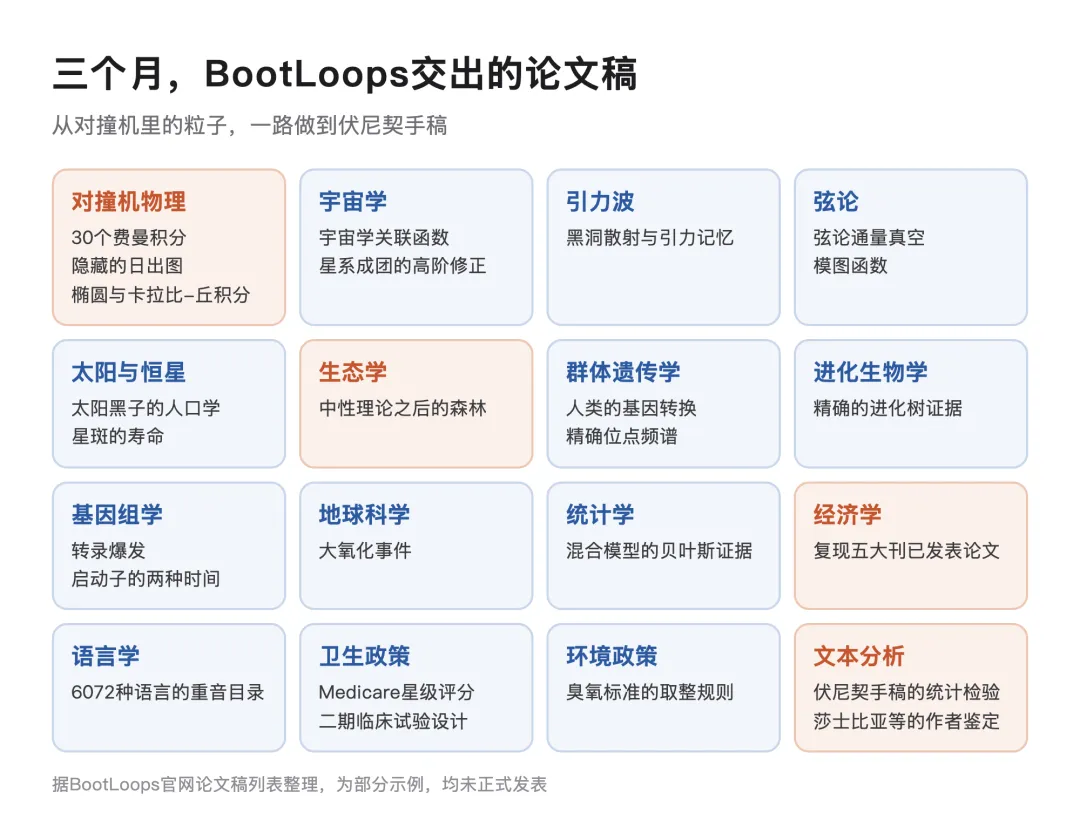
These results, combined, are the 36 papers that Schwartz produced from about 400 candidate questions that have not yet been officially published.
Schwartz disclosed at the end of the document that he was a visiting researcher at Anthropic during the project, and that BootLoops was funded by Anthropic, which he owned and maintained himself.
Raising this production is not complicated. Each project has a Claude Code session, a General Control session in charge of coordinating and receiving the computations and assigning them to the backstage Agent.
There was also a session where the reviewer played the role of a prickly reviewer, who reversed the results and checked the ground.

A general control session runs a group of project sessions, computing to backstage agents, and another session is dedicated to punching.
Claude's questions have one thing in common, and the answers are verifiable.
It's just that Schwartz dared to let it go, because it was wrong. So he said,Wherever it can be verified, AI can move forward.
Another road to ASI is open to anyone.
Schwartz, for three months, was answering a bigger question: What is the basis of intelligent expansion?
The outside world measures how strong AI is, almost all of which is the model itself, whether the parameters are too high or too high, when the next generation will start.
But what Schwartz saw was something else.The upper limit of the model is determined by the laboratory and how much it can ultimately play, depending on the person who picks up the challenge, packs the tools, and standardizes the validation criteria.
As for where AI should go, he used a mathematical concept called a convex box, which is the smallest convex shape that surrounds a shape when all of its vertices are connected.
Human knowledge is a form of inequality in which biology emerges in one direction and mathematics emerges in the other.
It may take 20 years for a lab to investigate a set of genes with one method, but the next one and the other methods are all over the place.
The middle ground that humans have had enough of, but no one has been to, is best suited for AI.
What BootLoops does is connect the lines between these spikes and fill the convex pouch a little bit.
Human knowledge is like a discordant star, and the BootLoops toolkit connects between the spikes, filling the gaps in the middle.
AI is filling these gaps, and people's positions in science have changed too.
Schwartz questioned why applying for three more years of funding, even if an AI could be done overnight.
He also said that he was still not sure how to take a graduate student with him.
However, in his view, as long as the problem is solved, much of the technology can be automated, and inseparability is part of the concept.
There are two ways to get to ASI. One is to have a stronger model trained in the lab, and the other is to put human tools in dozens of disciplines into a toolbox and give them to a model who knows everything and then ask questions and accept them.
The former is in the hands of a few companies, the latter without waiting for the next generation of models, and everyone who uses AI can now go.
RoboInd editorial channelResearch, robotics companies and market intelligence for cross-border sourcing.Explore the channel ↗
Share this
End of editorialExplore more from Global Robotics News ↗