Let's say you want to do a social experiment and see if a media outlet can't reverse the opinions that are being fermented. In reality, this experiment is almost impossible. You can't let the same group of people go through the same experience over and over again, throw out advertising, do nothing at once, and then compare the results. Big model-driven social simulation seems to offer a way.
Most platforms are good at "intercepting": sending a questionnaire to a group of intelligent agents and seeing the distribution of the answers as if they were not real people. However, social phenomena evolve slowly over time, and researchers want to intervene at some point in the same period of history and compare history with that without intervention.
Problem 2: Researchers intend to integrate the process with difficulty. More and more systems are handing over the entire research process to the intelligent body end-to-end, the researchers only look at the last report.
Social simulation can run at once, but the real experimental needs are not met.
A research team from universities such as Shanghai Institute of Creative Thought, Purdue University, King's College London and the University of Oxford has launched SocioVerse2, which expands the simulation from cross-sectional questionnaires into an intervening longitudinal process, expands the research process from a one-off outcome to a generational tree-shaped research context, and encapsulates everything that supports this population, environment and workflow into an open-source social science intelligence infrastructure.
Address of the paper:https://arxiv.org/pdf/2609.24911
The code repository:https://github.com/sii-research/SocioVerse2
The project's homepage and online workshops:
Running a simulation is not the same as completing an experiment.
Over the past two years, the LLM social simulation platform has evolved in roughly two directions.
One direction is about "how people and AI work". Early sandboxes built by researchers, how information flows, who interacts with whom, all died out in advance.
The other direction is about "what simulations can do". From verifying whether models can reproduce known group behaviour to asking what consequences a condition that has never occurred would bring.
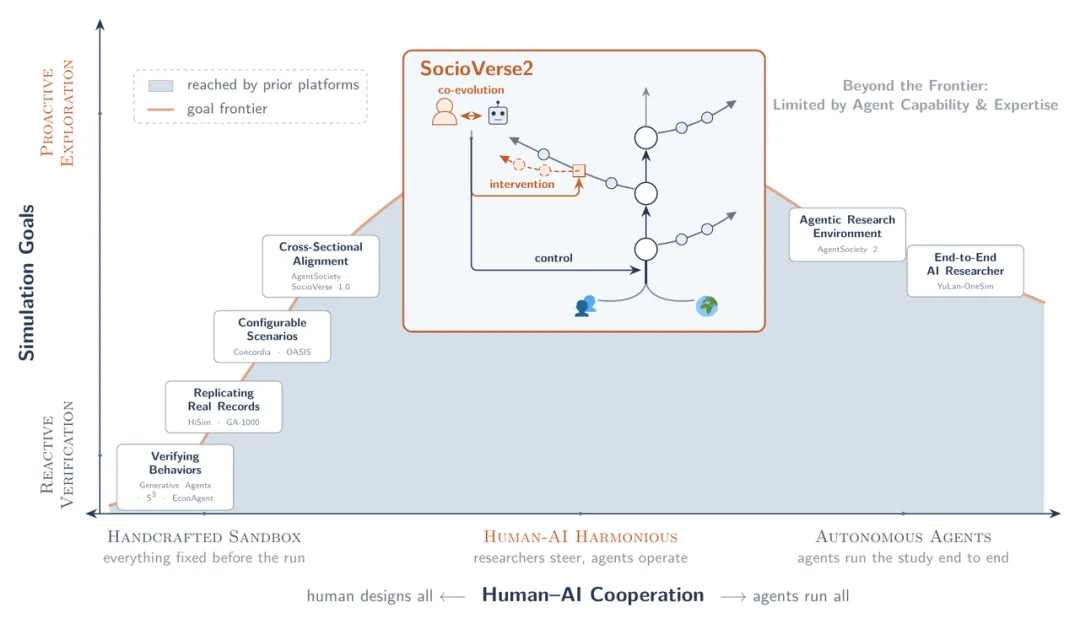
Figure 1 The existing LLM social simulation platform is divided into two axes: horizontal to see how people collaborate with AI and vertical to see what the simulation will answer.
The problem arises entirely automatically. Some in-depth analyses of autonomous research systems suggest that intelligent organisms that complete the research process from end to end may produce results and deviate from their claimed plans. Conversely, the effects of human intervention are apparent. Several studies have found that the inclusion of researcher feedback at each stage of the research process can significantly improve the quality of research produced by intelligent organisms, and systems of applied social sciences such as economics have begun to set up artificial decision-making at key points.
The team argues that social science requires not just more automated social simulators, but a way of studying how humans and intelligences evolve together.
A research tree: two circuits and a set of infrastructure
SocioVerse 2 follows a classic judgment of Lewin's field theory: a person's behavior is determined jointly by that person and the environment in which they live. The whole system revolves around two interchangeable parts of "people" and "environment", plus a "behavior function" that maps both into behavior.
On top of this, the team used a tree to organize the entire research process.
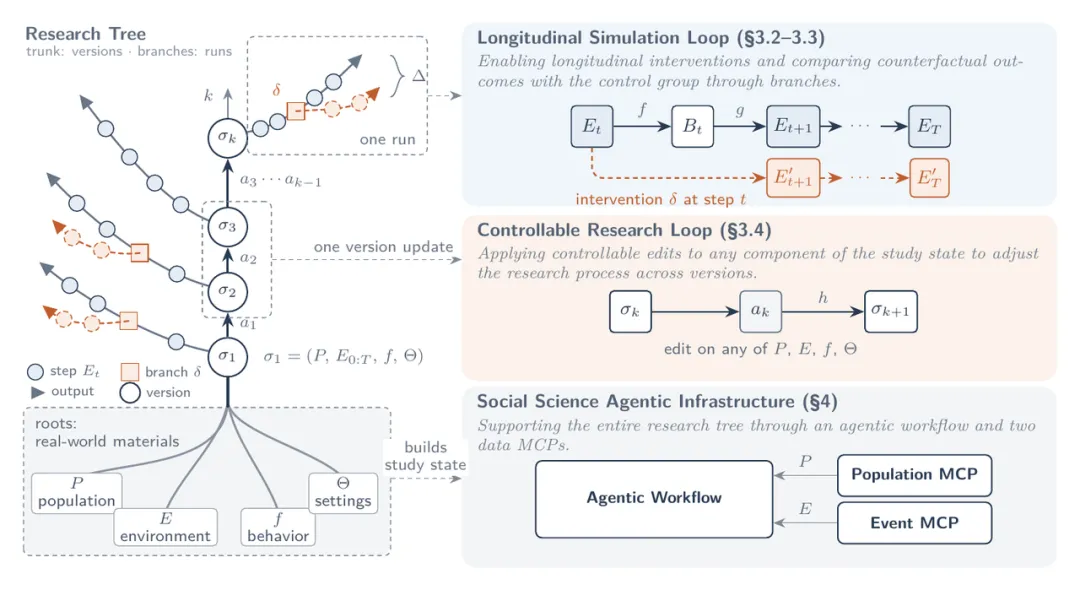
Figure 2 provides an overarching framework for SocioVerse2, which is a research tree. The tree roots are the infrastructure responsible for assembling real population and real environmental data into the first study state. The tree trunk is a research cycle, with each modification making the tree trunk taller by one section.
The tree has three parts, which correspond to three contributions to socioverse2.
The branches are perpendicular to the simulation cycle. The same group of intelligences act step by step in a changing environment, and each step changes the behavior of the next. Researchers can intervene at any step, causing the simulation to separate a branch of counterfacts.
The tree trunk is a controllable research circuit. The entire study, including which groups of people, what environments, what behavioral models, what parameters, is considered an editable state. Every time a researcher or intelligent body makes a change, the research enters a new version.
The root of the tree is the infrastructure of the social sciences and intelligence bodies. A skilled research pipeline, coupled with two services that provide real population and real environmental data, supports the two routes.
During the same period of history, the experimental and control groups were split.
Look at the branches.
In SocioVerse 2, an intervention is a statement written into the environment setting: in the first few steps, which part of the environment, what to do. It can be a policy adjustment, such as a new bus station being added to a block, or it can be a broadcast, such as a news feed to a certain group of people.
The intervention is effective and recorded prior to all the actions of the intelligent body at that step. Any later point in the indicator curve can counteract what happened at that time.
SocioVerse 2 uses "recoil" to generate branches: the first few steps of the new branch do not recall the big model, but read directly to each of the movements of each intelligent organism that the parent simulation has already recorded and repeat the same way.
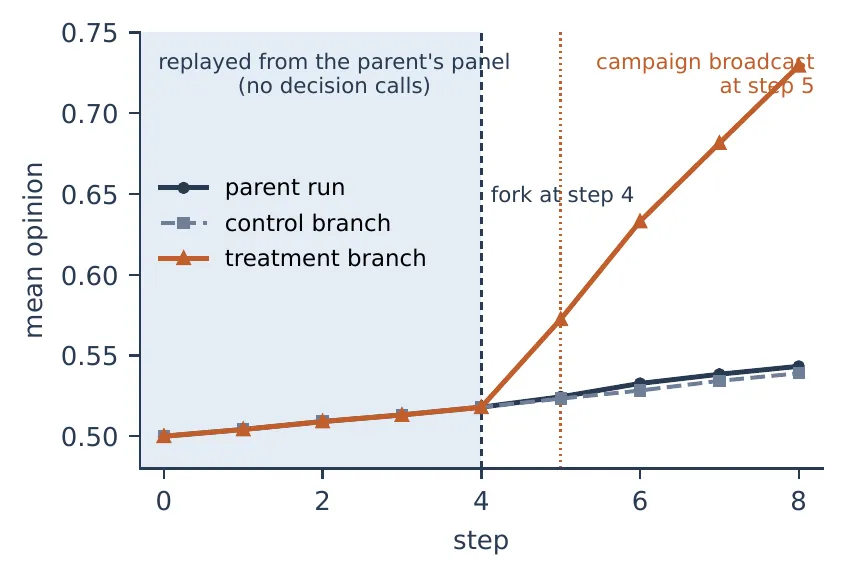
Figure 3 shows an example of a branch in an observational dissemination study. The two branches are recycled to share the history of the previous four steps, and the branch is processed to join a media campaign in step 5, controlling the branch to remain unchanged. The difference between the two curves after the fork can only be attributed to this campaign. Source: original paper Figure 4 (b)
Because the two branches use the same group of people, the same model of behavior, the same random seed, history is perfectly consistent before the fork, the gap between them can only come from that intervention.
The same mechanism has two side advantages: simulation that has already been run can be extended to a longer time span at zero cost, and simulation that has been interrupted can continue from a disruption.
Researchers do not hold the right to veto, but the right to edit
Look at the trees again.
In many "people-to-people" designs, the role of humans is to approve: the intelligent body proposes a plan, the human body agrees or disagrees.
The intelligent body can make modifications based on the results of the previous round of simulations, and the researcher can move directly to any part at any stage, in the form of a natural language instruction, a supplementary material, or a direct modification of the code.
The paper divides the modifications of each research process into three categories: 1) continuing experiments set up along the original study, which ensures that the cycle can be revoked at any time; 2) simply changing the environment to get the branches mentioned in the previous section, inheriting the entire history of the original simulation; 3) any other modifications, such as changing a group of people, changing a behavior model, will generate a completely new version, running from scratch, to be used to compare different research designs.
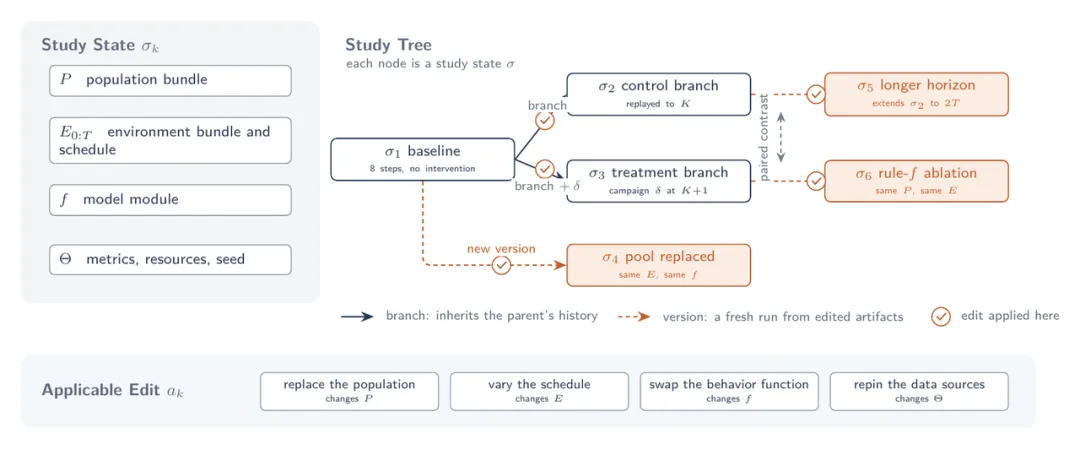
Figure 4 is a version tree of a controlled study circuit. Each node is a study state, edited by a researcher or by an intelligent organism, and each version preserves a complete workspace snapshot. Source: Original paper Figure 5.
Each version preserves the code, data, trajectory, and reporting in its entirety, so any early results can be traced back and run back. The population, environment, and behaviour models are independent of each other, and one study can only move one of them, while the others remain unchanged, each eliminating which factors are at work.
5 population sample sources and 21 types of signal sources.
Become an all-in-one basic service
Finally, the roots.
The research process is broken down into seven replicable skills, from identifying research intentions, building people and environments, running simulations, to writing reports and iterations. Each skill is suspended after completion until the researchers decide whether to continue. Researchers can open the automated mode, but there are four things that always come back to humans: identifying intentions before a new study, modifying existing research when deciding whether to build a new version, localizing or branching out, identifying expected costs before calling a large model, and using data services that require periodic authorization.
The data is provided in the form of two standardized services (MCP).
Population Services inherited the real user pool of SocioVerse 1.0, and added three open population datasets, unified under a set of demographic fields. The researchers gave the target population distribution, the service would be selected across data sources, spelled out, aligned by distribution weighting, complete labeling of attributes not covered by data sources, and finally deliver a group of research subjects with stable identities.
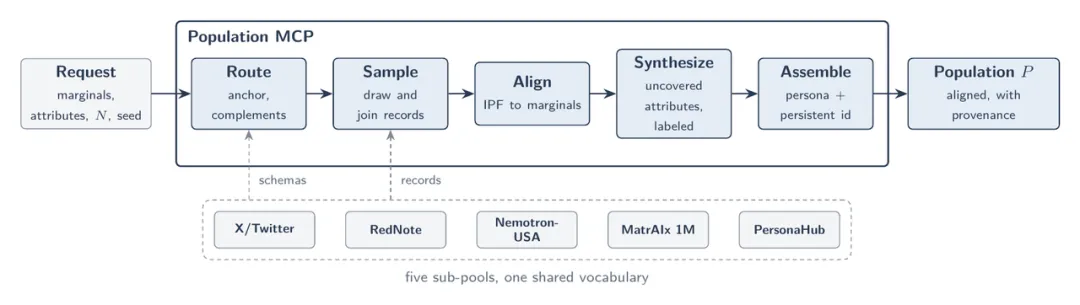
Figure 5 A call process for the people service: routing, sampling, alignment, synthesis, assembly. Source: Original paper Figure 7.
Environmental Services brings together 21 data sources from the four categories of macroeconomic, financial market, news trends and demographic surveys, and ensures "time-safe": simulating to a certain month to see only the data that had been made public at the time, eliminating the anticipation of the answers.
Seven examples: from repeated ABM behavioral experiments.
Forecasts for the macroeconomic index
The paper examined the framework in three groups, with a total of seven cases. It is worth noting that the control group and dissolution experiments in each case are themselves versions or branches of the study tree.
First, confirm the simulation itself. In 10 classic rule-based models such as the Sherlin isolation experiment, SIR transmission, bird group dynamics, the team replaced the handwritten rules with big model decisions, with the three big models scoring a consistency score of between 0.885 and 0.900, while the rule model itself repeatedly runs a consistency limit of 0.911. In the case of social media commentary, 300 major model-driven core users combined with 700 rule-driven ordinary users in all 15 sets of comparisons were closer to the real commentary trend than pure rule models, while the cost only increased with the number of core users.
In the Chicago segregation case, 19,235 weighed-in SMEs relocated to 781 real census areas. Starting with the randomly disrupted 2010 pattern of 15 percent, the black-white residential segregation index rose from 0.716 to 0.782 in 15 steps, the actual census value was 0.835, the Asian-white census index shrank to 0.435, and almost coincided with the census value of 0.434.
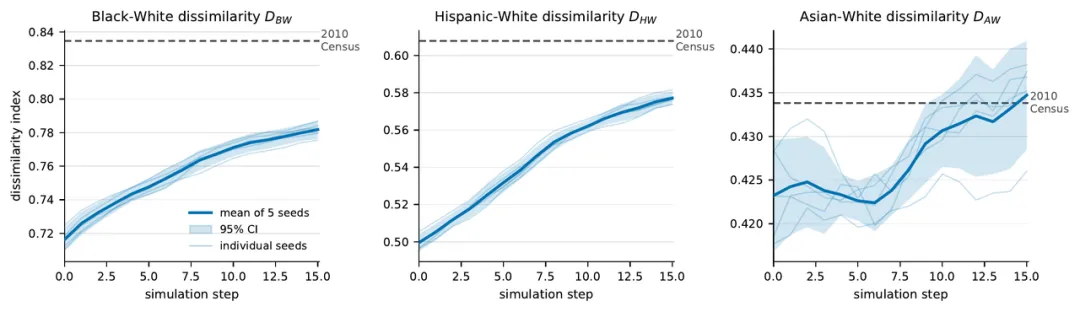
Figure 6 Changes in the three residential isolation indices of Chicago within 15 steps, the null line being the 2010 census value. Source: Original paper Figure 13.
In the case of drug cartels, the national drug cartels are seen as a three-party gamble: government regulations, corporate offers, healthcare providers reporting needs and carrying out purchases. In seven rounds of cartels, 325 pharmaceutical markets, the three parties simultaneously learn strategies, increase the median number of government benefits, corporate profits and the effectiveness of medical institutions, with the benefits and profits of the strongest corporate-only model baseline rising by 27.2% and 33.9% respectively.
Finally, the challenge remains unanswered. The Consumer Confidence Case of 5,000 households with micro-data calibration extended the simulation population to 250,000 households over 75 months of feedback in the United States, the European Union and Japan, leading the way across 12 traditional forecasting methods, with advantages concentrated in months of severe shocks such as epidemics, inflation, and the Russian conflict. The Procurement Manager Index case of 300 simulation firms filled out questionnaires on a monthly basis, and it was impossible to "get behind the answer" for 32 months after the model training data deadline.
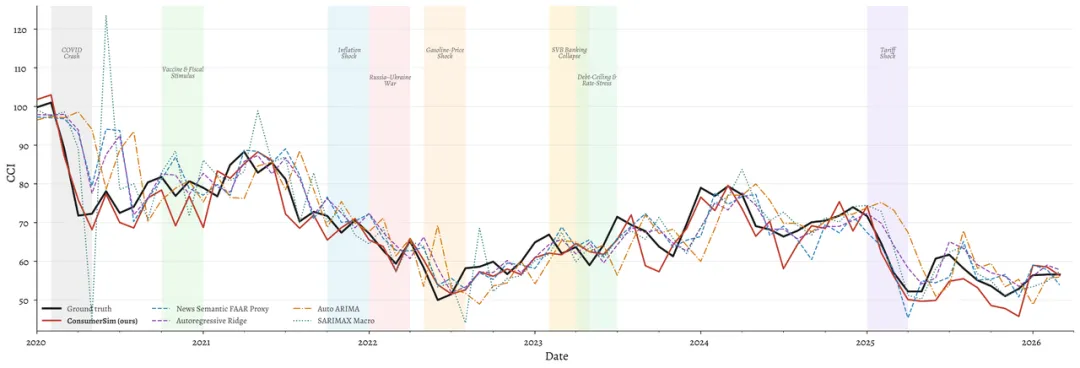
From the beginning of 2020 to March 2026, the official numerical value of the US Consumer Confidence Index, the Black Line, is simulated with several representative baselines for SocioVerse2. Source: Original paper Figure 15.
Written at the end
What SocioVerse2 wants to answer is a question about division of labour: where should people stand when an intelligent organism is able to complete more and more research steps. It is given by the trunk of a research tree. The intelligent organism is responsible for running a simulation, checking data, writing reports, and the researchers are responsible for deciding which direction the tree goes. It allows researchers to be not only bystanders of the process but also the navigators of social experiments. The framework for running SocioVerse2 is open source and provides an online desktop for non-computing background researchers.