Tibo texted again and again...
This time around, he says, OpenAI has "locked in": the next four things to do: streamline products, improve efficiency to support more use, breakthrough functionality, and new models.
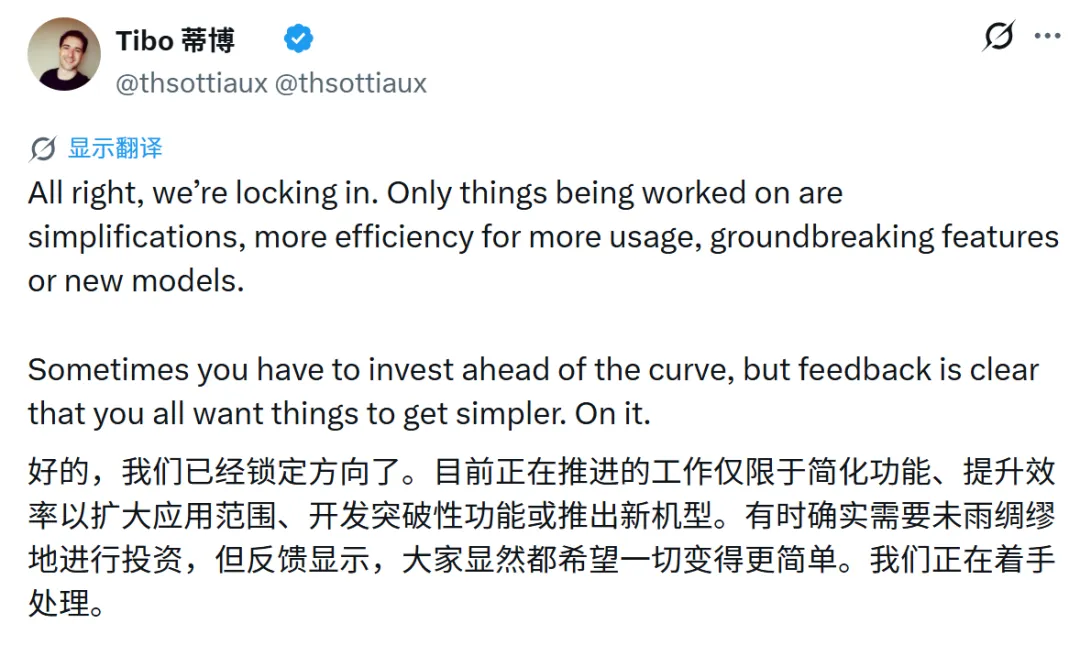
It was announced shortly afterwards that it would be releasing or resetting for 28 consecutive days, highlighting "clearly improved and practical functionality for users".
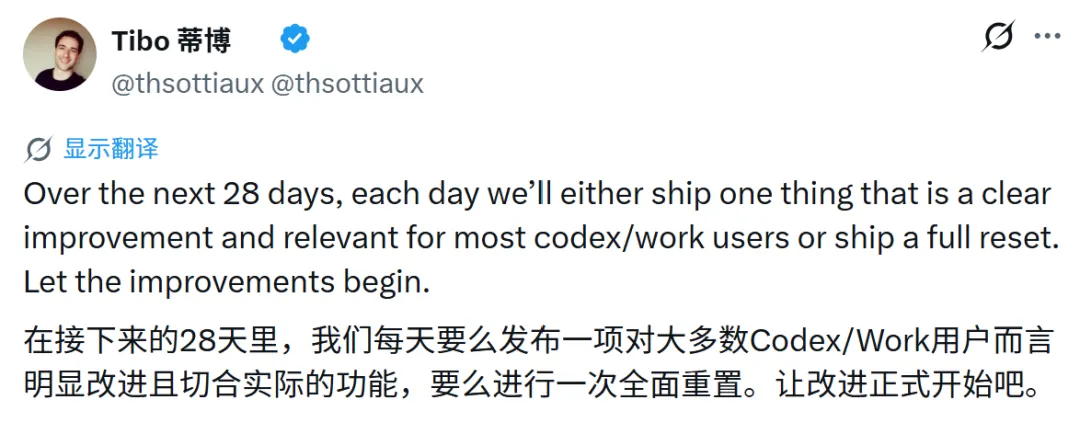
The comment section was cheering as usual, but another voice was more pronounced than before.
Many people are asking, "Is this believable?"
The day before the developers, OpenAI drew high expectations, and users heard too much of the same: 20 new features, major updates, that are about to change the way things work...
However, after the launch, many heavy users found that several issues that really affected everyday experience did not disappear: fewer quantities, slower models, and new products that were the most sought after did not immediately reflect the value in advertising.
One user said directly that before DevDay, OpenAI gave people the feeling that "it changed everything" and after the results were really released, "nothing at all". He was disappointed with the GPT-6.1 Sol, which he had been looking forward to, when it was actually used: the performance and efficiency on paper was beautiful, but it was still slow when it really worked, and the TPS standardised experience was still poor compared to Claude.
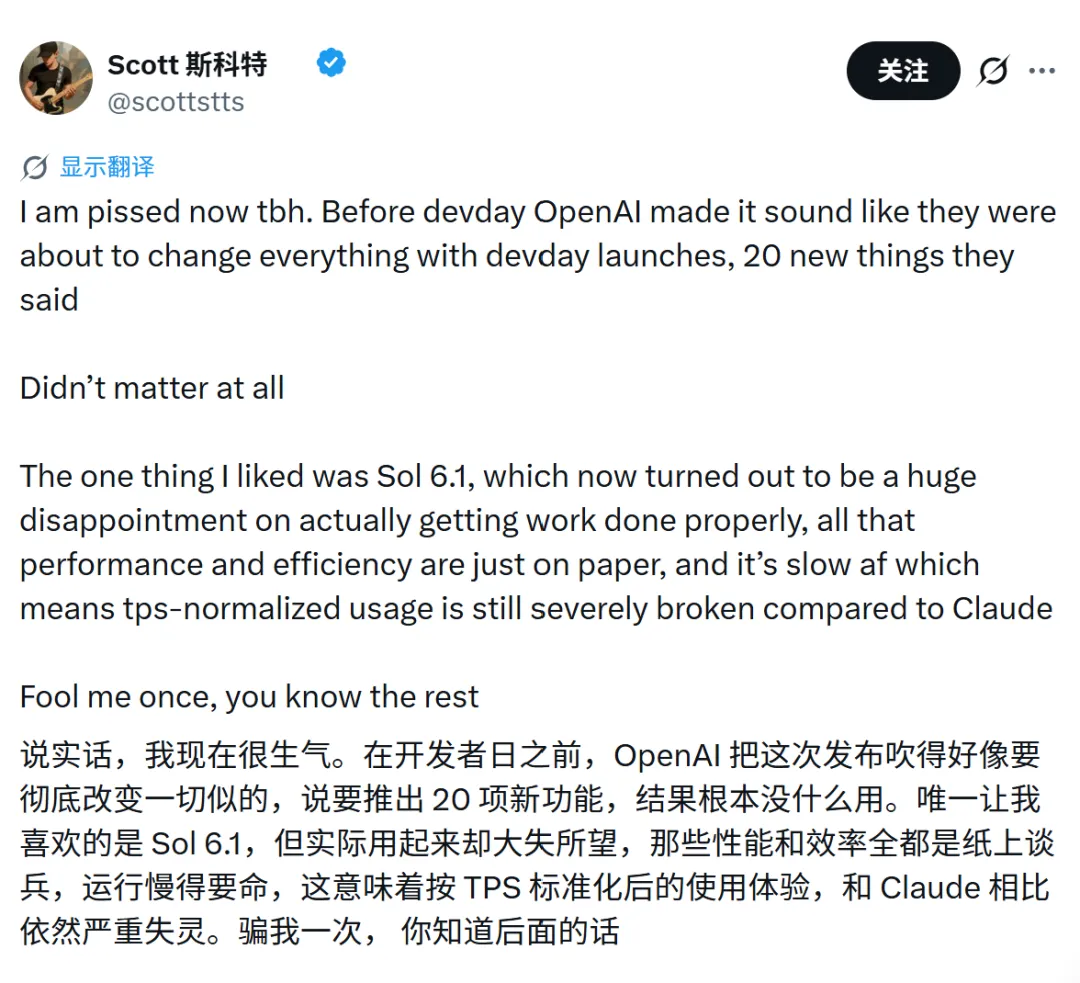
After Developer Day, OpenAI is experiencing a crisis of user trust.
A great war has begun.
Just now, Lauren Tan of SpaceXAI's Grok Bot team, @poteto on X, has sent out a provocative statement that points directly to OpenAI.

Tibo responds quickly, and the post smells even heavier.
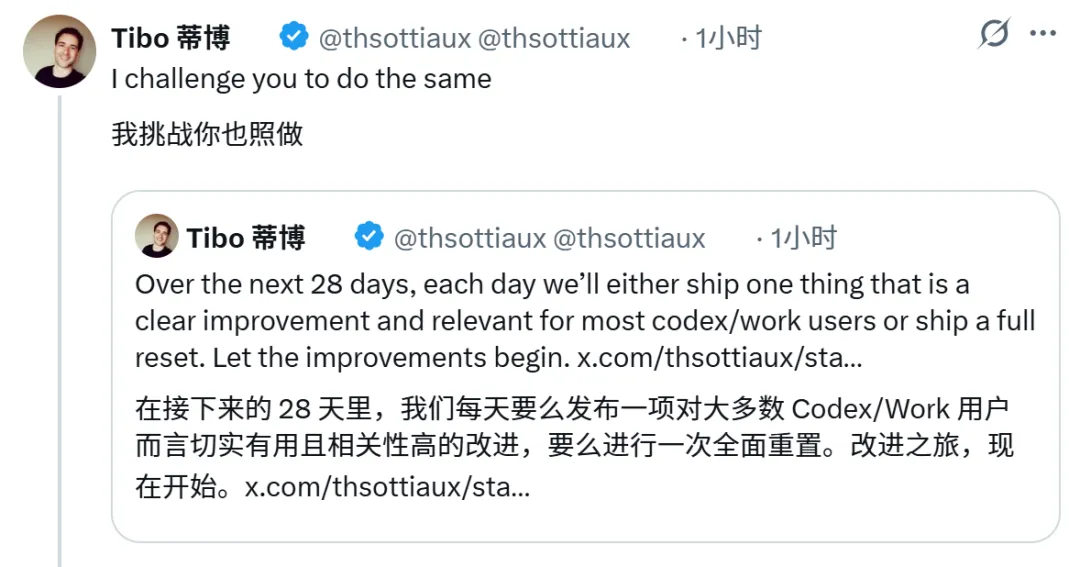
Lauren did not respond, but instead pointed out the recent dilemma of OpenAI: the publicity is high, but the quality is completely out of sync.
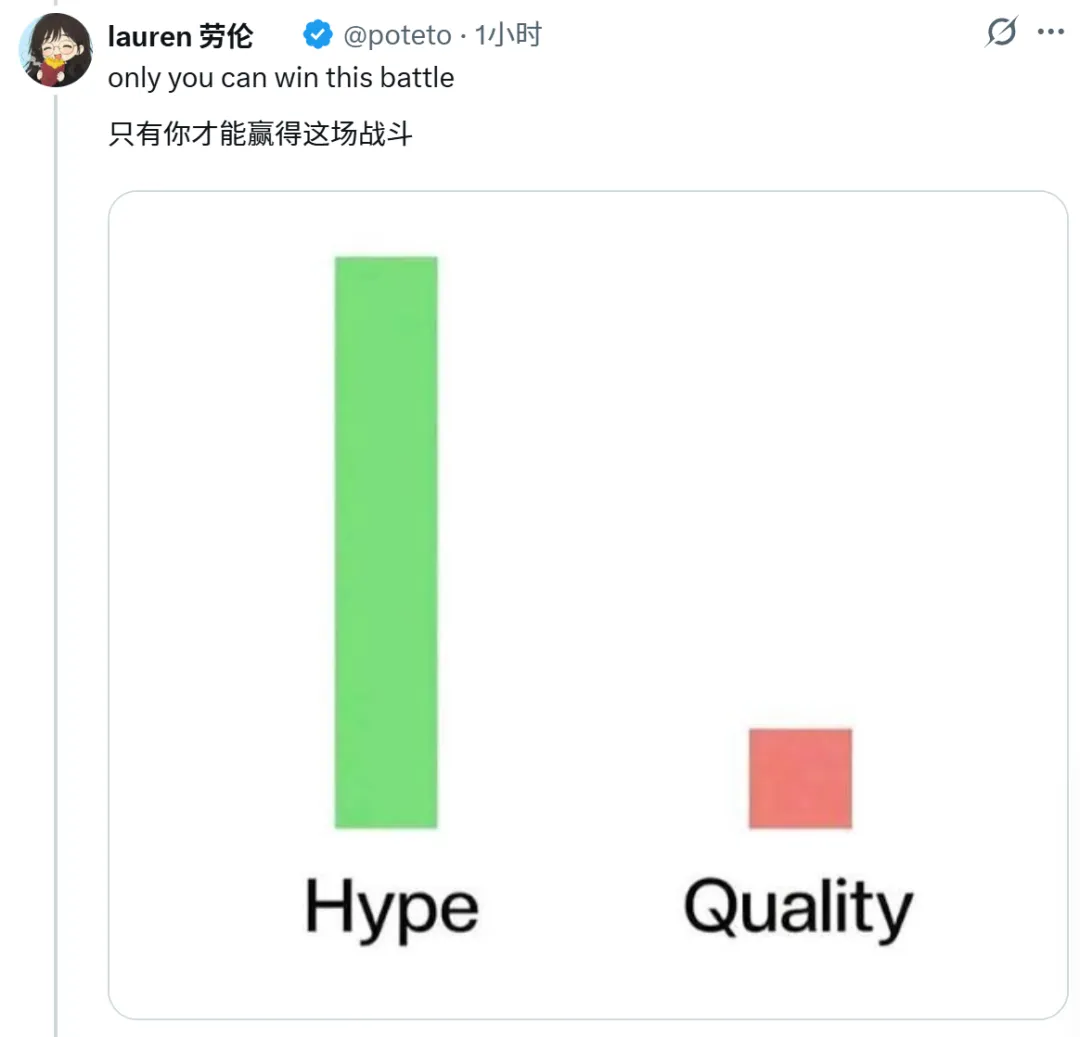
OpenAI's headache is that this isn't just a competitor's idea.
Twenty releases, have users bought accounts?
The problem with OpenAI on this Developer's Day is that there is a lot to be released, but not much left.
Prior to the launch, OpenAI had been raising expectations. Tibo even predicted in advance that there would be about 20 new announcements, giving people the feeling of almost a big update to the product line.
It's really Developer's Day, and there's a lot going on.
GPT-6.1 Sol, new Codex/Work capabilities, Dots, and a series of updates around Agent, developer tools and ChatGPT are on the rise.
But the feedback from users is also clear: how much, how much, has really changed the experience of everyday use?
In addition to Scott's previous disappointments, other users have given similar reviews. These complaints have just overlapped with another layer of greater discontent.
OpenAI has previously suspended subscription and usage quotas for new users of the $200 package due to computational pressure; subsequent use quotas have been significantly tightened. At the same time, the official explanation further emphasizes "model efficiency improves" and "the same amount can do more work".
Users don't pay any bills for this statement: money is not enough, but the quantity is less, and do they expect me to say something nice?
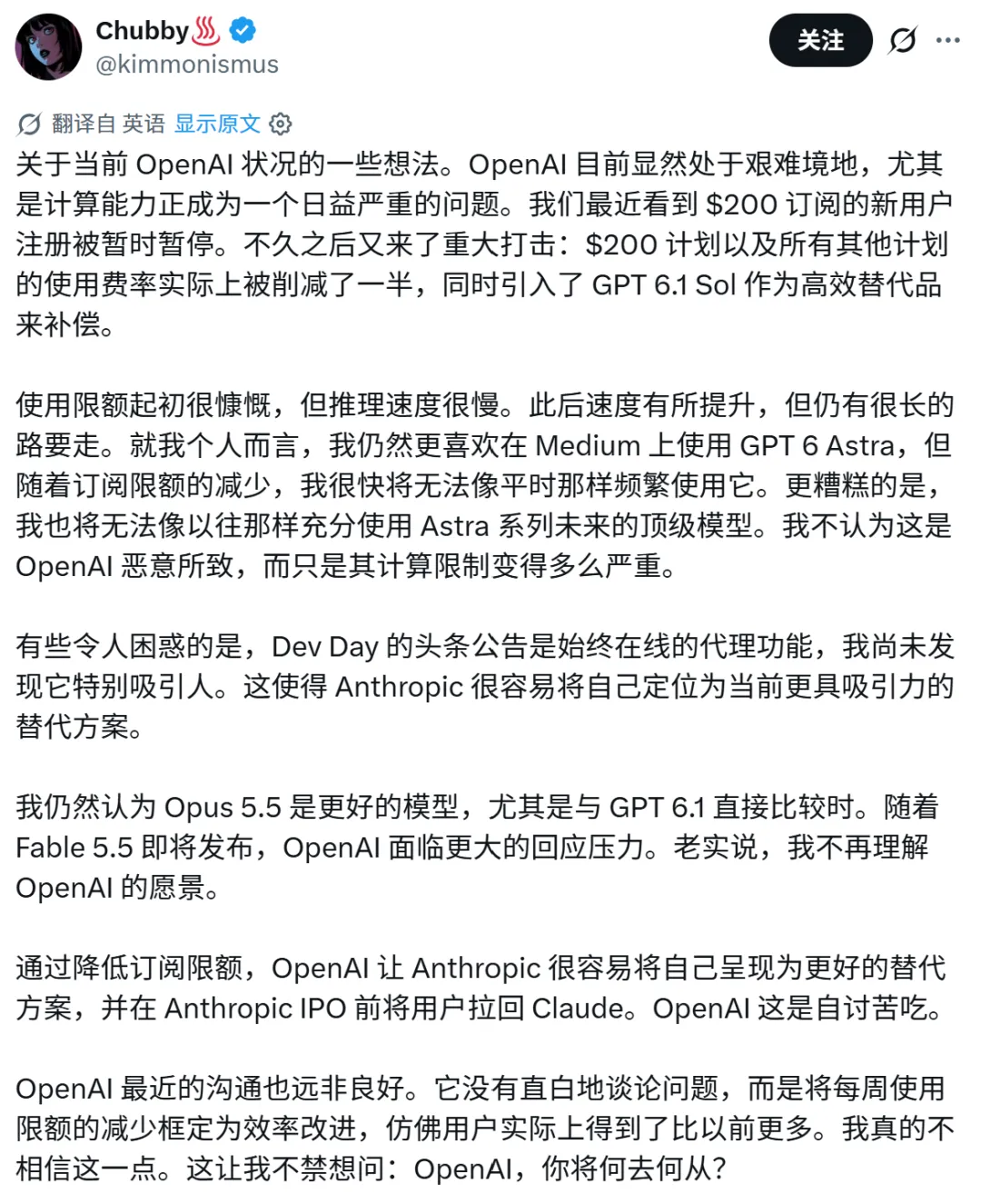
Developers are failing to address the core needs of heavy users, and 20 new features will change from "surprise" to "noise".
In this context, perhaps even more worthy of consideration is the "simplification" goal of Tibo.
So "simplify" might be right.
OpenAI's next goal is to simplify products, increase efficiency to support more use, breakthrough functionality, and new models.
Tibo made it clear: "Sometimes it is necessary to plan ahead, but the feedback is clear: everyone wants things to be simpler".
For a high-speed AI company, complexity is almost inevitable. But once the complexity exceeds a critical point, it begins to reverse the value of the product itself.
Of course, users want a stronger model, but they also want a new Agent, a new way of working. But before that, they want the most basic things to be clear, stable, and consistent.
So this time, putting "simplification" in the foreground is probably right.
Because OpenAI is no longer lacking in new stories, it needs more stories that have already been told.
Or Lauren's chart, which has already been promoted, for the next 28 days, let's see if the quality is up to par.
The link is as follows: