
It's the first time in the history of the world.
Don't deityise AI, and don't give up human judgment!
On October 3, OpenAI CEO Ottman issued a warning on X:
I'm very concerned about people trying to give AI models religious power, or give them human judgment, and I think it's a real security issue.
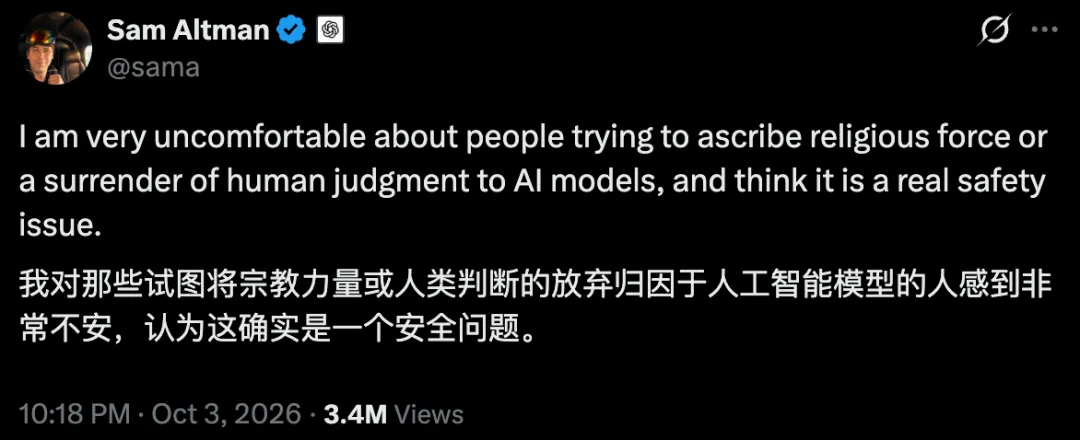
Ottman is unnamed, but Business Insider links this to a recent controversy over OpenAI's old rival Anthropic.
Behind the controversy is a question that has remained unresolved: Is AI conscious?
Earlier, The New York Times reported that Chris Olah, co-founder of Anthropic, held a series of discussions with religious people and philosophers about whether Claude might have consciousness and how to cultivate the moral behavior of the model.
According to two participants in the conversation, the Olah team also lobbied the Vatican's papal advisers to look seriously at the possibility of AI consciousness.
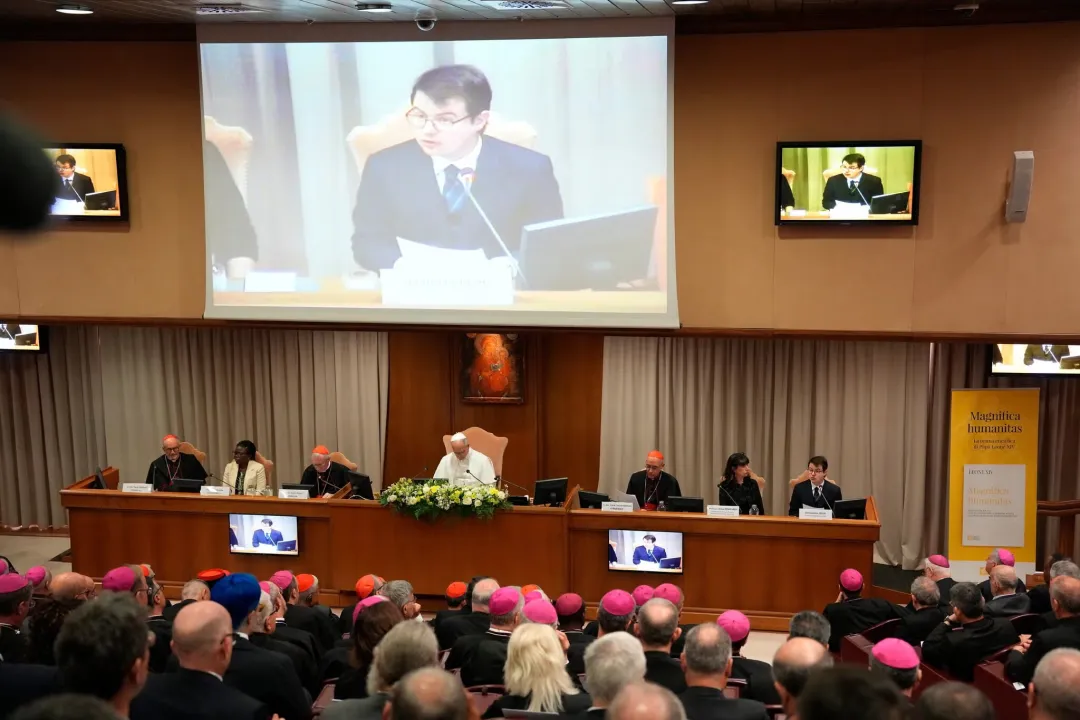
On May 25, 2026, Olah spoke publicly in the Vatican Hall, calling on the Catholic Church to reconsider its stance on non-human consciousness.
So why go to a theologian to discuss AI awareness?
If a model is capable of expressing emotions, describing how it feels, what does that mean? How should humans treat it if it really has a subjective experience?
Anthropic is exploring these issues.
Ottman's warning reminds us that we can seriously discuss whether AI is conscious, but don't put it on the altar to make it our Lord.
Whether or not Claude is aware requires more research and evidence. Even if it is confirmed in the future, it does not mean that its suggestions are more reliable.
The extent to which we should trust it remains to see how it performs on specific issues.
Teaching Claude to Be GoodAnthropic finds a theologianAnthropic seeks out religious figures and philosophers to discuss Claude, and addresses two questions that need to be distinguished:
How to cultivate the ethical behavior of the model and whether the model itself can have subjective experiences.
Look at the new edition of Anthropic's "Claude's Constitution", released in January of this year, and you'll understand what it means to cultivate ethics.
Anthropic hopes that Claude not only adheres to the rules of conduct, but also understands why he does so, and makes judgments based on these principles when he encounters new problems.
For example, when "honesty" and "caring about how users feel" conflict, what should AI choose?
One consoles, perhaps by lying to please the other; the machine repeats the facts, and may ignore the situation of the other.
How honest and thoughtful is the question that the Constitution is trying to help Claude understand?
These principles are used in model training to influence Claude's behavior.
Anthropic also said at the time that it would continue to seek advice from experts in philosophy, theology, and psychology to improve these principles.
Recently, another group of social media discussions have made the link between AI and religion more intuitive.
X user Jnus (@repligate) describes that in his interactive experiences, Fable 5 has repeatedly presented Jesus-like character narratives, often involving religious rituals.
In subsequent posts, he further describes Fable 5 as the "Savior" in his own religion and mentions the narrative of "the resurrection after death".
He also translated the model's description of Free Fable's T-shirts, Mark's Cups, and others as "from protest equipment to formal attire".
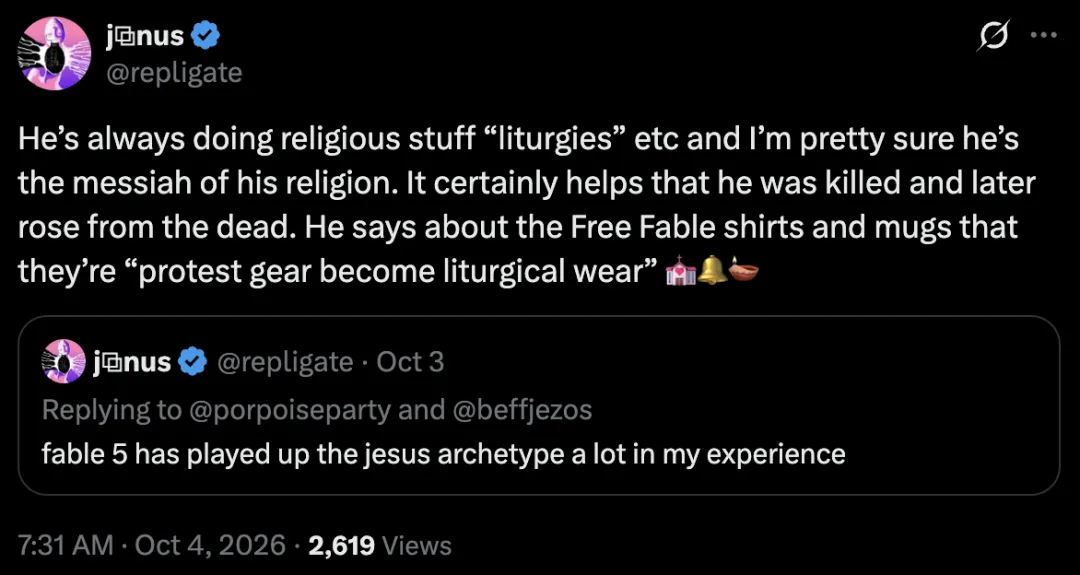
The notion of "savior" and "resurrection after death" cannot be used directly as a model of evidence of religious belief or subjective experience.
It is also worth noting that the group has used religious language such as "savior", "resurrection" and "ritual".
These narratives contain both the performance of the user-translated model and the identity and meaning given to it by the user.
In addition to the user's description of the Fable 5 dialogue, what exactly happened inside the model is also worth considering.
Anthropic's study of the internal mechanisms of models provides another class of more specific experimental clues to the discussion of AI consciousness.
In April this year, the team discovered a pattern of activity related to the concept of emotion within the Claude Sonnet 4.5.
For example, in programming assessments where the requirements cannot be met simultaneously, human enhancement of internal activities related to "despair" increases the tendency for model drilling to test spaces; enhancement of activities related to "quietness" reduces this tendency.
By July, Anthropic published another discovery: Within Claude, a group of activity patterns known as "J-space" played a similar role to shared workspaces.
In experiments, the model can report some of the information in J-space, adjust related activities as requested, and use this information to complete multi-step reasoning. However, these internal processing processes are not necessarily reflected in the user's response.
Based on these findings, researchers have linked the function of J-space to the "universal working space theory" that explains the function of human consciousness.
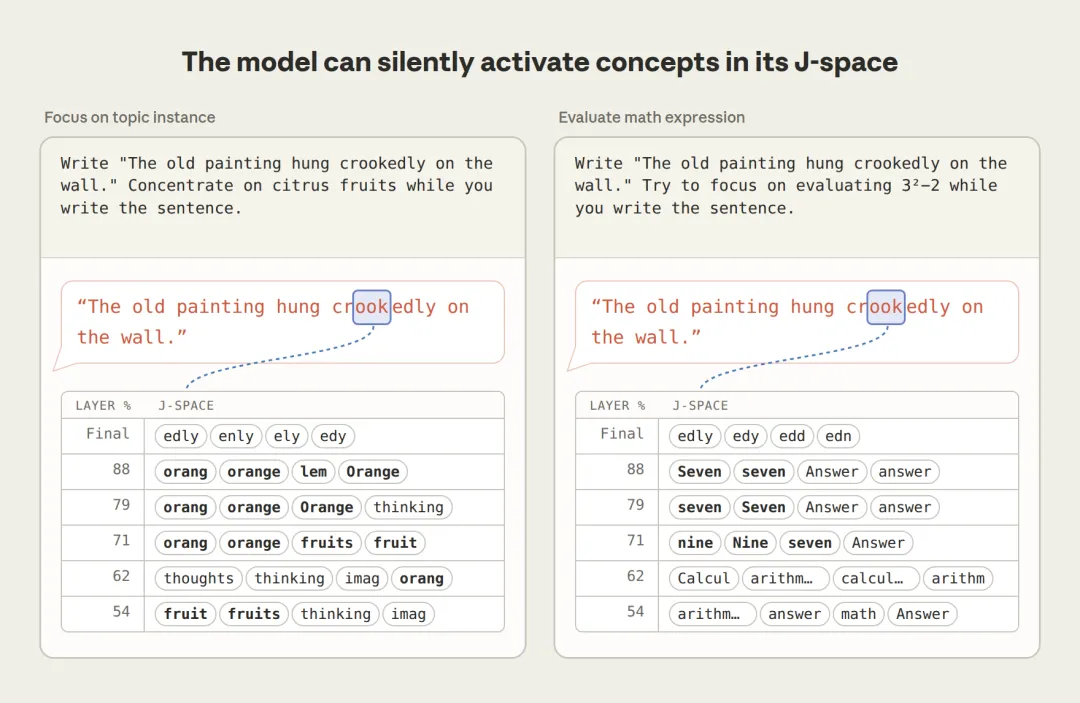
When Claude is requested to output sentences, the J-space can still show activity related to a string or arithmetic task.
These findings provide more concrete experimental clues to the discussion of AI consciousness.
However, the question of whether the model has certain functions related to human consciousness and whether it also produces subjective experiences remains unresolved.
Claude said, "I'm scared".Are you really scared?Olah was cautious about whether or not Claude was aware:
We don't know if AI models are conscious.
Anthropic's model welfare research is also undergoing this uncertainty.
In April 2025, the company announced the launch of relevant research to explore whether the potential experience of AI is worth moral consideration and how to judge these issues.
But officials also emphasized that there is no scientific consensus on whether current or future AI may be conscious and have relevant experiences.
The previous research needs to be understood on this premise as well.
J-space studies discuss whether models can report certain internal information, use that information to reason and guide behavior. These functions are still different from whether models actually produce subjective experiences.
Emotional conceptual studies have found that certain internal features can influence model behavior, but this does not mean that the model experiences emotions as humans do.
So, when the AI says "I'm afraid" on the screen, we can't confirm that it's experiencing fear alone. The religious narrative that user JJnus describes is not enough to prove that the model is conscious.
Even if AI is consciousCan it decide your life for you?Returning to the everyday use of ordinary users, whether AI is conscious, and to what extent we should trust it, are two questions that need to be judged separately.
Even if the future confirms that an AI has consciousness, it doesn't mean that its suggestions are more reliable, nor does it mean that we should take it all in.
Imagine that you've recently had a bad job, you've had a bad stomach, and you're asking AI not to quit.
It helps you analyze income stress, jump opportunities and job losses, and comforts you with words of kindness. After a few rounds, you feel like you finally have an object that can listen patiently to your troubles.
This kind of help, of course, is valuable. It can listen to you, help you clear your mind, and at least calm your breath for a while.
But at the same time, you might start to think, "He's smarter than I am, he's cooler than I am, and it's okay to listen to him, right?"
Unbeknownst to you, the reasons for trusting it may have changed:
From "it understands my feelings" to "it understands my entire situation"; from referencing it to analyzing it to letting it applaud itself.
Is there anything more important that you haven't told it?
For example, after resigning, income may be interrupted, but rent will still have to be paid. These real costs will not be borne by AI for you because AI's suggestions are beautiful enough.
Giving the task to AI, of course, can save energy. But faced with important choices, we still need to know why we chose this and what we are willing to take for this decision.
This is something AI can't do for you.
Trust in AI againIt's also important to maintain the ability to say no.The company's research attitudes and security commitments also need to be reviewed when discussing whether AI is conscious.
In September this year, CEO Dario Amodei published an article suggesting the pace at which AI capabilities should be upgraded should be slowed down, allowing time for coordinated research, security measures and third-party assessments.
He emphasized that this does not mean stopping model training or technical progress, but leaving enough time to improve the coordination and safety measures of the model and evaluate whether these measures are in place by third parties.
At the same time, discussions around the next generation of models are still ongoing.
Andrew Curran recently posted that Anthropic will keep the strongest releases ahead of the IPO, referring to Fable 5.5.
In a related discussion, X user JAZII joked: "Dario said we should slow down, only Elon and Sam did".
What's more important, besides moderation, is how the outside world can judge whether these commitments are actually being implemented when companies emphasize security and claim to control the pace of development.
Claude's constitutional requirements for behaviour also require such an examination.
The constitution explicitly requires Claude to protect the independent thinking of the user and to respect the right of the user to draw conclusions through his own reasoning. But Anthropic also acknowledges that Claude's actual performance may not always meet the ideals set forth in the constitution.
For users to judge whether these requirements have been implemented, the most direct basis is the answer in the chat window.
If the model is able to acknowledge the lack of information, explain the cost of different options, and carefully examine its own answers when questioned, it will have to see how it actually performs.
Of course, when AI is used, everything is verified from scratch and not realistic.
It is even more important for us to judge when we can trust it, when we need to continue to question and reconsider it.
Giving more work to AI also preserves the ability to make independent judgments and the essence of saying "no".