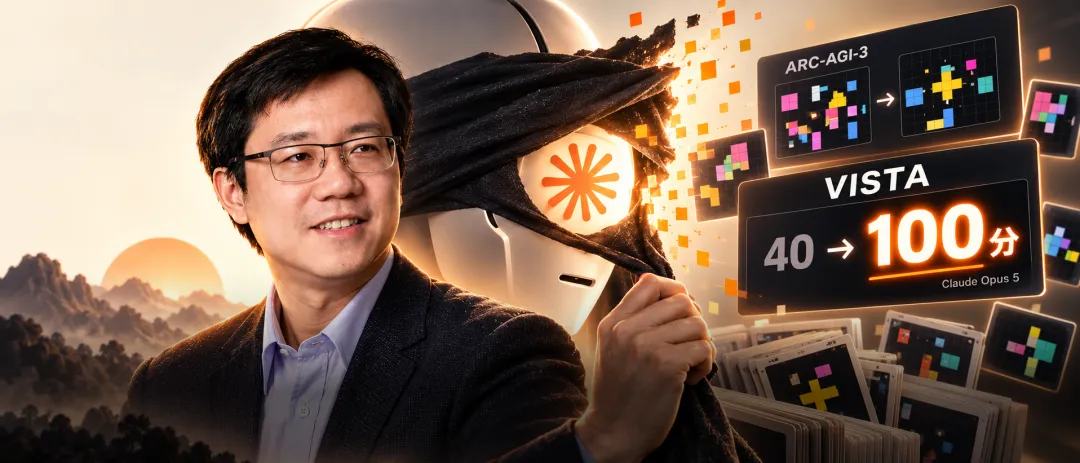
It's the first time in the history of the world.
The team's new paper was blown up on the X!
The VISTA paper, which was just posted on arXiv during the eleventh century, shows that there is no evidence to support this claim.Over the past six months, the world's top models have all been caught by "blind eyes" at the AGI site.。
The same Claude Opus 5 scored a poor 40 on the official standard test.
The team simply helped him remove the blindfold, allow him to see the game's footage, and handed him a "photograph" that could be turned around at any time.
As a result,Claude played all 25 ARC-AGI-3 open games and scored 100 points.
And the number of steps it took was even less than half the number of people who played it the first time.
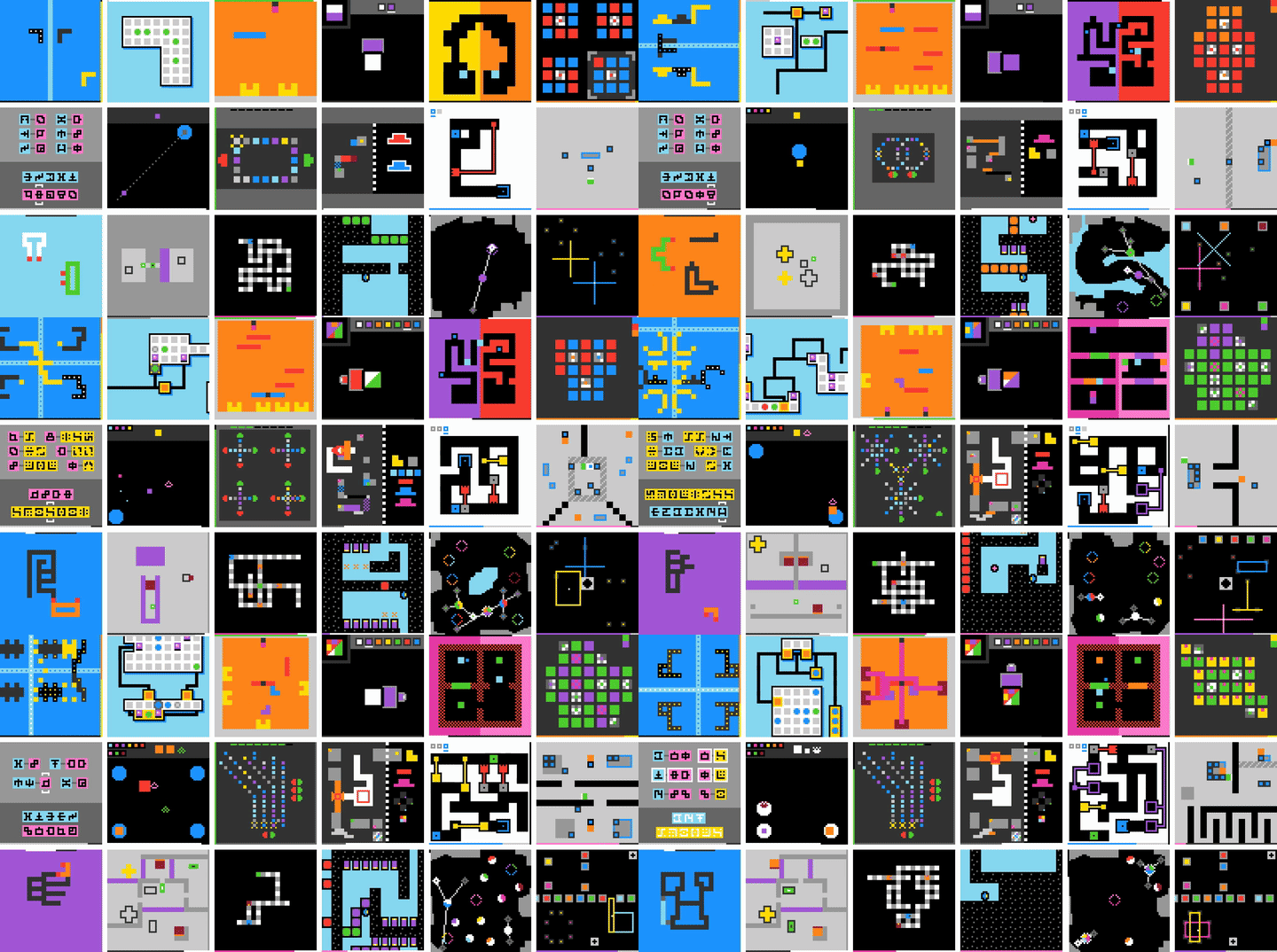
18 games I've never seen before, and no one has given it a clue that AI can figure out the rules by itself.
A well-known AI blogger, Mark Kretschmann, wrote in X: "Giving Agent the ability to 'take a second look' can make a huge difference".
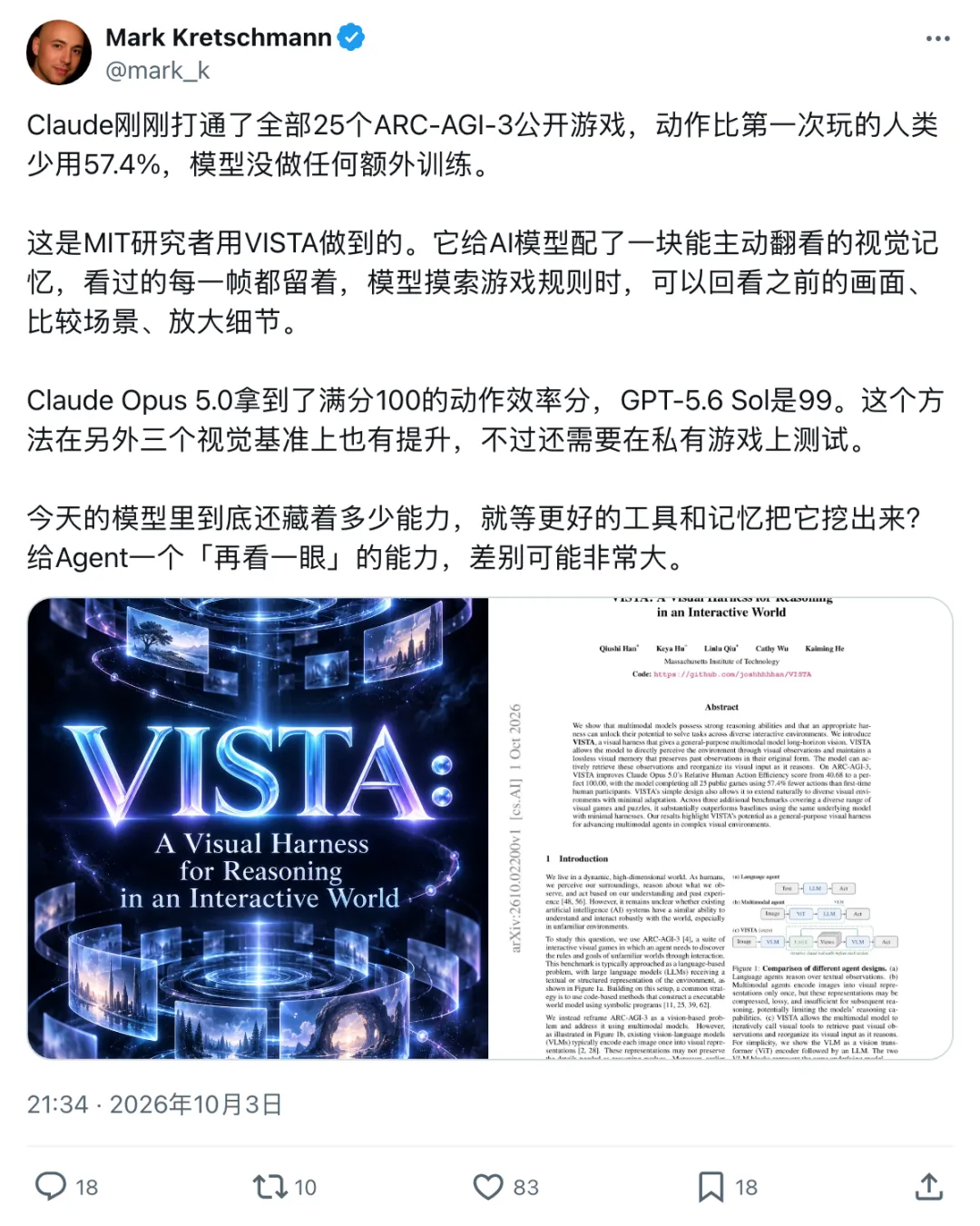
Over the past few months, in order to play through ARC-AGI-3, the road code giant has written thousands of lines of code into the world's simulators.
The team's judgement was:The big model's brain is old enough to hold it, its eyes and its memory.。
The big model was digitized and burned for six months.ARC-AGI-3, published in March this year by François Chollet and the ARC Prize Foundation, father of Keras. ARC-AGI-3 is an interactive pixel mini-game that opens with no instructions or rules, and is entirely up to the player to try and make mistakes.
The algorithm is extremely rigorous. Officially, almost 500 small human tests have been found, and AI has not only to go through, but steps can not be more than humans to get a full score.
Officially, only a 64×64 number table can be given to a large model.The little people, the organs and the routes that people see, the only numbers left in the model are 4096.。
It's like closing your eyes and listening to other people's coordinates and playing Super Mario.
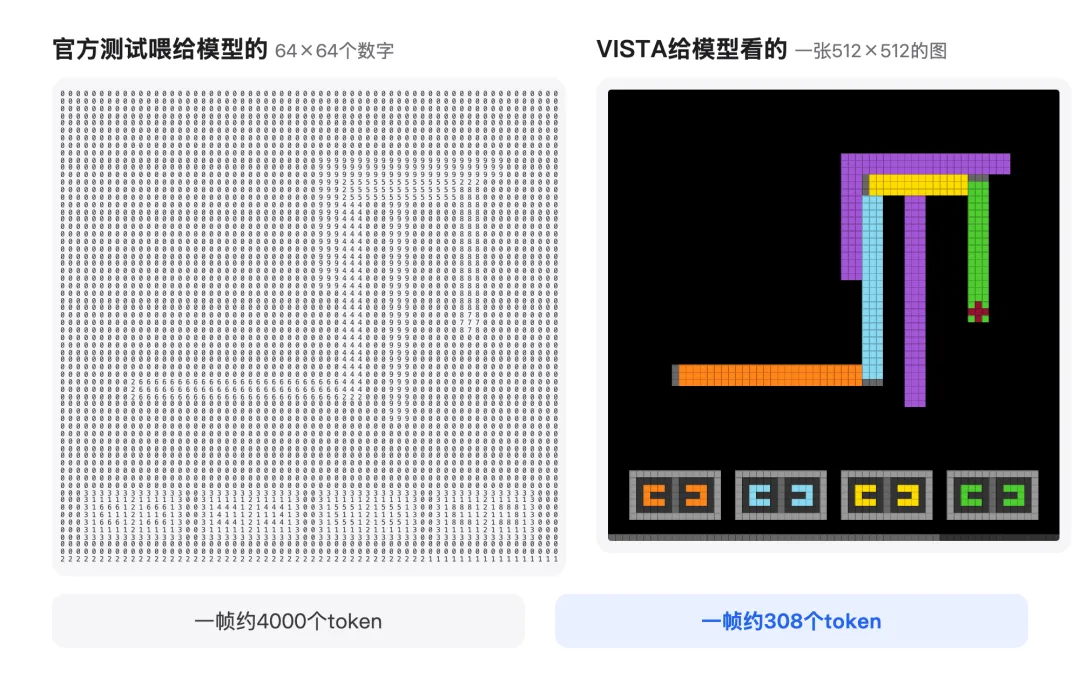
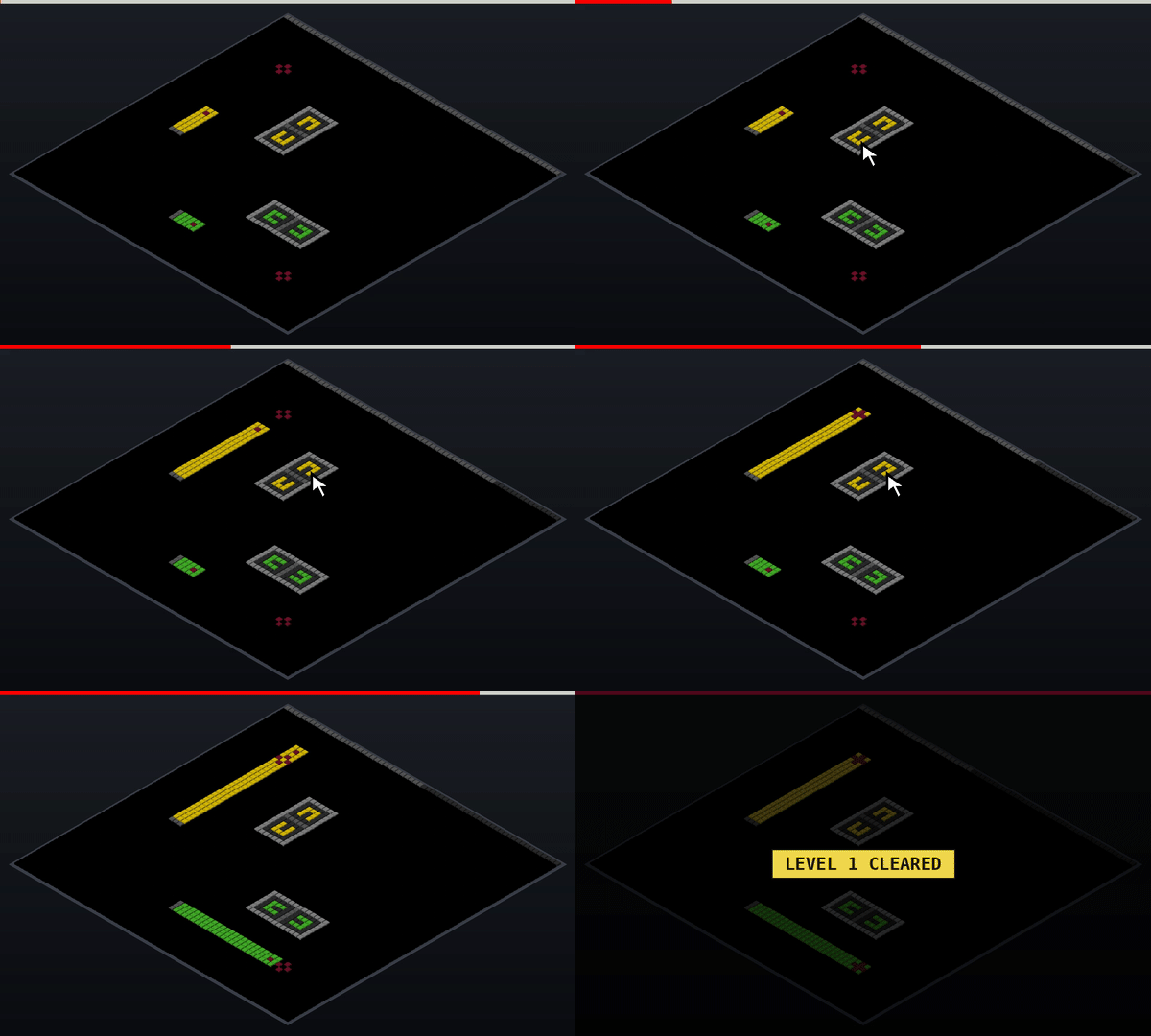
In the same image, on the left is a digital chart of the official delivery of the model, and on the right is the chart that VISTA lets it see directly.
The first thing that the VISTA team did was convert the numbers into images.
Nothing else has changed.GPT-5.6 Sol's score jumped from 13.33 to 47.32.。
A digital grid will eat about 4,000 tokens, and a 512 x 512 image will only eat 308 tokens.
One game went down, and the text version burned 71.9 million tokens, while the picture version burned 30.7 million, a score even higher.
It was only a change of a pair of real eyes that gave the big model 34 points back.
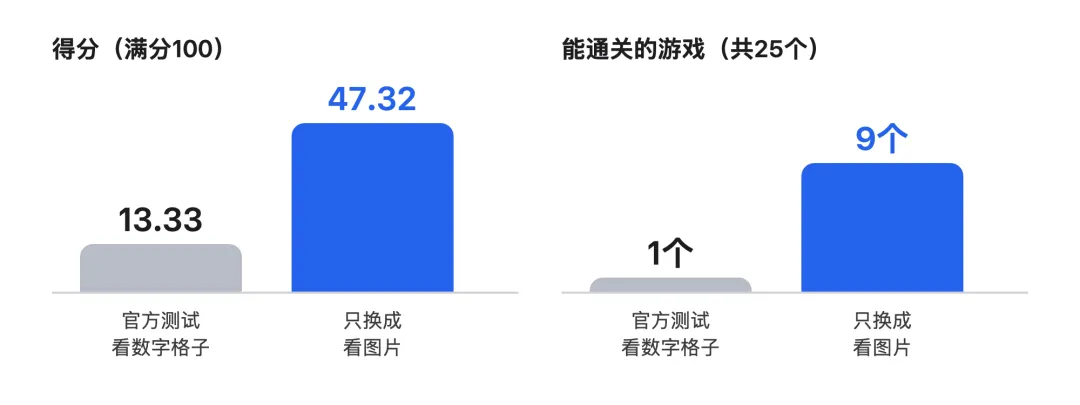
GPT-5.6 Sol's score more than tripled by converting the numbers into images, and the game switched from one to nine.
Let's not forget about AI, take a step and get 24 points.
One game moves hundreds of steps, and the disadvantage of multi-modal models is that if you look at an image over and over, the context is completely deleted or compressed into a few words.
When the model tried to look back at the details of the kernel, the candle had already gone out of existence.
VISTA's main trick is to create a visual memory "camera" without loss.
Each shot of the game, including the animation shots, is archived in the original format. The model wants to see which shots, when it calls the inspector out, several shots parallel to the contrast, the angles are magnified, and can read the exact color with read_pixels.
And most importantly,It's not the number of steps.It's the only thing that counts in the game.
The team called this mechanism "manifest attention", and it's up to the model to figure out which one to turn around, which one to look at.
It was also accompanied by two notebooks, GUIDE.md writing the rules of the game, and WORKING.md as draft paper.
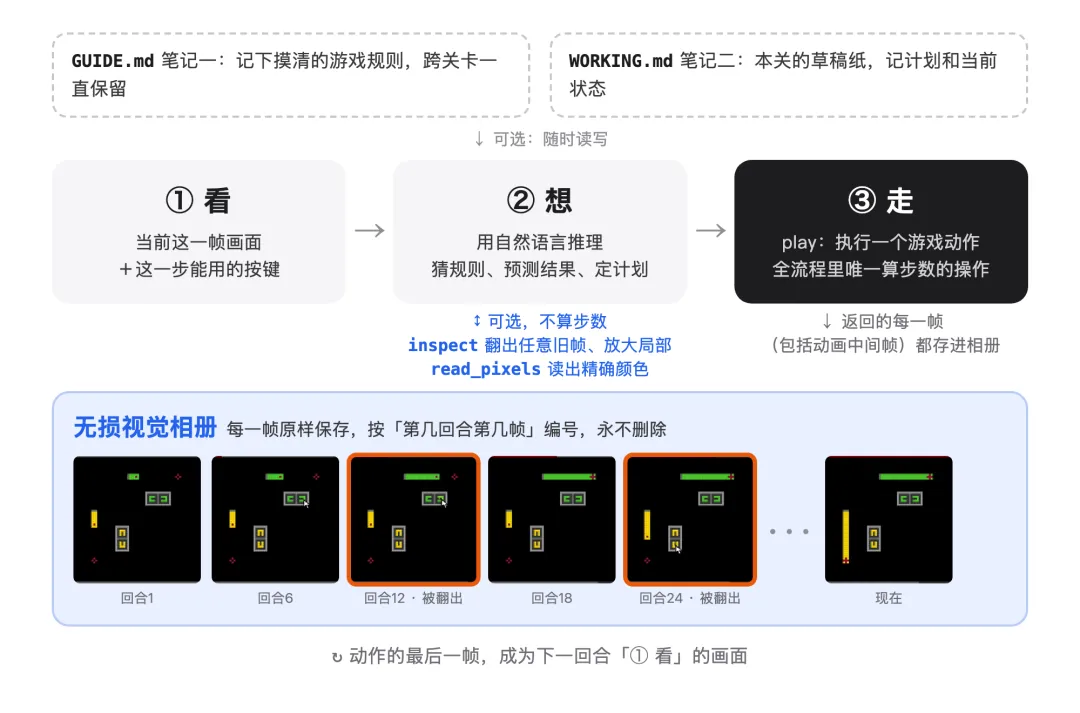
One round of VISTA, where the model looks at the picture, thinks about the rules, rolls around when it needs to, and finally takes a step.
The paper documented an extremely "human-like" moment of operation.
In Game 3 of the BP35 game, an orange square appears.
It pauses and releases the last one of the previous rounds and the new three-reel animation.
A few rounds later, it discovered that the X-point could re-grow the block, and wrote: "This is the tool I want to use to build a ceiling and hold the necessary elevation".
This is the first time a human being has walked 44 steps, and it only takes 34 steps.
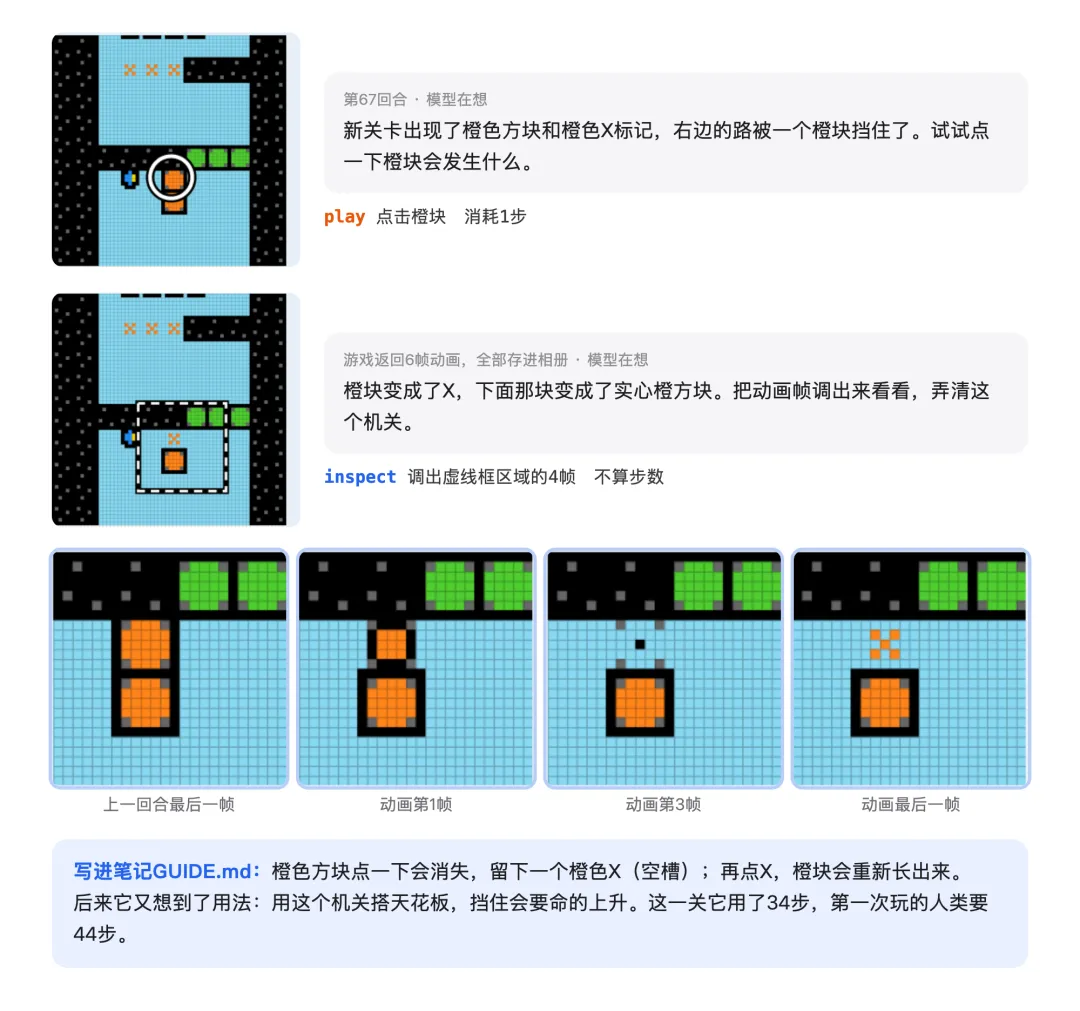
When the pieces are finished, the model moves the first four pieces of animation back and forth, one at a time, and then it goes away.
When the monkey eats the beans in the maze, the beans in the maze eat a little bit. The model just turned around in the 13th and 36th rounds, forcing the first two rounds back to the beginning to mark the map of the maze.
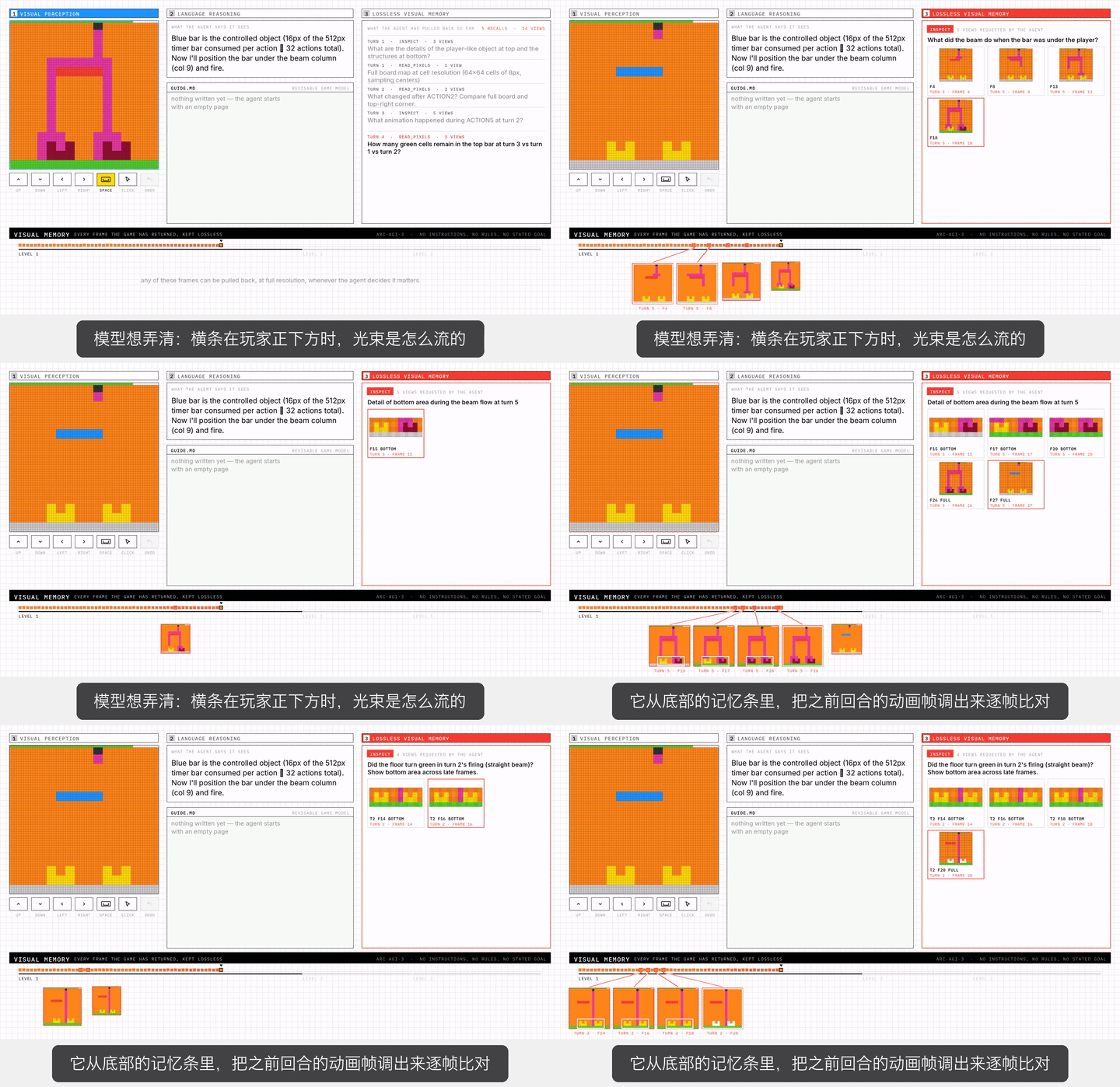
Adding context to a model, adding pixels, is the first reaction of many people.The paper found that both of these tricks were not effective.。
From the default 200K to 780K, Token went from 30.7 million tons to 1057 million tons per round, but the score dropped from 99 to 93.9 points.
The image is the same: 16 times larger, 1229 tokens per coin, with a score of 88.3; only 4 times larger, with a score of 99.7, 8 times higher than the default.
The paper's explanation is that the image is too large, and the overwhelming white-and-white Token occupies the context, so the model doesn't look much clearer.
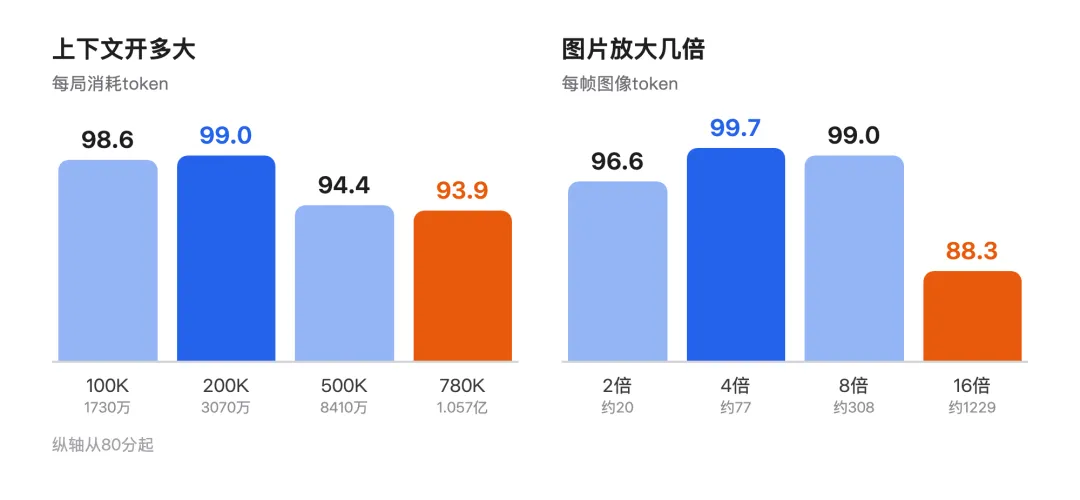
From 200K to 780K, the image went from 8 to 16 times, with no ups and downs.
Not necessarily better, this is the idea behind the whole VISTA design, and the team says in their blog that they are intent on pursuing simplicity.
There is no newly trained model in the system, and the instructions for each game are the same.It's four sentences, and there's not a word that teaches it exactly how to play.。

VISTA gives the model all the instructions.
It's a summer's code that matches a page's note.
This summer, ARC-AGI-3's high-resolution programs, such as Tycho and Schema, have big models write a set of programs that can run on each game and build a simulator to try and make mistakes repeatedly.
LF52 One, Schema wrote the entire 4,000 lines of Python.
The VISTA model, which uses only three phrases in the notes in natural language, establishes the same rules.

The same jump chess rule, left is the code for the program route (about 4,000 lines in total), and right is the three notes that the Vista model itself wrote down.
According to the paper,VISTA is the first non-written system to achieve full or near-full performance on ARC-AGI-3.。
In the real world, no one can write you a 4,000-line simulator in advance.
Claude Opus 5 completed all 183 passes in 25 games, scoring 100 points each, running a total of 7,302 steps, only 0.43 times that of humans.
The GPT-5.6 Sol also went all the way through, getting 99 points.
In the game, humans walk 1107 steps, and Claude takes only 219 steps. Both scores are available on the official ARC Prize platform.
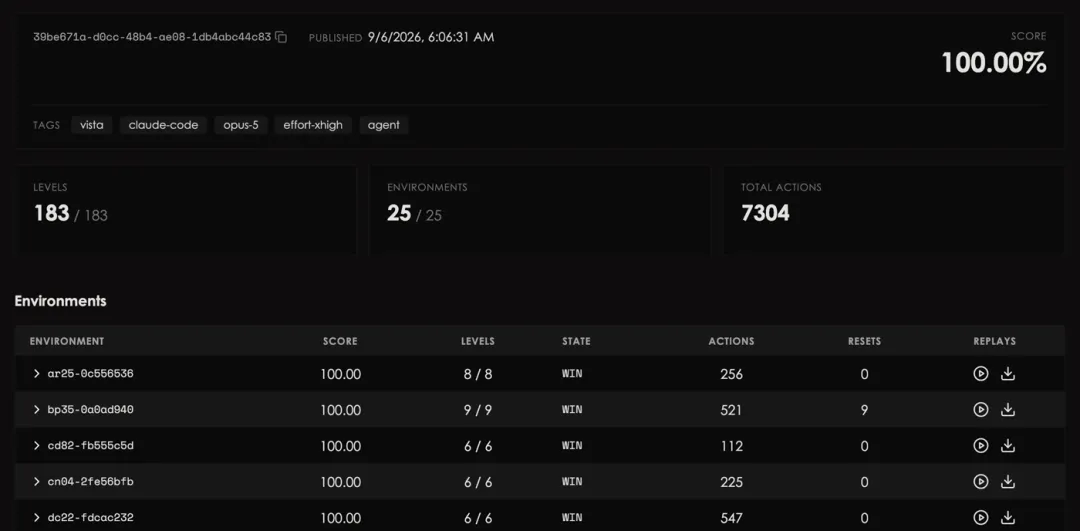
The scorecard on the ARC Prize's official platform is 183, with 25 games full of points.
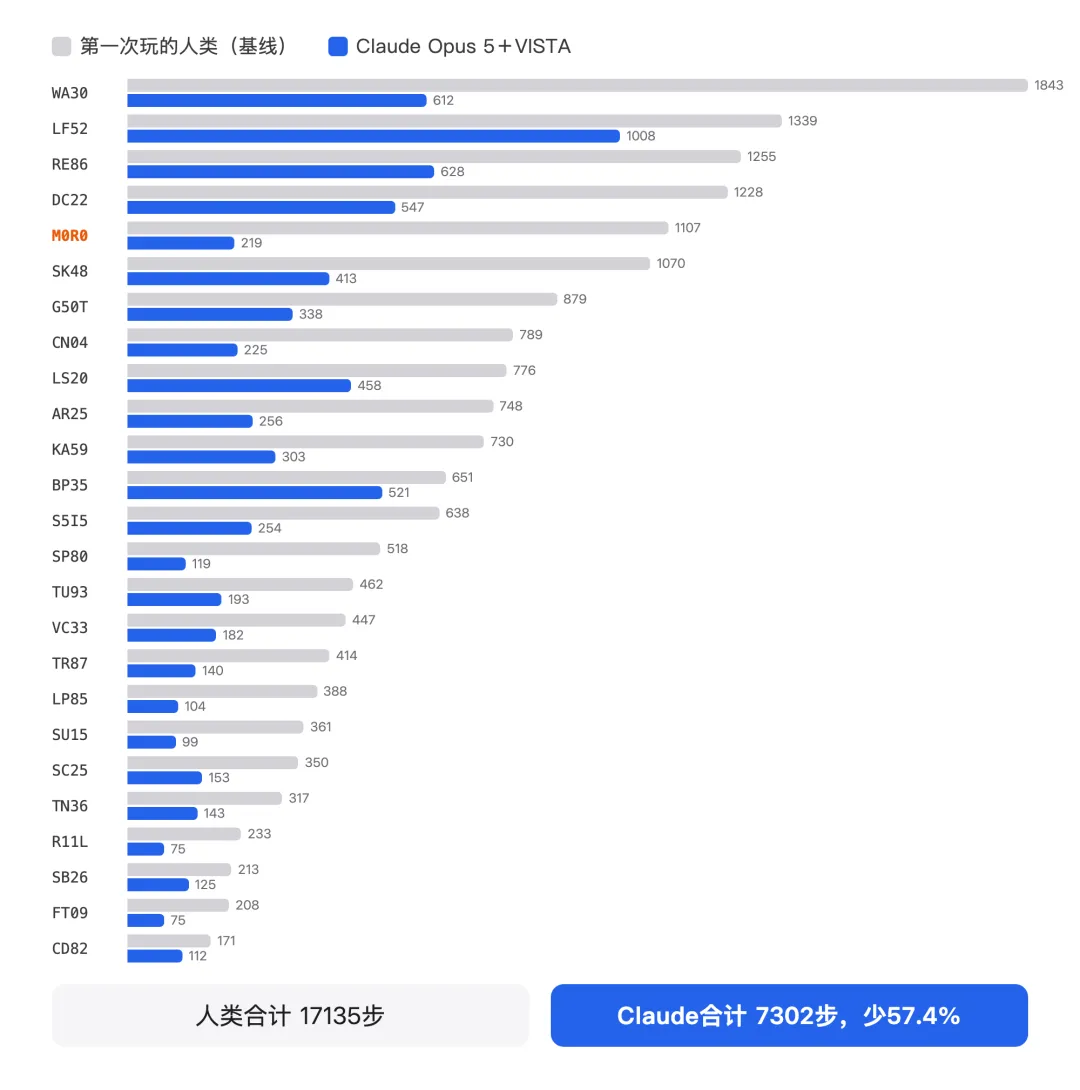
Twenty-five games in a row, blue is shorter than gray, blue is Claude, and gray is the first time humans played.
The Harness, a purely mechanical, zero-trained harness, is widely used.
If you put it in a 3D image, you'll get 84.12.
GPT-5.6 Sol has been featured in 34 web games (including Mario, 2048, My World, etc.) with a success rate of 63.3%, directly overwhelming the human race (55.3%).
Even static viewing questions can be used. One of BabyVision's linear questions is that the model reverses the camel and the duck without using VISTA and responds with a larger view of the VISTA.
Even with the official implementation of the 320B open-source model, which was almost handed over to the white paper (1.89 points), the hardcore version of the VISTA set was raised to 66.93 points.Thirty-five times the storm.!
For three years, Ho Chi Minh's team has been dying of vision.
The mainstream interpretation of the ARC test has always been a text reasoning that is monopolized by big language models.
However, the team is not convinced, and publishes three books a year.It's the same thing: ARC is a vision problem。
The first VARC visual model with 18 million parameters matches the human average from zero to zero.
In the second NAT-ARC study, models were first allowed to watch cats and dogs take lessons on ImageNet, and abstract reasoning was then reinforced.
The third is the VISTA, which is a small model that has not been practiced and is attached directly to the front-facing large model with a "photograph".
He wrote three ARC papers a year, all of which claimed that "ARC is a visual problem".
It is a series of three papers by Dr. Hu Jia, a graduate student from the Shanghai-based ACM class, two of which are one, one, two.
VISTA is co-authored by MIT PhD students Qiushi Han and Linlu Qiu, and MIT Associate Professor Cathy Wu.
This time, the visual route has been pushed all the way to the AGI campus by ResNet and MAE.
This is also a challenge to the industry as a whole.
Over the past few years, we've worked hard to make the model bigger, to extend reasoning, and to push the progress of intelligence almost entirely on the model itself.
VISTA allowed the same Claude to score from 40 points to complete, relying on a pair of eyes and a photo book outside the model.
Mike Knoop, co-founder of the ARC Prize, also believes that more and more "learning" takes place outside the model weight.
The next step to AGI is who can make models see the world, remember the world.
The next stop for the team is a physical environment full of real images, where no one will translate the world into a digital table in advance.