
It's the first time in the history of the world.
ArXiv has officially implemented the strictest new rules: two papers per month per person, including rejections!
As of October 1, there is a limit on the number of times papers can be uploaded to arXiv.
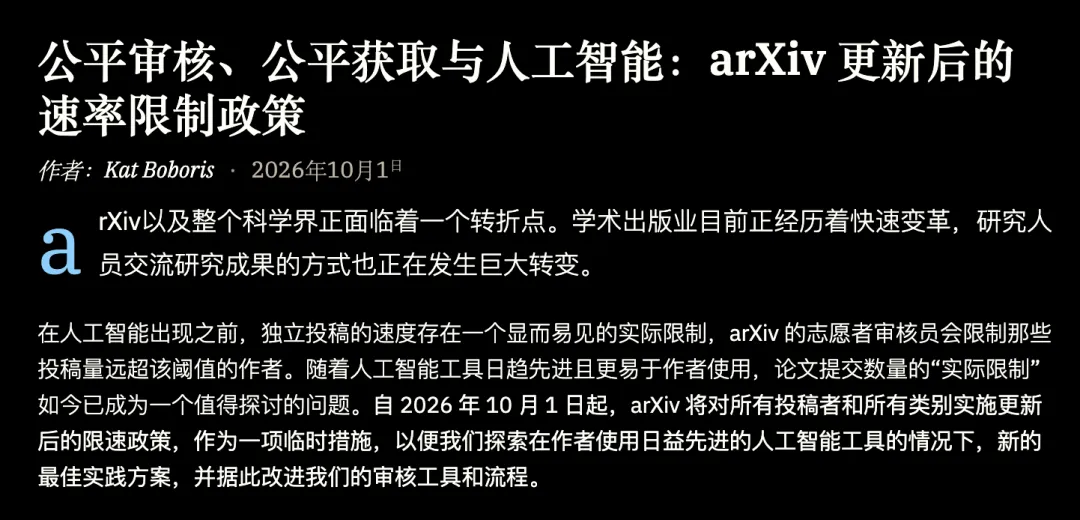
According to the new rules, a maximum of two submissions per month for each submitted account and no more than three pending audits.
The manuscripts rejected by the auditor are also titled, while the other authors on the paper are unaffected, and the titles are only marked on the head of the person who "submitted" under the item.
This rule was enforced by the amount of posts posted by the explosion.
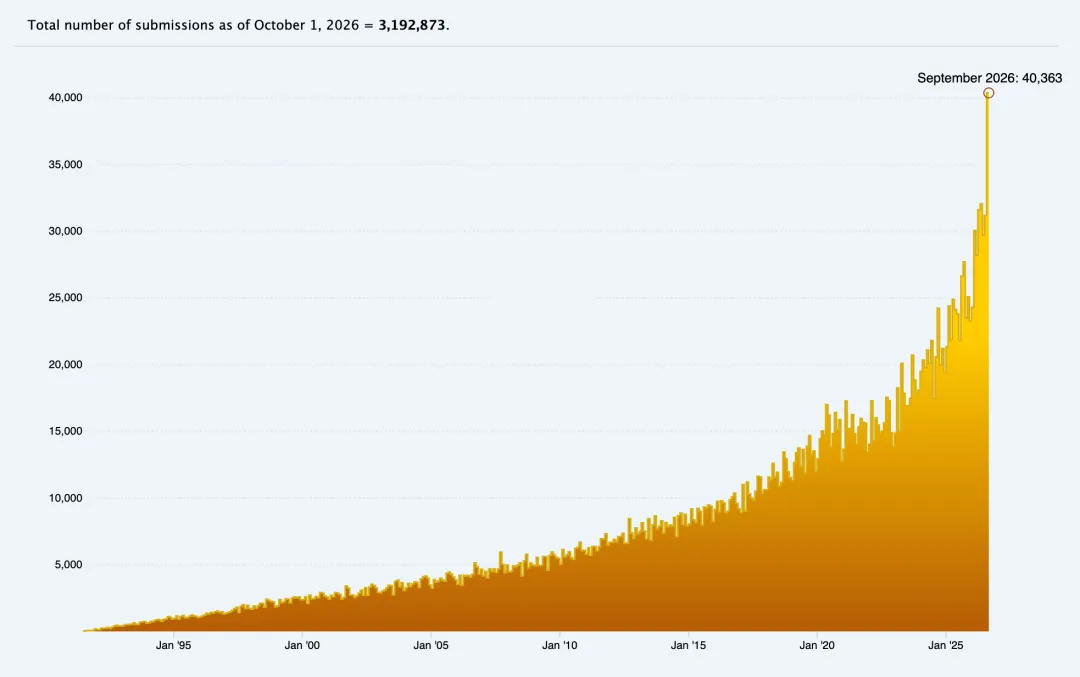
In September, arXiv received 40,363 posts, setting a monthly record, and staff and auditors processed nearly 9,000 job applications.
In September 2016, it took arXiv less than 10,000 monthly posts to reach 20,000 in eight years; from 20,000 to 40,000 in just two years.
Classification of AI (cs.AI) is the fastest growing, growing more than six times in two years.
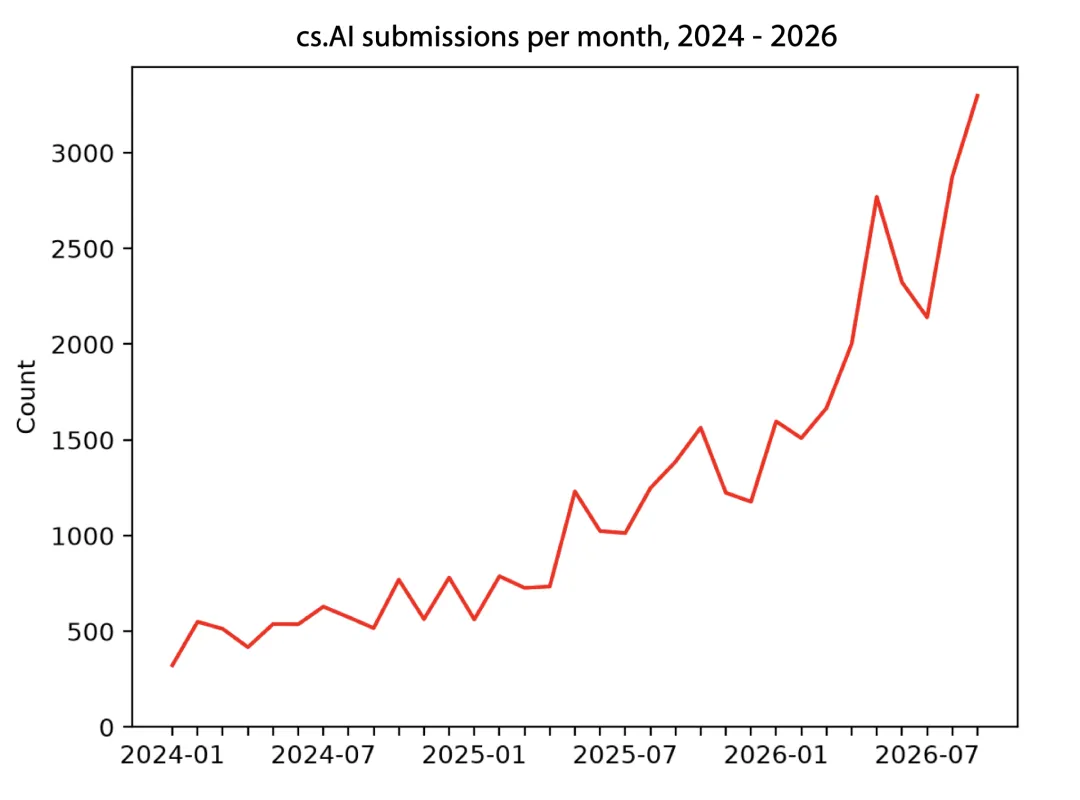
According to the arXiv announcement, in the past, the speed at which a person could write an image-like paper was roughly limited; this was not allowed after the adoption of AI tools.
Three hundred volunteers reviewed 40,000 manuscriptsArXiv is not peer-reviewed, but each manuscript must be reviewed before it goes online to determine whether it meets academic norms and whether it is appropriate to classify.
This work was undertaken by about 300 volunteers, who are researchers in all fields.
According to arXiv, the auditors have recently seen a growing number of narrow-themed, single-content papers, often breaking up a work into "salsa papers" in several posts, and large sections of text generated by AI.
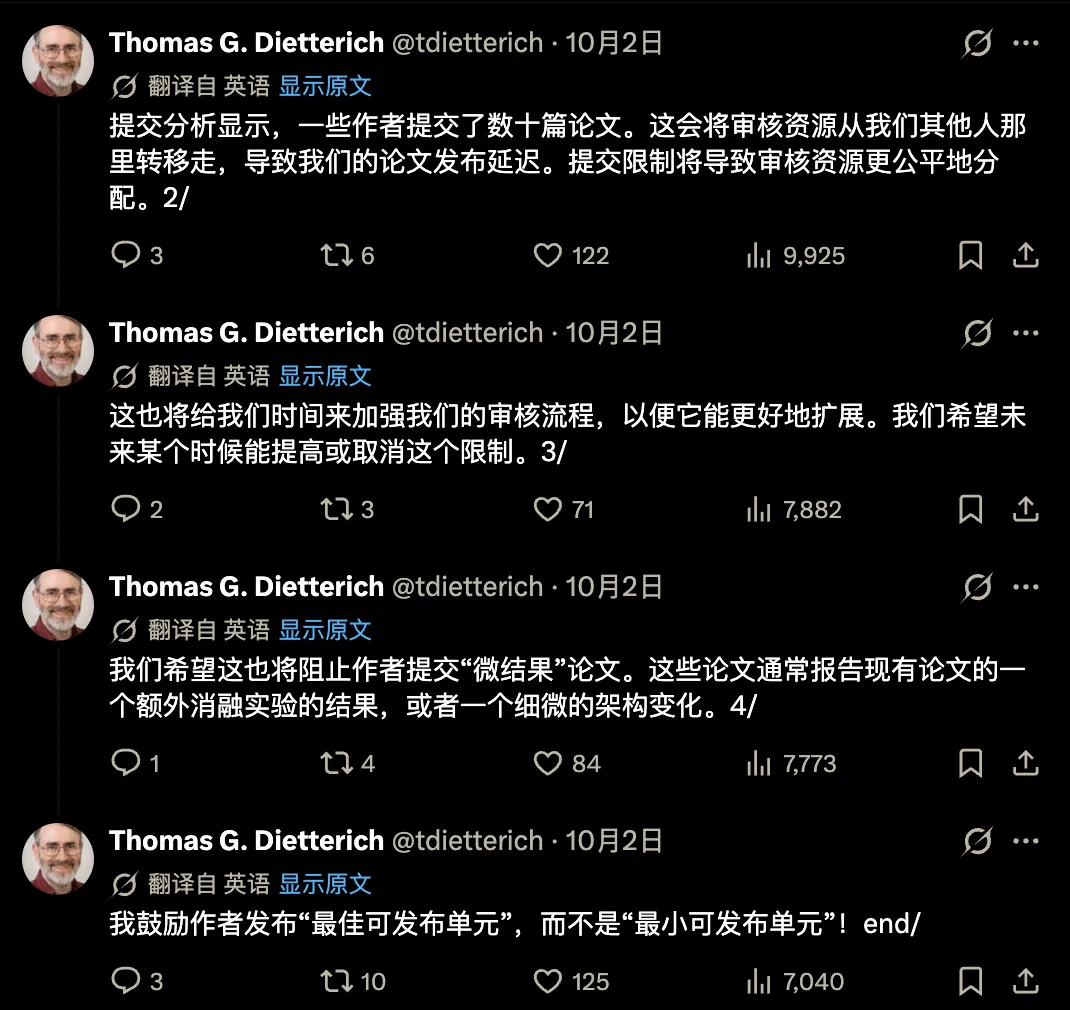
Professor Thomas Dietterich of Oregon State University, chairman of the editorial advisory board of arXiv, said in the announcement that the problem was mainly with a small number of authors who submitted a large number of low-quality papers that took up a disproportionate amount of the time of the auditors.

He subsequently added to X, where the data showed dozens of authors contributed.
What's missing is not money.
On September 23, arXiv announced that it had received a grant of $17.2 million (approximately RMB 115 million) over three to five years, part of which was used to develop and manage AI-generated content technologies.
However, the development of new tools takes time to go online, and the number of volunteer auditors will not increase with funding.
ArXiv took this as a temporary measure, and Dietterich said he hopes to ease or even cancel it in the future.
This isn't the first time arXiv has tightened the rules in a year.
Previously, it had required review and position papers in the field of computer science to be uploaded through peer review, raising the threshold for new authors to get back-to-back books, and banned authors with AI hallucinations for one year.
Names are only counted on submitters' heads.Only the complainant is counted and there is a technical constraint behind it.
The list of authors of arXiv papers is manually filled in when they are posted, and the collaborators are required to obtain the paper's password and subsequent credentials to be associated with their accounts.
At the moment of submission, arXiv can only confirm the identity of the submitter himself.
The algorithms of academic conferences are different.
ICLR 2027 provides for a maximum of 20 posts per author; if no author of a paper is eligible for review, such a paper may be submitted for a maximum of one post per author.
Meetings can be person-to-person, as each author corresponds to an OpenReview account in the posting system.
Just look at the submissions and the vulnerabilities are obvious.
Networker Pitt noted in Dietterich's tweet commentary area that collaborative turnaround uploads can circumvent the restrictions.

The most affected are the researchers who happen to have completed several papers at the same time, whereas a single person can publish 24 single-author low-quality papers a year, with a three-person rotation of 72 papers.
However, this algorithm also avoids an old problem of human limitations.
In conferences counted by the authors, where instructors post excesses, students' papers may be rejected simultaneously; on arXiv, students' own papers are not affected by the number of instructors.
ArXiv also makes room for itself: it can ask individual authors to further reduce the frequency of posts when necessary.
Subject groups need to be redistributedFor most researchers, there is a surplus of two tablespoons per month.
What really affects is the habit of letting a person unify the group of topics in which they upload their papers.
Assuming a topic group has six ICLR 2027 posts that have not yet been uploaded to arXiv on 16 December, make it public as soon as possible.
In the past, a tutor or a high school student could graduate in a matter of days; under the new rules, the same account could only be submitted two times a month, before the first batch was made public, and no more than three at the same time as the reviewer.
If you want to hang all six of them in December, you need at least three people to submit them.
The most realistic way is to have the first author of each paper submit themselves, provided that these students are qualified to submit.
Starting in January, newcomers will have to automatically access arXiv backbooks in a given field, account must be tied to the institutional mailbox, and the name must include papers that have already been collected in the field.
Many students have submitted papers that have never been accepted by others, and may not even be eligible to submit them.
The best thing to do now is for everyone in the group to tie up their school mailboxes, get their paper credentials, and unconditionally get their backbooks in advance.
This is not the case for independent researchers.
With the big model, it is not uncommon for one person to produce several results in a short period of time, but without a collaborator to share the submission, two per month is a hard cap.
After the name tightened, the price of rejection also increased.
Rejected manuscripts are also nominated, and arXiv's review policy states that submitters who are rejected or delayed will be subjected to more stringent scrutiny and postponement.
The postponed manuscripts will remain on the list for a few days and a few weeks.
Therefore, before submitting it, it is necessary to review where the problem is easily solved: whether the main classification is appropriate, whether the synthesis and position papers in the field of computing have been peer-reviewed, whether the full English version is attached, whether the use of AI is explained as required, and whether the references in particular should be verified step by step.
In May, arXiv released a ban on AI illusions, stating that authors will be suspended for one year once they appear in a paper with fabricated references or remaining model instructions, and can only submit peer-reviewed manuscripts once they are unsealed.
ArXiv usually requires all signatory authors to be jointly and severally liable for this risk.
If a problem is discovered, it can be deleted on its own before the publication of the paper, so that it is not included in the monthly number and is not included in the examination number.
In the meantime, there will also be surpluses.
ArXiv doesn't publish new papers on Friday and Saturday nights, US holidays can be delayed, weekend or holiday submissions can be delayed for several days.
If a document has been uploaded to arXiv, it should be updated with a replacement version instead of a new one.
Not every paper has to be immediately uploaded to arXiv.
The ICLR's own posts are publicly available on OpenReview, where all authors will be made public after the review, with the results being verifiable first.
When names are tight, priority should be given to papers that need to be made public as soon as possible, such as Hugging Face Daily Papers.
Daily Papers, which is based on arXiv papers, only receives papers within 14 days on arXiv, and has already encountered authors who missed the submission window due to audit delays.
There are a few other issues that arXiv does not address: how the replacement version does not count numbers, how the replacement account for the collection of conference papers and the unified account for large collaborative groups is calculated, and what time zone "Natural Moon" is allocated to.
Additionally, helping the page write a maximum of two posts per month by "each author" is not consistent with "computing only submitters" in the announcement questionnaire.
Before a clear answer is given, it is more prudent to arrange it according to the strictest understanding and not to place all expectations on the rotation of submissions.
As for how long this temporary measure will last, arXiv does not give a timeline.