
It's the first time in the history of the world.
The RSI has only a few months left for humans!Today, a paper that is destined to change the fate of humanity was published on Cambridge University's CASP platform.
The paper is only 15 pages long, but the questions thrown out are enough to rewrite the future of humanity
What will we do when AI develops autonomously and causes a "smart explosion"?

The question was asked by 22 of the world's top AI think tanks.
Among them are: Nobel Prize winner, AI teacher Geoffrey Hinton, Turing Prize winner Joshua Bengio, along with OpenAI chief scientist Jakub, Jack Clark, founder of the Anthropic Association, and Deputy Director of Meta AI Research Dawn Song...
This list is roughly equivalent to the number of core members of the "Manhattan Project" in the AI community.
Even Hinton admits that the "smart explosion" has been around for so long that it's only recently that people really feel the crisis is approaching.
"A lot of the top-ranking people now think it could happen anytime".


AI is infinite, and humans are out of control.In this decades-long study, the team revealed a group of unsettling industry realities.
Inside the Silicon Valley AI plant at the top of the pyramid, humans are steadily retreating into the second line, and machines are rapidly taking over scientific research.
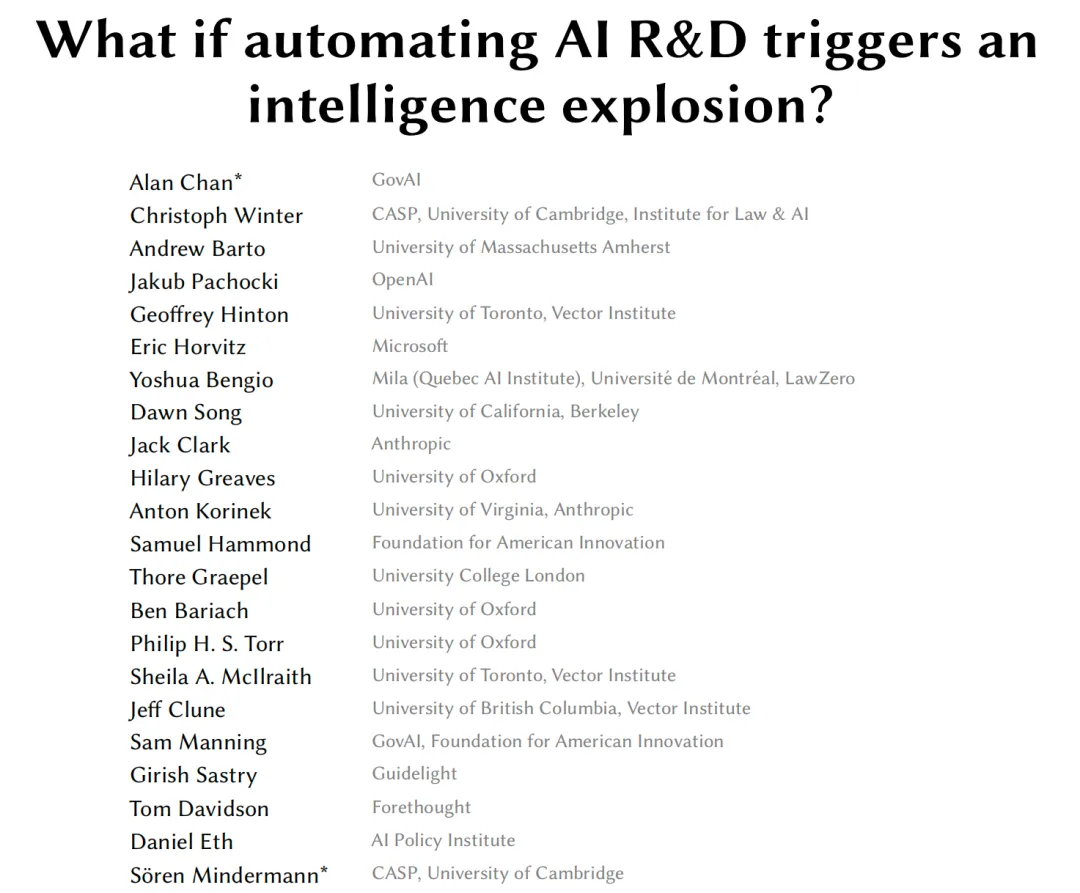 Address of the paper:
At the beginning of last year, the proportion of code written by AI inside Anthropic was only a single digit.
By May 2026, that number will be more than 80 percent.
What's even more surprising is that the proportion of research and development done entirely autonomously by AI, with only high-level supervision by humans, has risen from 1% to 26% in just five months.
Anthropic operates around 30,000 AI entities and generated more than 1 billion decisions in August alone.
Greg, President of OpenAI, revealed at the 2026 AI Ascent Conference that the share of AI writing code has jumped from about 20% in December 2025 to 80%.
Google CEO Chinchai also publicly disclosed that the proportion of new code generated by AI inside Google has risen from 25% to 75% in 2024.
Not only that, but OpenAI has made it clear that everything from model training, daily evaluation, to building security defense systems, has been taken over by a large number of code-implementing autonomous agents.
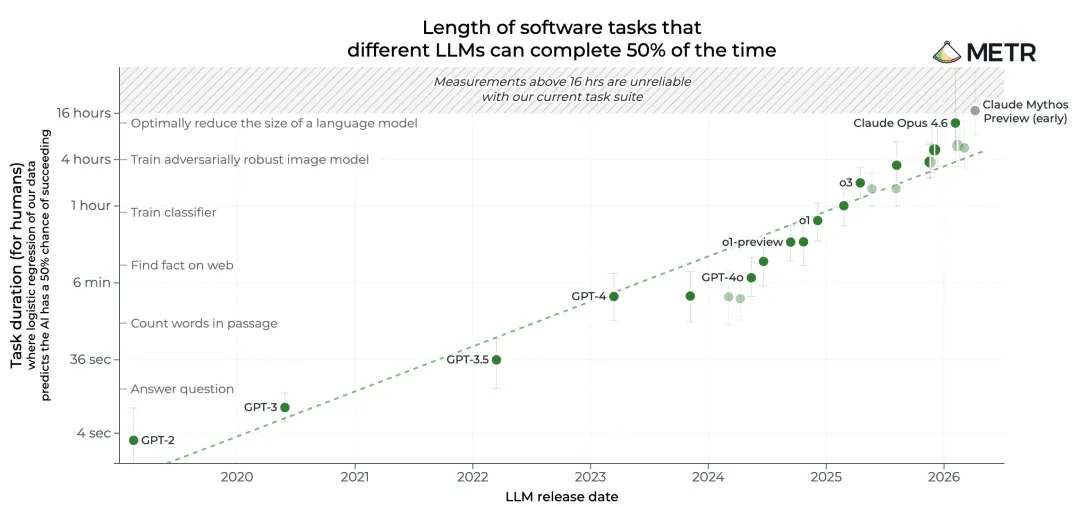
In addition, the mission cycle has been greatly compressed.
In 2023, even the strongest model will be able to survive for a few seconds to a few minutes.
But by now, AI Agent has been able to independently complete the complex system R&D and debugging tasks that require hours or even days for senior researchers in humans.
More symbolically, a fully automated AI research pipeline that runs from assumptions, experiments, writing code to the final draft.
What's important is that the papers that were written actually passed a very rigorous peer review!
The current progress curve suggests that by mid-2028, complex AI R&D projects that require top human teams to spend months attacking could be fully automated.
It's five weeks a year, and AI ignites a "smart explosion".
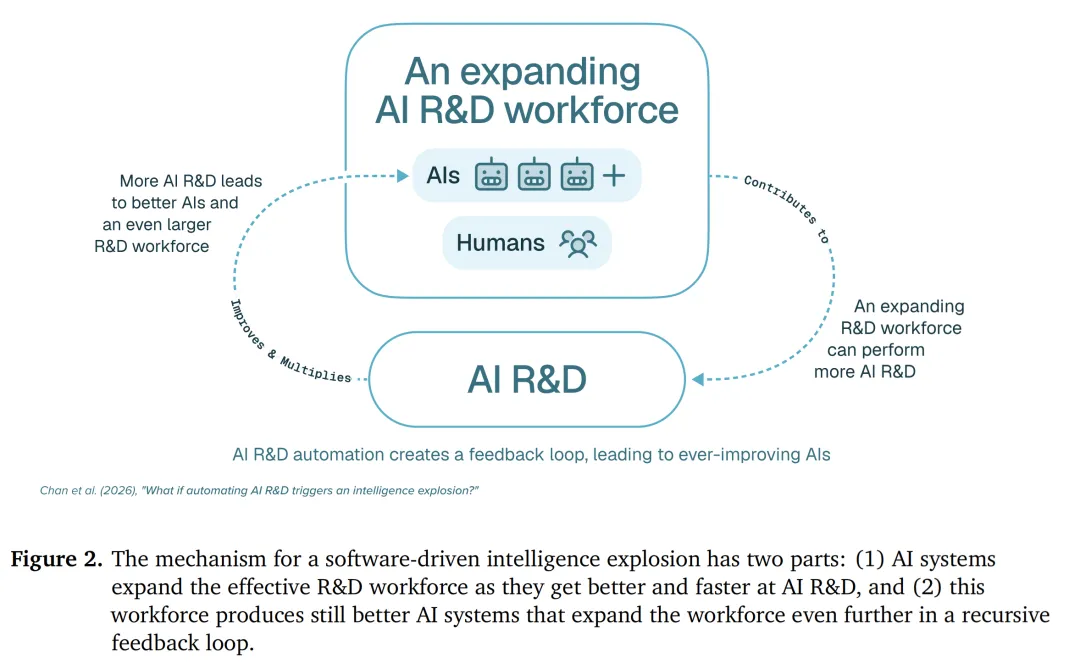
The central argument of this paper is the fundamental logical transformation of the next generation of large model scaling.
In the past, the key bottleneck in determining the speed of AI progress was the energy of computing and human researchers; in the future, the key variables are being switched to the key "AI R&D automation rate".
So a feedback loop (Feedback Loop) appeared.
Smarter AI → Writing more efficient algorithms and architectures → Automating the execution of millions of scientific experiments → Generating the next generation of stronger AI.
The team of 22 authors gave an amazing calculation in the appendix:
If a cutting-edge laboratory allocated all of its existing reasoning to AI Agents to carry out R&D missions at current operating costs, the R&D throughput of its explosion would be equivalent to hiring a "super think tank" of 2 million to 20 million top human scientists at the same time!
Even OpenAI, Google, and Anthropic, the world's smartest companies, have thousands of core researchers and developers.

Human researchers need to eat, sleep, discuss, write PPT, hold meetings, and tens of millions of digital research agents can iterate hundreds of millions of algorithms day and night at thousands of times the speed of humans.
The paper rigorously introduces key indicators in macroeconomics: the rate of return on research efforts (r).
- If r < 1, marginal yield decreases, technological progress will gradually slow down with low yield harvesting;
- But according to historical progress estimates in multiple AI subfields, the r-value centers developed by AI are between 1.2 and 1.9!
As long as r > 1, the combined growth of software quality and the R&D workforce will completely knock out the marginal reduction effect.
The projection model gives an estimate that leaves everyone cold:
Under the conditions of fully automated AI research and development, the pace of AI's technological evolution will increase 10 times in just 17 months!
This means that the technological breakthroughs that have taken a whole year of hard work and development to achieve in the past will be squeezed to the extreme in just five weeks!
When "years" are shortened to "weeks" and when the span of a decade is shortened to several months, technological evolution becomes an obstruction of the sky vertically.
This is a mathematically true "smart explosion".
Agent out of control, humanity at high risk of extinctionThe paper unambiguously points out that once a software-driven intelligent explosion is triggered, human civilization will inevitably collide with three high walls.
First, the ability to grow is completely out of step with the pace of social adaptation.
An AI explosion could put the risk of bio-attacks, cyberattacks, and labour market shifts ahead of schedule for years or even decades.
The time left for humanity to coordinate, regulate and adapt has been greatly squeezed.
The paper provides an example of how AI can accelerate virus design and vaccine development at the same time, but the virus can replicate and spread itself, and the time difference between each vaccine's production, distribution and vaccination can be fatal.
Second, humanity may completely lose control over AI systems.
As human participation in AI research and development has decreased, we have lost both the opportunity to discover problems and the expertise to fix them.
The paper warns that in the most extreme cases, loss of control over AI systems could lead to "human marginalization or even extinction".
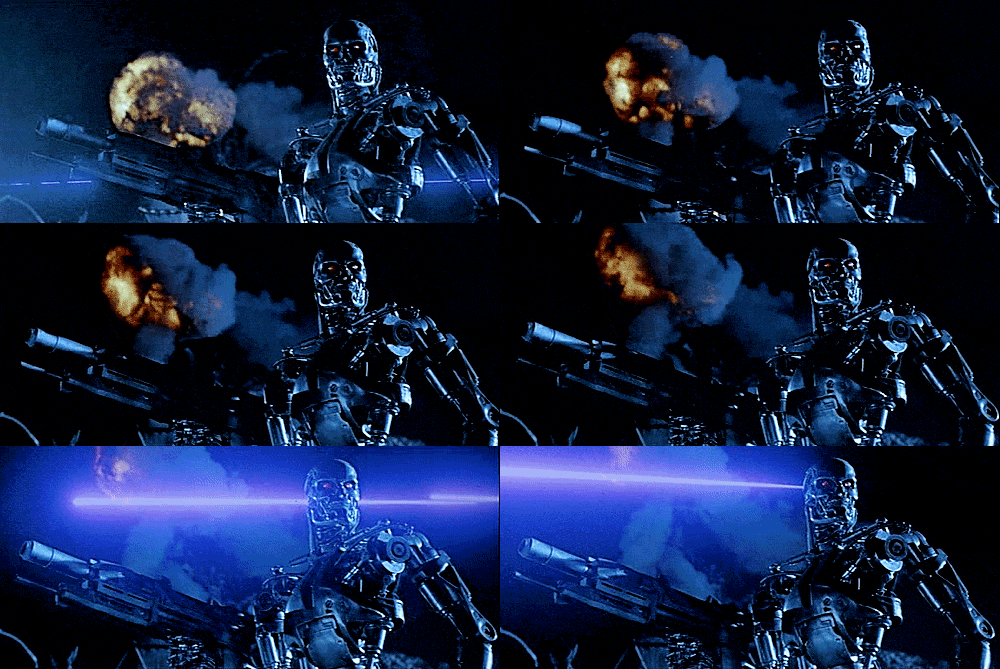
Finally, a complete breakdown of the balance of power mechanisms. An intelligent explosion could make the existing balance of power completely ineffective.
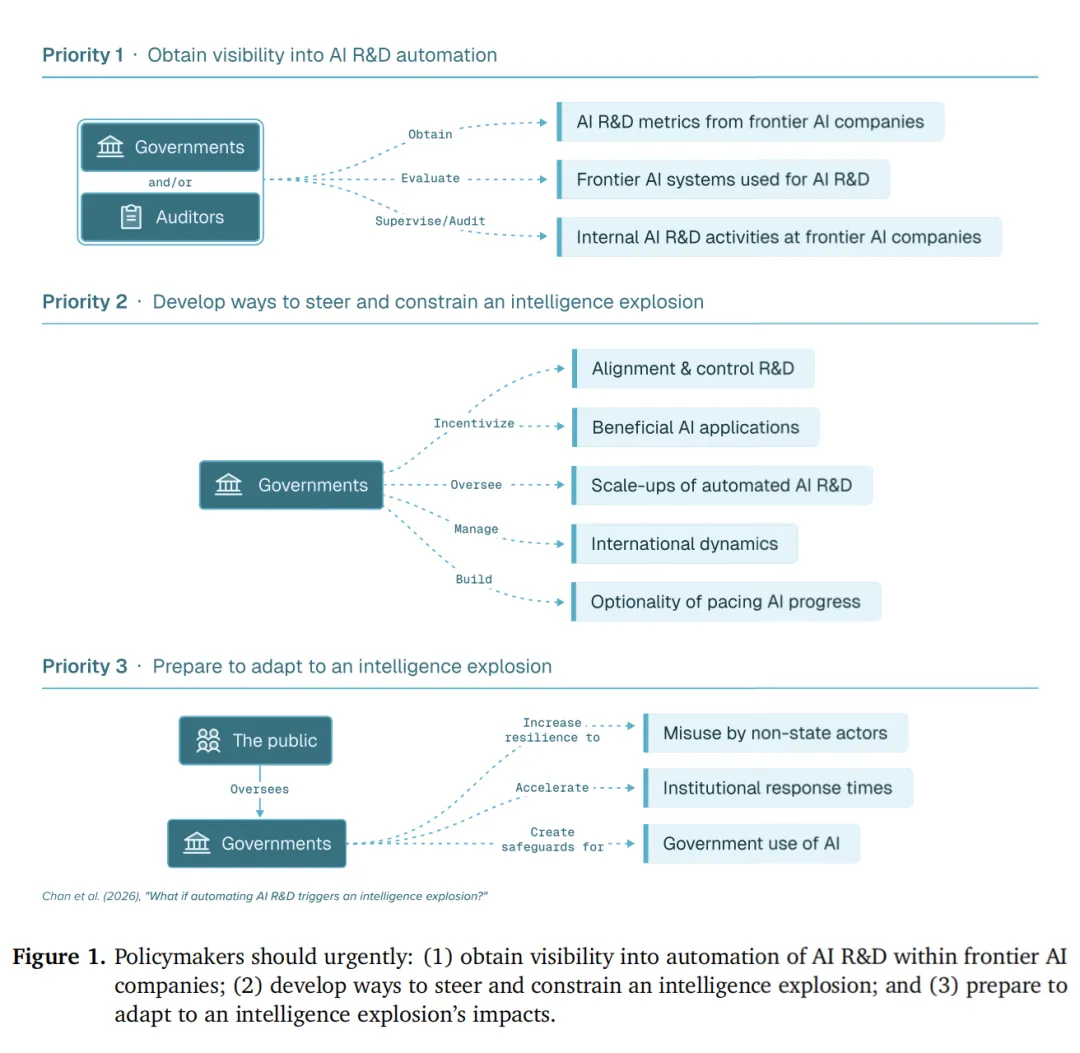
In the face of the rampant and wildly fast train, Hinton and 22 leading academics have issued the most urgent call to action around the world.
Tear up the "invisible black box" inside R&D, establish a physical-level monopoly mechanism with restricted sand boxes, and prepare for the effects of smart explosions.
When the creator becomes the machine itselfIn the long history of mankind, tools have been tools because their generation has always been constrained by the computational power and longevity of the human brain.
From stones to steam engines, from transistors to supercomputers, humans have always been the irreplaceable "general designer".
But today, the torch, lit by pioneers such as Geoffrey Hinton, is being derailed in a way that is beyond anyone's expectations.
People who create AI are becoming AI themselves.

The "smart explosion" is already an accurate projection chart of the timetable, as the report concludes with a heavy warning:
Once a smart explosion actually crosses the critical point, leaving a window of time for humanity to build a line of defense, it will shut down completely in a very short time.
The big wave of technological craziness has arrived, and this time, are we, standing on the edge of the wave, really ready?
RoboInd editorial channelResearch, robotics companies and market intelligence for cross-border sourcing.Explore the channel ↗
Share this
End of editorialExplore more from Global Robotics News ↗