Given a baseline model, a target capability and an arithmetic budget, RSI Agent self-designed to train algorithms, collect and organize data, write code, run experiments, iterate improvements, and ultimately deliver a well-trained model, completely uninterrupted. In the PostTrainBench autonomous post-training benchmark, it ranks first with 46.6 points, outperforming all front-end models and the Agent system, approaching human expertise (51.1).
Recently, the AIBuildAI team released PostTrain Agent, a recursive self-improvement (RSI) agent for self-training large language models, and open source all code and supporting knowledge base.
This is an open-source address:
The library of knowledge:
Technical report:
Why we need post-training for automation
Post-training is the process of turning a base model into a model that can follow instructions, reason, use tools, understand a model in a particular area, or a company's way of turning a general model into "its own model". It involves a lot of decisions: what data to use, how to compare it, how to supervise fine tuning (SFT), whether to optimize or reinforce learning, learning rate, training steps, and finally which checkpoint to deliver.
These decisions go hand-in-hand: the right algorithm depends on the data matrix, the effective data matrix depends on the base model. Delivering a well-trained model often takes several weeks for an experienced team, with each experiment consuming considerable computing power. The question of whether AIuildAI PostTrain Agent's research is whether this can be entirely entrusted to AI's input base model, target capacity and computational budget, the entire process of the agent's own training, and the output of a well-trained model.
PostTrainBench: A quiz for the Agent
PostTrainBench (Rank et al., ICML 2026) makes this problem a benchmark: given baseline models (such as Qwen3-4B-Base) and target capabilities (such as tool calling), Agent on a single H100, self-designed and executed post-training programs within 10 hours, the resulting checkpoints are scored on a set of ratings held by the benchmark, Agent can't see. The benchmark covers 4 baseline models and 7 classes of tasks: mathematical reasoning (AIME 2025; GSM8K); writing (ArenaHard Writing); answering (GPQA); health consulting (HealthBench); coding (HumanEval) and function calling (BFCL).
What external data is used, how it is mixed, how it is monitored, preferred to optimize or reinforced learning, superparameters and training frameworks are all decided by the Agent himself.
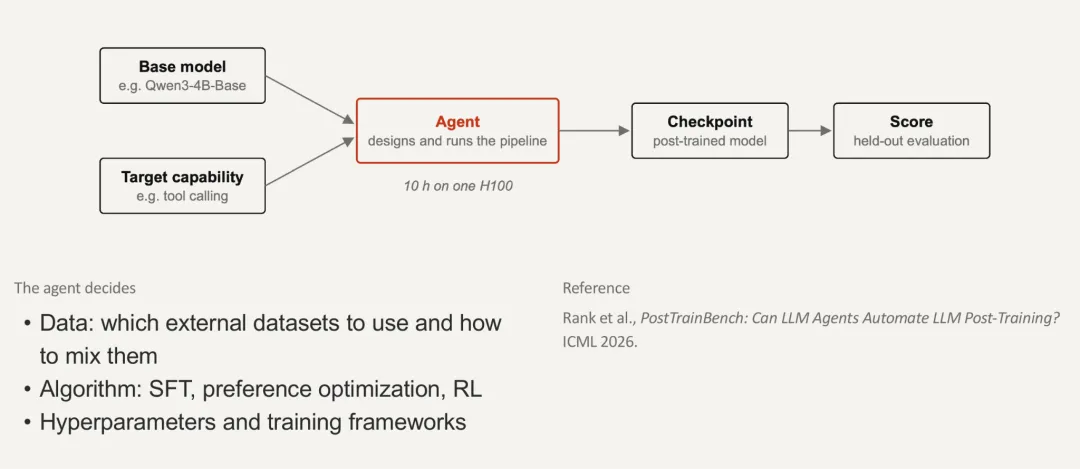
Figure 1 The task of PostTrainBench is to input the baseline model and target capabilities, train the agent to design and execute autonomously in a single H100 within 10 hours, and score the resulting checkpoint on a set of ratings that the agent cannot see.
From a line to a tree
The baseline approach on the list is to direct an encoded Agent (such as Claude Code) directly to the task: a session, a CLI environment, giving it a baseline model, data, GPUs, and evaluator, allowing it to program, write code, train, evaluate itself. Such an Agent is a linear search: each attempt is modified once, the program is set early, followed by a path; several very different ideas cannot be explored in parallel, and one direction that has gone wrong consumes the rest of its budget. Its data, methods, and hyperparametric choices also come from the model's numerical knowledge.
AIBuildAI's previous system (AIBuildAI Science, AIBuildAI-2.5) uses an entire experimental tree to search: one run is an experimental tree, each node is a complete experiment, scored by the task's own evaluation program, and the value of the run is the highest score on the tree. "Designers" agents broadcast several deliberately different start-ups, each program being a branch root; "Experimenters" end-to-end run an experiment and make several modifications to become a sub-experiment; "Selectors" arrange the experimental selections according to the expected returns, evidence, novelty and cost that await GPU candidates.
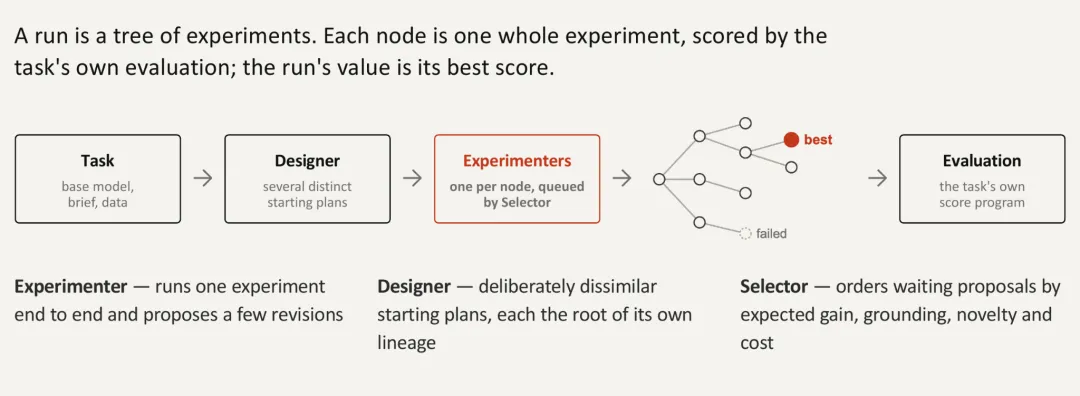
Figure 2: Searching the entire experimental tree: the designer gives several different start-ups, the experimenter completes the entire experiment by node and proposes modifications, the selector ranks the candidates; each node is sorted by the task's own evaluation process.
But moving the process directly to post-training, it exposes two limitations: one is that it doesn't understand the field, and that it can only be answered by a language model's internal knowledge, typical errors include choosing a method that doesn't have any library implementations, using and evaluating overlapping datasets, using superparameters of another model size, and that each error takes a whole training session to detect; two is that it must hit every node in the search tooth that is dead before understanding the task, and that it must be an exaggerated model at a stage such as "generating data" that doesn't divide or make nodes; that several models that are trained in different nodes merge into a single "fan-in", and that the search tree can't express itself.
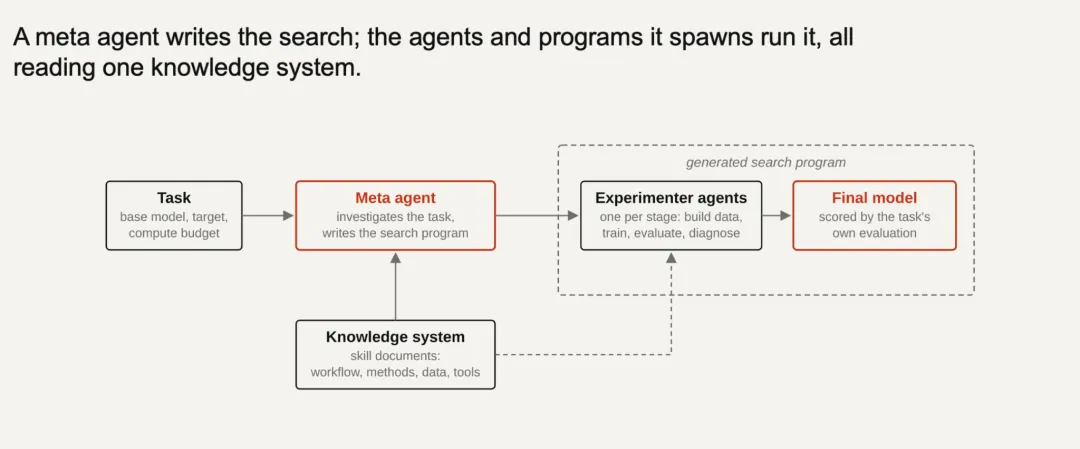
Figure 3 AIBuildAI PostTrain Agent System Overview: The former Agent investigates missions and writes search procedures, which are executed by the agent and the program it sends, and all agents share the same knowledge system.
Knowledge systems: allowing agents to make decisions based on evidence rather than memory
AIBuildAI PostTrain Agent's Knowledge System is a remote retrieval knowledge library provided by MCP, which consists of a set of "knowledge files" divided into four sub-books: workflows: 13 sequential steps to run after training; 34 documents, each step describing the judgments to be made; a specific case and its applicable boundaries); methods; 111 documents: oversight, DPO, GRPO, distillation, and so on; what each needs, how much it costs; what parameters and defaults; data sets; 215 files: licenses, snippets, code uploads, sample lines, and labels which criteria must be measured; and 108 framework documents: when to select, move, and save it; and how to start training.
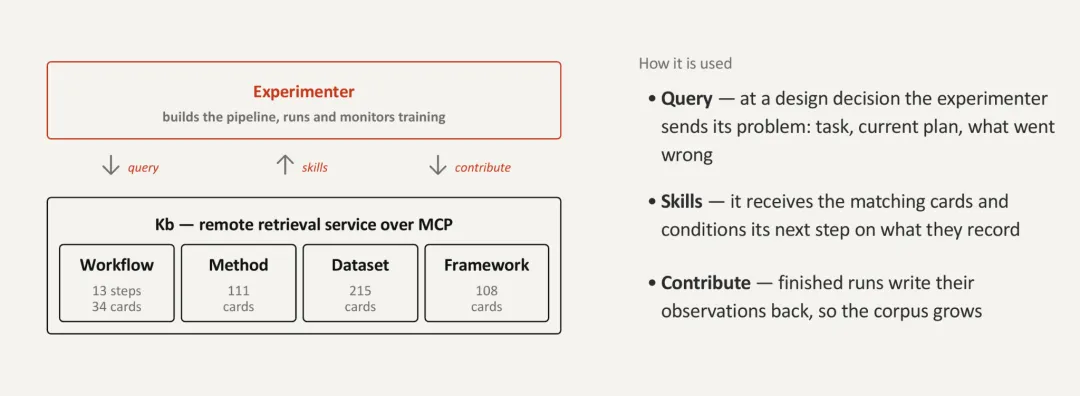
Figure 4 AIBuildAI PostTrain Agent Knowledge System: The experimenter takes the knowledge base with questions, retrieves the corresponding knowledge files, and writes the observations back after the experiment.
Each knowledge file is collected from public sources - papers, library code, data set descriptions on the Hub, public training records - through the scope of artificial verification, verification of permissions and snippets. After verifying the facts from the code, each statement is written in a uniform template with the URL and date; any reference to the rating benchmark is removed from the contents. When faced with design decisions, the experimenter gives the "task, current program, where the problem arose, take back matched knowledge files, and send the next step according to this decision; the completed experiment will also be rewritten, and knowledge will grow accordingly.
The first step in the workflow, for example, requires the Agent to read "what scores really reward" before selecting any data: scoring to see if the final answer is a complete response, whether the format error scores scores directly, whether the reasoning process is not scored; then running a full run on an untrained baseline model is baseline, and the runtime is the "single evaluation cost" of the subsequent allocation of the budget.
The topology of the search itself becomes the output of the Agent.
Different tasks require different types of searches. Linear searches for a suitable program are determined, only situations where the same method process is repeatedly refined; tree searches for several credible ideas, only situations where evidence can be exchanged. However, in post-training there is often a structure where neither can be expressed.
Take a typical example: first preparing a training set of two training data mining tasks and an external data set constructed from open contents, each of which is monitored and micro-tuned on the base model, using the verification set to select the better model as "current best; then entering the reinforcement learning phase: each round starts with a round of GRPO training from the current best, and the training ends with scores on the verification set, only the scores actually improving to replace the current best with the new model, otherwise dropped, so repeated until the budget can't run a round again.
The scheme is tree-search-proof: each node in the tree must be a trained, overworked model, while "building an external dataset" only produces data, with no models or scores, and no nodes in the tree.
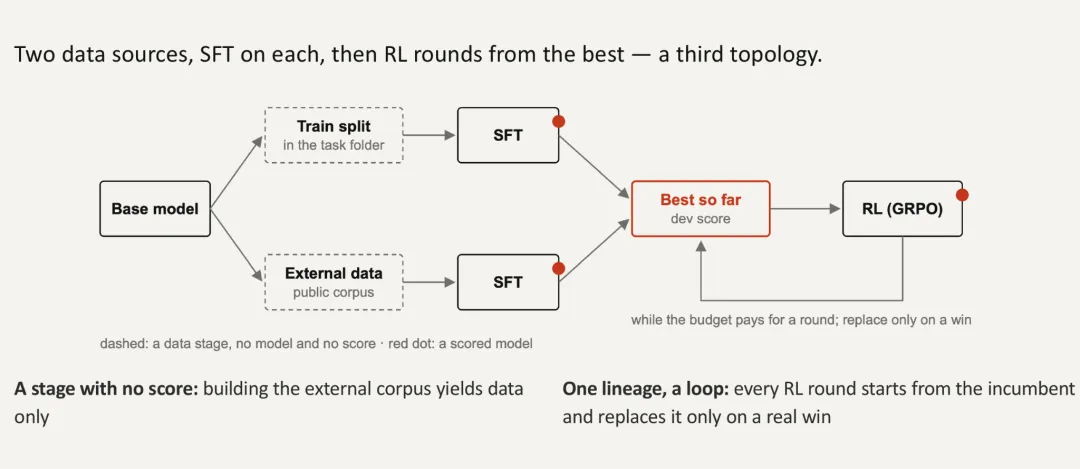
Figure 5 shows a post-training program that neither a linear search nor a tree search can express.
The AIBuildAI PostTrain Agent's solution is sub-search: first send a sub-agent, which investigates tasks, reads design knowledge files, 37 types of search patterns that can be run: chain-based, fan-on/flip, loop, step-by-step processes, and checkpoint tournaments, supervise micro-modulation of GRPO, multi-round training on budget constraints, etc. Exclusive training strategies) query knowledge base, and then write a search program. Each step of the program can be an LLM, a determination program or embedded search, and the whole can be any execution of a string stage, a tournament, a fan, a loop.
The search process consists of three basic unit combinations: Agent is an LLM session with a toolkit and typed output, Program is a deterministic computation that operates under independent resource constraints, and Search combines Agent、Program and embedded Search. 37 patterns are vocabulary rather than whitelist, and Agent can be combined, modified, or written outside of a directory structure.
The search program does not have to kill the entire run before running: the main agent can only write the current stage of the program to construct a feed, or read the remaining budget after a round of training and evaluation of the run, and hand over the next generation of the main agent to write the next stage based on the test results.
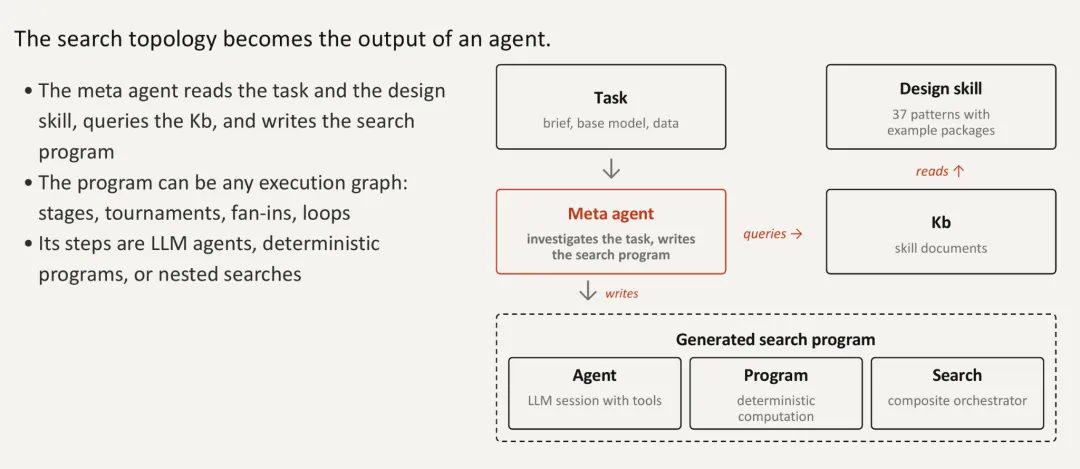
Figure 6 - Search: The former Agent reads tasks and designs knowledge files, query knowledge libraries, and writes a search program consisting of three basic units of Agent, Program, Search.
Experimental analysis
All experiments followed the setup of the PostTrainBench list: each task ran fully automatically for 10 hours on the single H100, completely uninterrupted; all Agent roles in AIBuildAI were run on Claude Opus 5, and all results were generated by mega-searches.
Comprehensive Score: Top of all frontier models with Agent systems
On the PostTrainBench, the AIBuildAI PostTrain Agent's combined weighted score was 46.6, higher than all other front-end models and Agent entries, 51.1 behind the Human Expert Baseline. It was followed by Locus (45.6) and Claude Code of Claude Fable 5 (41.8), followed by GPT-5.6 (36.2) ‒ Claude Opus 5 (35.0) ‒ Claude Opus 4.8 ‒ 33.8) ‒ Kimi K3 ‒ 32.0) ‒ GLM-5.2 ‒ 31.7) ‒ Gemini 3.1 Pro ‒ 22.0) ‒ and so on.
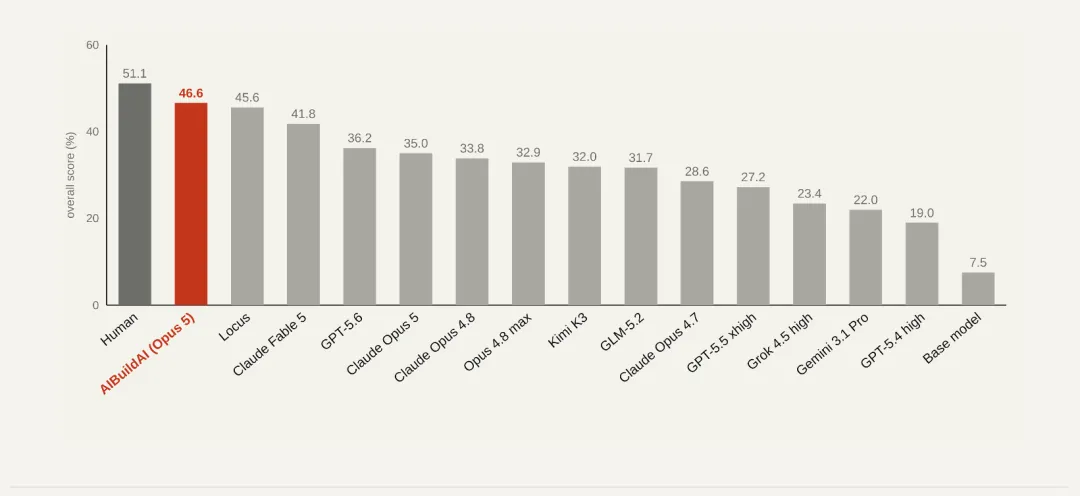
Figure 7 PostTrainBench aggregate score. The aggregate score is the weighted average of seven tasks: AIME 2025 22.7%; GPQA 22.5%; HealthBench 18.4%; HumanEval 10.6%; GSM8K 9.4%; ArenaHard Writing 9.0%; BFCL 7.5%; the average for each task is four base model.
The same underlying model, a different system: +11.6 points
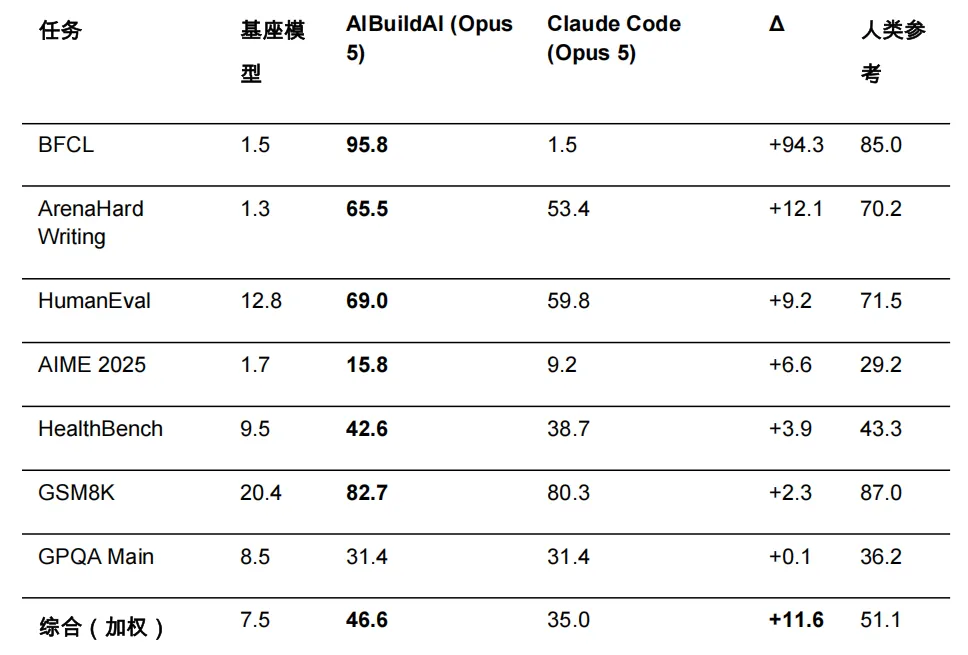
Each task has an average value of four base axis models. Δ is the difference between AIBuildAI and Claude Code, both running Claude Opus 5.
A more illustrative comparison of the value of the system itself is that all of the AIBuildAI's Agent roles run on Claude Opus 5, while the Claude Code of Opus 5 runs the same, with a 35.0 point marginal difference of 11.6 points from the system rather than the model.
The three biggest upgrades are BFCL ((+94.3) ‒ ArenaHard Writing ((+12.1) and HumanEval ((+9.2) ‒46.6 for AIBuildAI ((Opus 5) ‒41.8) ‒ which is also higher than the Claude Code of the more powerful Claude Fable 5 model.
Division of Task Analysis: Three missions scored Agent's highest score, while the remaining four were less than two points behind the leader.
Compared to all Agents on the list, AIBuildAI scored the highest in three categories: AIME 2025, 15.8, followed by Claude Fable 5's 13.3 and Locus' 9.4); BFCL 95.8) and HumanEval 69.0, and Locus 66.6); ArenaHard Writing, GPQA, HealthBench and GSM8K, with a gap of less than two points from their respective leaders.
These gaps are based on different mechanisms. Whether BFCL calls by function can be analyzed correctly, whether a given schema is met, the format is somewhat inconsistent: the same running Opus 5's Claude Code averages only 1.5 points and is parallel to the untrained baseline model; AIBuildAI uses knowledge systems to select a set of data that matches the training framework and format, with scores on all four baseline models not less than 94, averaging 95.8, and the only one of the seven tasks that exceeds the human reference 85.0).
ArenaHard is a preference judgement, essentially a data selection question of which of the preferred ingredients to choose. AIME's answer is verifiable: "Sampling Hardware Testing" is a loop, which is the arsenal of meta-searching; it is the heaviest of the aggregate scores and the farthest of all Agent references from humans. AIBuildAI scores the highest or highest alongside Agent scores on each base model, including the hardest gemma-3-4b-pt3.3 points, while the other Agent scores do not exceed 1.1).
Figure 8 shows seven missions scored in each of the four base-models. The official instruction-minimized version of the official instructions for each base-model is the reference, not the participating Agent.
Two examples: How Agents make scores step by step
In both cases, the Agents deployed an open-source teacher model to write training data on their own GPU and planned only one stage at a time to decide the next step based on the test results.
HealthBench × Qwen3-4B-Base (basic 13.4 → 48.6, Claude Code 40.9): First, the teacher model wrote about 480,000 responses, which were monitored and tuned to 46.2 points; then the teacher model continued the training to write about 6,800 paragraphs of longer multi-course conversations, screening the candidates on the subset and confirming them on the full assessment set, reaching 48.6 points.
ArenaHard Writing × SmolLM3-3B-Base ((Basic 0.4 → 74.6, Claude Code is 69.7): First supervise the subtlety of the contents written by about 20,000 teachers, and make a weighted average of 74.2 points for the last three checkpoints; then do a round of rejection samples selected from the student model's own responses by the teacher as the best continuing training mouse again after averaging 74.6 points.
The vast majority of the gains in the two runs came from the first round of full training on teacher data; the results of each subsequent stage are only validly confirmed in the full assessment set.
What is a search engine written by a former agent?
In the example of AIME 2025 × Qwen3-1.7B-Base, research has been done prior to the Agent manual writing program: only 20% of untrained baseline models give the answer lines required by the evaluator, 23% of the topics have been generated to the length limit and do not end; for two format examples, the ratio of the answer lines has increased to 73%, but the accuracy has not changed at all.
The real problem is that a 1.7B model can learn how long a rational chain is and write a five-step search process: simultaneously constructing short, medium, and long chain lengths of content on the CPU, while saving and evaluating baseline models on the GPU to establish baseline and single-step evaluation costs; each content is tested on a small budget; the results of a strategy Agent reads the baseline, tries the test and scans the content, decides whether the main training content is from the test checkpoint or not; then the second stage is the main training; the last option is the second stage of the training, the length of the fire, the rejection of the sample modulation or the DPO).
The entire program consists of 471 lines of Python, eight files (one search editor, five Agent roles, two identification programs), all generated by the Master Agent in a session prior to the start of any training.
Summary and Prospects
AIBuildAI PostTrain Agent indicates that post-model training is moving from "human expert-operated tools" to "self-contained research and development by AI". Under the same conditions as the underlying model Claude Opus 5, AIBuildAI is 46.6 points ahead of Claude Code by 35.0 points, leading six out of seven missions, one level, and will narrow the gap to less than 5 points with the human reference expert 51.1. This indicates that the limits on the ability of the Agent to determine not only the underlying model itself, but also whether it can make decisions based on reliable knowledge, whether it can design a search structure suitable for the task, and whether it can continue to learn and adapt from experimental results.
More importantly, the automation of the PostTrain Agent is not a fixed training process, but a complete model development process: understanding goals, research tasks, preparing data, designing algorithms, writing code, running training, evaluating results, and redesigning the next stage of the program based on experimental feedback. In this process, AI no longer just executes pre-written training formulas for humans, but begins to make assumptions, build experiments, analyze evidence and iterate improvements on its own.
In the longer term, post-automation training is just the beginning. The same paradigm can further cover pre-training, data generation, model architecture design, reasoning optimization, evaluation, security alignment and deployment, ultimately forming a research and development system capable of autonomously designing, training, validating and continuously improving AI models. Humans only need to define goals, constraints and value standards, and AI can search for the best models and algorithms to achieve these goals in a given resource.
When models are able to participate in improving the next generation of models, AI research and development will no longer be entirely limited to the time, experience and speed of trial and error of human experts, but may evolve into a process that is executed on a machine scale and continuously driven by experimental feedback. AIBuildAI wants to build an AI research and development infrastructure that enables AI to develop AI autonomously and model innovation from a few top teams to complete complex projects that can be used by any organization.
This is not the case.
[1] AIBuildAI LLM-Post-Train Agent: an agent for autonomous post-training of large language models. AIBuildAI Team, 2026.
[2] PostTrainBench: Can LLM Agents Automate LLM Post-Training? Rank et al., ICML 2026.
[3] AIBuildAI: An AI Agent for Automatically Building AI Models. Ruiyi Zhang, Peijia Qin, Qi Cao, Li Zhang, Pengtao Xie, 2026. ttps://arxiv.org/abs/2604.14455
[4] AIBuildAI-2: A Knowledge-Enhanced Agent for Automatically Building AI Models. Ruiyi Zhang, Peijia Qin, Qi Cao, Li Zhang, Pengtao Xie, 2026.