I don't see enough cycling anymore.
On September 22, Anthropic released Claude Opus 5.5, which was quickly screened on X with a strange "front-end piece".
Some used the word Prompt to create a 15-second Motion Designer job-seeking Showreel that drew an audience of over two million people; others used a button to turn the music into a player, a slider, a chart and a control panel; and others used Opus 5.5 to build a 3D camera lab that turned the focus ring, and the mirrors and focus panels inside really followed suit.
Recently, AI companies around the world have piled up major model versions, and the front end has become the "open-box ritual" of this generation of models. Whether or not to write HTML before is not a problem, as everyone compares it to a Prompt, which has no aesthetics, no understanding of space, can complement a vague idea into a truly visible work.

Several of the Prompt's were quickly replicated: in card games, ten consecutive drawings of the Moon Cat SSR; when the piano played, the hand-drawn lines stretched forward with the notes a little bit...
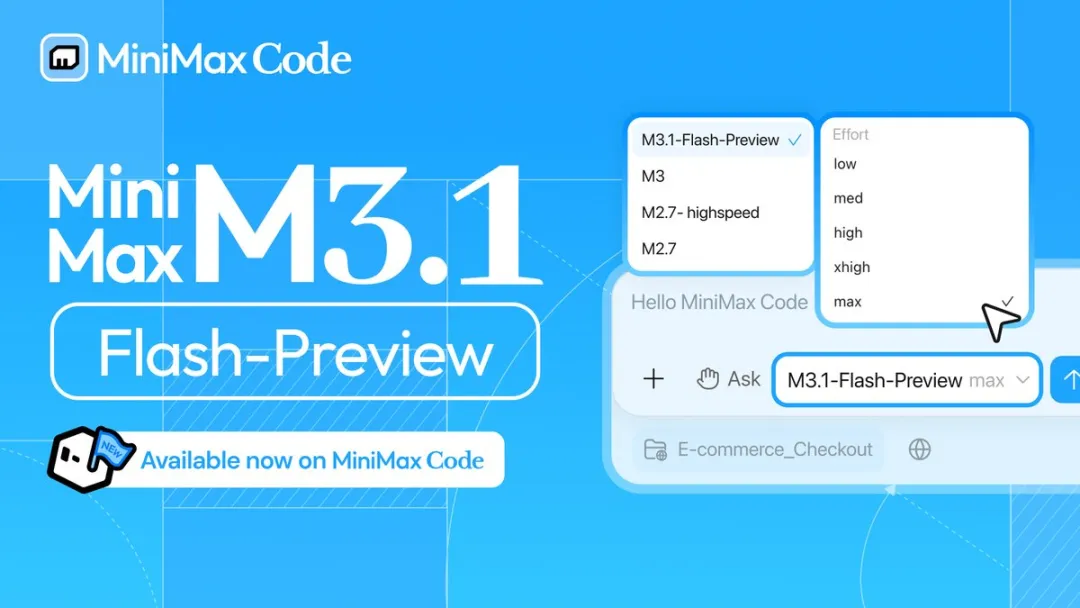
Six days later, on September 28, MiniMax released the M3.1-Flash-Preview. It is the latest model in the M series, with millions of tokens in the background.
So someone threw the Prompt at it, not thinking that the result was not only running, but that it could be replicated on M3.1 Flash without drawing multiple cards. Opus 5.5 is the new flagship that was just defined a week ago, and now a Flash model can replicate that part of it.
These front-end cases
The M3.1-Flash is running.
Let's see what the M3.1-Flash-Preview can do.
Ten-line drawcards are the most sophisticated decades in the gaming industry designed to have an attractive visual lighting effect, and the revelation of the rhythm point, the SSR classification must be refreshing, and the reason to not jump in the middle. The results of the previous Opus 5.5 (true step-by-step instructions input) can be said to shock the audience:
M3.1 Flash's work is called ASTRAL SUMMON Star Spirit Call of Duty, and the page is a complete prayer process: 1600 drill lines, upper right corner with SKIP, ten cards turned on and off, with special dynamics when "SSR-NEW" comes out, and the card is not a static map, followed by a complete set of character panels, level growth, star break, character unlock.
How many systems are running at the same time? Particles and light effects are a set, card flipping sequence animation is a set, card pulling state machines are a set, and the numerical panel has a real-time update effect. Any link is slowly sliced or distorted, and the ritual feel shrinks instantly, while in the version delivered by M3.1 Flash, the systems are bitten together.
It seems that AI has already grasped the essence of it.
The second topic: Hand-drawn animation of the piano soundtrack. The original version is the effect created by the netizens with Opus 5.5, and the sound of the piano and the hand-drawn images are synchronized:
The M3.1 Flash version of the game is called Mcode and the Piano Piano of the Black Cat. 1080×1080 frames, 24fps torque, the soundtrack is an original piano piece, with a total of 20 movements. The model not only paints an animation, but also completes the composition.
This gives us confidence in a bolder test.
To make things even more complicated, we could use M3.1 Flash to create a retro dance machine game that you can play in your browser and share online:
Or let it take 45 minutes to build a 3D interactive game interface on a spacecraft in Earth's orbit:
In the community, developers have even created a dark myth with M3.1 Flash: 3D modeling of the Enlightenment. The multi-dimensional structure, materials, lighting, and interaction of complex 3D scenes seem to have taken on this role.
While 3A games have yet to be directly generated, AI models are now able to significantly advance the verification phase of content production, quickly verifying concepts, characters, and scenarios.
In practice, we can also observe a detail in which M3.1 Flash Preview actively scans its own projects during the course of the task, or writes bugs before re-checking, like a person who has pre-verified himself several times before delivery, only occasionally doesn't know how to use them.
So the question is, what is the parametric size and token cost of the Flash-level model, and how does it achieve flagship-level front-end completeness?
This means that this front-end thing is more than just "front-end" technology.
Why is M3.1-Flash doing this?
For AI, front-end code is relatively easy to learn, and it's really hard to have a "taste".
For this purpose, the model must first construct a closed loop of vision to be able to "see" its own work. If it is purely manual, the front-end work goes from the first line of code to the final delivery, and in the middle it goes through many rounds of "generate, screen, screen, check, modify" cycles, writing a layout that sees the rendered page, and finding the problem to go back to the code to track.
There are two ways to implement AI: one is to train a language model and then install a visual module; the other is to learn text and images together in the same model from the first step of the training. M3.1 Flash takes the next step. According to MiniMax's official description, the M3 series began multi-modal training from Step 0 with the purpose of reconstructing the pre-training data pipeline and introducing a large amount of crossover data, which gives the model its flagship visual judgment and correction capabilities.
It is not enough to see clearly, but it is more important to establish a feedback loop between vision and code. This step is mainly based on the chain of thought in the past, and each step is a fundamental function of the testing model, the greater the advantage of the parameters.
In the original multi-mode model, visual judgement is more like a direct "seeing" out, and when vision and code complete semantic space alignment in training, redundant thought chains have been perceived to have been replaced. In the official case of M3.1 Flash Preview, converting visual reference to interactive code has been separately listed by MiniMax as a capability.
There's also the hardest thing to quantify: models have to understand the design intent, and have the ability to truly understand multi-models. Now the many tasks facing AI models are only one "big direction", and it's about understanding the "what I want" intent behind Prompt.
Considering that M3.1 Flash comes from MiniMax, this is not the ability to appear suddenly. In its product line, there is full-mode integration, H3 video models with powerful contextual understanding capabilities; in combination with the Agent desktop MiniMax Design, people can complete complex production in a simple way through natural language interaction, from creative direction, Agent execution, all the way to auditing and final delivery, transforming the underlying AI capabilities into controllable commercial products.
Intent-understanding visual style was originally the MiniMax's ability to produce long-term training and productivity in multi-mode generation. Now, this ability has also been introduced in large M-series models.
Flagship capacity begins to decline
The rules for separating people from AI have also changed.
Within a few years of the emergence of the big model, the way humans collaborate with AI has changed quite a bit.
At first, we used large models in a way that was like filling out a detailed worksheet: layout, color, what to write in each text, where to switch the buttons, and AI itself can often not see the details. Later, the model began to get some vague descriptions, the worksheet can be written roughly.
This is a shift in division of labor. When delivery is no longer a bottleneck, the value of people in creative work is concentrated on defining issues and aesthetic judgment.
The front end can be said to be the best place to present a large model complex. Unlike Benchmark's untouchable scores or the details of the model architecture, the web pages and games generated by a large model are becoming more mature and have quickly become the miles to AGI. It makes AI's comprehensive capabilities visible and easier to understand, behind which tests are not only code generation capabilities, but also instruction-following, long-range tasks and aesthetic judgments.
More importantly, it is potentially useful. For users outside of developers, front-end generation is easy to judge, and there is also a lot of landing space in the content scene. It may have been first used by people who already need a lot of visual content: brands, designers, e-commerce and gaming teams. Work that used to require collaboration between multiple people is now being compressed into one Agent task.
And once AI-generated products enter the real workflow, quick program verification will change the way they work.
Finally, it is apparent that the shelf life of the current flagship model capacity is shortening.
Opus 5.5's calibration capabilities, as defined on September 22, were delivered by Flash-level models six days later, even faster and less costly. The speed of this tracking front-end model used to be quarterly and is now daily. The front-end is just the latest example of the same decline in context, tool calling, and code capabilities over the past year.
For model companies, the real barriers are no longer just computation and data, but the choice of training routes and the worldview of models are becoming increasingly important.
What is the meaning of this verse?
The M3.1 Flash is currently only a Preview version, but its front-end performance allows it to handle more, more complex tasks.
In the field of AI, the wind has shifted, as the GPT 6.1 Sol, launched by OpenAI on September 30, shows us that AI has also begun to play on the real price. Big models have evolved to this stage, taking on too much real work needs, efficiency and the real price is becoming increasingly important: it is now the flagship model that is responsible for bringing the ceiling of intelligence to the top, and the functional model that is responsible for dealing with everyday real work.
Six days, one round, the next round has already begun.