“ Without a powerful motor, a life-size spine allows four-legged robots to run faster.
When we talk about four-legged robots running faster, the first reaction is often to upgrade the motor, increase the drive power. In the industry's conventional thinking, stronger power output is almost equivalent to higher movement speeds. But nature has long given a different solution: falcons, grey dogs, elephants, these fast-running mammals, not only rely on their limbs to produce power, but also their spinal columns to flex repeatedly with their state cycles, and their limbs to work closely together to complete their body movements.
Based on this biological phenomenon, a team of professors from the Beijing University of Technology's School of Artificial Intelligence, Shi Qing, developed a miniature four-legged robot FLEXOR with a double-joint jointed spine, with an overall weight of 338 g and a body length of 110 mm. The team unveiled the underlying mechanism of dynamic spine-leg collaboration to improve the propulsion and energy efficiency of robotic movements.
The study was completed by Beijing Technological University as the first completed unit, jointly with Nanjing University's Shenzhen Vice-Professor; the first author, Prof. Wang Jiaqiang; the Northern Institute of Technology Triangle Institute of Technology (Jiaxiang) as a communication author, with support from the National Natural Science Foundation, Zhejiang Province's Shenzhen Military Headquarters and the Science Program.
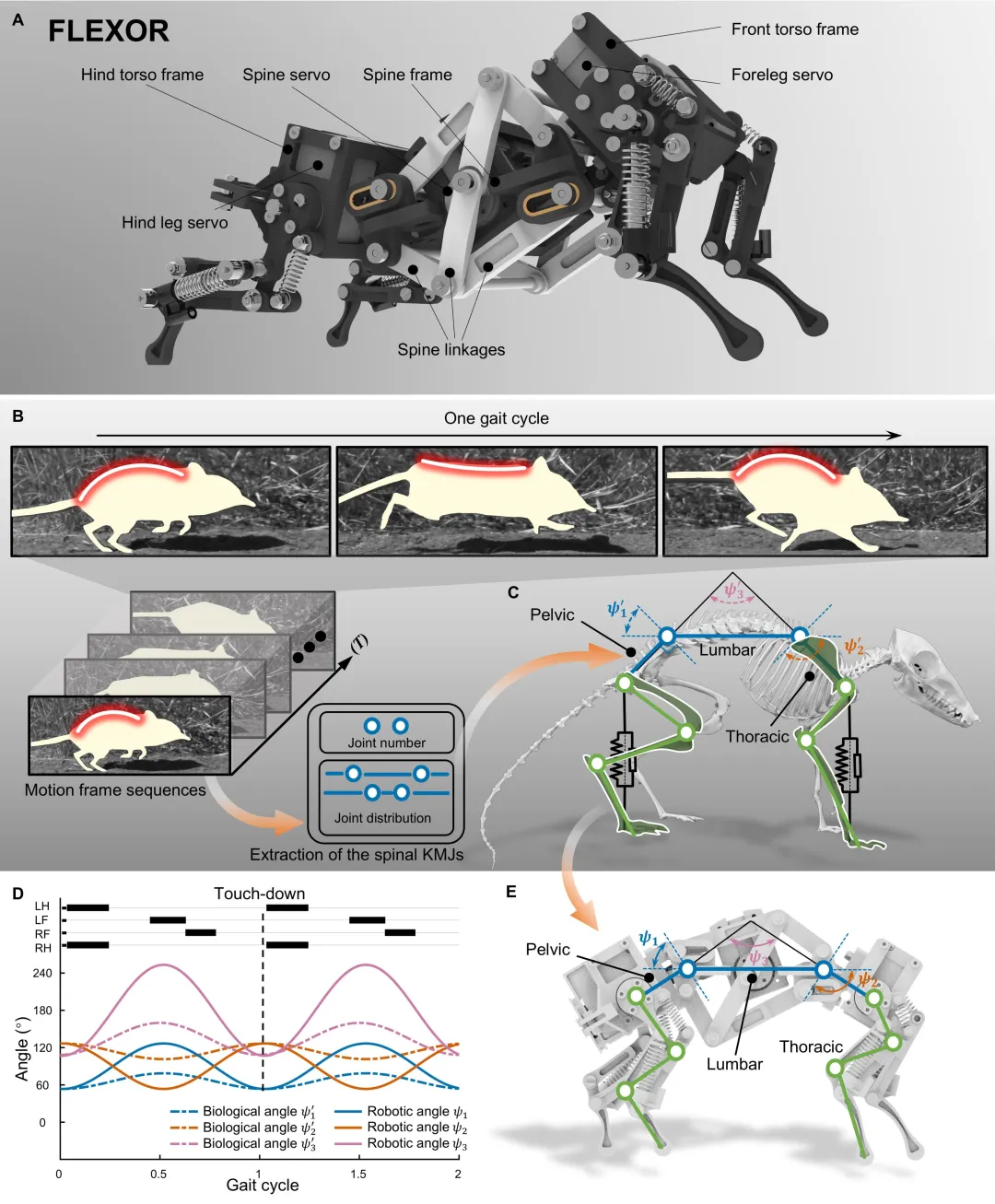
Robot systems used to understand dynamic spine-to-leg coordination
01.
Small robots are not running fast and not all are driven.
For small quadrupeds and micro-robots, the body type is unlocked. Limited body space makes it difficult to plug in a high-power drive, and many people agree that running too fast is not enough power.
Its core secret is not the absolute strength of the muscles of the legs, but the substantial stretching of the spine when running at high speeds: the spine is involved in the entire propulsion cycle, assisting in the lengthening of the pace, adjusting the timing of the gaps and touches.
Traditional flexible spine quadruped robots mostly use single-rotating joints to simulate the motion of the biological spine, making it difficult to reproduce the mechanical coupling effect between the biological polygons; while rope-driven, fluid-driven spine schemes, which shrink the body, make it difficult to achieve precise timing control, and it is difficult to truly release the performance potential of spine-leg synchronization.
Demonstration of dynamics of robots
The team extracted the spine's critical motion joints from high-speed motion images, simplifying the complex biomechanical multi-spine structure into a pair of joints joining the spine, creating the FLEXOR prototype.
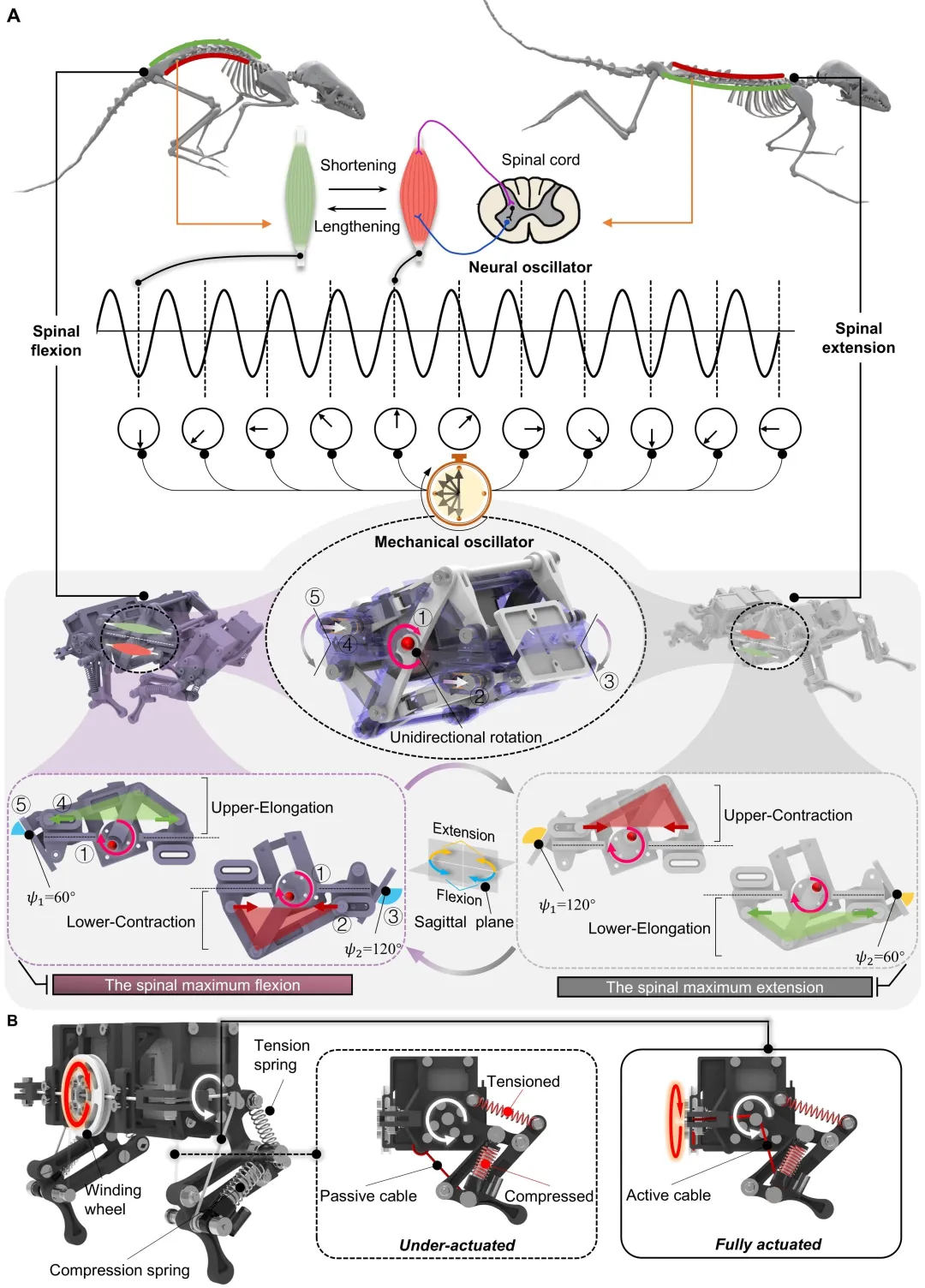
FLEXOR overall design
The device is very cleverly designed, the drivers only rotate in one direction, relying on the closed chain polygon structure, to achieve a fast, cyclic bending of the spine, the maximum can achieve 120° arcuate plane curvature, and the width of the motion of the ivory spine is close. The device also amplifies the force torque effect, can transmit greater thrust to the hind legs, without the need to upgrade the motor, can amplify the output power at the base of the foot, and avoids the torque and control problems caused by the motor reversal.
02.
The key to running fast: Power timing is more important than power size
Having a movable spine does not mean that a robot can run at an automatic speed. What really determines the movement limit is the timing between the bending of the spine and the movement of the legs.
A large number of simulation and real-life sampling experiments have demonstrated that the robot enters the optimal coordinate state when the posterior leg is slightly behind the spinal stretch, i.e. when the position is close to π/10.
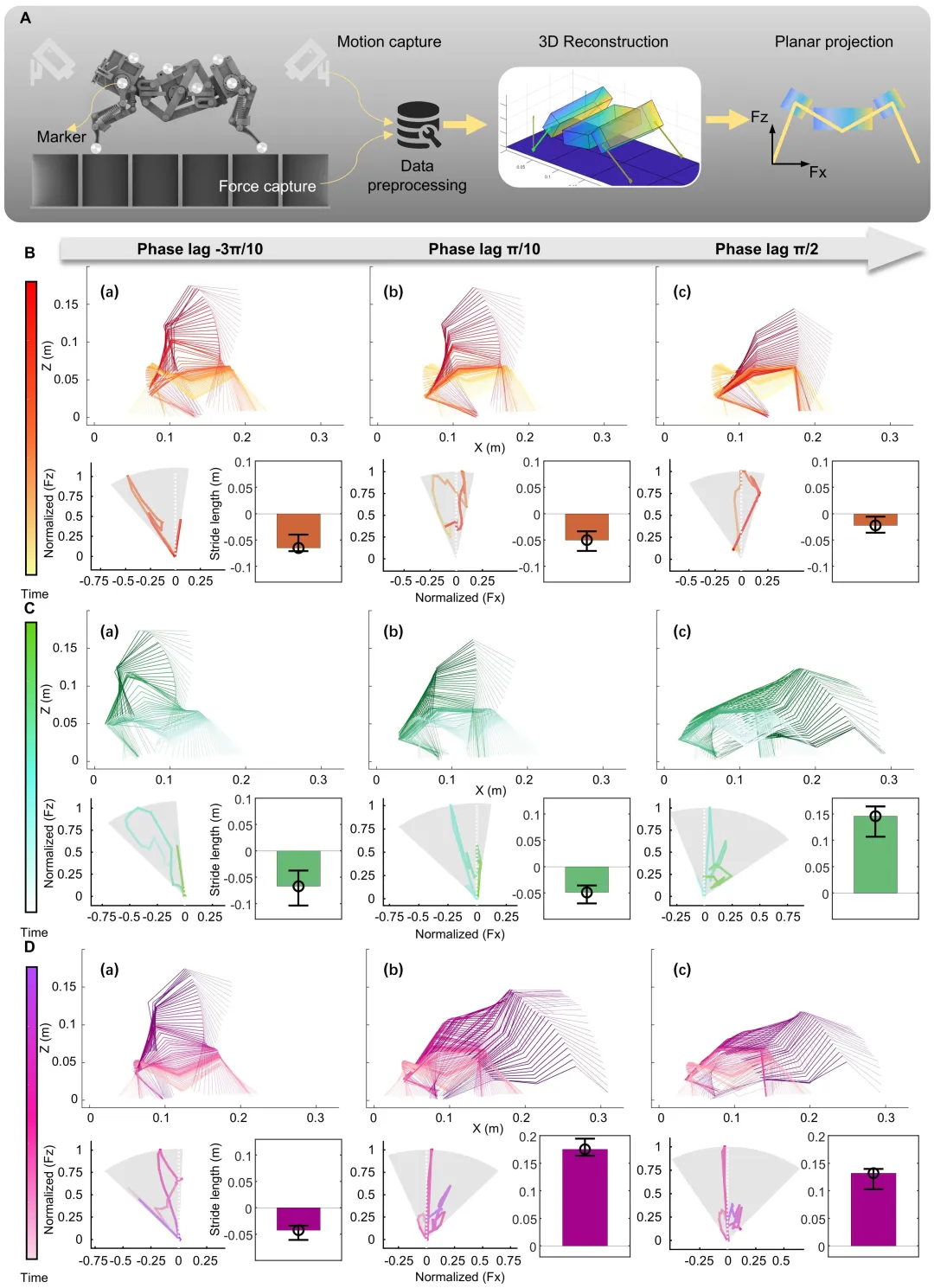
Movement and mechanical representations of dynamic spine-leg coordination
In this state, the power output of the spine and the hind legs will work together on the ground at the right time. The ratio of the ground counteraction force forward is amplified, the direction of the force is closer to the robot's center of gravity, and the body's tilting motion is significantly suppressed.
Demonstration of robotic foot-earth interaction
To verify this mechanism, the team developed three models with different rear leg configurations: passive leg FLEXOR P, non-driving leg FLEXOR U, full-drive leg FLEXOR F. During the experiment, it was seen that the passive leg model could not run steadily forward; the non-driving version could only move forward at a few stages; the full-drive model adaptation had a wider range of synchronous stages and peaked performance at the optimum time. Once the optimum coupling sequence was turned on, the hardware remained completely unchanged, and the robot's speed, stability and efficiency dropped significantly.
03.
If we change the structure of the spine, why can we increase the speed by 30%?
In rigorous control experiments, the weight, shape size, and maximum engine power of the two groups of robots were all consistent, with the only variable being the spine, which combines two joints and the traditional single-joint spine, respectively.
Video 4 - Robot dynamics running show
Exercise performance in optimal dynamic spine-leg coordination mode
In the optimum spine-to-leg coordination mode, the FLEXOR full-drive version reached an average speed of 0.784 m/s, achieving mobility of more than 7 individuals per second. Compared to the single-joint spine control group, the average speed increased by 31.6%, the transportation cost of measuring exercise energy decreased by CoT by 32.2%, and the peak ground resistance of the rear legs increased from 2.82 to 5.19 cows.
A key point is that the performance improvement is not achieved by pulling in higher input power. In actual tests, the average power consumption of the twin-joint spine model is lower. Performance gains are derived from the power transmission effects of body organs and the coordination of motion timing, rather than simply giving the engine greater power output.
By default, many people assume that a robot's acceleration requires a buildup of power, but this experiment gives a new answer: it is possible to achieve significant performance improvements without increasing energy consumption by relying on the dynamic cooperation between the body's components.
04.
This is not a typical example of a prototype!
Is this best timing synchronization a unique coincidence of the FLEXOR sample or a general principle that can be replicated?
The team built an expanded kinematic simulation framework, carried out large-scale simulation tests, constantly changing the structure of the spine, the structure of the legs, body size, the width of the joints, the range of motion, and the maximum driving range. Numerous test results showed that no matter how the shape of the robot changes, absolute speed, the best performance is always concentrated in this phase area between the spine stretching and the back legs.
In other words, dynamic spine-leg coordination is not an effect of a specific mechanical structure, but of the dynamic laws applicable to many quadriplegic systems, which can be transferred across shapes and scales. Whether the spine is double-joint or multi-structure, the legs have different designs, and if you want to achieve high-speed efficient running, you have to follow this timing principle.
05.
It is not entirely dependent on large-scale model computation, and body structures can share motion control.
Currently, the industry is focusing on physical intelligence, with research and development focused on sensor switching, algorithmic upgrades, and complex AI algorithm training. The study offers different realization ideas: transferring some of the movement control capabilities to a robotic physical entity, relying on mechanical structure to achieve physical level intelligence. FLEXOR's dual-joint coupling spine is like the same set of mechanical neurotransmitter generators, which can replicate the cyclical motion of neurotransmitters, without the need for a controller high frequency output to complex complex instructions, and relying on the column connector to generate spine cyclic bending, both reducing the operating pressure of the upper controller and reducing the dependence on system computing sensors.
Animals' motion books are the result of a synergy between neural regulation and the physical properties of musculoskeletal muscle, but in robotic research and development, many programs have the habit of assuming all of the motion tasks by algorithms, ignoring the potential of the mechanical body itself. Of course, at this stage, there is still a gap in the performance of the samples and the real-life models, the density of the drive power is the main bottleneck, and the artificial motor is still unable to accumulate the mass output of the units of the biological muscles.
From the research itself, the study deepened human understanding of the biomechanics of running mammals and produced a model for the next generation of high-motion leg robots. The most important revelation to the industry at the Robotics Workshop was that physical intelligence is not just a race track for mathematics and algorithms to explore the dynamic potential of physical physics, but also to realize the inevitable direction of high-performance robotics.