Corporate AI is entering an increasingly subtle phase of model decentralization. China's open model is eating up the AI reduction dividends of U.S. companies.
OpenAI, Anthropic, is starting to get disliked by customers.
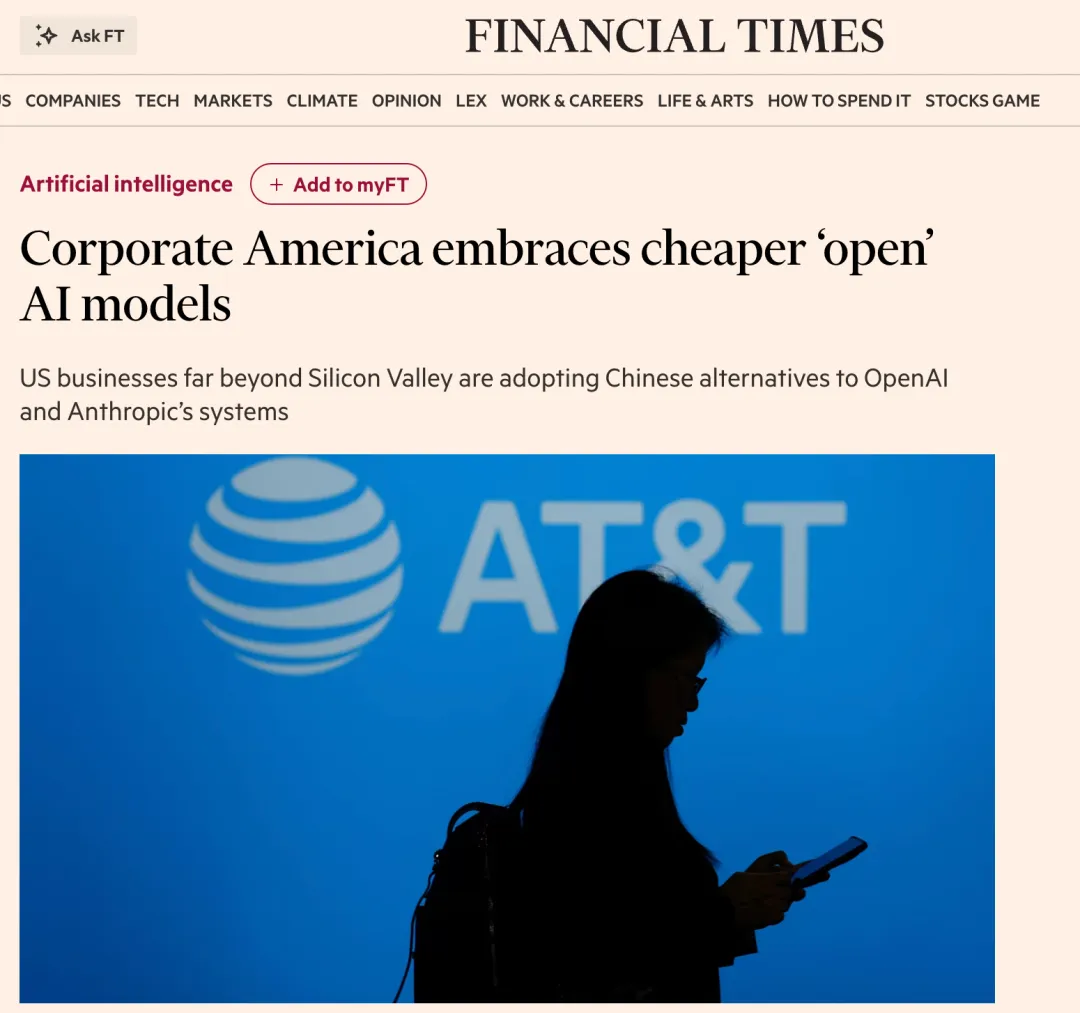
It's not just Silicon Valley startups, even telecom giants like AT&T, that are doing this.40% of AI workloadIt's going to be put on an open model and it's going to be upgraded further in the next year.70%。
And it's not hard to see why AT&T's daily Token number has reached its peak.45 billionAt this scale, the model is a bit cheaper per million tokens, which in the end, reflected in the financial statements, can be quite a considerable figure.
So a group of American companies that used the OpenAI, the Anthropic front-end model, began to shift more and more tasks to the open-weight model.
U.S. companies are increasingly using open models provided by Chinese AI companies.
According to the Financial Times, there has been a significant increase in the number of business discussions and actual calls for open models since this year, while the most active players in the current open-weight model market are coming from China.
The names of companies such as DeepSeek, Intel Spectrum, and others have also started to appear on the bill for recalculating AI costs for U.S. companies.
It's a million dollars a year.
Six months later, it was $10 million.
Why do businesses start taking an open model seriously? A number can explain the problem.
Tinder CTO Vinay Kuruvila revealed that in January of this year, the company estimated the size of its AI usage at the time, with annual spending of about Rs.One million dollarsBy July, that number had grown to:$10 million a year.
In the last six months, Kurvila has gained 10 times as much.
I don't want to see another ten-fold increase.
Now, Tinder has begun to shift a portion of the requests from ordinary users to open-weight models. Because, for many enterprise tasks, the real question has gradually become which model is the smartest:Is this a task that isn't worth calling the most expensive model?
Kuruvila believes that current cutting-edge models such as OpenAI Astra and Anthropic Claude Fable are enough for about 90% of Tinder's tasks.
This also means that as the open model gets closer, the need for companies to continue to pay the front-end model premium for this part of the capability will decrease.
In other words, enterprise AI is entering an increasingly subtle phase of model differentiation. The most difficult tasks continue to be handed over to the strongest models. Large numbers of repetitive, explicit, border-clear tasks begin to flow to cheaper models.
It's about 45 billion tokens a day.
40% have been given to open models
And what's even more exaggerated is AT&T.
The American telecommunications giant now handles roughly every day.45 billion tokensIt's about that.40% of AI workloads are already running on open models.And the company has set itself the goal of raising that percentage within a year.70%。
AT&T's chief data and AI officer, Andy Markus, explains that cost has become a very critical variable in model selection at this level of calling. If a task can move from an expensive closed-source model to an open model without a significant decrease in accuracy, the company naturally moves.
More importantly, AT&T does not simply download an open-source model for direct use. They also use their own proprietary data to optimize the model. In some specific tasks, open-source models that have been optimized for enterprise data can even do as much or even better than closed-source models.
This is also one of the most attractive aspects of the open model for businesses:It can be transformed into its own model by companies.
After the opening of the parameters, companies can deploy and fine-tune their own tokens without having to pay the model company for each call. This is especially easy to calculate if the company already has a large number of computing, data and engineering teams.
It's not the mouth gun, it's the calls that really came up.
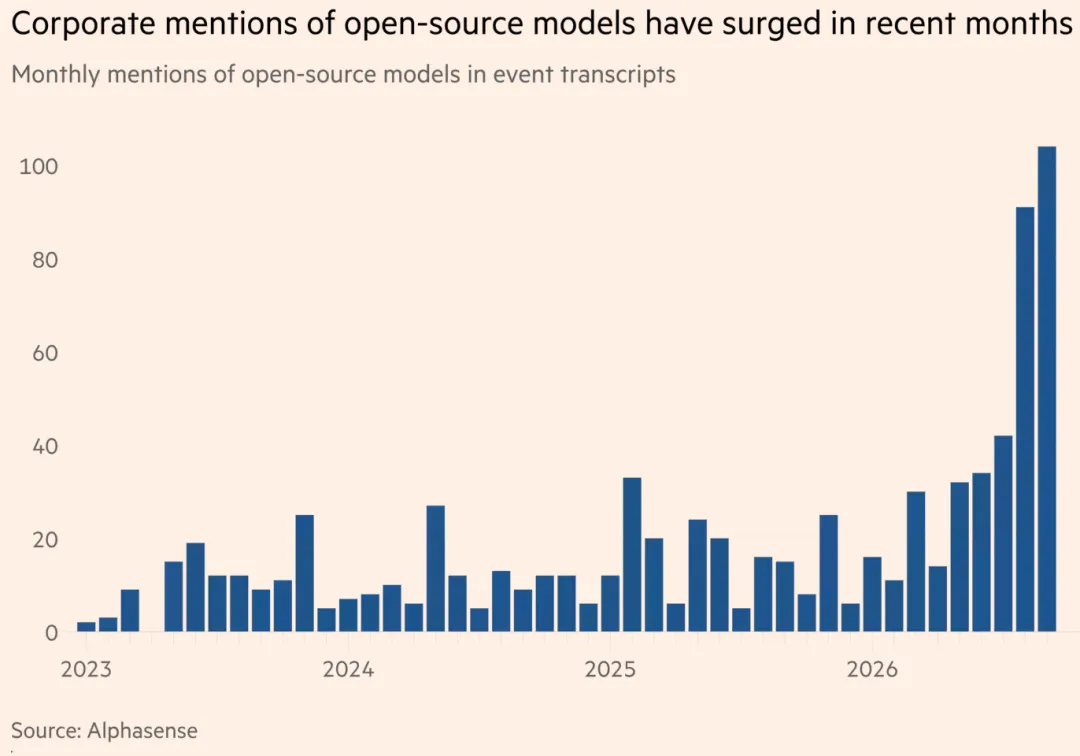
AlphaSense statistics show that in August and September of this year, the number of times U.S. companies mentioned open weight or open source models in performance calls and investor meetings increased from the same period last year.Six times as much。
Companies discussing these models have also spread out of the tech industry. PNC Financial Services, logistics company CH Robinson, and industrial giant Siemens have recently spoken publicly about the use of open models.
It's really worth noting that models call data.
In August of this year, among all the tokens processed on Vercel AI Gateway,56% are already from open-weight modelsIn December last year, the proportion was only:7% 。
In less than a year, it rose from 7% to 56%.
A similar trend has been seen on OpenRouter. According to Token Call Quantity Statistics, open models from Chinese laboratories have already taken a rather prominent place among the top-ranked models.
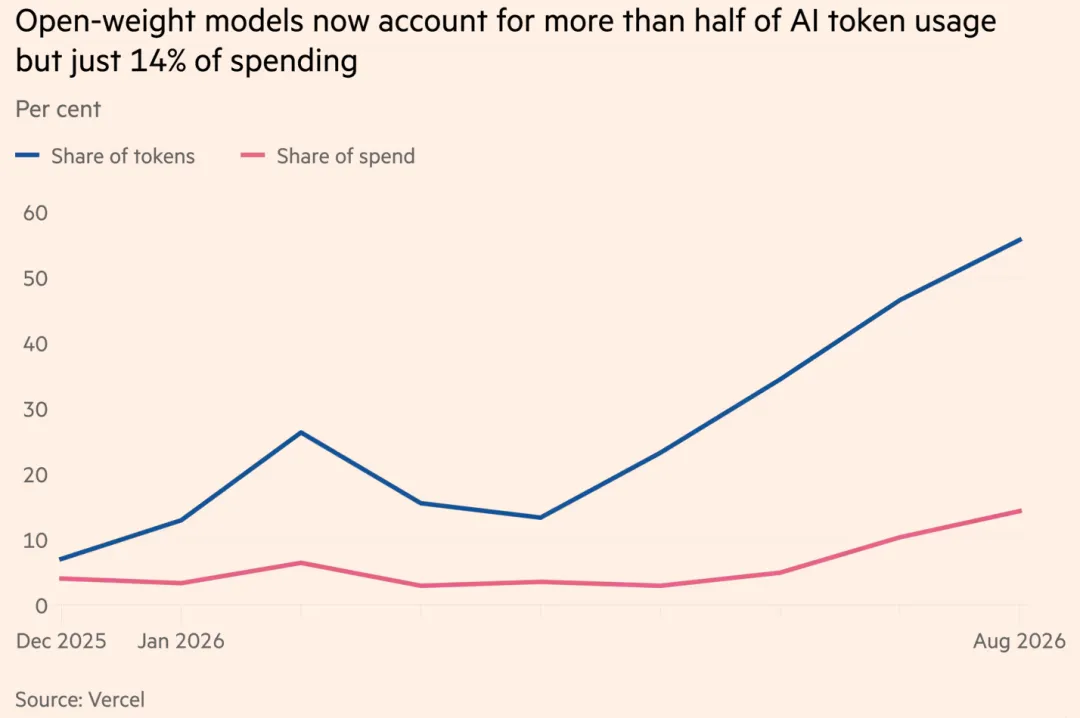
So, corporate interest in the open model has already emerged in two places simultaneously: on the one hand, the earnings call; on the other hand, the real consumption of tokens.
China's model of corporate dividend reduction in this round
Now in the global open-weight model market, an unstoppable force comes from China. Chinese companies such as DeepSeek, Intel Spectrum have become important players in this race.
In addition, French Mistral, as well as Nvidia, reflection AI, Thinking Machines Lab, in the United States, are also launching models with a higher degree of openness.
The business model of these companies is not exactly the same as OpenAI, Anthropic.
For OpenAI and Anthropic, the most advanced closed-source model is the core commodity itself.
Open model players have more options. Some are charged via the Token API. Some are free to provide models that want to expand ecological and developer coverage.
Thus, as businesses become increasingly sensitive to the cost of AI, open models can push prices to a completely different level. Especially for enterprises that can deploy themselves, Token APIs can even be skipped. Models are downloaded and run on their own infrastructure.
This is why open-weighted models are becoming an option from the developer community to enterprise CIOs and CTOs.
In addition to costs, there is another word: data.
However, enterprises embrace an open model not entirely because it is cheap.
Scott Wallace, Director of Global Solutions Architecture at Digital Realty, points to two other reasons:Data sovereignty and security.
Digital Realty has built its own internal chat system, running an open-weight model at the bottom. The company switches between the open-source model and the commercial closed-source model depending on the sensitivity of the different tasks. Some of the company's internal data will only enter models deployed on private infrastructure.
Wallace said: "Customer data doesn't get into an external front-end model".
In fact, this reveals another trend in enterprise AI: in the past, the focus has been on which model is the strongest. But when it comes to the real deployment phase, businesses consider a whole set of questions:
How much it costs, where the data is stored, how much the model can customize, how much it can delay, whether it can be privatized, and how much it can control after problems arise.
In these dimensions, open models naturally have some advantages over closed-source APIs.
The real opponent of OpenAI, Anthropic, is the world's first artificial intelligence.
Maybe an Excel table.
Of course, it's far too early to talk about companies completely abandoning OpenAI and Anthropic.
Currently, the two companies are still taking a large part of corporate AI spending. The most complex coding, reasoning, research and Agent tasks are still heavily dependent on front-end models.
These models continue to support global data center building momentum for large-scale demand for computing.
In the past, companies may have tended to put all their tasks into the most powerful models. Now more and more companies are doing something else:Dismantling tasks. Which tasks must use the strongest model? Which tasks are enough with the secondary model? Which tasks can be assigned directly to open models deployed locally?
Once AI calls have grown from millions of tokens per day to billions, tens of billions of tokens, this model routing will no longer be engineering detail.
For OpenAI and Anthropic, this may be more tricky than the emergence of a larger competitor with a larger parameter. Because when companies make this decision, it's not necessarily a benchmark. It's more likely an Excel table.How much money can you save each year?
Reference links