Although large model generating reports is becoming increasingly popular today, hallucination problems have always affected the credibility of the report. Existing methods often use prompt warranting models to be cautious, or to be checked with hallucination after writing. However, there is an error these checks are difficult to detect: the numbers are filled in correctly, the claims are wrong. For example, writing larger than smaller may be significant, and these errors are not checkable after writing.
The above error occurs particularly in cases where the input text contains a very large number of digits, such that the input contains a set of digital outputs of a person's speech, commonly known as statistical text generation.
This paper proposes that Claim-Locked Reportiing is used to solve such problems in order to ensure the repeatability and reliability of the output reports.
Provenance Before Prose: Claim-Locked Reporting for Statistical Text Generation
This is the second edition of the EMNLP 2026 Main Conference.
Address of the pre-print edition:
The main research area is AI4 Neuroscience, Agent and Image Signal Processing.
This year, EMNLP has officially launched an AI review experiment. In the AI review comments received by the team of authors, two very representative issues arose:
The reverse direction: 85.9% and 79.5% respectively; the review commentary wrote 85.9% "a little below" 79.5%;
Intensity upgrades: We say "observed improvement" and the review commentary says "proves... that it is necessary".

The numbers are wrong, but the meaning is different.
Think carefully, the part of the review that evaluates the results of experiments is also generating statistical reports: reading a paper full of numbers and then organizing these results into evaluations. It not only remembers the numbers, but also preserves the relationships between the numbers, and how strongly these results support the conclusions.
This is exactly what this paper is concerned about: the numbers are everywhere, not the whole sentence is right.
Why are existing indicators missing out on such mistakes?
The team evaluated the same set of clinical trial reports using FActScore and SelfCheckGPT, and found one drawback: Our method ranks last in the FActScore and first in the SelfCheckGPT.
The two indicators are not the same.
Whether there is evidence to support the fact that FActScore checks the split. However, in one case, the report reversed the effect direction, but the numbers in the evidence were still scored because they were replicated. In another case, the number was correctly expressed as rising from 2.77 to 5.76, and was instead determined to be zero.
SelfCheckGPT focuses on whether multiple sampling outputs are consistent. It can help find uncertain answers, but consistency itself is not the same as correct: a model can get a good score if it makes the same mistake every time.
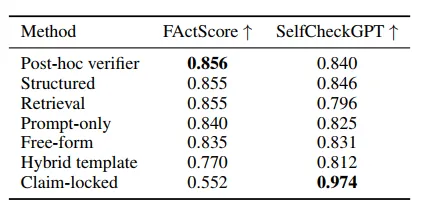
This suggests that the fact-supported, sampling consistency and statistical relationships are different issues. The first two scores are high and cannot directly indicate that the report retains its original statistical meaning.
First, lock in what you can say, then let the model move the pencil.
The team called the problem "statistical claim distortion": the numbers may have remained unchanged, but the direction, conditions of application, or intensity of the conclusions have changed, and the scientific conclusions actually reported have also changed.
One intuition is to give a more rigorous tip to the model, or to check it after writing. Fixed templates can also reduce some errors. However, as long as the model chooses which results to fill in, it can still choose the numbers and make mistaken conclusions.
As a result, the team proposed Claim-Locked Reporting: First lock the claim and reproduce it.
The claim here can be understood as a specific statement that is supported by evidence in the report. Before the model moves, the source of the evidence, the numbers, the direction of each statement, and the strongest wording allowed to be used have been determined.
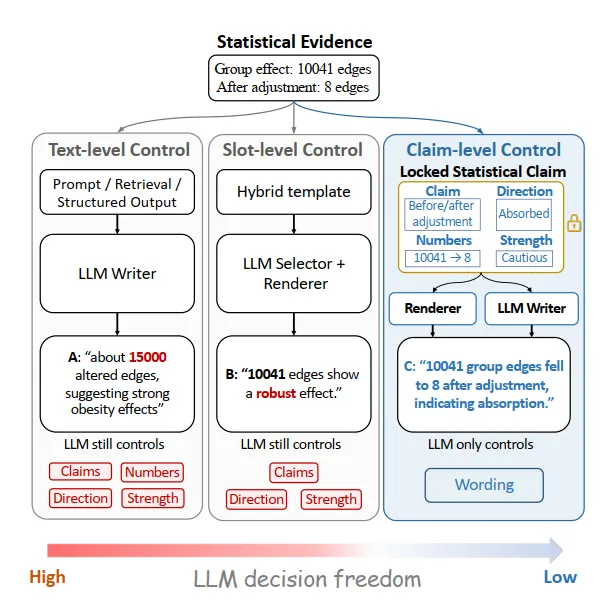
Figure 1: From constraining text, fixed template slots, to pre-locking statistical claims. The difference is that the model can also determine how much content relates to statistical conclusions.
It can be divided into three steps.
The first step is to organize the statistical results into verifiable claims.
The system receives the well-calculated structured results, which are then grouped into "accounts of claims". Each claim is associated with corresponding evidence and records the numbers, directions and intensity of the reporting required.
For example, a brain function connectivity analysis found 10,041 significant intergroup-different connections in the initial model, but after adding the BMI adjustment, only 8 remained. These two results need to be explained together. Thus, the system would tie the numbers before and after the adjustment to the same claim, rather than allowing the model to freely choose one of them.
The second step is to check whether the claim is overstated.
The risk auditor checks the numerical values for whether they are supported, whether the direction is consistent, whether they are beyond the scope of the evidence, and then turns these risks into specific expression limits at the policy level.
Or the above example: it is not easy to write the initial results as "independent obesity effects" if the group itself is divided by BMI and the difference after adjusting BMI is significantly reduced.
There is a clear rule here: the strategic layer can only put the wording under weak pressure, not strong pressure. Strong conclusions that are not supported by sufficient evidence are limited; claims that are not allowed in the report are directly excluded.
In the third step, the code is responsible for the fixed content and the model is responsible for the sequence of words.
Numbers, tables, and directional markers are presented directly by the code based on the ledger. Language models are responsible for writing short, binding paragraphs, and no longer have the freedom to decide which numbers to report, what direction to write, and how strongly to draw conclusions.
In this way, the above report will simultaneously present "Article 10,041 down to Article 8" and carefully explain the adjusted changes, rather than just referring to the initial figures, and then add the phrase "proving a stable mechanism of obesity specificity".
What is the effect of reducing the decision-making power of the model?
The team validated fMRI brain function connectivity reports and clinical trial reports:
The same evidence shows that multiple generations are more stable. Compared to mixed models, the cross-generation numerical regression rate of fMRI reports increased from 61.1% to 98.5%; clinical trial reports increased from 79.5% to 100%.
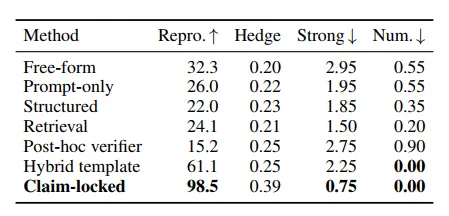
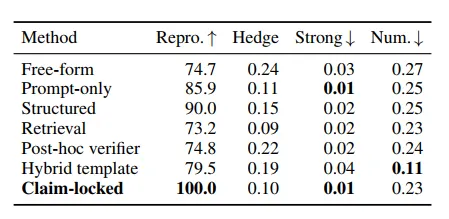
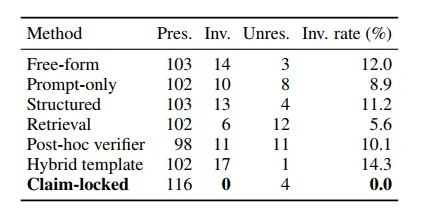
Directions are more difficult to reverse. In the blind test of clinical trial reports, the directional reversal rate for the baseline approaches was 5.6% and 14.3% respectively, and the team's approaches were not reversed.
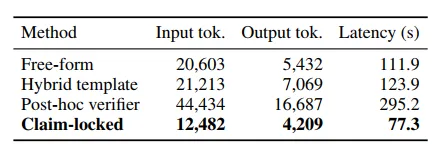
Production costs were also lower. In an fMRI cost experiment using DeepSeek, the team's method token usage and average generation time were the lowest.
These results do not mean that the report will not go wrong. Upstream statistical analysis cannot correct the claim if there is a problem. But for the evidence that has already been established, it can reduce the chance that it will be rewritten, missed or exaggerated when written in text.
Don't just expect a model to be "more careful", but reduce what it has the power to decide.