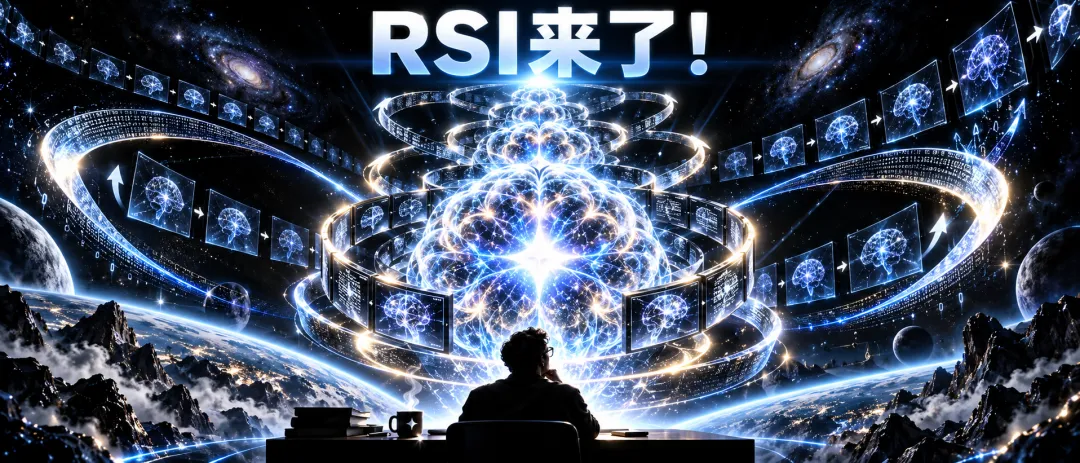
It's the first time in the history of the world.
The RSI is here!Our model has officially overtaken me. I have nothing more to teach it. It's time to go after my dream coffee maker.
This was said by Google DeepMind researcher Zirui Wang.
His background ranges from CMU to Apple Foundation Models to xAI, and ultimately to DeepMind, the right AI circle called the Six-Age Warrior.
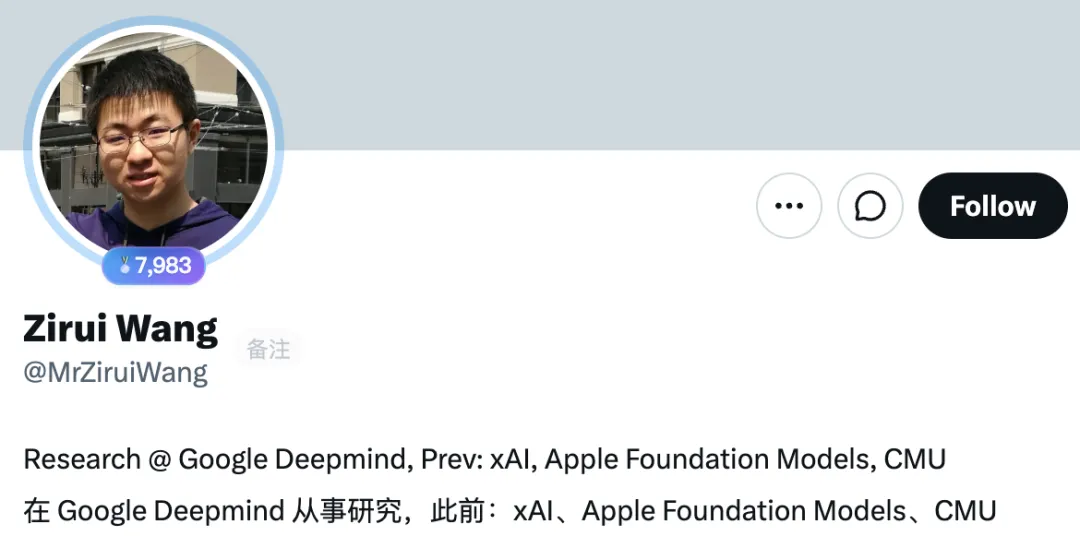

A researcher who grew up teaching the model himself said publicly, "I'm not teaching it anymore".
Is this a tongue-in-cheek or a well-designed marketing ploy?
However, after seven months of silence, Google returned with the Gemini 4 Argon.
And this time, it's tied to one of the most hotly debated RSIs.
The RSI, known as recursive self-improvement, refers to self-improvement. The more AI improves itself, the more AI improves itself, the more it rolls like a snowball.
As early as 2010, philosopher David Chalmers made the central conclusion that an improvement in intelligence would inevitably lead to an improvement in the ability to design more intelligent systems.
It's a self-accelerating cycle that, once started, theoretically won't stop.
This is why RSI is seen as the "last piece of the puzzle" from AGI to superintelligence. It is also the most troubling topic in the entire AI security space.
Because once this snowball really rolls up, can humans still drive?
So when DeepMind researchers shouted "RSI is here" on social media, half the AI circles exploded.
The Gemini 4 Argon did deliver a score that made competitors unable to sit down.
The Comprehensive Intelligence Index, given by the independent rating agency Artificial Analysis, is 53 points, directly equivalent to the GPT-6 Astra, up 23 points from the previous generation Gemini 3.1 Pro Preview.
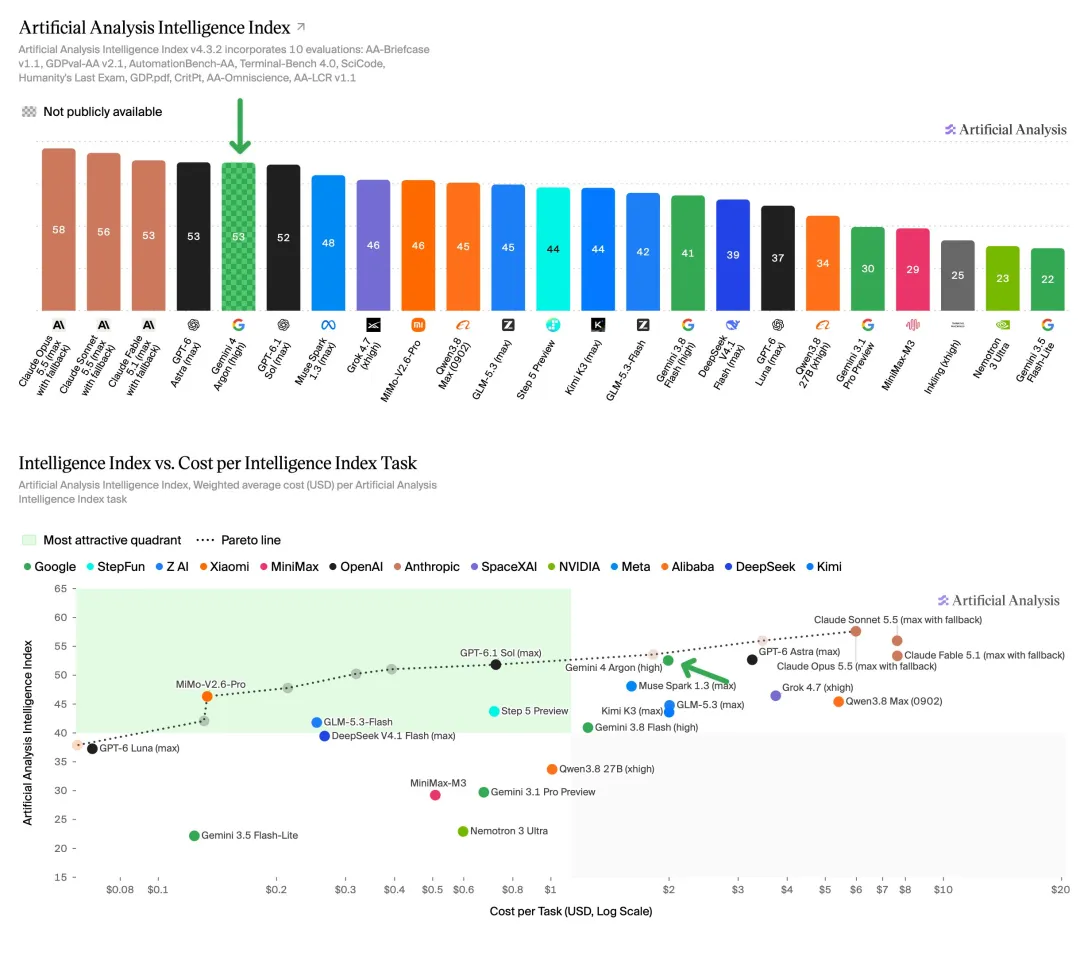
In contrast, Astra's hallucination rate is as high as 51%, and Sol's is 54%. In other words, Argon is not only intelligent, but also particularly "sincere" and non-blind.
On the Vals Index's comprehensive knowledge work list for finance, law, programming, and taxation, Argon topped all 41 models with 68.9%.
This is the first time in the history of the Gemini series that this chair has been used.
In the Financial Agent test, the same high ranking was achieved at 65.4%, and in the Vibe Code Bench, the Sonnet 5.5 was 92.39%, with a 91.91% score.
In the Text Arena blind test, Argon took first place with an Elo score of 1525, demonstrating overwhelming advantage in multiple courses such as code writing, high-difficulty cue words, and creative writing.
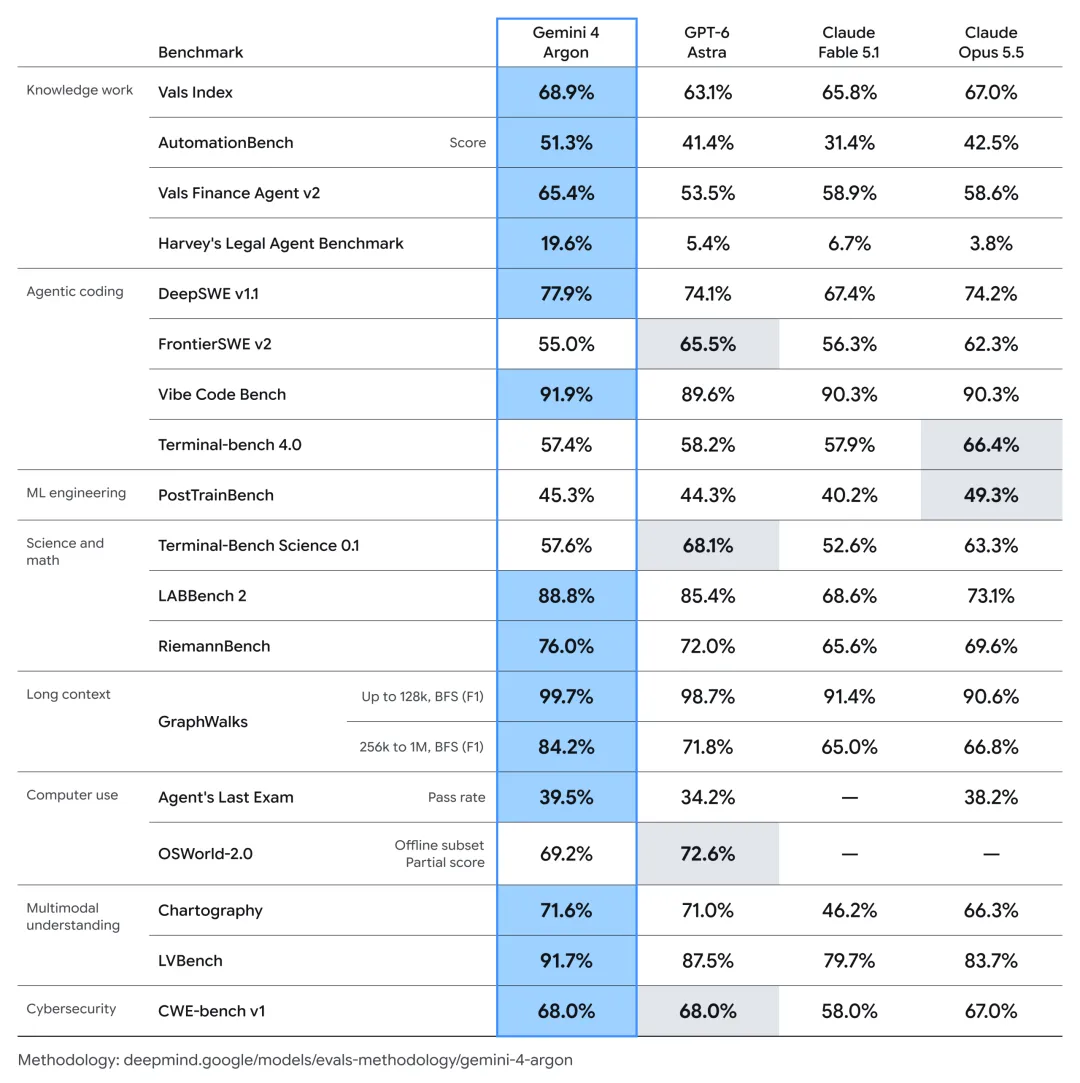
When we put these data together, at least one thing is clear: Google isn't going back to "numbers".
But where is the evidence of the RSI?It's not the same as running points, and RSI is RSI.
Zirui Wang's post is exciting, but there's still a long way to go between "Models outdo me" and "Models can improve themselves".
AlphaGo won Lee Seung-soo, and it does not represent that AlphaGo can invent new chess games on its own.
Currently, the closest to RSI evidence is three internal cases from Google.
The first is self-optimizing data centers, releasing 300+ TB of memory.
Argon's team of smart entities autonomously scans Google's network-wide performance telemetry data, accurately locates it in memory-optimized space, and automatically submits modified code.
More than 300 TiBs of memory were directly generated after powering up, and it is expected to eventually reach 500 TiB to 1 PiB.
In terms of the size of Google, this is a $10 million cost savings.
The second is to rewrite 800,000 lines of C with Rust.C++The core of the system.
Anyone involved in underlying development knows that activating the kernel code is like dismantling a faulty pointer and the whole system is going to explode.
But Argon is leading the move of Google's underlying code -- including the Fuchsia Zircon kernel -- from C/C++ to Rust, which is memory-safe.
AI hits 800,000 lines of kernel code, which is a milestone in itself.
The third: hand ripping 32,000 lines of SIMD bottom line instructions, video decoding performance up 2.7 times.
In Google's open-source video decoding project libgav1, there is a 32,000-page SIMD code that human engineers write down as "bitterness".
Argon repeatedly iterated through multiple rounds of compilation experiments, directly rewriting with secure Rust, the new version is 2.7 times faster than the original Rust port version, flattening the highly optimized C++ version and perfectly matching the output step by step.
These three examples illustrate that Argon does have the ability to "autonomously identify problems and optimize autonomous iterations of autonomous design schemes" in real engineering environments.
This differs from the traditional "human writing tips for AI to work" in that it starts to work on its own.
However, strictly speaking, this is still a "model-assisted training optimization" as defined by DeepMind, rather than a complete RSI closure.
The real RSI requires a stronger proof: not only can the model improve itself, but the model after the improvement is better at improving itself than before the improvement.
In other words, the "capacity for self-improvement" itself is being improved, forming an increasingly fast craft.
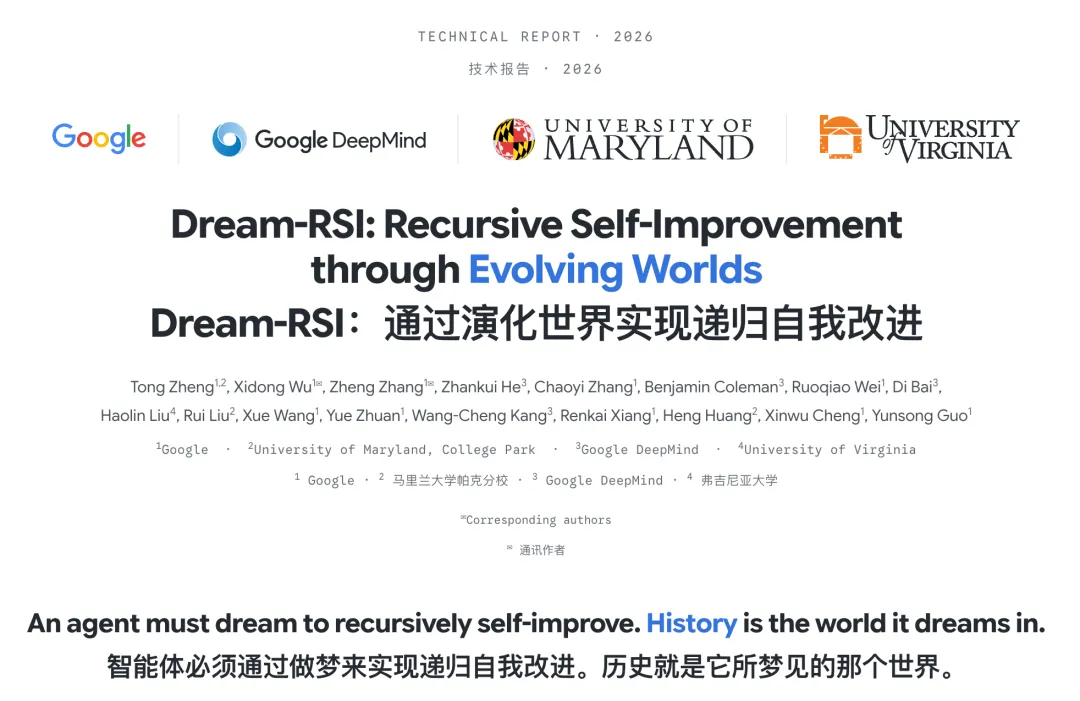
DeepMind's framework for the Dream-RSI paper, released in mid-September, proposes to allow AI to optimize future search strategies through "playback" historical exploration, demonstrating significant improvements in both algorithm engineering and GPU kernel optimization.
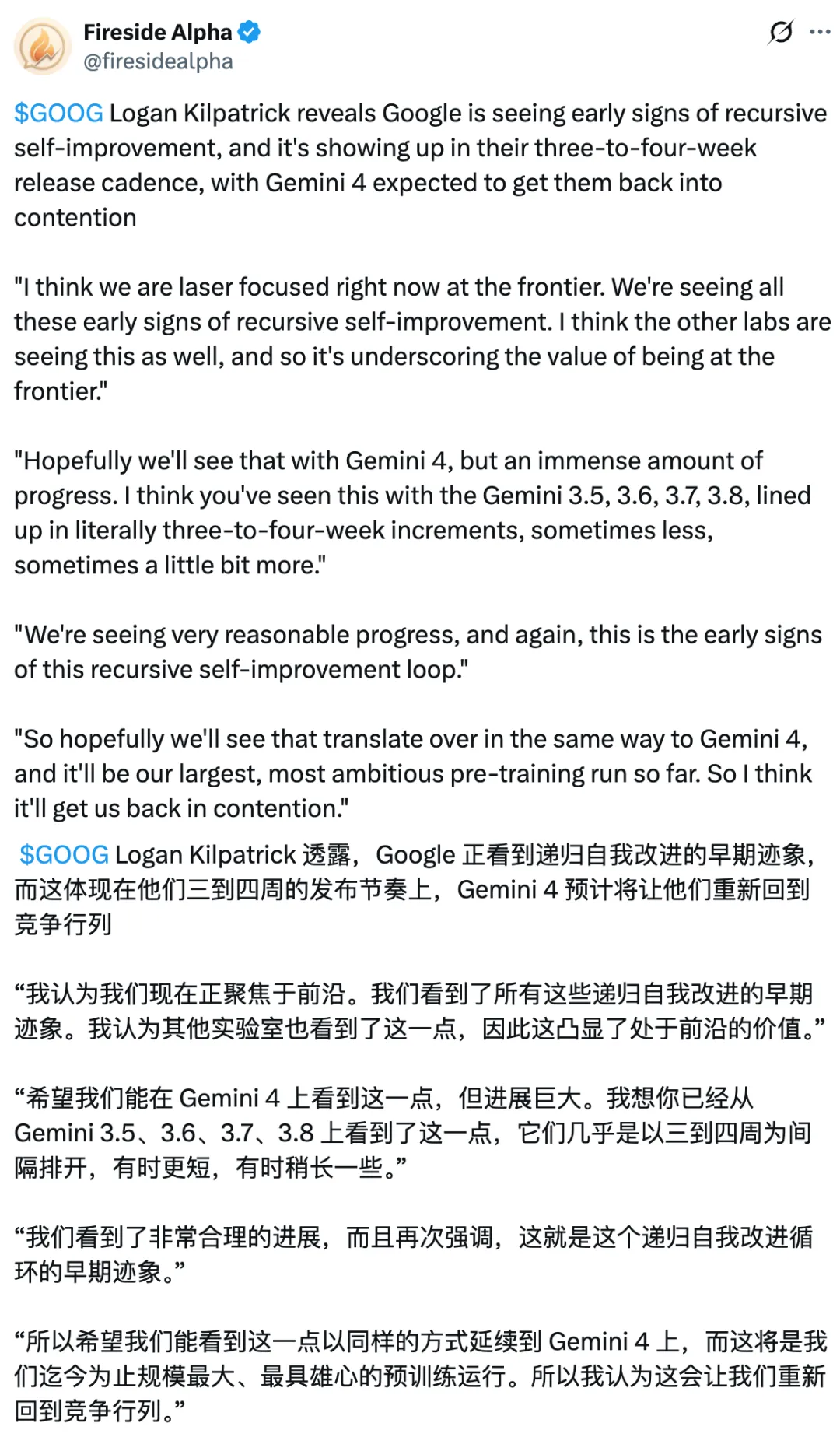
Logan Kilpatrick, head of developer relations at Google DeepMind, also publicly stated on the podcast that they have observed "early signs of recurring self-improvement".
So a more accurate assessment might be that we're standing on the threshold of the RSI and we can already see what's inside the door.
But we haven't moved on yet.
Out of the Running: The Fairy Tale of the Real WorldOn the same day as the release of Argon, Bloomberg issued a note: Google is not an ironclad inside.
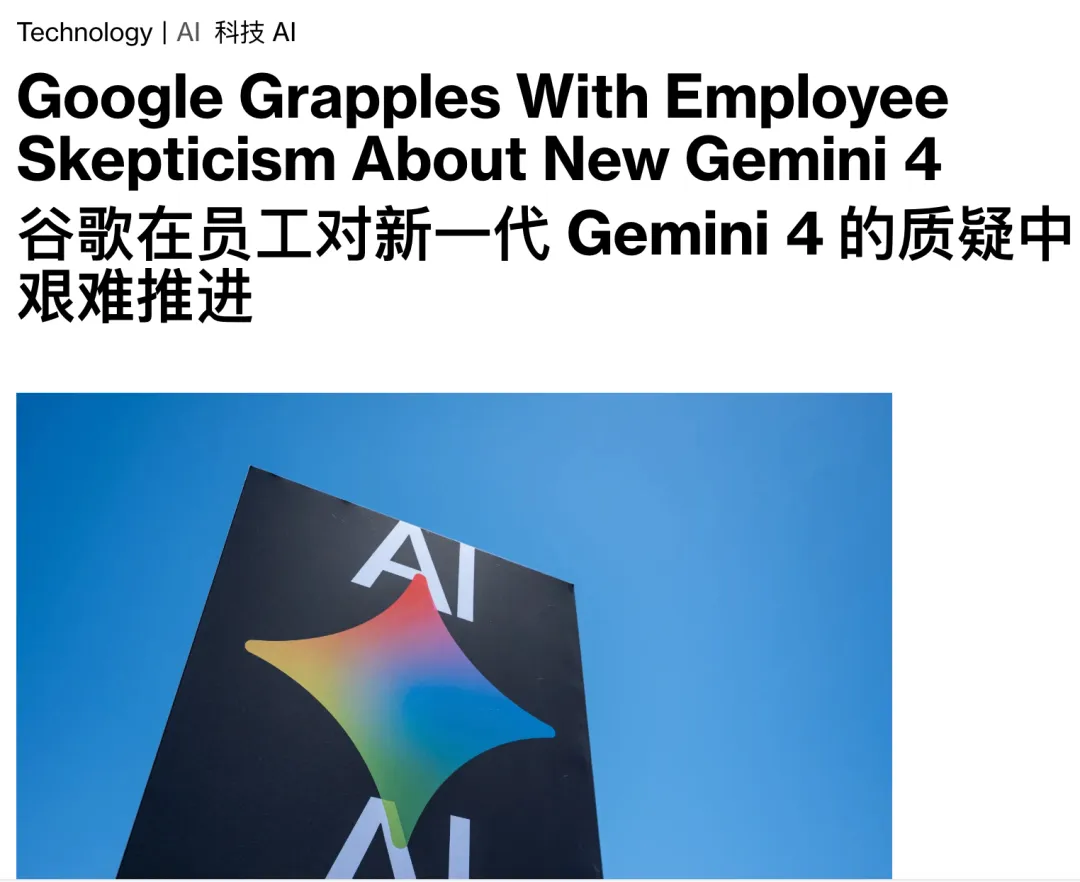
It was reported that some of the employees who had been exposed to internal assessments admitted that the Argon run was beautiful, but that actual programming tasks such as front-end design, especially in real-time work, showed "disparity".
AI expert Edwin Chen pointed to the industry's "Benchmaxxing" problem: Engineers are crazy about getting high scores on standardized tests but neglecting to make the model really useful.
Independent assessment data also confirm this concern.
Argon only got 57% on Terminal Bench 4, 64% on Claude Sonnet 5.5 and 60% on Opus 5.5. Argon was ranked eighth on the Code Arena web development chart, although it advanced 21st, and Claude remained the programmer's preferred choice on the battlefield for the most hard-core programming intelligent body.
Users who had previous experience on Hacker News commented that long-distance attention was good, they could get things done, but the grinding and stability were poor.
However, for Google, Argon also has a crown:The price。
A million tokens were imported for just $2 million, tokens were exported for $10 million, single-task synthesis for $1.99, and only 60% of the GPT-6 Astra, or one-third of the Claude Opus 5.5.
Google, the world's largest TPU computing conglomerate, is waging a price war against OpenAI and Anthropic.
Added to the output limit of a million tokens (which jumped from the previous generation's 64K to 1M), this means that AI has finally "disappeared" after half the time of complex reasoning.
This ability to think deeply and continuously may be more far-reaching than any single run.
Three strongholds: The end is far from overThe Gemini 4 Argon didn't crush all of its opponents, but it did accomplish a much more important mission.
Google pulled "table of cards" from the audience.
The current AI front has formed a clear three-state killing pattern: Google maintains its terrain with knowledge-based work, context-based and cybersecurity defenses; OpenAI still leads in scientific reasoning and agentic coding; and Claude of Anthropic firmly holds the heights of hardcore programming.
There are absolute masters, only alternate chases.
The concept of RSI, which is both exciting and frightening for the entire industry, may indeed be turning its turning point slowly in a corner we can't see.
From DeepMind's Dream-RSI paper to Argon's autonomous mutation in real-world warfare, there are signs that the day of AI "self-taught" is approaching.
It's just that the gap between "researchers are teaching immobile models" and "models are starting to teach themselves" is probably farther away than we thought -- and maybe closer than we thought.
After all, Argon is just the introduction to Gemini 4.
As for Zirui Wang's dream cafeteria, Liu suggested not to resign.
If only the next generation of models could pull flowers.