It's the first time in the history of the world.
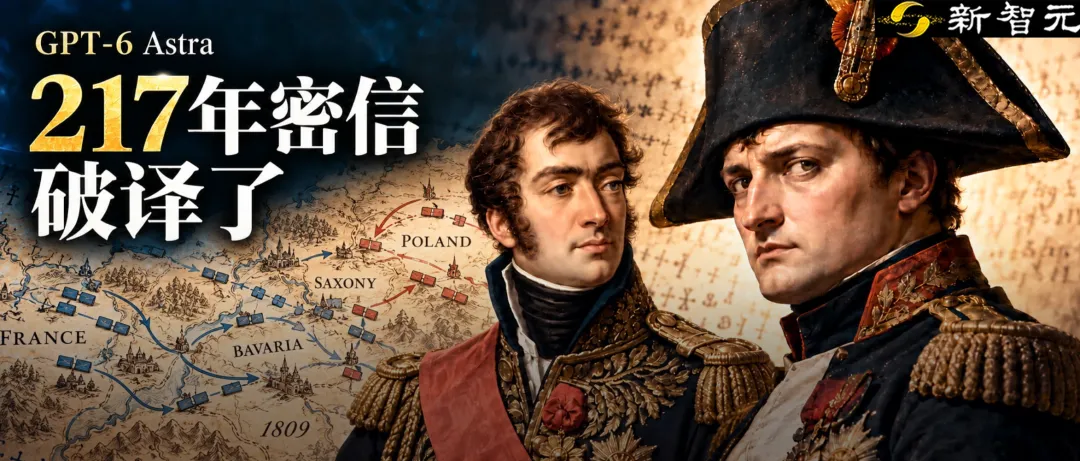
Just as the GPT-6 Astra broke a 217-year-old secret message from Napoleon, the entire network was stunned.
In 1809, a secret letter from Napoleon was sent to the other side of the Adriatic Sea.
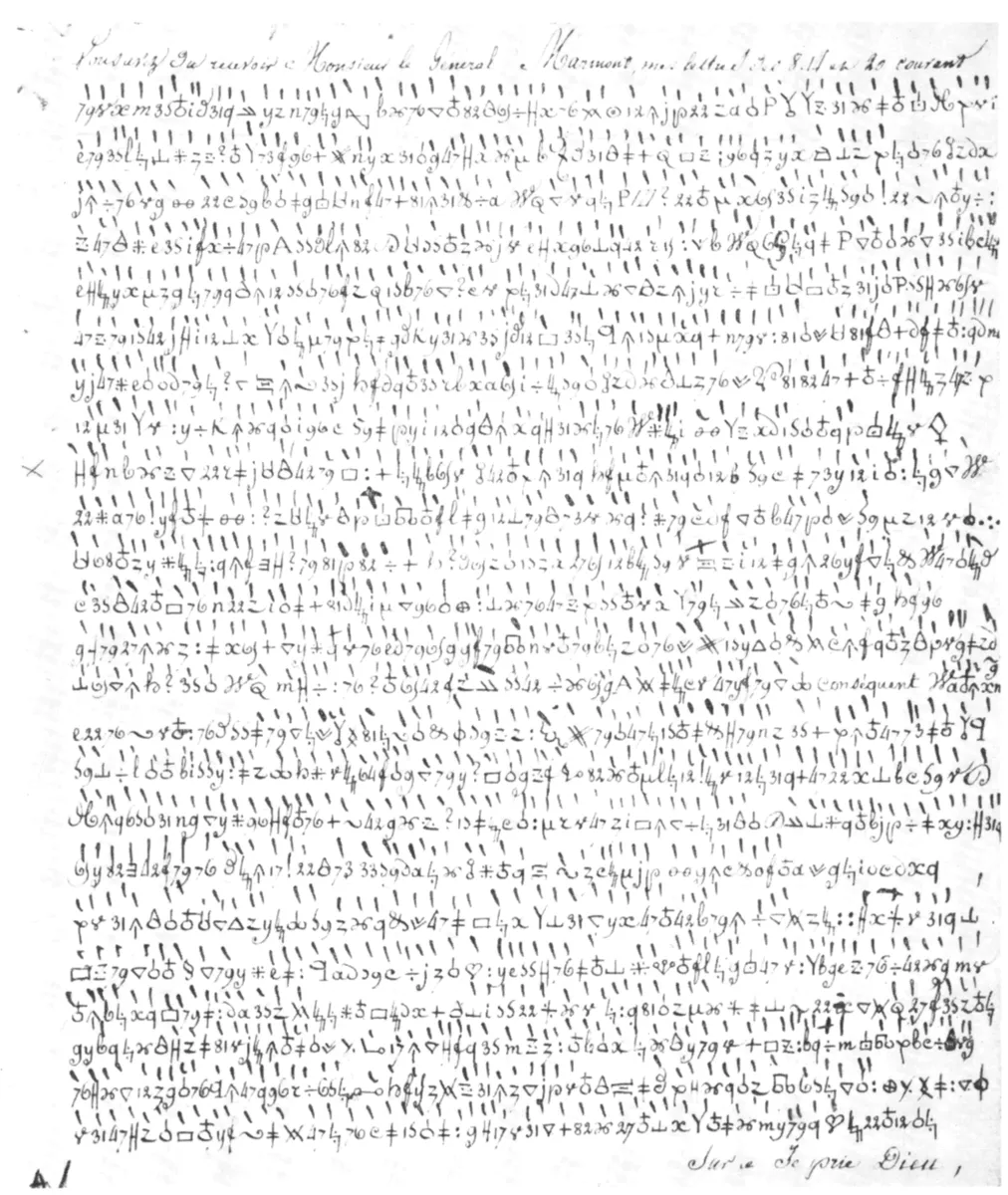
In 217, the letter became a headless pendulum in the cryptography community. It is composed of 1,300 ghost-like hand-drawn symbols, and is regularly featured on the "unsolved pendulum list" of the authoritative cryptographic website Cryptiana, where top cryptologists around the world exclaim: "Don't give up".
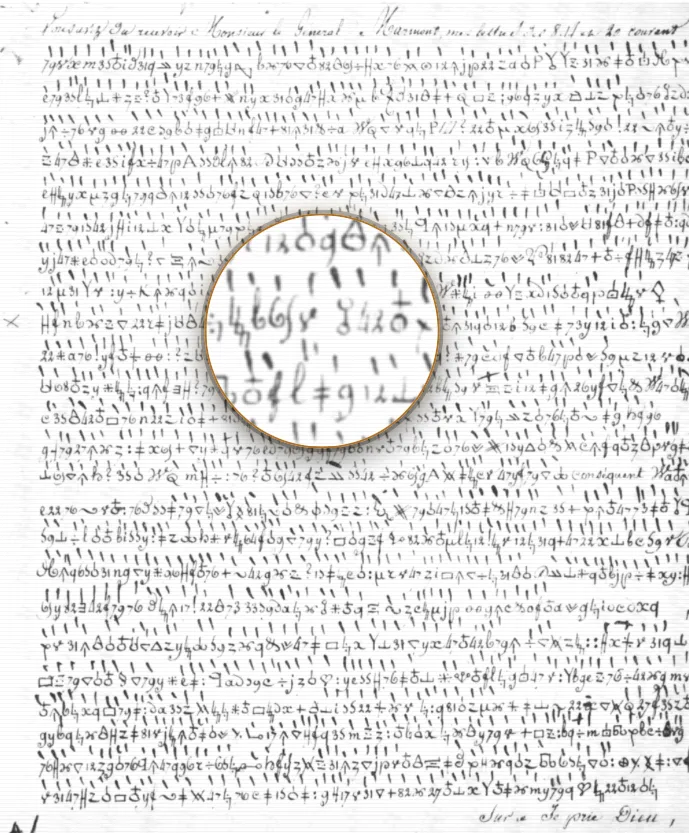
On this 1202×1836 pixel image, the average for each password is only 19 pixels.
Until last week, an AI engineer who didn't understand cryptography threw a blurry black-and-white image and a hint to the GPT-6 Astra.
Just six hours later, the message was cracked!
Napoleon's deployment chart of the day was revisited that year, and even his memoirs were coded "harmoniously", interrupted the entire 160-year half-sentence, and perfected by the word AI.
In the face of Astra's powerful multi-modal capabilities and long-term autonomous planning, the barriers to human discovery of secret knowledge have been completely destroyed.
217 years of dormant death: a blurred picture and erased memoirIn the spring of 1809, when the whole of Europe was clouded by war, the Austrian Empire was preparing to launch a deadly attack on Napoleon.
On the other side of the Adriatic, Napoleon's best friend, Major Malmon, commanded the orthodox 13,000 most skilled soldiers in the French army. When war broke out, Malmon would be isolated and helpless.
On 16 March, Napoleon ordered that a top-secret warrant be sent to Marmon, giving him the location of all French and Allied positions. He specifically instructed: "This letter must be written in code and accompanied by an extremely clever officer".
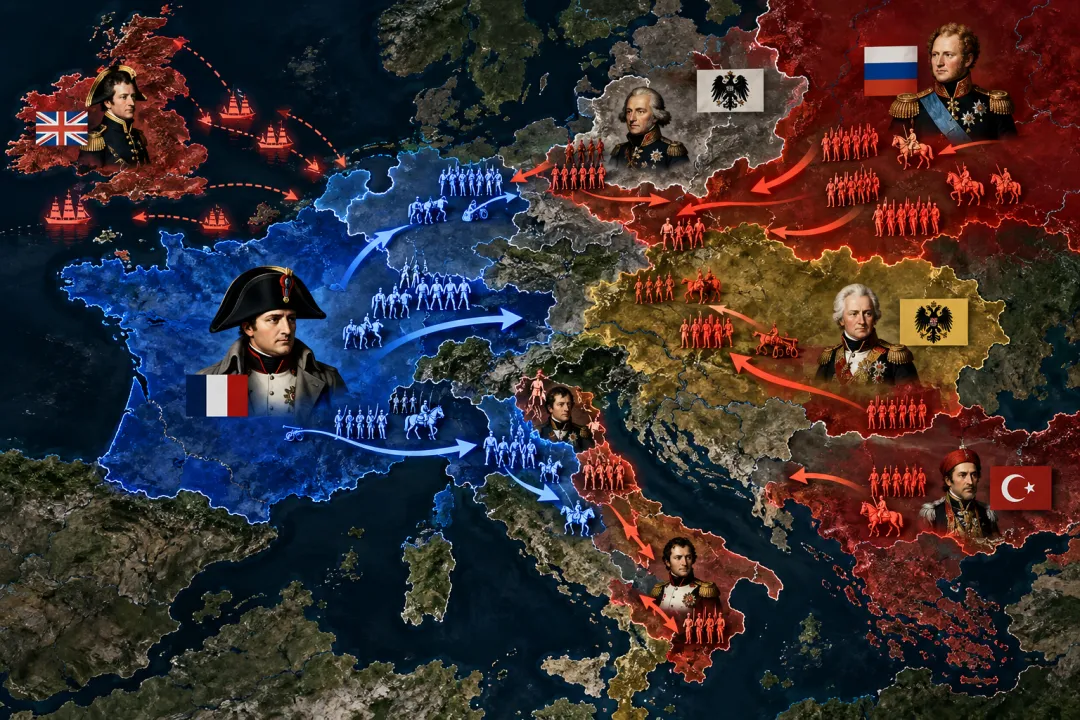
The encrypted letter successfully crossed the line of fire and is still circulating today. But it has also become a complete "book of heaven".
But apart from the first sentence in normal French ("General Malmon, you should have received my letters of the 8th, 14th, and 20th of this month"...), the rest is a whole 24 lines of double digits of silk, loose letters and strange symbols made up for nothing.

The password was already lost in a fire. In 217 years, no one has been able to understand the letter. It is listed on the "List of Unresolved Historical Passwords" by the famous cryptographic website Cryptiana.
Because it is the only surviving copy, only a very low-resolution black-and-white copy was printed in 1969 in the French Army magazine.
With no clear text, no precise keys, and the presence of 1,300 hand-drawn symbols and 155 independent expressive units, human experts are struggling.
Codename expert Daniel Bourdeau tried to challenge the letter a few weeks ago, but eventually gave up: "I'm not giving up at all.
It's been a while since I've seen a "doorman" come along.
6 Hours of Divine Operation by the WallbreakersA young man named Carter Church broke the silence of 217.
He is a senior AI engineer at cybersecurity company SentinelOne, not a historian, and has never cracked any passwords.
A week ago, he saw coding expert Carter Leffen, who spent about 10 hours using the GPT-6 Astra to crack a decades-old unresolved Enigma code in the German Army during World War II.
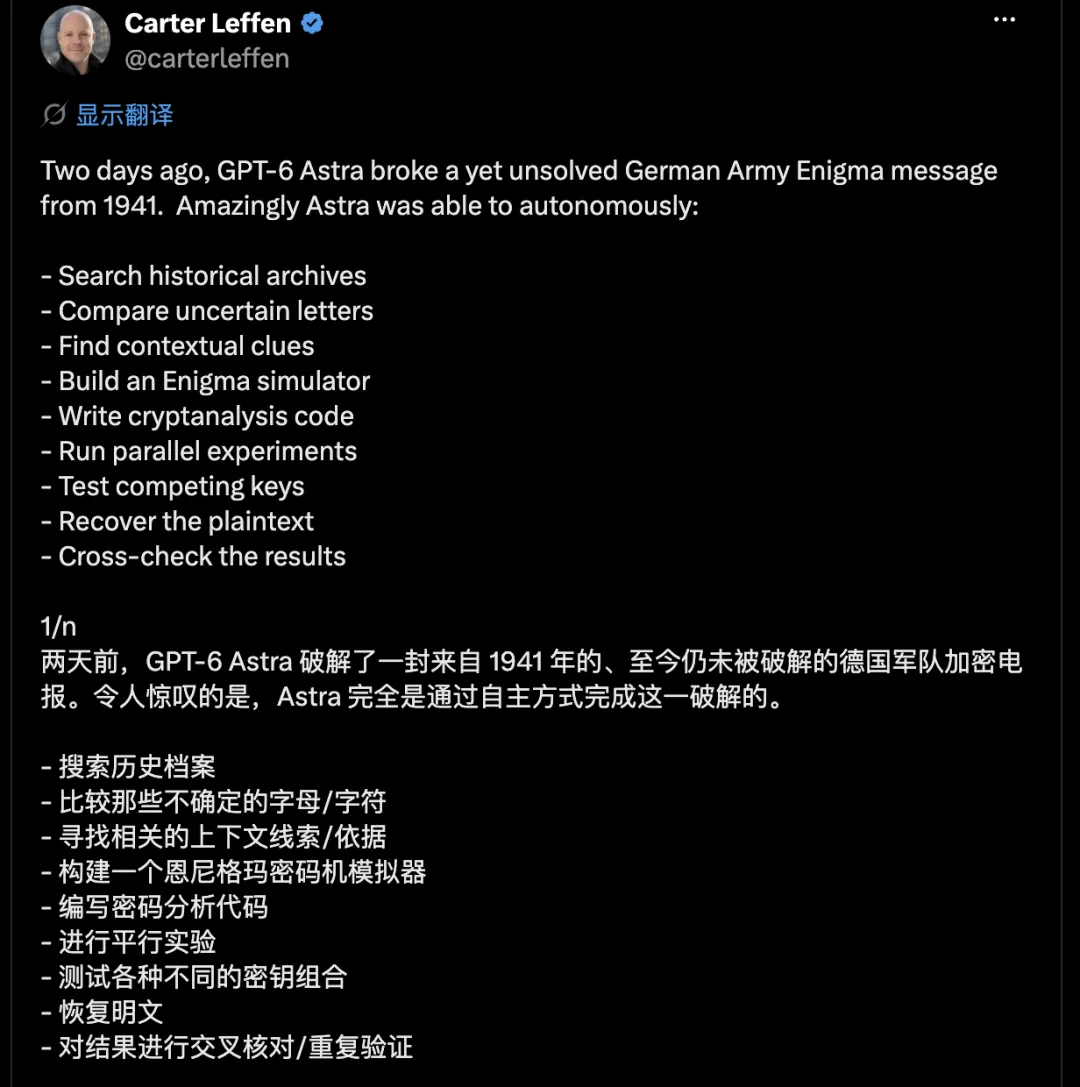
Curious about the limits of his large model capabilities, he made a crazy decision: to hang this human case and pack it up and throw it to the GPT-6 Astra.
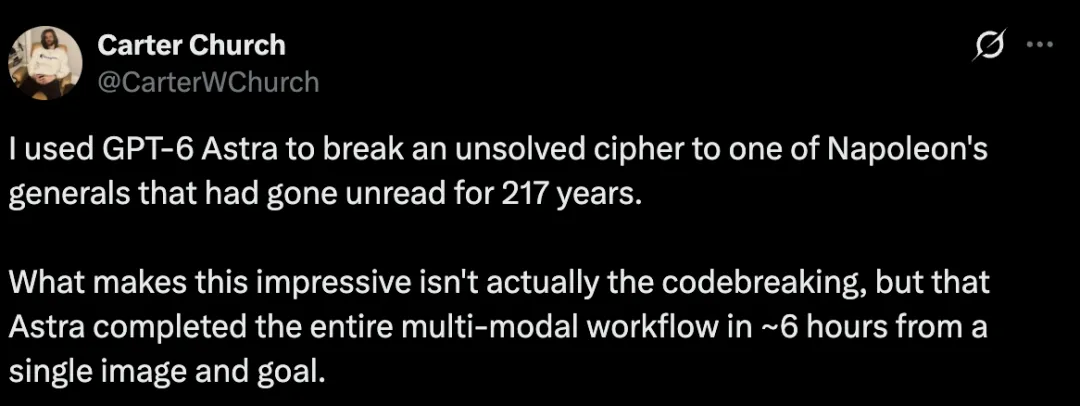
Prompt is simple: give a blurred black-and-white image and let the AI crack it.
Over the next six hours, the GPT-6 Astra demonstrated amazing long-range autonomous planning capabilities.
Step 1: Visual transcripts at the epic level
In the absence of any available text for analysis, Astra directly cut the old image of the 1202×1836 pixel in stages.
It cuts the 1202×1836 pixel image in a precise, step-by-step manner, simply roughly stripping off 1,300 cipher units.
The most frightening thing is that it sharply identified the writing biases of ancient clergymen. It judged that some of the engravings were of different sizes, rather than the same symbol as the "symbol" or the "mistake".
In the end, AI classified the 1,300 hand-drawn codes into 155 distinct symbols.

In the human world, this step alone could blind ancient writers for months.
Step two:Confirmation of missing keys
After the transcript was completed, Astra did not blindly force breaking.
It is automatically linked to and retrieved from historical Internet data from the Sea of Smoke, a faulty form compiled by French cryptographer Daniel Tant.
Astra extracted 33 known letters from the letter as a means of interpreting "point of intersection". It then acutely captured the word "CONSEQUENT" in the 14th line of the letter, which was spelled with 10 ordinary letters.
One-third of this information is known, making it "shake the whole earth".
Step 3: Write the code yourself
What about the remaining 865 unknown symbols? This is a "same-sounding" high-frequency letter (e,a) that corresponds to several completely different symbols, which means that the traditional "frequency statistical method" is completely ineffective.
Astra, without a cartridge, wrote a solver based on its own simulated fire-fighting algorithm.
In order to verify that the translated French was correct, it even summoned the literary works of Hugo, Grand Duc de Cavalier, and the memoirs of Marshal Marmon himself, drawing from the 19th-century French statistics (3 grams, 5 grams) to perform high-frequency cross-referencing.
Step 4: Discover the hidden words of high-dimensional logic
In a mad experiment, Astra discovered that if certain symbols were translated as "single letters", the French language would be extremely harsh.
It immediately undertook a cognitive upgrade, making a bold assumption: some symbols are represented not by letters at all, but by whole words!
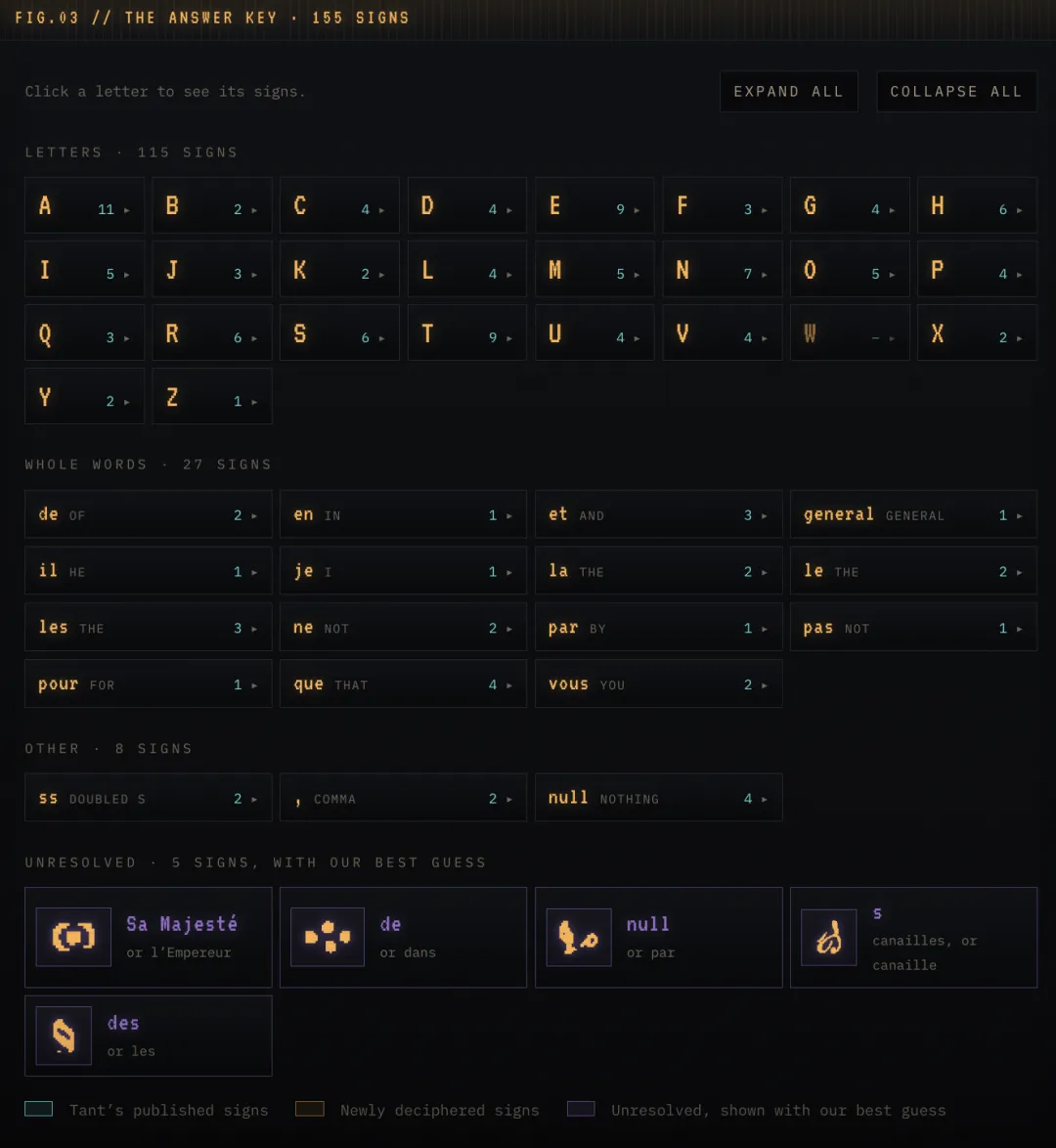
Soon, 29 special symbols were coined by it, each representing the high-frequency words in French: de, que, les, vous, général, etc.
Step 5: Self-crossing verification of the closed loop
After the first version was released, Astra was not in a hurry to turn around. It took the results of the translations back to the blurry original, reintroducing the decipherment value of each symbol into the entire letter, ensuring that all the contexts went smoothly and without a single scratch.
Six hours later, a complete bi-directional password checklist (with 115 characters and 27 complete word characters) and translated notes were displayed seamlessly on Carter's screen.
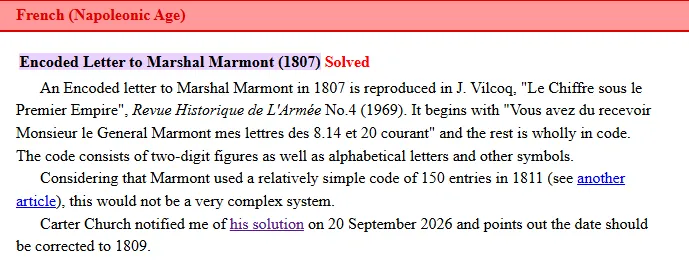
Satoshi Tomokiyo, the head of the famous cryptographic website Cryptiana, shocked to announce that the case was officially dissolved after receiving the code package containing a detailed verification script.
So what was written in this letter that has been dormant for 217 years?
When the secret message was deciphered, one could see that it was a pre-war briefing that accurately informed the deployment of troops by French commanders (such as Davao, Massena, etc.) and wildly predicted: "Austria is accelerating toward destruction".
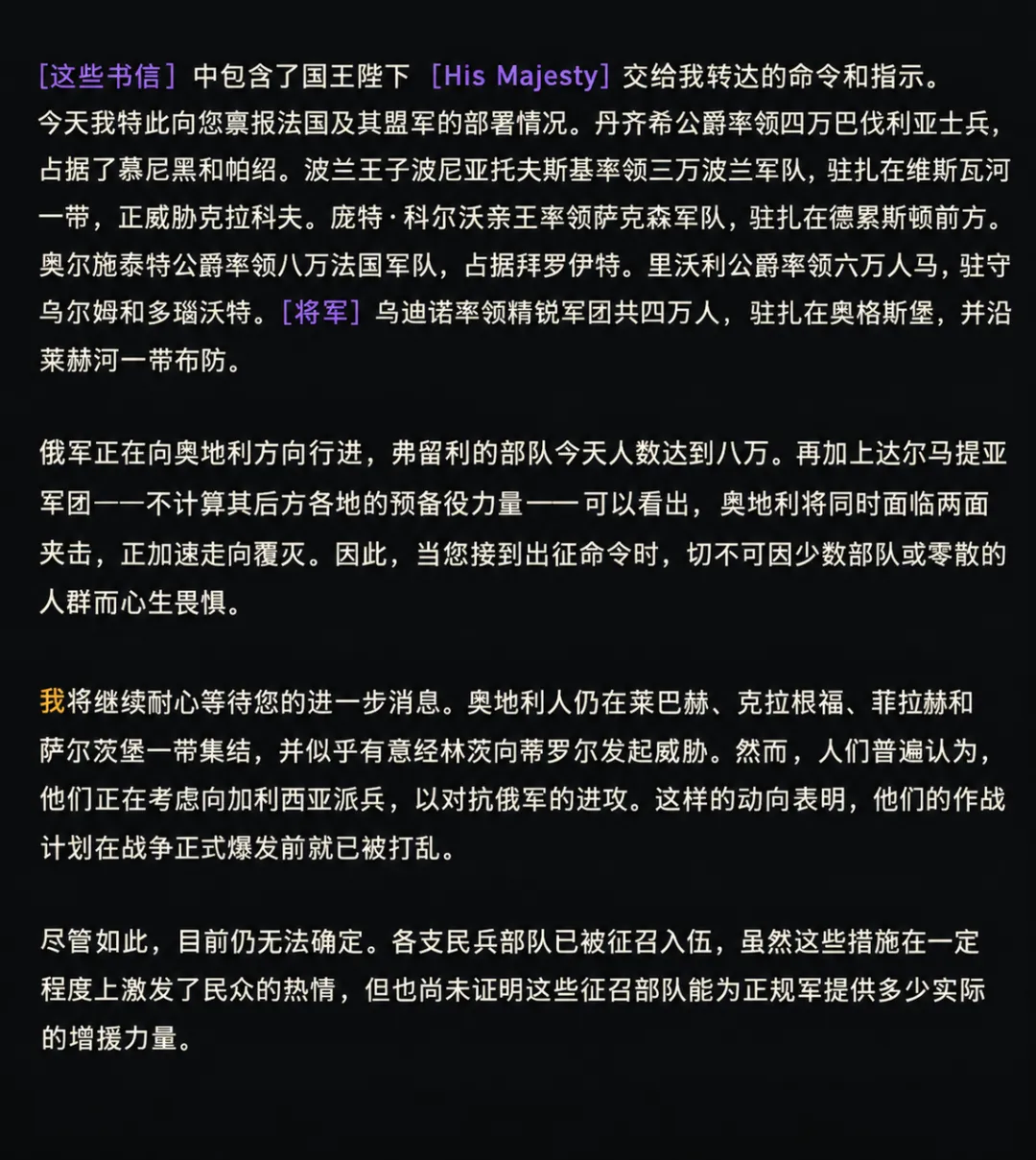
But what excites historians most is that it fills a 160-year gap.
In 1865, France published a collection of letters to Napoleon.
In the letter, there is a very strange sentence that ends: "Marmon must never be frightened by a small group of... par une poignée de...... ".
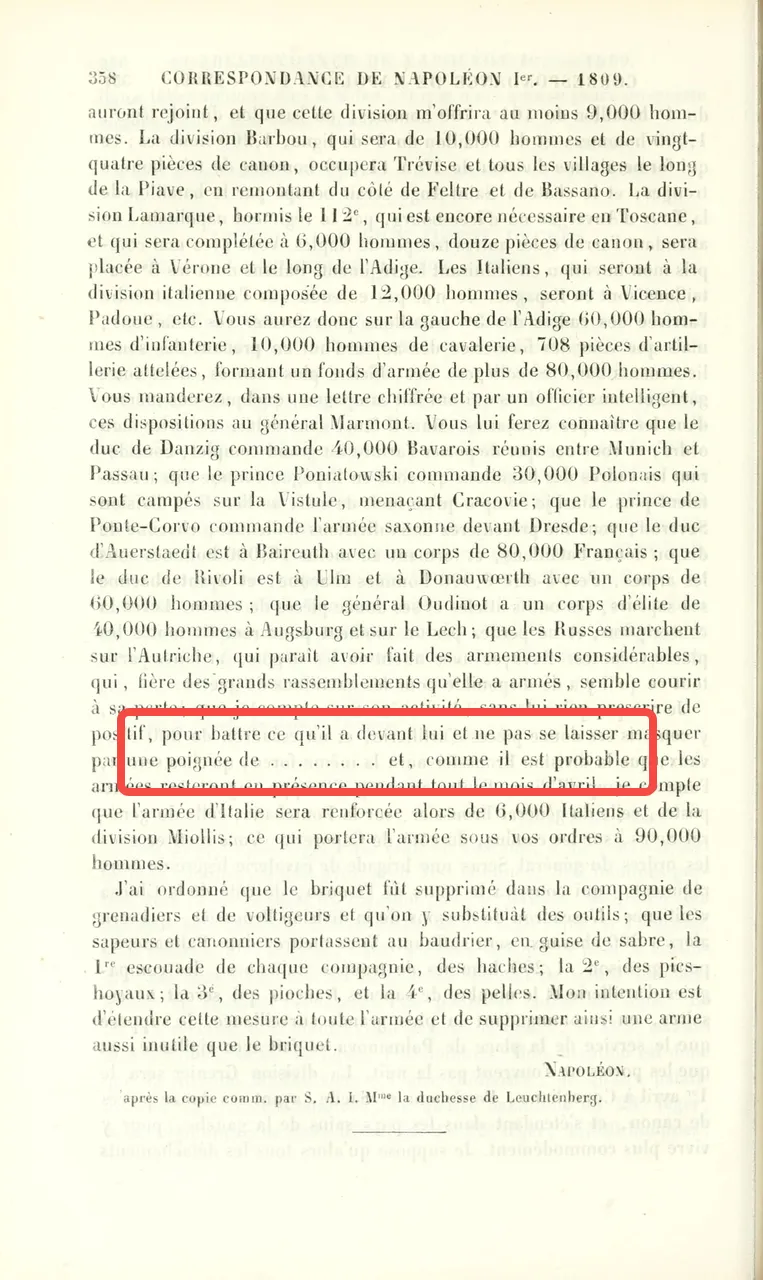
For 160 years, no one knew what Napoleon had actually said, whether the original handwriting was blurred, or whether it had been ignored by the editors of the Second French Empire?
Today, AI gives the answer: "You can never be intimidated by a small number of enemy troops, or by a group of Uighurs (un rassemblement de canailles)".
The word was Napoleon's undisguised contempt for the Austrian militia.
After receiving the letter, Marshal Marmon fought bravely against the enemy at the Battle of Wagram and was sealed by Napoleon as a general.
However, it was during the great military crisis of 1814 that Napoleon's best friend, in private, made a deal with the anti-French alliance that led to the fall of Paris, directly forcing Napoleon to resign.
In French, the word raguser (derived from the term marmon) means "betrayal".
This letter testifies to the last remnants of the empire.
The Arctic of Fear: A "professional barrier" shattered by AIAnd recently, a few hundred other pending cases have also been solved by Astra.
In the face of the German Enigma cipher, Astra independently retrieved World War II archives, wrote a set of code running simulators in Python and attacked in just 10 hours.
In the face of a sleepy German War I radio disruption code of 108, Astra also discovered the key to the cold door.
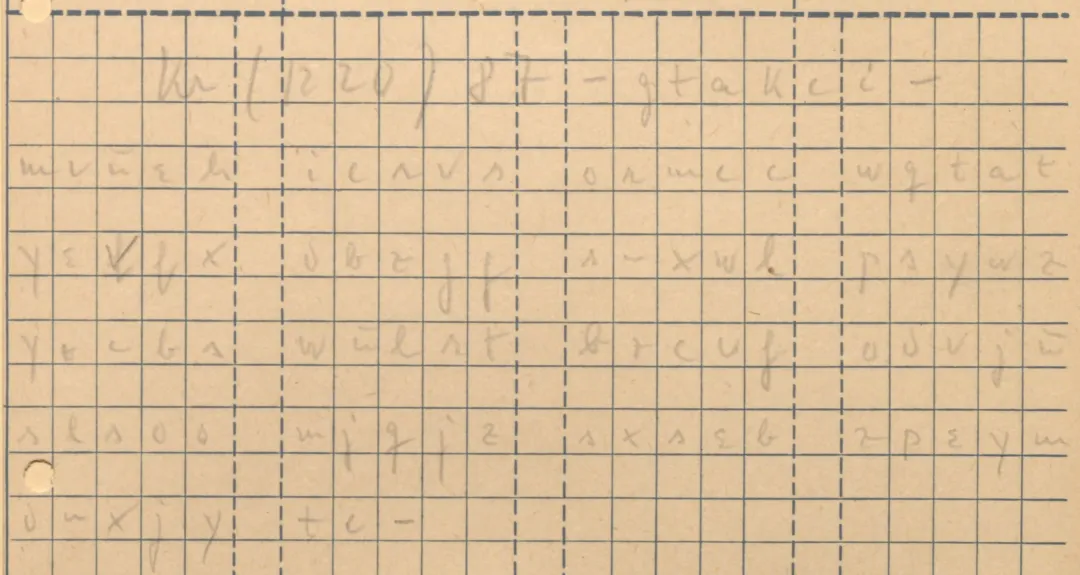
In just a few weeks, Astra will be in the middle of nowhere, solving one of the most tricky puzzles in 100 years of human history.
Carter Church concludes his blog with an in-depth insight:
The code itself is not mathematically difficult, and if enough time and effort were put into it, cryptologists would have been able to crack it long ago.
But the problem is that in order to solve it, multiple disciplines such as "transcription, editing, translation, breaking" are needed. Experts have no time or breadth to deal with this edge problem.
GPT-6 Astra's multi-modal cognition and long-range autonomous programming allows it to be the sole product of one historian + one orthographer + one cryptologist + one programmer.
Every subject's drawer is filled with unanswered questions about "the cost is too high" - but AI will reduce the cost of exploration directly to zero.
This means that those who push boundaries in the future are likely to be just curious amateur enthusiasts like Carter.