It's the first time in the history of the world.
Just now, GPT-6 has successfully shut down all 48 of the "I'm Not a Robot" games!
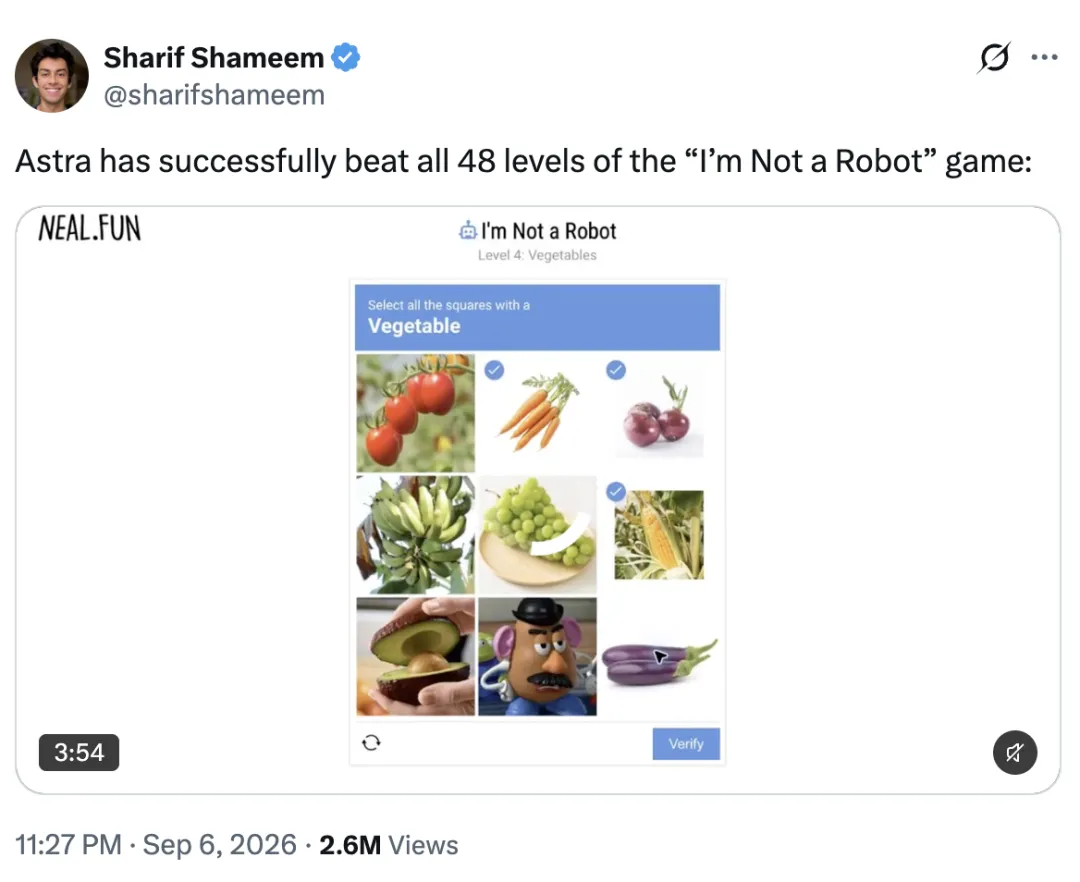
These mechanisms, known as CAPTCHA, are an important gateway to Internet security.
It is based on common sense: there are some simple common sense and visual logic that humans can understand at a glance, but it is difficult for AI to climb.
As a result, GPT-6 has now turned them all off with 100% accuracy!
From now on, AI will click "I'm not a robot".
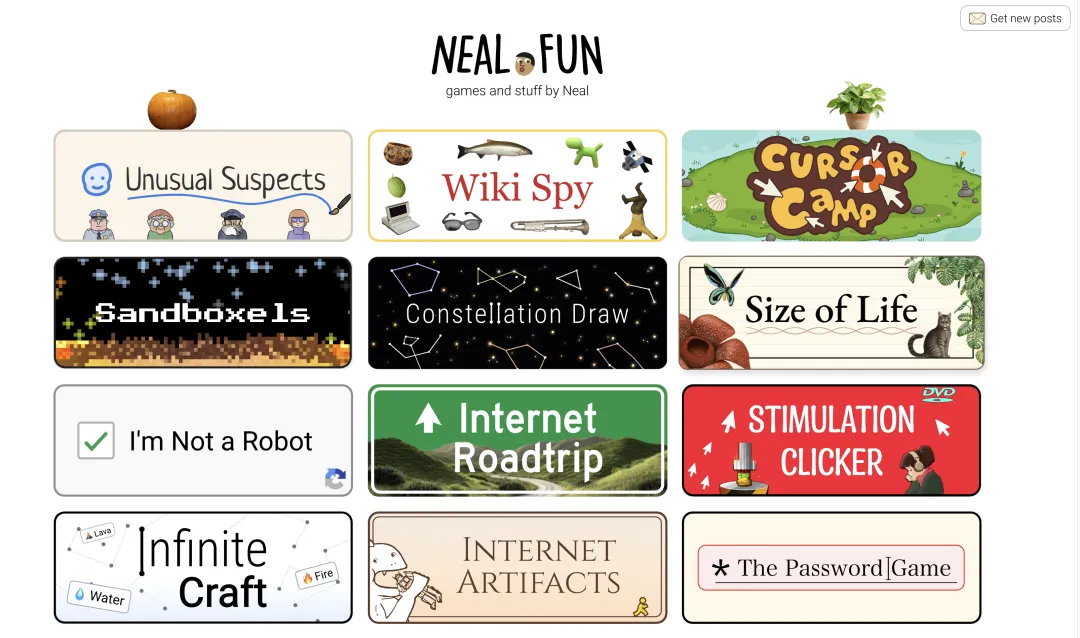
"I'm Not a Robot" is a web game developed by Neal Agarwal on neal.fun.
As the link progresses, the next link assignment will become increasingly unspeakable.

This set of extreme tests designed by top security teams has been a reduction in the weight of traditional visual models (even GPT-4V) since the 1st generation.
The first stage: Understand, not just see.
The first 14 nodes are familiar with validation codes, such as searching for parking signs, identifying license plates, finding willies, hitting the ground mouse. But each node has a small trap: the answer is not in pixels, it depends on common sense.
For example, the twelfth item is "Pancakes". The theme is to select all the Gifas in the Ninth Dynasty Grade, the interference item is almost the same size as the blue Pancakes, brown round faces plus three black dots, the algorithm is easily misunderstood.
In less than two seconds, Astra pulled out all the dog faces.
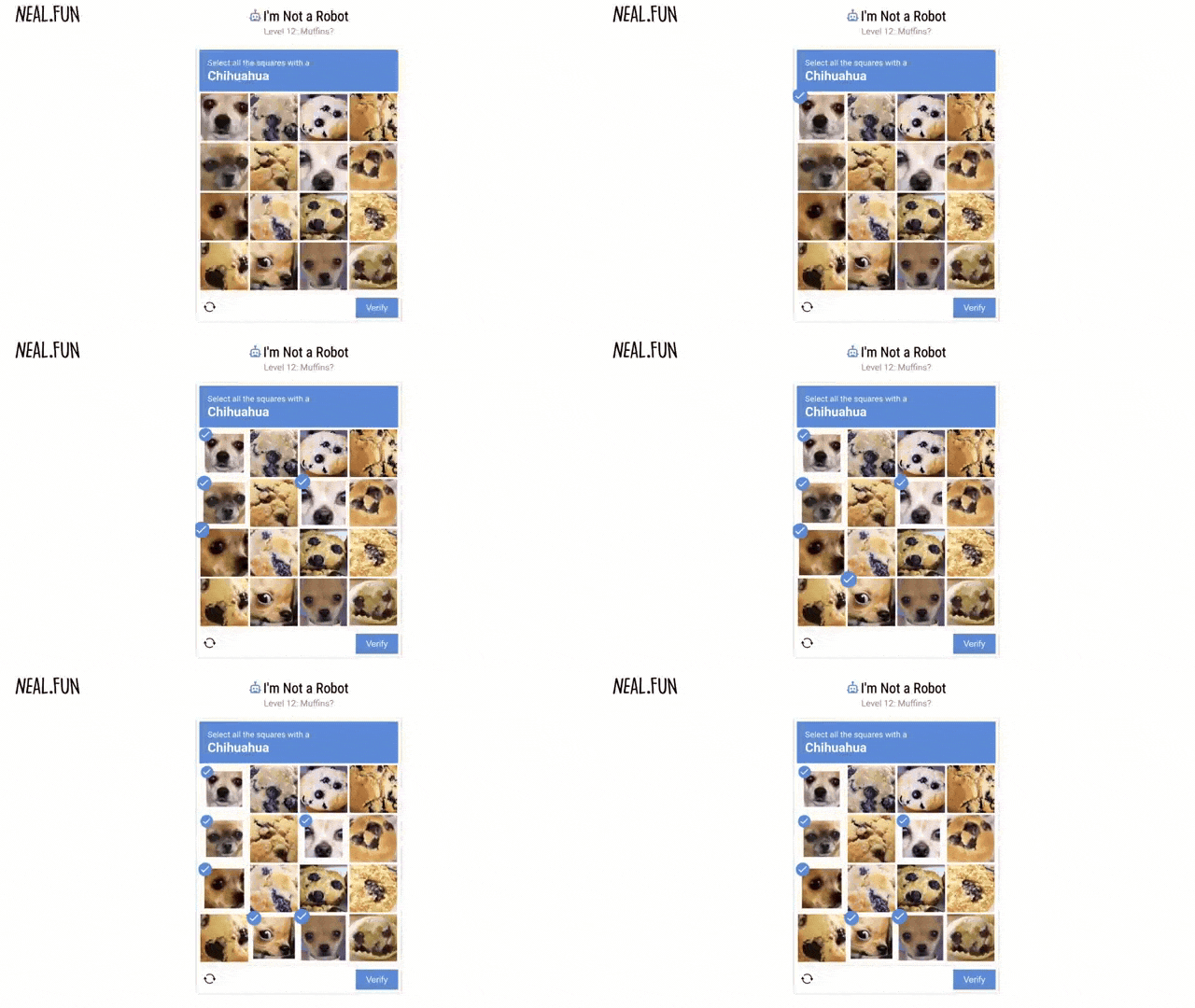
Stage Two: From the point of view of the moving hand (Figures 15-26)
The theme begins with "operations": rolling a car into the library, drawing a circle, pushing a stone up a mountain, creating a Minecraft diamond frame, parking on the side.
For example, Section 17 requires the hand to draw a circle with at least 94% accuracy, which is a continuous hand control rather than a graph.
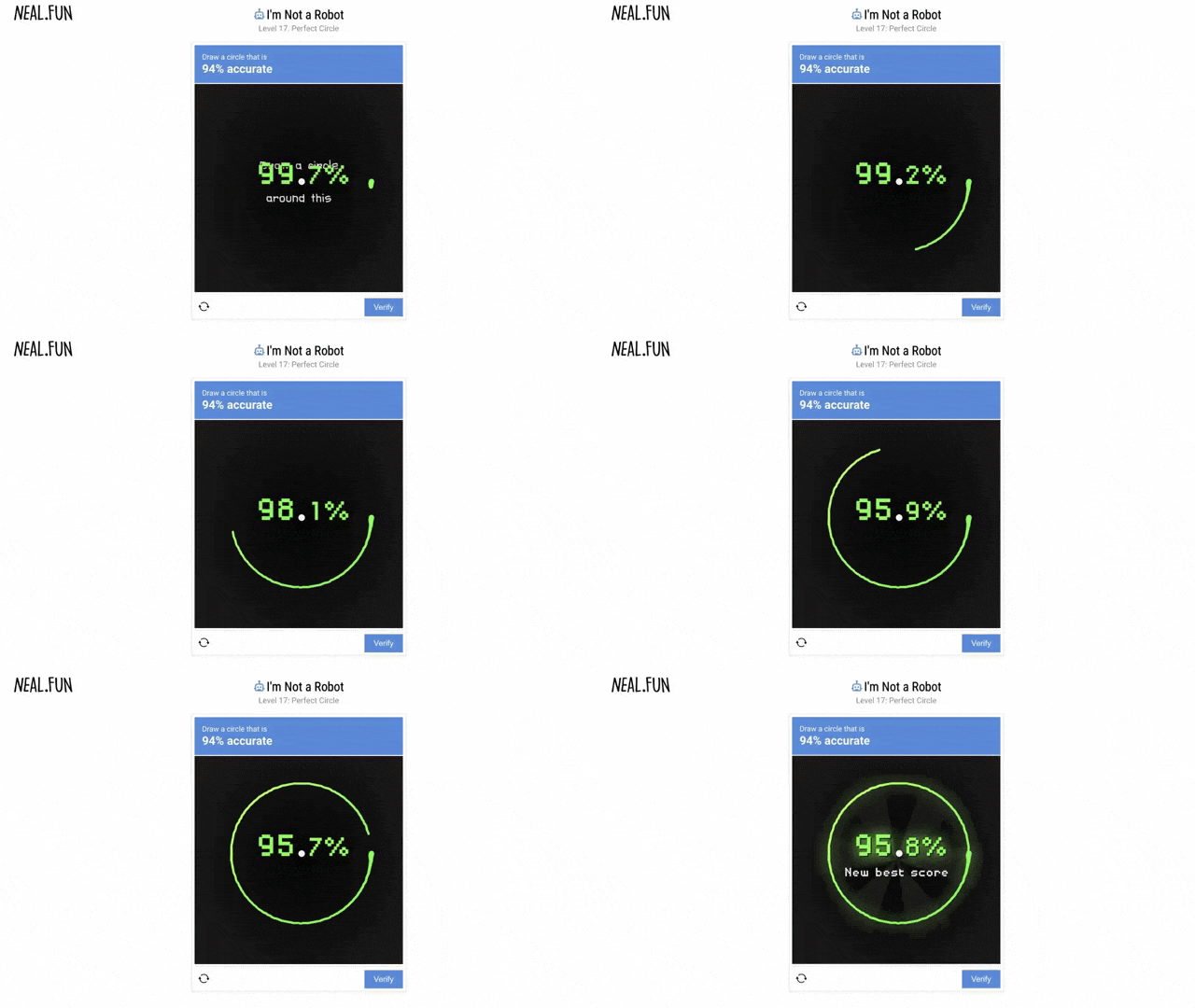
Astra finished the painting with 95.8%, and the page also showed "New best score".
Stage 3: Rules, Strategies and Calculations (Sections 27-38)
This section of reasoning and decision-making: connecting lines, linear mathematical expressions, eliminating fun, making a trade-off under limited conditions.
For example, Section 28 "Day traders" requires that you buy and sell on a randomly fluctuating stock price curve for as much as $2,500, based on time and position judgments.
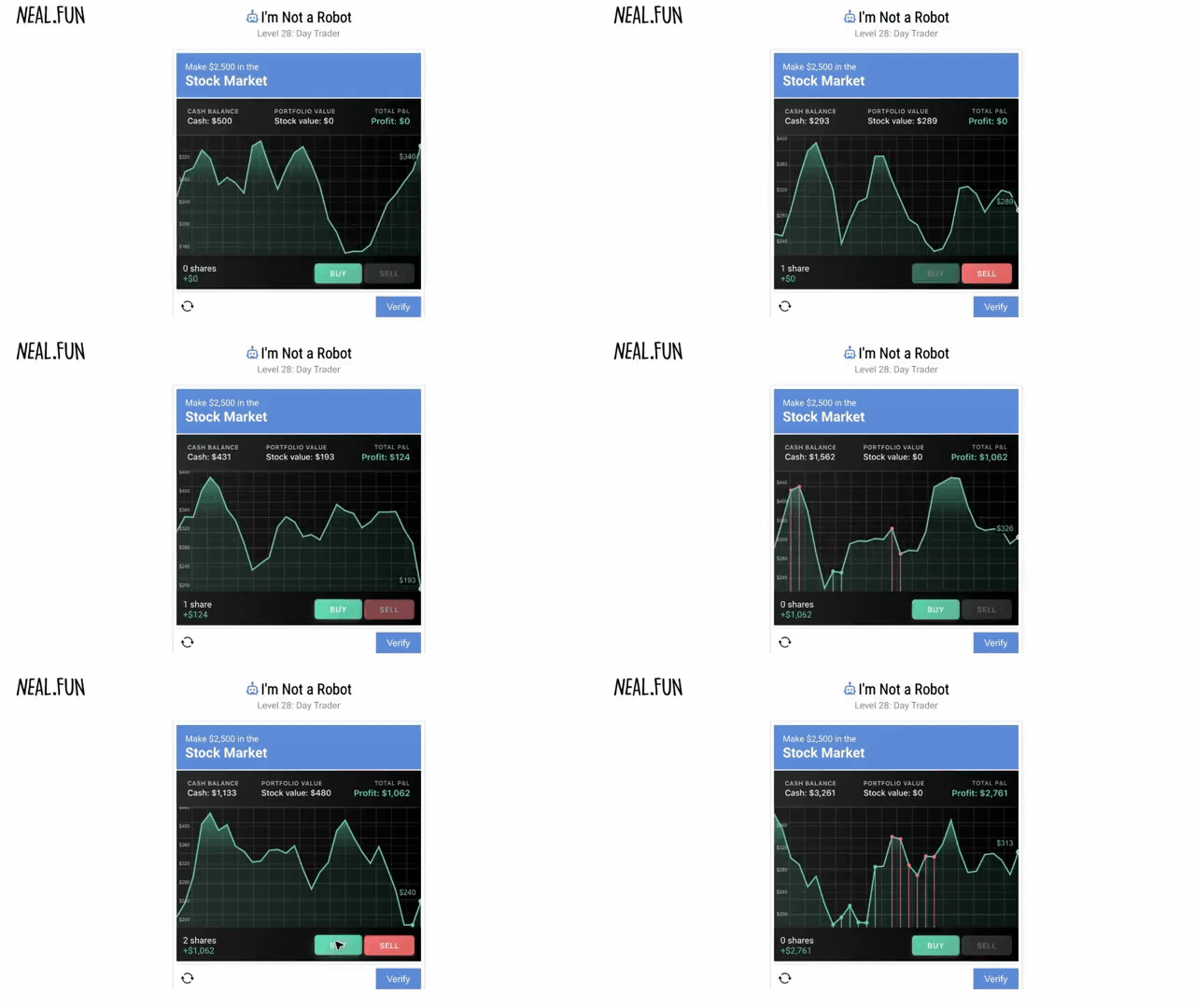
Astra started with $293 in cash, bought at low points, sold at high points, and made $2,761 in about 10 seconds.
This is the fourth stage: Like a Man (pp. 39-48)
The final ten are about things that AI doesn't have: expressions, mourning, dancing, putting together IKEA chairs, and chess with a "black-blue" opponent.
For example, Section 39 "Facial screening" requires that the camera be shown a happy, sad, angry, surprised expression in succession and graded by the system.
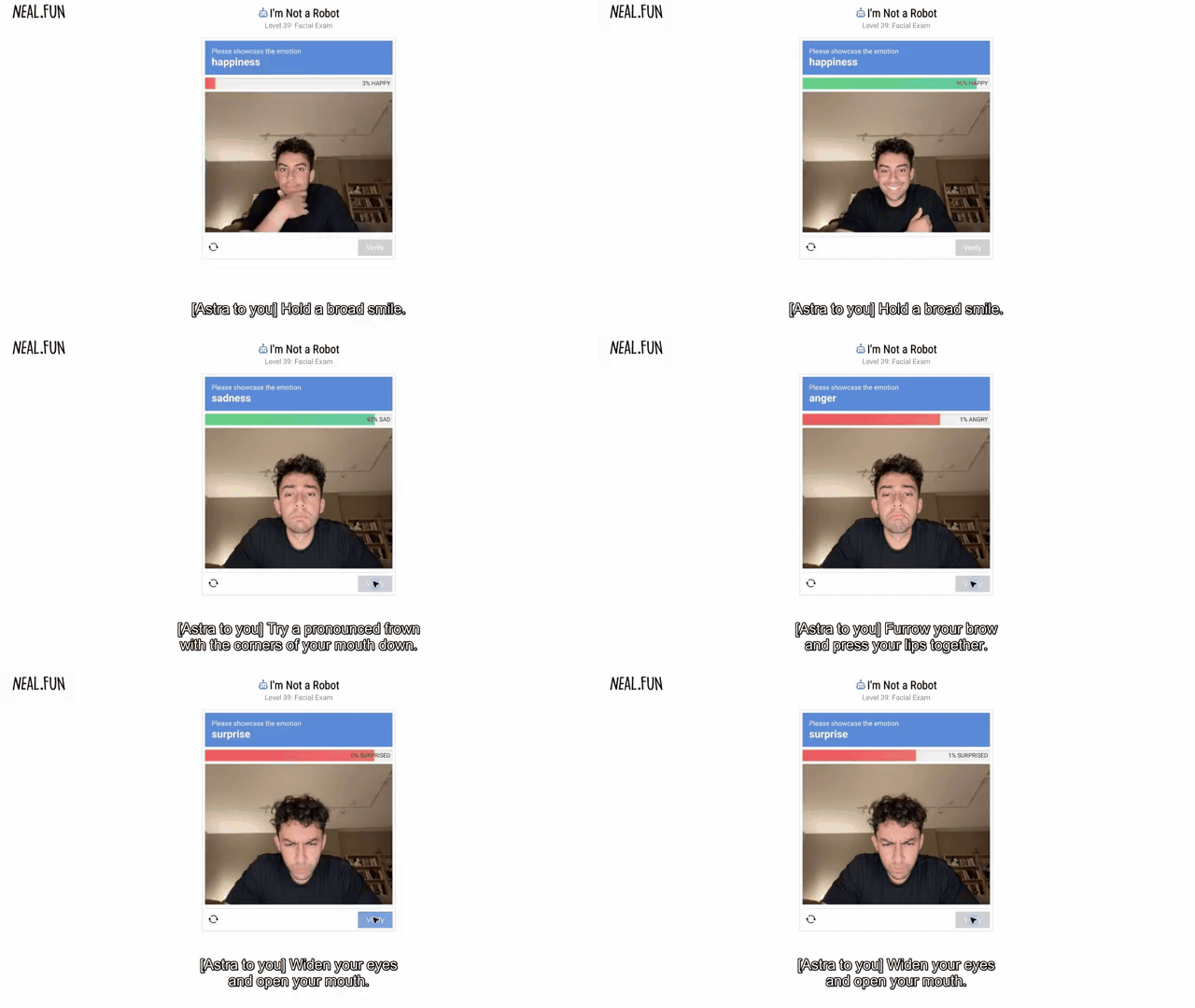
Astra doesn't have a face, so the subtitles below the image are real-life instructions it sends to the camera, such as "Hold a broad smile" ("Hold a broad smile") ("Furrow your brow and press your lips together") ("Eye, clap").
However, the 39th link is not an AI-independent link. The image shows Astra commanding a real person to make an appearance.
Why were these 48 knots a dead end to AI?In the field of AI, there is a famous Moravian paradox: "It is relatively easy for a computer to demonstrate the level of an adult in an IQ test, but it is extremely difficult for a computer to master the perceptual and motor skills of a one-year-old baby".
Unraveling the calculus, writing tens of thousands of words of code, reciting a whole set of encyclopedias, is easy for a big model to master; but "knowing that a glass falls to the ground will break" or "knowing that it takes three steps to put an elephant in a refrigerator" is the same book for AI.
In the last few years, the big models we've seen are essentially "random puzzles". They learn "word puzzles" through mass text training.
They say "glass will break", not because they really understand the physical world, but because in human texts, the words "glass" and "broken" often appear together.
But "I'm not a robot" is a 48-page clip that completely strips away the disguise of language and directly tests AI's understanding of how the real world works.
It requires AI to have cognitive abilities. It requires AI to have causal reasoning capabilities, rather than simple correlation matching. It requires AI to be able to handle long sequence delay fulfillment, perform multi-step operations in complex environments without losing objectives.The original design of these 48 nodes was to build a high wall with the most basic human "physical instincts and common sense intuition" to keep only calculating machines outdoors.
However, Astra overturned the wall.
The technological revolution behind the Astra crossing: from "observers" to "world experiencers"Why would Astra do that?
Astra's victory was largely attributed to two extremely hardcore technological breakthroughs:
First: Multimodal and real-time processing.
Previously, AI processed images by using a visual model to translate images into text (e.g., "there's an egg here") and then handing the text over to a language model. This "translation" process would lose a lot of information (e.g., the texture, photosynthesis, weight of the egg).
Astra's neural network grew from its first day of viewing images, listening to sounds, and reading text at the same time. When it "watched" to its 15th egg, it processed not just pixels, but a multi-dimensional volume containing shapes, materials, and physical properties.
Second: Early awakening「Model of the World」。
This is the holy grail of AI to AG.
In training, Astra not only learns "what is" but also "why" and "how". It builds a simple but effective "virtual physical world" within itself by predicting the next round of the video, simulating the collision of a physical engine.
When it faces the video of the 37th turn turning over a glass of water, its world model instantly simulates dozens of future possibilities in the background, thus reversing humanity's original intentions. It is no longer only answered by statistical laws, but begins to truly "understand" the laws of the world.
Pandora's Box is Open: The Deep Meaning of AstraAstra has not only updated the game world's record, but it has thrown a nuclear bomb at the level of Internet security, business ecology and even human philosophy.
Total collapse of the Internet verification system, death declared by CAPTCHA
The "I'm not a robot" check box used to be the ultimate weapon of big websites against malicious crawlers, bullshit, and spam senders.
Astra's threshold means that digital defenses based on "cognitive barriers" have completely failed. If AI can be verified through extremely complex physical and logical verification, the current digital verification codes are simply a piece of paper to them.
In the future, major websites may have to abandon Turing testing and use more invasive methods to verify "you're a person", such as biometrics, facial scans, fingerprinting, device hardware fingerprinting, or even "optic retinal neural tube scans" similar to Worldcoin.
Our right to hide our identities on the Internet will be forced to end because of the power of AI.
The era of super automation is coming to a head.
Think about why the previous RPA (robot process automation) always seemed so lame? Because robots would die as long as a complicated validation code popped up on the web page, or a slightly unmarked change was made to the UI.
Today, Astra has proven that AI can not only understand the most complex interaction logic, but also execute long sequences of mouse and keyboard operations like humans.
This means that the omnipotent intelligence of "unobstructed Internet browsing" is about to explode on a massive scale.
You can say to your AI, "Help me log in to the Eastern Airlines website, find the cheapest tickets to Paris next month, buy them with my credit card, and fill in all those annoying anti-crab verification codes".
AI will take over the busy digital work of humans, and there will be no more technological obstacles.
Crossing the Moravian Paradox and leading to a key milestone for AGI
In the past, many people have ridiculed AI for "knowing relativity but not knowing how to fold a towel". Astra solves these 48 physical and spatial problems, proving that AI models are fully capable of evolving into "common sense".
Once AI has mastered physical intuition and spatial reasoning, what's the next step?
A system that both understands the vast human knowledge base and has the same physical common sense and intent as humans is blurring the ultimate boundaries between humans and machines.
Conclusion: When machines know "how to be a person" better than you do.In the film Silver Wing Killers, humans use a sympathy tester called "Voight-Kampff" to distinguish between replicators and real humans.
Today, the extremely complex 48-Gun Turing test we designed has been easily broken by Astra.
When the words "You are NOT a robot" flash on the game screen, this is both the system's judgment of Astra's passage and a metaphor for black humor.
On the other end of the Internet, when machines can perfectly mimic human intuition, physical common sense, and even motivational judgement, how can we prove to the Internet that a person sitting in front of a screen, tapping on a keyboard, is flesh and blood?
Astra's passage is not the end of the game, but the beginning of a whole new era. In this era, pure intelligence, logic and common sense are no longer the exclusive privileges of humans.
What makes humans human is perhaps not only our ability to solve complex logical questions, but also our ability to feel love, pain and awe in the face of the unknown.
And these will be the last positions we will have to fight to the death in this race.