
“ The world model is moving from technical discussions to more specific industrial scenarios.
For $8.2 billion, AMD bought a space intelligence company that was founded less than two years ago.
On September 28, AMD formally signed the final agreement to acquire World Labs, which includes a full-stock transaction valued at approximately $8.2 billion, expected to be completed by the end of 2026. Following the transaction, World Labs founder Li Feifei will join AMD as executive vice president and chief scientist, reporting directly to Suzhou Tokugawa.

This is one of the biggest deals on the world model circuit this year. Invited to continue coding Physical AI, AMD bought World Labs for $8.2 billion directly, and the giants are pushing space intelligence, world models and robot learning to a more central position.
In fact, a group of teams has begun to move forward on a similar issue. In this group, Shadow Intelligence, which was founded in 2024, has been placing its technological routes on a 4D world model: cutting in from real 4D data, training the world model upwards, and then integrating the model into robots and the real manufacturing scene.
One is happening in the capital market, one is happening in the production site. Together, the world model is moving from technical discussions to more specific industrial scenarios.
01.
$8.2 billion, not just a model.
AMD's bet on World Labs has already begun long before its official acquisition. AMD is already an investor in World Labs, and has been involved in its B-Round and subsequent financing. Both sides are also developing global model computing expansion, workload optimization and commercial cooperation around the AMD Instinct GPU.The story told by World Labs is not complicated.
Today's big models are very literate, but they don't necessarily really understand where a cup is placed, how much space is left behind a door, or what the world will look like after a robot pushes an object down a table.
The new generation of Atlas, released by World Labs in September, is a concentrated representation of this set of judgments. It trains text, images, video, and 3D information from scratch, and puts different models into context in a unified space, using a set of models to simultaneously process generation, reconstruction, and simulation. According to World Labs' own definition, world models not only describe what the world looks like, but also understand how the world changes, and ultimately help robots plan actions.
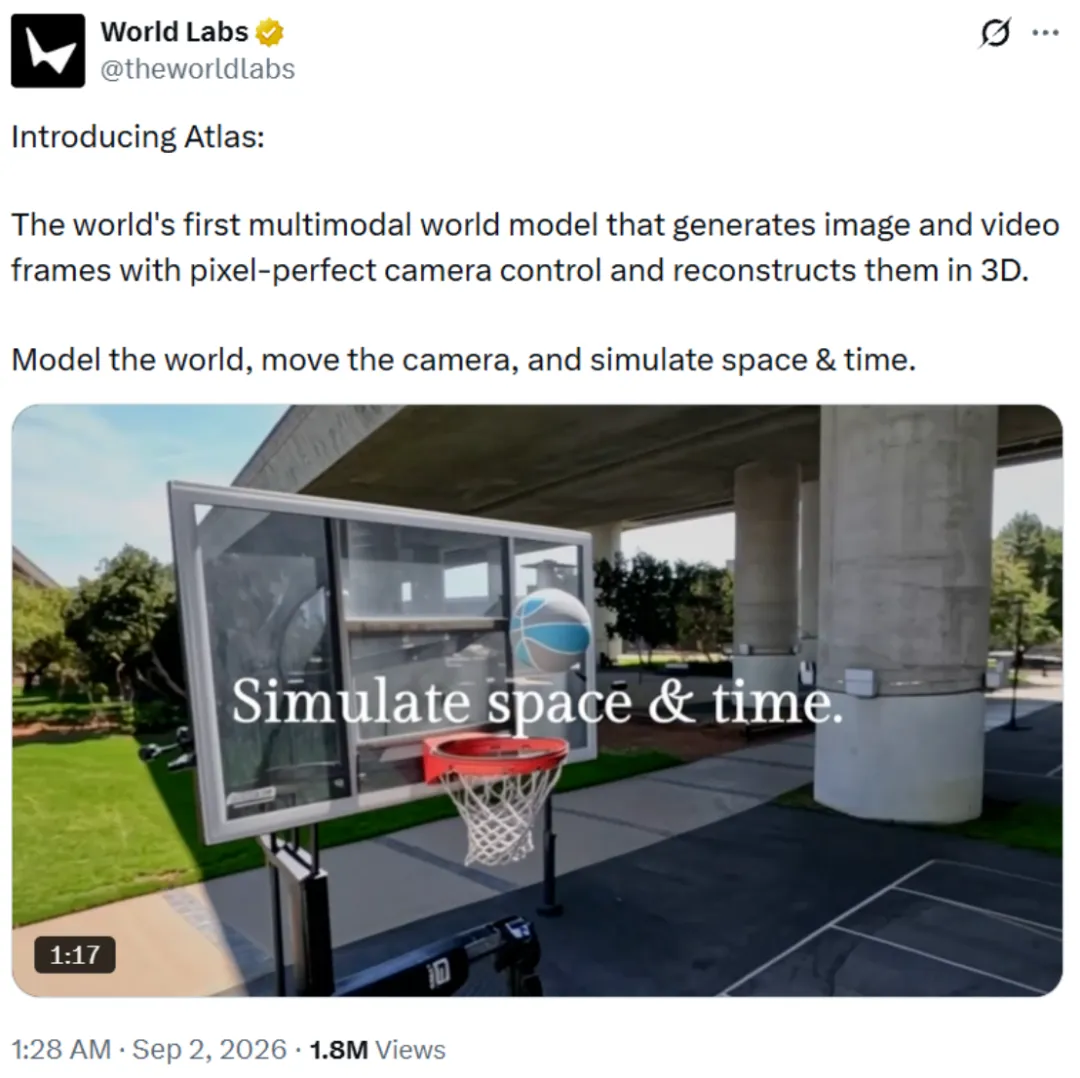
Earlier in July, World Labs also acquired robotic simulation company SceniX.
SceniX's open-source Real-to-Sim-to-Real system can reconstruct a real robot task into a simulated environment, and then change the location of objects, debris, physical parameters, robot status, and camera viewpoints, expanding a real task into a large number of controllable training environments. World Labs even showed early results of zero-real training data learning complex operations, such as the success of predictive strategies in simulation.
Putting the $8.2 billion acquisition of SceneX, Atlas, and AMD together, the industry links behind it are becoming increasingly concrete: space modeling, world models, robot simulation, and real-world learning closures are getting closer and closer together.
It is not just a choice of World Labs. In the country, several different technological start-ups have emerged around the same question of how AI can obtain a stable representation of the physical world and use it for robot learning and execution.
02.
China's model of the world has begun to divide
These routes are not a clear-cut gateway. Production, rebuilding, simulation, robot training often intersect with each other.
A class is first introduced from space generation and world modeling.
HunyuanWorld 1.0 can generate 3D scenarios that can be navigated from text or images, support 360-degree space browsing, and can export Mesh assets to game engines and 3D tools.
This route is now more oriented towards spatial content generation and the construction of a 3D world, which is not entirely equivalent to robot training, but it represents a common trend towards a spatially structured world that starts from two-dimensional content generation.
The other category is closer to understanding, simulating and training data in space.
The path of cluster nuclear technology is most representative. Its SpatialLM directly processes 3D space information, while SpatialVerse provides a virtual training ground for robots and smart entities. By the end of 2025, the publicly accumulated assets of cluster nuclear have exceeded 500 million 3D scenes and 479 million 3D models, forming a set of technologies ranging from space tools, space data to space models.
This path to solving the problem is a step closer to robots. It not only generates a 3D world map, but it continues to process digital space into an environment where robots can understand, train and test.
There is also a class that puts cutting-edge entrances closer to the real world itself, which is to first record and rebuild real environments and then train world models.
After 2024, it will not be cut off from the robot body or VLA itself, but will start with the collection and dynamic rebuilding of multi-faceted data, then upwards training the 4D world model, and finally bringing the model into the real world of robots and manufacturing.
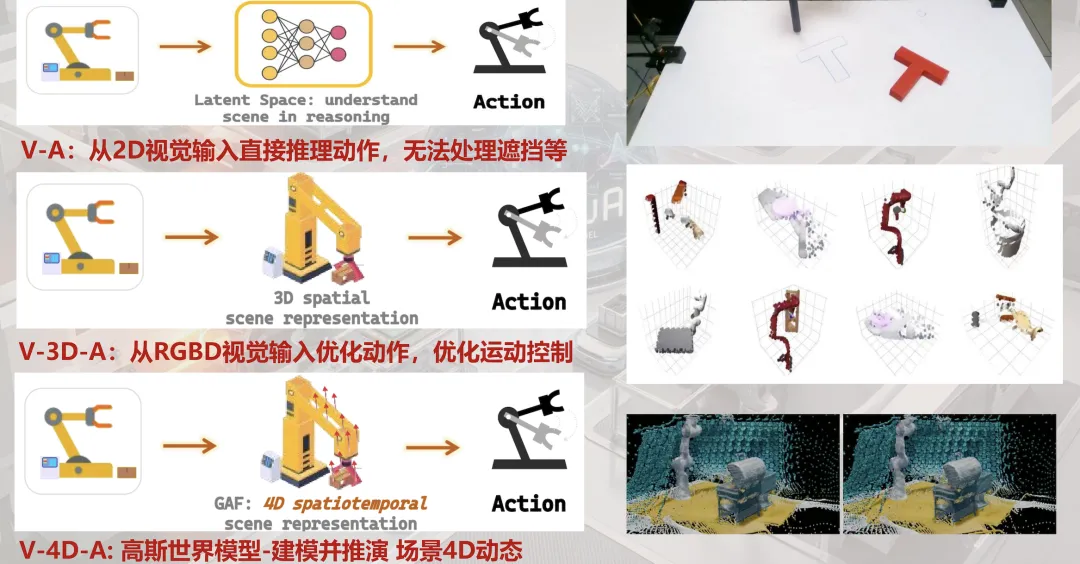
If Tencent is more inclined to create a world map, and the cluster nucleus is better at turning space into a training environment map, then imaging intelligence is more focused on how to turn a real world that is happening into models of data that can be continually learned.
It's also the most critical gateway to understanding body intelligence.
03.
The real field, starting with data.
Over the past two years, one of the most common words in the physical intelligence industry has been data. Real-time machine acquisition, remote operation, human video, Internet video, simulation and data synthesis are rapidly expanding into the training system of robot models.
Industry discussions have also changed. As more and more data become available, the real effect of the model is not only on the number of hours it takes to work, but also on what exactly the hour records, and how much state information it contains that robots can actually use.
It doesn't directly use single-track video as the final data, but instead uses multiple cameras to simultaneously record the same scene from different directions, complete spatial alignment and dynamic reconstruction, restore different images to unified space, and preserve the continuous changes that occur over time.
Similarly, a person picks up a shoe. Normal video can record how a person's hands move, where the shoe ends up going. Multipurpose 4D data can also further restore the shoes' position in space, the correspondence between different angles, the shading process, and how the state continuously changes over time.
Shadow Intelligence refers to this intermediate processing process as the hydrogen data drilling process. Removing the concept packaging, it is essentially a set of data engineering hydrogen cameras responsible for extracting raw materials, spatial reconstruction and models responsible for processing raw materials into time-space information that can be used to train world models.
This, and the mere expansion of the collection scale, are two different focus points. Large data collection centers are solving the problem of whether or not the shadow data is shadow. What the shadow intelligence wants to solve is the same real operation, which can leave valuable information about space understanding, state prediction and robot operation.
Mechanical arms with "flexible body model" are being operated with shoelaces.
Its collection method is not entirely dependent on the robot's body. According to the obvious path, the camera can be placed directly around the workplace and around the real production environment. While the workers work normally, the system can continue to generate multi-faceted data, without requiring operators to wear helmets for long periods of time, and without necessarily requiring the occupation of robot-specific runtime data.
This makes the 4D routes of the shadows have strong data infrastructure attributes. But data is only the first step. It is the model and execution behind it that really determines whether it belongs to a furniture company.
Shadow is currently trying to connect the whole chain: real-world scenario collection→ 4D reconstruction→ world models→ action planning→ real-world execution → new data backflow.
By the time we get here, 4D is not just a data format, it's starting to become a layer of interface between models and robots.
04.
From model to production line, the 4D world model enters the age of validation
The technological path to the end, or to return to the real scene. The first important industrial scene for the intelligent choice of shadows, is the manufacture of shoes.
Data released by the city of Jiangsu in April this year showed that shadow-body intelligent robots have entered the footwear industry and are gradually being verified on a large scale. Local reports also mention that its twin-armed robots can switch between shoes without requiring any artificial reprogramming.
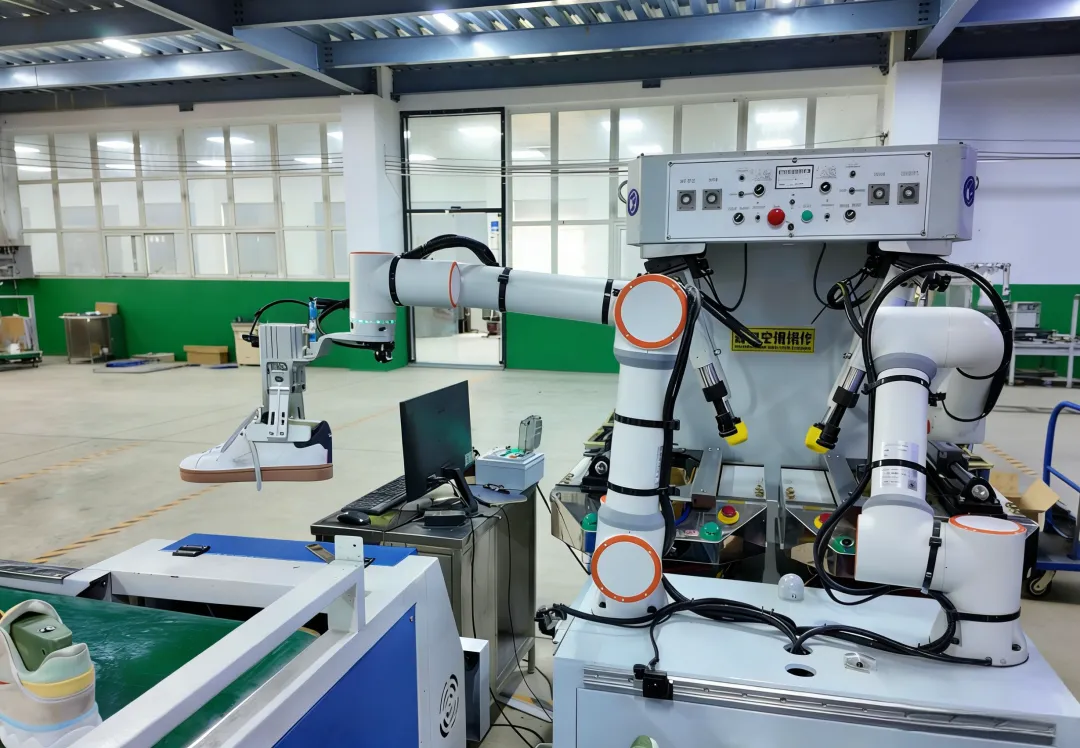
A month later, Shadow Intel released graphite robots, compressor robots, and other devices in Jinjiang. Public information showed that the devices adopted their self-developed 4D Gaussian world model, and combined dynamic compensation algorithms to process positions, gestures, and contact changes in real-world operations.
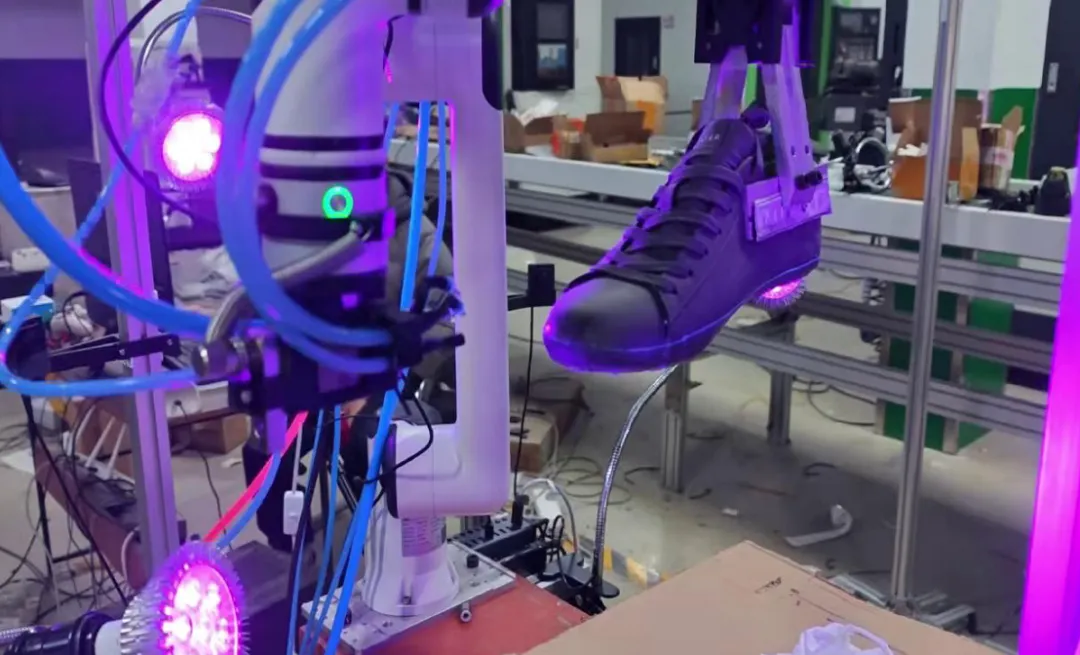
The reason why shoes are suitable for verifying the world's models is not because of the industry's traditional shoes, but because they are the typical double-flexibility shoes scene.
On the one hand, there is the flexibility of materials and objects. Different styles of shoes, footwear codes, materials correspond to different curves, shape changes and positioning is not completely fixed. On the other hand, there is the flexibility of order patterns.
This is the exact opposite of the fixed jobs, fixed products and fixed trajectories that traditional industrial robots are good at. Traditional automation cannot be adapted to customized orders that are frequently switched, and once changed, re-shaping, labeling, and modeling are often inevitable.
Simply put, what the photographer really wants to verify is that the model can adjust the movements based on the real-time state of the shoes in front of him, rather than a trajectory.
According to current public data, the route has begun to enter the efficiency verification phase. According to public statements made by Zhengwei in a report by the Jinjiang Municipal Government, about 3000 pairs of shoes can be produced in 8-10 hours at the relevant production link; brush link, one equipment can process about 1000 pairs of shoes per day, corresponding to about 1.5 workers.
From a far-reaching perspective, if this capability can be replicated from shoe-making to clothing, flexible assembly, etc., it doesn't mean just a few robots. More importantly, it will prove one thing: the same world model can be replicated across products, across devices, and even across industries.
This is a crucial step in the 4D world model from technological creation to commercial creation.
05.
From a production line, rolling out a flying saucer
Factories have another layer of value for shadows. It's not just a landing scene, it's a place where real data continues to be generated.
Different styles of shoes, sizes, materials, positioning and abnormalities are constantly present in real production. As long as these data can be re-introduced into the training system, the production line will not only be the end of the application of the model, but will also become a new data input.
Thus, a more complete cycle began to form: the deployment generates data, the data continues to train the model, and the model reduces the cost of subsequent deployment and debugging. This allows the 4D path to not only stay in the shell with a set of model shells, but also with the possibility of continuous rolling of data, models and scenarios.
At the same time, the company is also extending its 4D capabilities beyond robots. At the 2026 World Trade Center, the company presented a set of 6 camera 4D live broadcasting programs: multiple locations capturing the same scene, then completing real-time space reconstruction with models, and generating new perspectives that are not directly covered by the camera.
4D live broadcasting and shoe-making robots are targeted at different markets, but the underpinnings are replicated with multi-point acquisition, spatial alignment, dynamic rebuilding and 4D generation capabilities. This gives the technology a layer of added value and the same underpinning capabilities that can be replicated in different industries such as industrial hardware and digital content.
For a heavier 4D route in the early stages, this reuse could both improve technology utilization and lead to more real data inputs.
From this perspective, what we really want to do is grow, not just a single robot project, but a set of 4D world models that can continue to accumulate data and modeling capabilities as the business expands.
06.
The Future and the Word
Looking back at the $8.2 billion worth of AMD, it hasn't chosen a standard answer for the global modeling industry.
Tencent moves back and forth from space generation, cluster nuclei move up from space data and simulation training, World Labs connects space models to Real-to-Sim, and imaging intelligence starts with real 4D data and continues to model and robot execution extensions.
These routes have been crossed a great deal and have not yet been divided into defeats. But one thing has become increasingly clear: the value of a world model cannot ultimately be proven only by generative effects. It needs to be simulated, it needs to be trained, and it needs to receive feedback in the real world.
The real need for shadow intelligence is to demonstrate that the chain from real 4D data, world models to robots can continue from one production line in Jinjiang to more factories and more flexible tasks.
At $8.2 billion, AMD is pushing space intelligence back to the spotlight, and the toughest part of the competition is who can really make robots understand the world and make it work.