
“ Why is it that robotics finance is so early to get new ones?
As the third quarter of 2026 approaches, funding for smart racetracks is shifting from the concept premium to the pricing of lithium delivery capabilities.
Looking at the financing of a single startup is more likely to expose the real preferences of capital than looking at multiple financing of a parent company. The heat of financing itself has not subsided, but the pace of liquidity financing, which is significantly ahead of the pressure of commercialization, has become a central topic of public discussion.
In this context, the August financing data provides a clear snapshot for the observing industry. According to the robotics conference, which is not a complete statistic, a total of 63 financing events were recorded in August.
The structural characteristics of capital flows can be seen in the four dimensions of turnover, industry, amount and time of establishment: early events dominated, the whole system was concentrated on both ends of the core components, large volumes of financing shifted significantly, and new companies became dominant.
01.
Round: Over 80% of funds pressed early
In August, the sub-structure of the financing rounds shifted to earlier rounds. Seed rounds and angel rounds combined amounted to 19, accounting for about 30.2%; Series A rounds 33, accounting for 52.4%. Both combined, early financing combined amounted to 52, representing 82.5% of the total for the entire month.
In other words, more than 80% of the funding this month came before Round B.
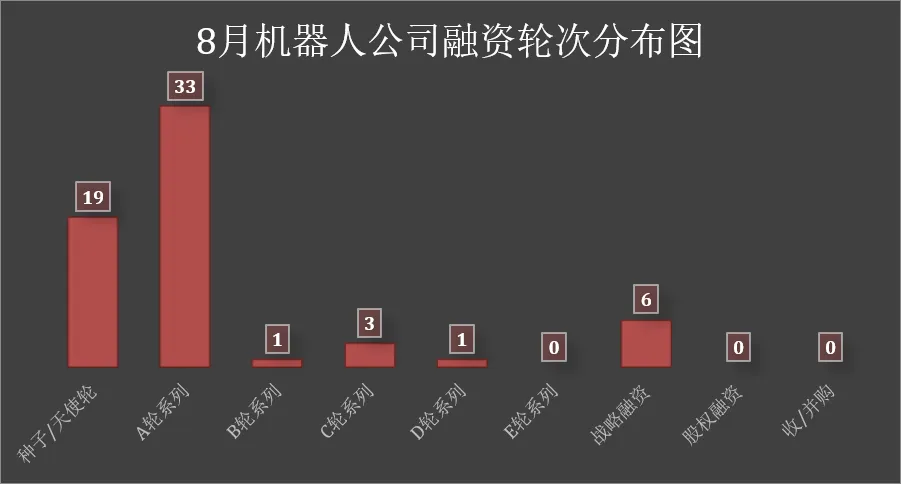
Medium-to-late financing has shrunk significantly. Only 1 round of B, 3 round of C, 1 round of D, and 0 round of E, with a total of 5 mid-to-late financing, accounting for less than 10%.
The reason for this structure is not complicated. After nearly two years of racetrack competition, the leading companies have formed a clear valuation constraint, fully releasing the demonstration effect. For capital, the earliest intervention means a higher potential multiplier rate in exchange for a lower valuation; while mid-to-late companies need to prove the rationality of the valuation with solid exports, revenues and gross margin.
Capital in the early-to-mid to late-to-early-early-to-early-to-early-to-early-to-early-to-early-to-late-to-mid-to-late-to-late-to-early-to-early-to-early-to-early-to-early-to-early-to-early-to-early-to-early-to-early-to-early-to-early-to-early-to-early-to-early-to-early-to-early-to-early-to-early-to-early-to-early-to-early-to-early-to-early-to-early-to-to-early-to-to-early-to-to-early-to-to-to-early-to-to-to-to-to-to-to-to-to-to-to-to-to-to-to-to-to-to-to-to-to-to-to-to-to-to-to-to-to-to-to-to-to-to-to-to-to-to-to-to-to-to-to-to-to-to-to-to-to-to-to-to-to-to-to-to-to-to-to-to-to-to-to-to-to-to-to-to-to-to-to-to-to-to-to-to-to-to-to-to-to-to-to-to-to-to-to-to-to-to-to-to-to-to-to-to-to-to-to-to-to-to-to-to-to-to-to-to-to-to-to-to-to-to-to-to-to-to-to-to-to-to-to-to-to-to-to-to-to-to-to-to-to-to-to-to-to-to-to-to-to-to-to-to-to-to-to-to-
02.
Industry: Concentrated on the whole machine and parts
In terms of industry distribution, August's cash flows showed a clear slump.
Human robots were ranked first in 26 markets, with 41.3% in the field of physical intelligence, and 18 in the field of core components, with 28.6% in the second place. Together, they accounted for 69.8% of the entire month. This means that almost 70% of the month has been spent on physical intelligence and parts.
The middle ground is obviously cold: 7 service robots, 45 special robots, 4 industrial robots, 3 medical robots, and the number of core parts in a single category is still low.
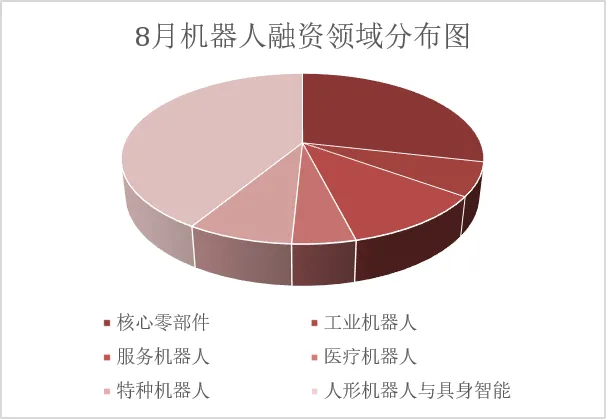
As a result, the direction of capital betting is becoming clearer, on the one hand, to directly build integrated circuits and brains, and on the other hand, to supply critical components to the integrated circuits.
The reason that the core components continue to absorb gold is that it is an unbreakable link in the mass production of humanoid robots, downstream demand is relatively certain, and the profitability pattern is clearer; while in the application of services, industry, and specialties between the two, as it has not yet run out of a large-scale commercial shutdown, financing activity naturally declines.
03.
Amount: Large funding and round-the-clock misplacement
The quantity-dimensional signals are worth looking at more closely.
The largest single financing of the entire month was the $900 million A round of small business robots. But the peculiarity of this transaction is that its automotive background, which is heavily focused on industrial capital, does not represent a market reference to the pricing of mid- to late-term projects of pure start-ups.
It is really worth paying attention to the density of financing above the million yuan level: A+ wheels with a power limit of 1 billion yuan, A+ wheels with a power limit of 1 billion yuan, A+ wheels with a power limit of 1 billion yuan, A+ wheels with a power limit of 1 billion yuan, A+ wheels with a power limit of 1 billion yuan, A+ wheels with a power limit of 1 billion yuan, A+ wheels with a power limit of 1 billion yuan, A+ wheels with a power limit of 1 billion yuan, A+ wheels with a power limit of 1 billion yuan, A+ wheels with a power limit of 1 billion yuan.

It is also worth noting that many large-scale financing took place in the early stages. The demand for tech angel rounds is $100 million, the demand for smart angel rounds is $500 million, the demand for underground tech seed rounds are $100 million, and the demand for general intelligence seed rounds is $100 million.
Angel wheels and seed wheels have reached multi-billion yuan, almost unthinkable in a traditional venture capital context. According to industry practice, these two rounds typically range from millions to tens of millions of yuan.
The August financing data showed that capital had a strong willingness to raise capital for early projects on the main track, which had reached the point of actively raising valuations and compressing successive turnaround spaces. There was a clear gap between the amount of financing and the development phase of the company.
It should also be noted that a substantial part of the 63 financing has not disclosed the specific amount, and that the actual total financing for August will be even higher if some of it is not disclosed.
04.
The new face took 60% of the money.
Another signal emerged from the time when the venture was founded.
Of the 63 corresponding financing firms, about 41 were founded in 2023 and thereafter, accounting for more than 60 percent. Of these, about 21 were just founded between 2025 and 2026, accounting for one-third of the entire month.
In other words, a significant portion of the money spent this month went to the team that has been around for less than three years.
This means that capital is speeding up the betting on new startup teams, rather than waiting for the company's performance to prove itself. Sourcing early, sourcing new companies has become a common practice in the first-tier market at this stage.
A new company's valuation baseline is low, negotiation space is large, and once the technical path or team background is identified as the next potential headache, the rate of early intervention returns is far higher than in the mid-to-late period. Accordingly, a company that has been in existence for several years and has not yet reached the mid-to-late period of inventory is faced with higher valuation ratios and more stringent adjustment standards, and the financing environment is more difficult.
Between hot and cold, there is actually a liquid layer within the track.
05.
Two signals worth paying attention to
In addition to the above structural features, there are two other signals worth noting in August.
The first is that automotive companies have begun to delve deeper into humanoid robots. The $900 million A-Round financing of small robots is the largest single financing of the month, which means that after Tesla promoted the development of humanoid robots as an industry consensus, domestic automotive companies are also being followed by real money and silver in capital. The competition for humanoid robots is evolving from a comparison between startups, to a place where automotive companies, Internet platforms and industrial capital are participating together.
Second, the shrinkage of mid-to-late financing could lead to industry shrinkage. For companies that have gone through early verification and have a certain shipment size, the prospect of mid-to-late financing means an increase in continuing capital pressure. When early-market capital flows and mid-to-late funds are cautious, companies that rely on continued financing to maintain their operations will face more severe tests. Some companies may be forced to lower their valuation financing, others may be merged, and real liquidation has begun.
A structural map of the August robotics trajectory was drawn from the 63rd round of financing. This heavyweight, lightweight structure itself reflects the true spirit of capital in the industry's transition from narrative-driven to delivery-driven: neither willing to miss out on a potential hundredfold return, nor willing to pay for an unrealized scale.
For the industry, the real question that needs to be answered has never changed. When the early high-value dividends are gradually declining, will enterprises be able to rely on real orders and revenues to complete the switch from financing-driven to business-driven.
Financing is just a ticket, and whether or not it can run through the commercialization cycle is the key to deciding who these companies can go to the next stage.