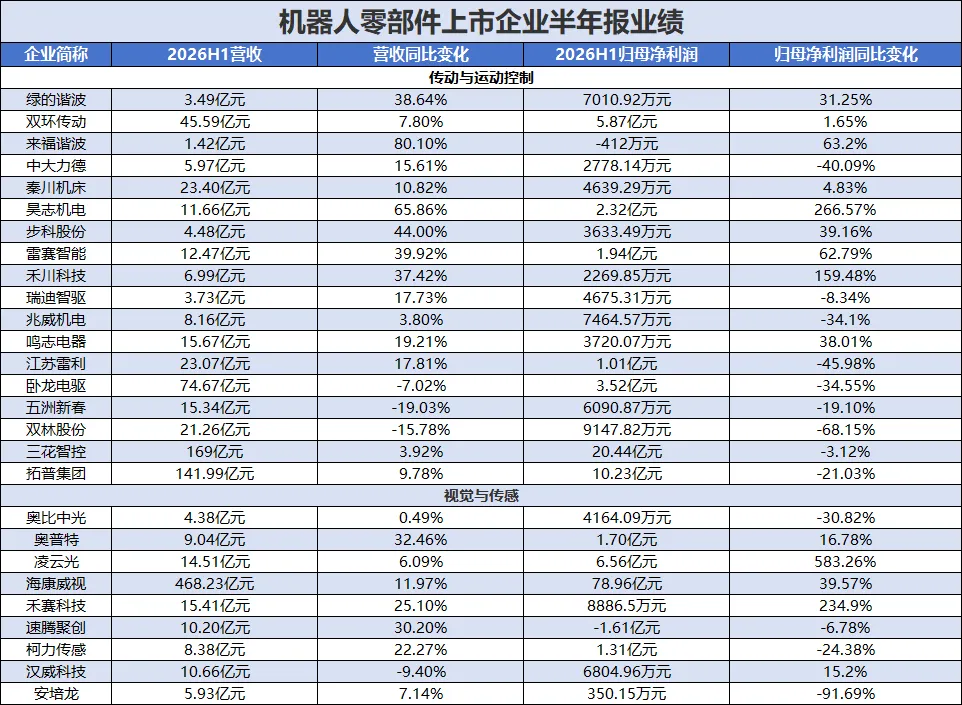
 In the first half of the year, the three major categories of components that pioneered large-scale deliveries grew at a faster pace, with wavelength reducers shipping up to 100,000 units; unbroken rectangular motors reaching millions of units on hand orders; and laser radars relying on service robots and industrial robots to scale earlier.
In the first half of the year, Fujifilm shipped 23.95 million units, an increase of 112.0%, driven by the growth in demand for humanoid robots and collaborative robot customers. Among them, the share of shipments of small wave accelerators for humanoid robots increased to 10.6% from 5.1% in the same period last year, and it can be seen that wave accelerators for industrial robots remain the main supplier.
As of the end of July, more than 400,000 units were ordered in hand, about 1.7 times the volume shipped in the first half of the year; the capacity utilisation rate reached 95.1%, the production line is basically in full load operation, the new capacity is digested by real orders, and the main constraint on order delivery has shifted from the demand end to the capacity end.
On order-driven basis, the monthly capacity of Fujifilm will increase from 396,000 units at the end of 2025 to 648,000 units at the end of July 2026, which is planned to reach 80,000 units at the end of 2026, reaching 150,000 units at the end of 2027, when the combined annual capacity will be about 1.8 million units, approximately 3.8 times that at the end of 2025. The scale effect is synchronized in the cost end, and the cost of Fujifilm's single-speed decelerator decreases from 482 yuan to 351 yuan in the same period of 2025, a decrease of about 27 percent, while the gross margin of the decelerator decreases from 20.7 percent to 29.6 percent.
The order is a change in the structure of demand, the main integrated customers have significantly increased the purchase of pulse reducers after the product enters mass production. However, some integrated companies are simultaneously developing motors, reducers and joint modules in parallel with outsourcing and automation, which may further affect the stability of the order of parts enterprises in the future.
In the first half of 2026, the green wave for the decelerator leader grew by 38.64% and 31.25% respectively in revenue and net returns, respectively. Green wave will be attributed to the increase in the share of the industrial robot industry, as well as the growth in the size of the robot business.
Green Wave has a production capacity of 43.37 million tonnes in 2025, with a capacity utilisation rate of 67.76%. Under such capacity utilisation, the pace of expansion of Green Wave is more prudent, prioritizing the digestion of the annual output of 500,000 tonnes of projects funded by the IPO, which will extend the fundraising of 1 million new generation of Wave Reducers to the end of 2028. At the same time, Green Wave expects to invest 100 million yuan in advancing the development of flexible installation of Wave Reducers manufacturing systems.
Putting together the semi-annual results of the two leading wave reducer companies, it is easy to see that the demand for industrial robots is warming, but the price competition is fierce, and humanoid robots have raised the capacity threshold, and orders are concentrating on companies with strong delivery capabilities and rapidly falling costs.
Rectangular motor with no limits: orders reach a million units
In the first half of the year, a common change in this category was that the company's expansion plans began to unfold in millions of units, and the delivery form gradually shifted from single motors to joint modules, with the gap between orders and capacity becoming a new contradiction.
In the first half of 2026, about 114,000 unframeed rotor engines were shipped, representing more than 400% of the company's market share. Among them, industrial mechanical arm and collaborative robotic direction, its unframeed rotor engines have also entered the supply chain of leading global and domestic customers, and orders in the field of humanoid robots have also been converted from small to large batches.
The revenue edge is also accelerating, with the robotics business earning around 240 million yuan in the first half of the year, an increase of 62.3% on the previous year, and a total revenue share of 54.36%. Industrial mobile robots (AGV/AMR) are still the mainstay of its robotics business, and humanoid robots, collaborative robots and industrial mechanical arms are becoming new sources of growth.
Orders and capacity planning for Reys Smart have reached the millionth level, and in 2025, the delivery volume of its unframeless matrix engine has exceeded 120,000 units, an increase of more than 20 times, with products entering the supply chain of most mainstream humanoid robot manufacturers in the country. The semi-annual report shows that its hand-ordered units have exceeded 1 million units, about 8 times the total year-round delivery volume by 2025, automated production line planning has also increased the annual output of 2 million units to 3 million units by the time of the annual report, and the supply volume of joint modules has been reached, with nearly 100 customers.
The linkage between orders and capacity is a central point of view for the second half of this category. Millions of orders need corresponding automated production lines to be digested, and there is still a clear capacity climb cycle between hand orders and actual delivery. Therefore, the speed and goodwill of the construction of subsequent new production lines will directly determine whether orders can be converted into revenue on time.
Laser Radar: Robot business from co-star to protagonist
Laser radar is the fastest-growing component category in the robotics business, unlike decelerators and motors, it is largely driven by mobile scenarios such as lawn mowing, commercial cleaning, and unmanned delivery, followed by industrial scenarios, AMR and forklift AGV navigation barriers to the need for 3D laser radar, and new growth from humanoid and quadruped robots.
GGII data shows that in the first quarter of 2026, GGII ranked the top two global 3D laser radar shipments in the field of robotics. GGII expects the global 3D laser radar market to be close to 64 billion yuan in size by 2030, with a compound growth rate of about 26% from 2626 to 2030.
In the first half of the year, the market for laser radars in the field of robotics reached 28.26 million units, an increase of 510.4%, and already accounted for 39% of its total sales; in terms of revenue, the share of revenue from the robotics business as a product revenue has increased by about one-tenth to almost half in 2024, becoming the main source of gross product and achieving independent profitability.
According to two disclosed data estimates, the company has generated sales of about 97,000 units in the field of robots in the second quarter, while sales of 118,30,000 units in the first quarter and 144,240,000 units in the second quarter have increased by 193.4% compared to the first half of the year, exceeding around 239,000 units in the full year of 2025.
In terms of demand structure, lawnmower robots are the largest source of growth at the moment, and Fast Company expects its lawnmower robot business to ship more than 600,000 units this year, followed by commercial cleaning and unmanned delivery.
In the industrial scene, the Heisei JT, XT series has provided positioning navigation and obstacle avoidance support to mobile robot manufacturers such as Nissan; Accelerator has also ranked industrial transportation as one of the main application scenarios and has replaced some traditional camera schemes in scenarios such as factory automation.
In addition, laser radar enterprises are also accelerating the expansion of other robotics businesses, such as joint modules and other sensing components. In addition to accelerating the speed of laser radar imports from robotics enterprises, modular products are also beginning to scale, with cumulative power module deliveries of more than 10,000 units as of H1.
The first enterprise-level production project with visual touch and MEMS touch is scheduled to begin commercial delivery at the end of September, entering mass production in the fourth quarter; the Joint Module has formed the first batch of tens of thousands of purchasing needs and plans to start bulk delivery in the fourth quarter.
From capacity to profitability: three challenges for the second half of the year
Putting speed reducers, motors, and laser radars together, the growth of robot parts in the first half of the year shows the scale of the contribution of silicon industrial robots, the shape of the contribution of humanoid robots to the increase of silicon, and a common characteristic: order growth generally precedes shipping growth.
After orders ceased to be scarce resources, the competitive focus of parts companies shifted from picking up orders to fulfilling orders, and the second half needed to answer the three-way questions of capacity, cost and profitability.
The first is the capacity, which examines whether the pace of expansion of production can match real demand. The annual capacity planning is being broken down into different execution rates, orders are being prepared for full capacity, stable enterprise concentrations are being delivered. New capacity is mainly wagered on the scale of humanoid robots, as industrial robot demand is still difficult to digest separately even if it continues to warm up.
The second is the cost, which examines whether the unit cost can fall faster than the sale price. The market for parts of industrial robots has entered the stock market, products tend to be homogeneous, price war pressure increases, and has already affected the profitability level of the industry as a whole. Human robots have to move from technical verification to the popularity of the scene, as well as the ongoing exploration of parts costs.
The third is profitability, considering whether the scale can really turn into profit. The first half of the year's profits were better, either for industrial owners who are stable or for those who have formed a scale scenario. Although the robot business of some parts enterprises has achieved independent profitability, the robot business of more enterprises is still in the stage of investing in exchange for growth.
If in this line of man-made robots, last year's newsletter phase is compared to delivery, and this year's middle newsletter phase is compared to bulk, then the next phase is profitable; and in this line of industrial robots, the ratio is always cost control and delivery stability. The two lines will eventually converge on the same newsletter: whether hand orders can be converted to revenue on time, whether new product lines can climb on time, whether the price can be lowered. The forthcoming three-quarter results will be disclosed, and will be the first window of inspection of parts companies ordered in a single color in the first half of the year.
* Cover for AI mapping