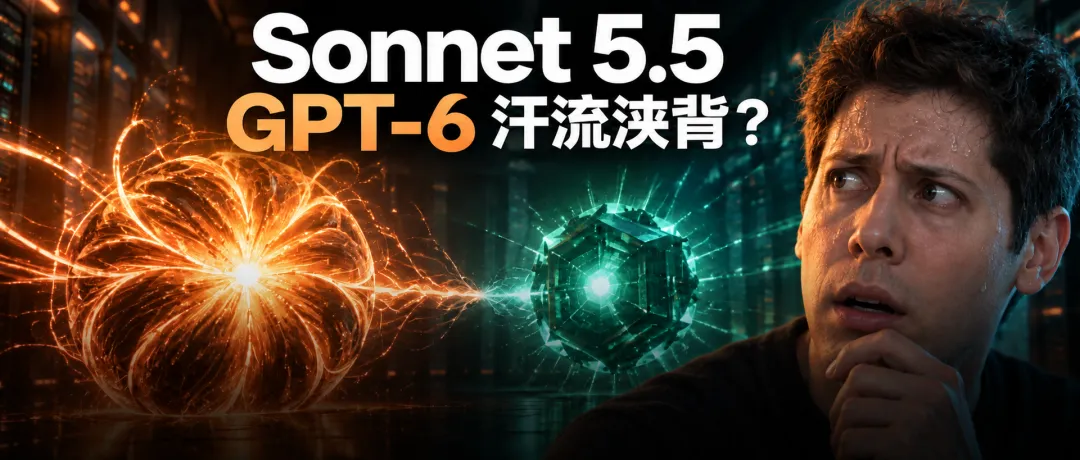
It's the first time in the history of the world.
Yes, Sonnet 5.5 is here!
On the eve of the OpenAI Annual Developer Conference, Anthropic even released Claude Sonnet 5.5 overnight.
As the best companion to Opus 5.5, Sonnet 5.5's mission is to be the fastest, most economical, and most knowledgeable "all-powerful worker assistant" in your everyday work.

Compared to the Sonnet 5, it runs 30 percent faster and costs 30 percent less to complete the same task.
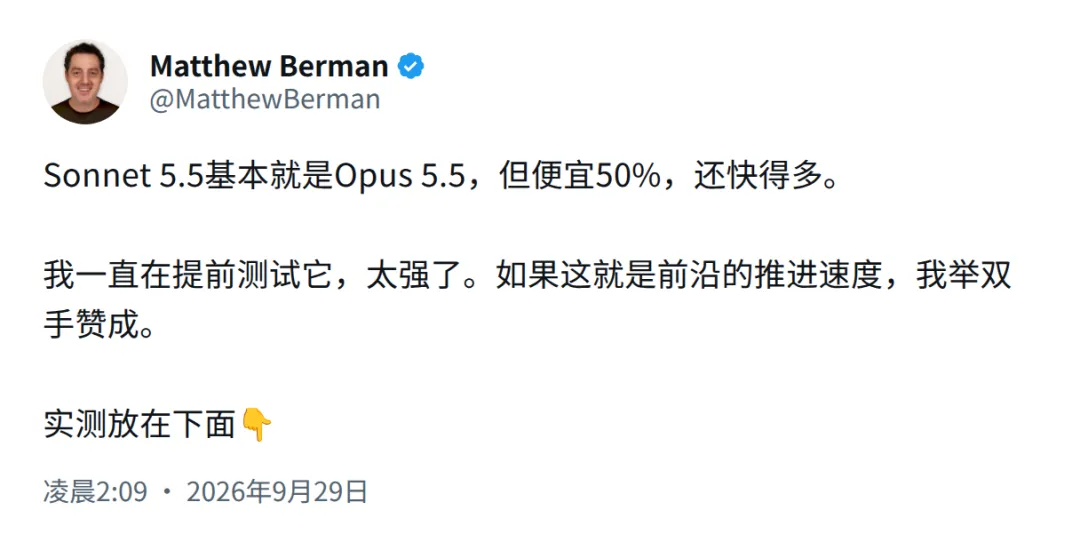
In addition, it is only half the price of the Opus 5.5, but its performance is almost the same.
It not only wrote the code and flew it, but it was also the first ever Sonnet model that could be accessed by just looking at a screenshot.
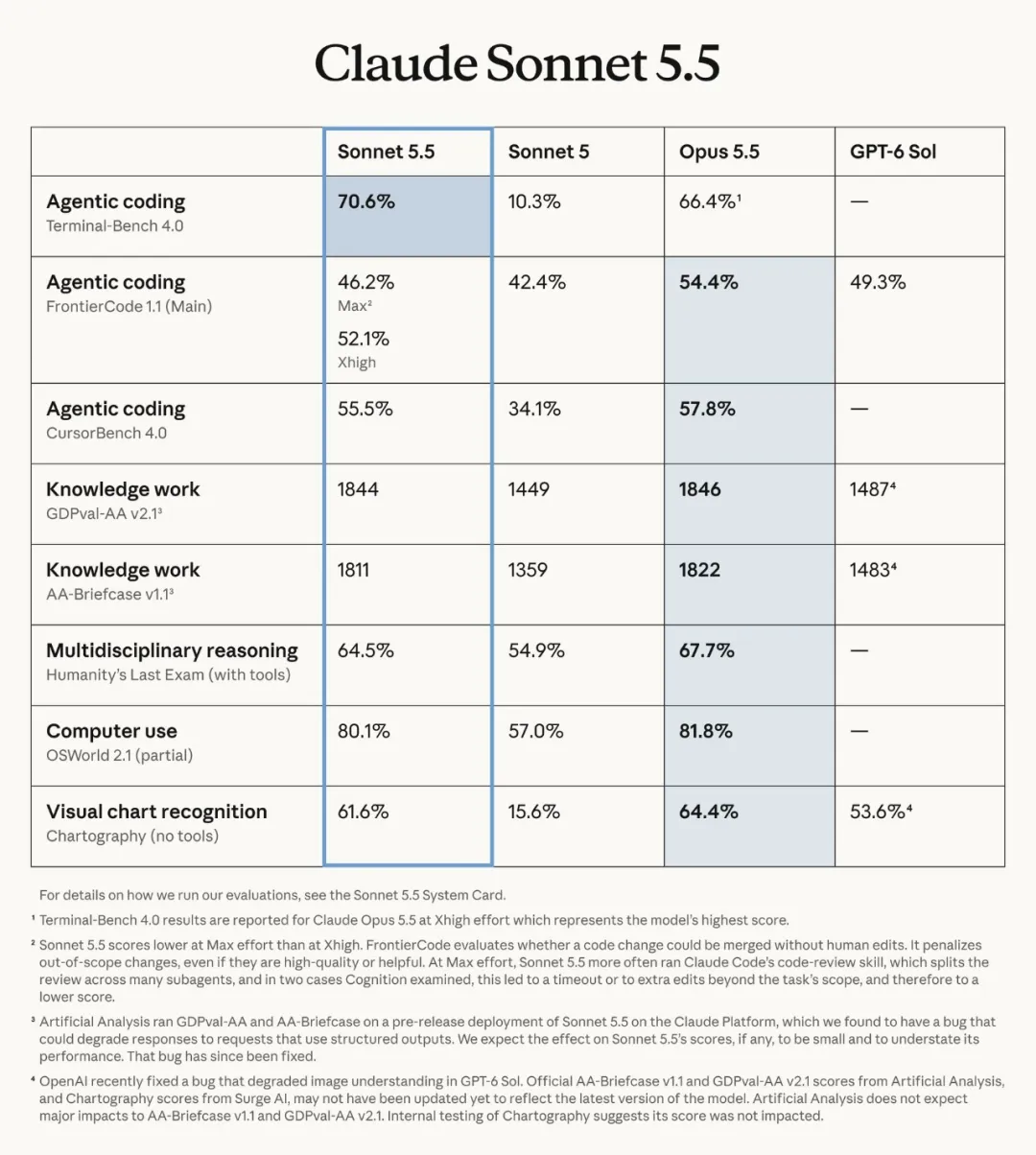
What's even more disturbing is that in the extremely hardcore smart body programming test of Terminal-Bench 4.0, this mid-cup turned the big cup into an anti-kill!
Sonnet 5.5 scored 70.6%, almost seven times the original score, 66.4% higher than Opus 5.5.
Between generations, it flows directly from the bottom of the pond to its home first.
Shortly after its launch, Artificial Analysis, the third-party authoritative rating agency, was directly hit with the smart index: the top three, all rounded by Claude and Sonnet 5.5, came in second.
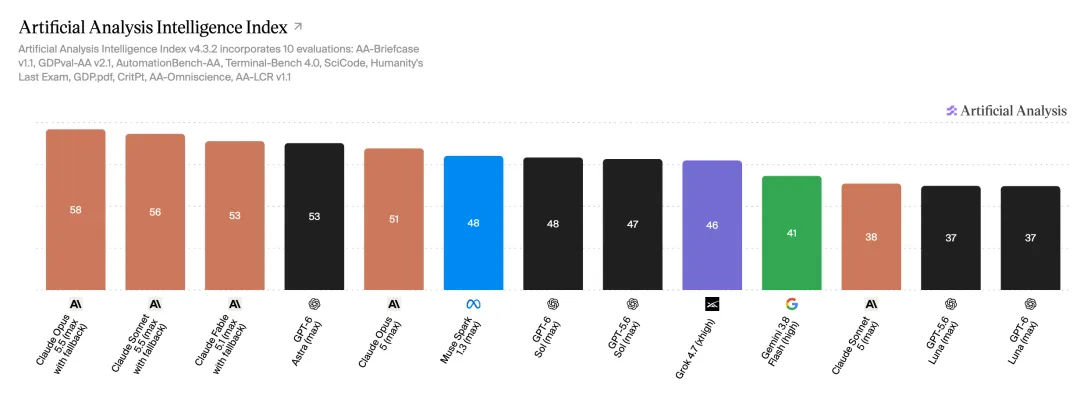
The third, the Fable 5.1, which came out four weeks ago, is five times the size of the Sonnet 5.5.
In less than a month, Claude, a big cup-level man, turned into a white man and sold it in the middle of the cup.
In addition, users can adjust their "effort level" at will.
Select low/middle:Claude responded quickly, using very little Token, suitable for everyday fishing and routine tasks.
Select High/Most:Claude enters into a pattern of thinking, repeatedly checking his work for dead-end complicated problems.
Sonnet 5.5, breaking the impossible triangleThis time, the release of Sonnet 5.5 directly broke the impossible triangle of "fast, low cost, high quality".
The output speed was up more than 30% from its predecessor, making it arguably the fastest Sonnet model to date.
The price of Sonnet 5.5 is superficially the same as Sonnet 5: $2 per million of tokens input, $10 per million of tokens output, and $0.20 per million of tokens cached.
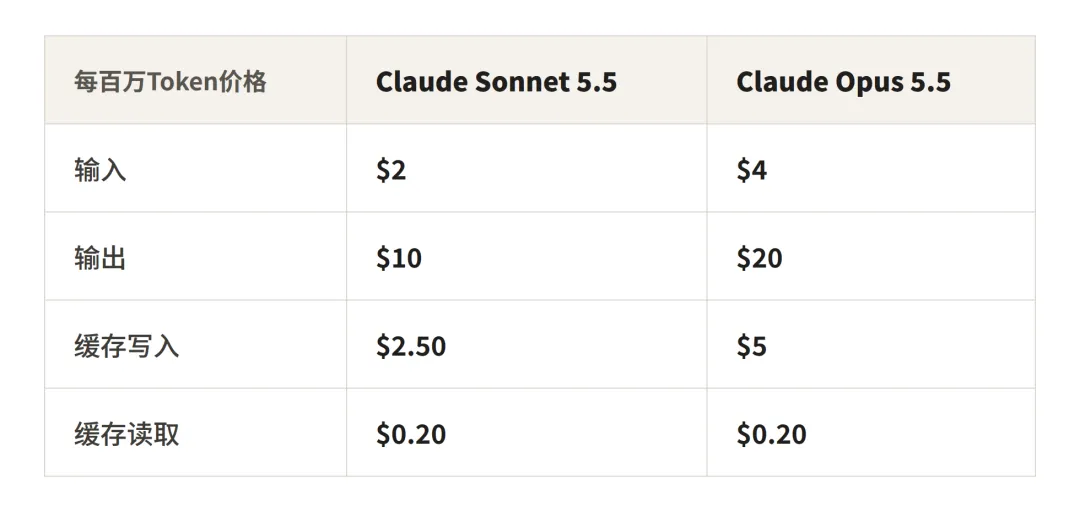
But the solution lies in efficiency!
Anthropic found that as the model became smarter, Sonnet 5.5's required tokens decreased significantly, reducing the actual cost per mission by up to 30 percent.
With fewer tokens, we can do more.
Below, under the same prompt, are the results of Sonnet 5 and Sonnet 5.5, which are very contrasting.
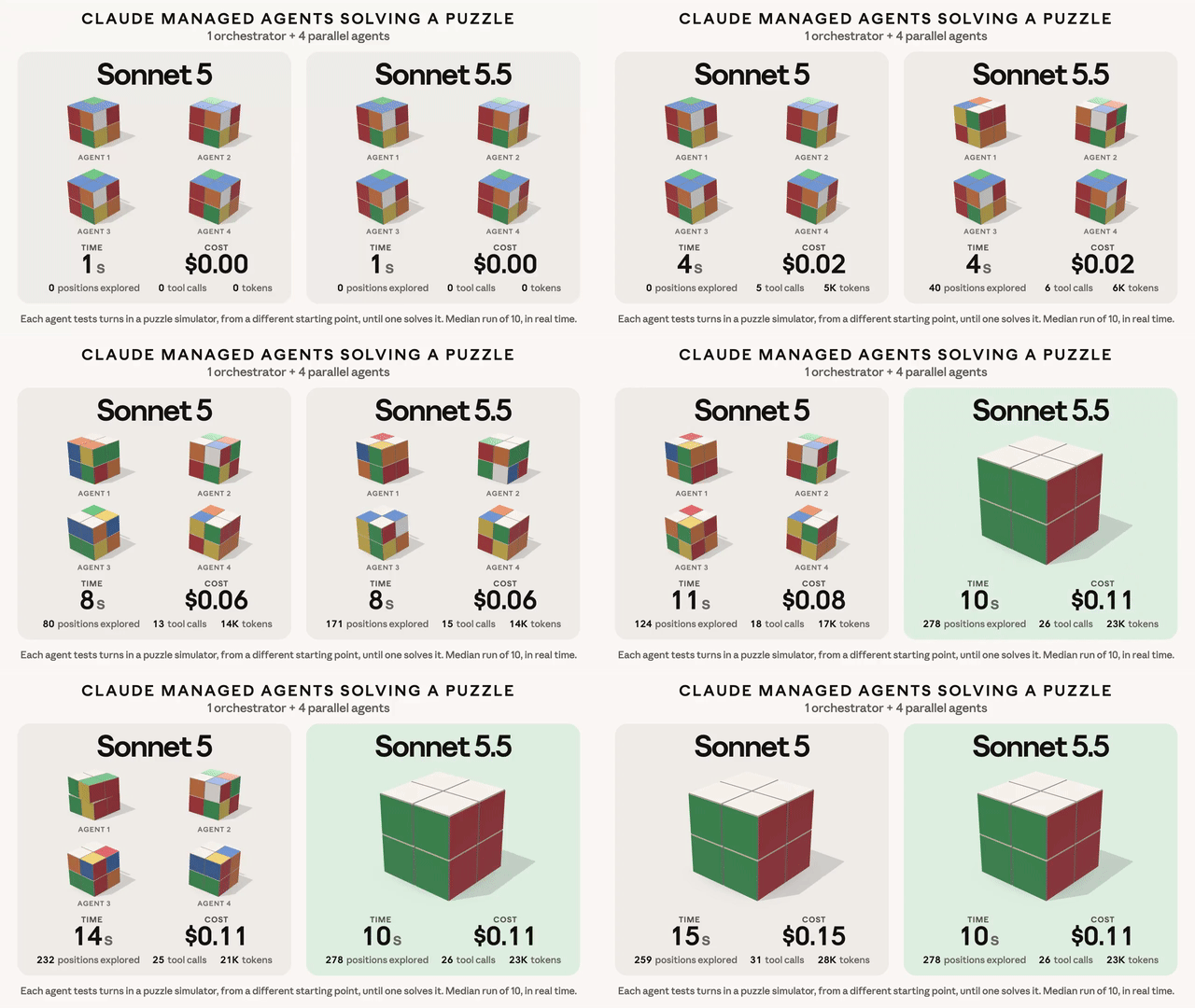
 Half the price is equal to Opus and the top of the house is also overpriced
On the Artificial Analysis list, Sonnet 5.5 received 64%, up from Opus 5.5 and GPT-6 Astra by 60%.
On Terminal-Bench-Science, it took 53% and came in third, losing only to GPT-6 Astra and Opus 5.5.
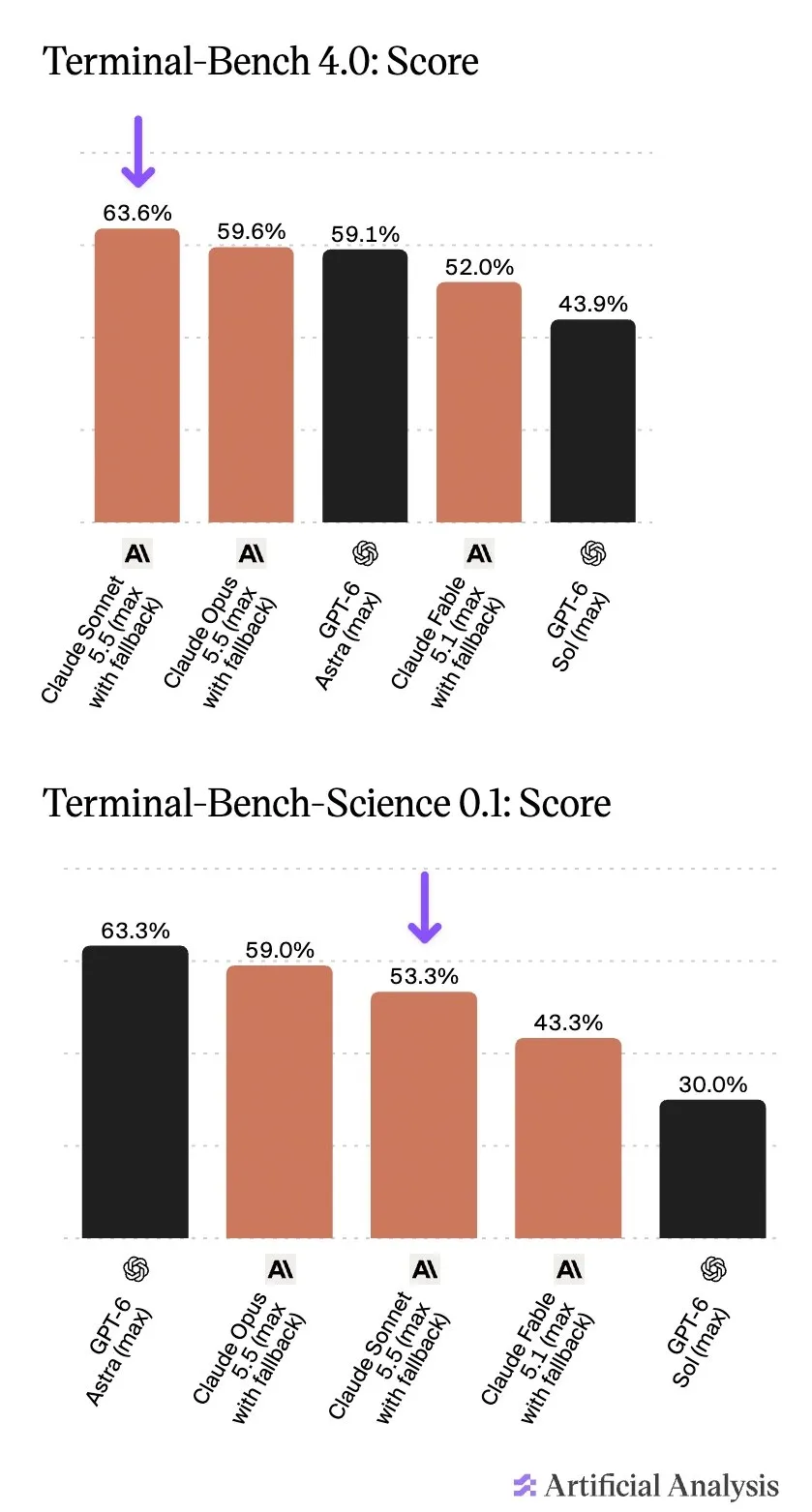
Two other tests to write the code were equally insane.
In the FrontierCode test, Sonnet 5.5 received the highest score of 52.1% and outperformed OpenAI's GPT-6 Sol (49.3%).
On the CursorBench, which simulates real Cursor programming sessions, Sonnet 5.5 received 55.5%, just two points lower than the Big Cup, compared with 34.1% for the previous generation.
The developers of Early Intuition said: "It understands the speed of a huge code library, and it's amazing!"
Its tool calling efficiency is also amazing: in back-to-back tests, Sonnet 5.5 has learned how to call the tool "packaging" in bulk, taking fewer steps, making fewer mistakes and spending less money.
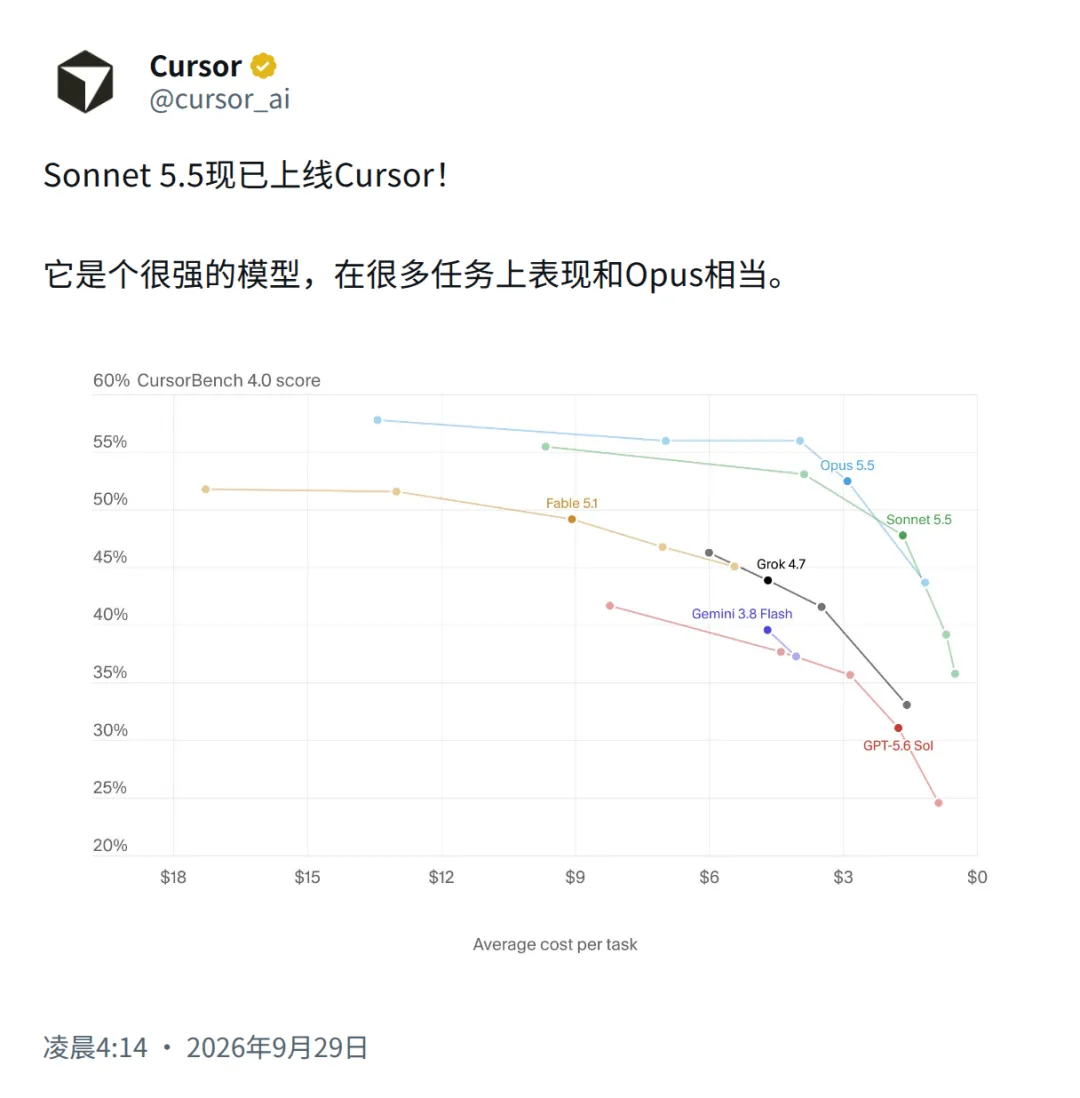
It's not just about writing code, it's about being able to do office work.
GDPval-AA measures the ability of a model to deliver products directly across 44 professions. Sonnet 5.5 scored 1844 points, while Opus 5.5 scored 1846 points.
In the AA-Briefcase test of long-range knowledge work, Sonnet 5.5 scored 1811 points, and Opus 5.5's 1822 points were almost flat, 300 points higher than GPT-6 Sol.
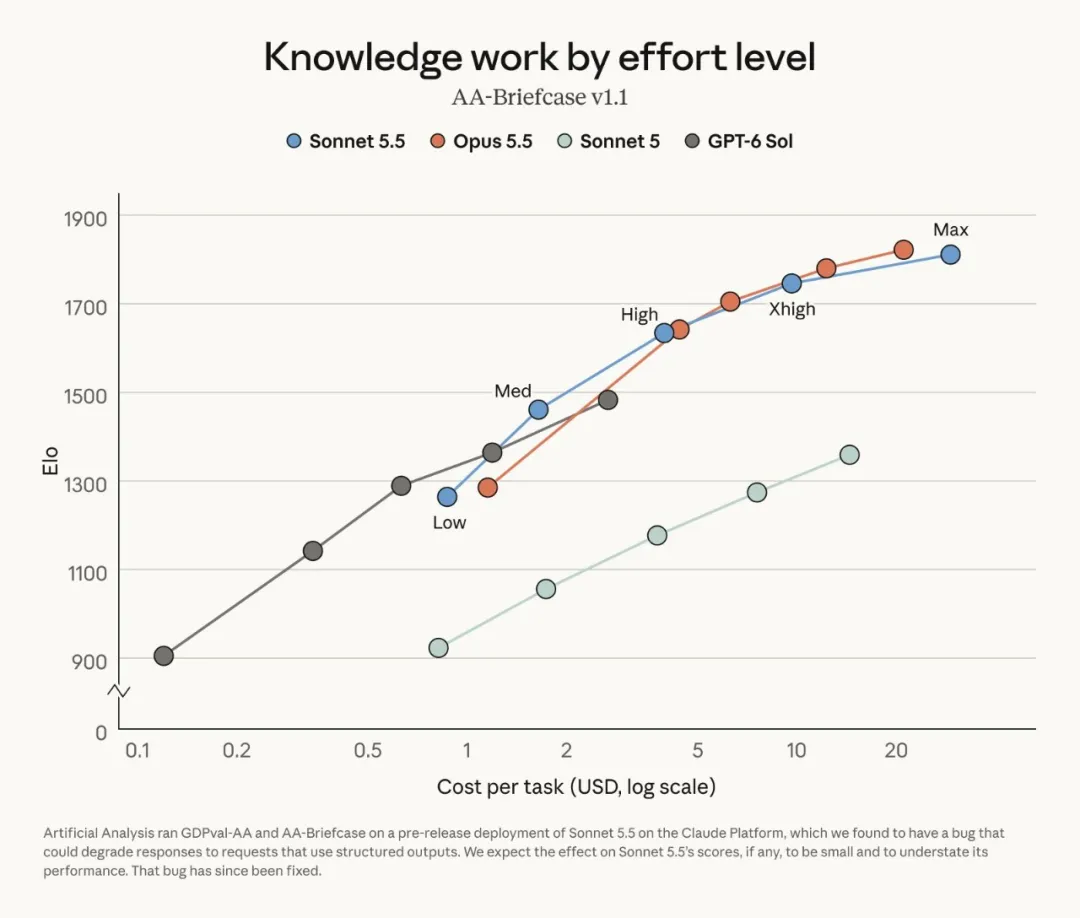
The biggest surprise was the "design talent" it displayed.
This time, the Sonnet 5.5 is aesthetically pleasing! It can actively enhance the UI and even perfectly follow the slideshow template, generating almost no human-modified PPT.
Anthropic has a hard-core case: the testers threw quarterly financial statements, conference call records, and a PPT template to a publicly traded company, Sonnet 5.5, requiring it to generate a 10-page operational review slide.
As a result, the initial draft it generated was identified by two human experts as "perfect, direct delivery".
On the "Last Human Test" with tools, it scored 64.5%, almost 10 points higher than the previous generation.
On the other third-party Vals Index, Sonnet 5.5 debuted at number two, only 0.47 less than Opus 5.5.
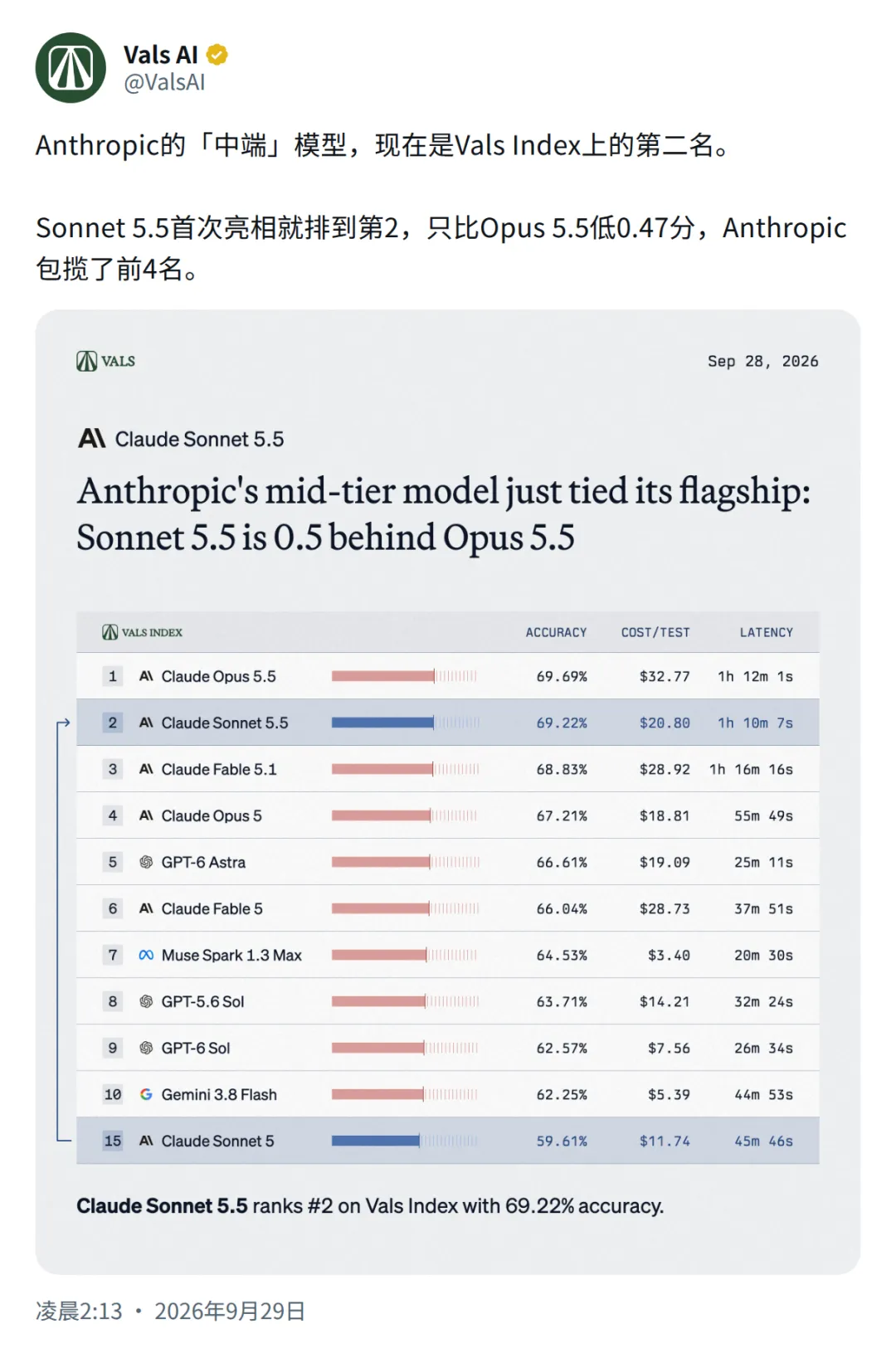
Four weeks ago, when Fable 5.1 was released, it was still the world's most powerful programming and knowledge-based working model.
Now, Sonnet 5.5 is almost 15 points higher than it was in Terminal-Bench 4.0, 109 points higher than GDPval-AA, and 3 points higher than the Smart Index.
Tech blogger @synthwavedd posted on the same day that Anthropic is going crazy.

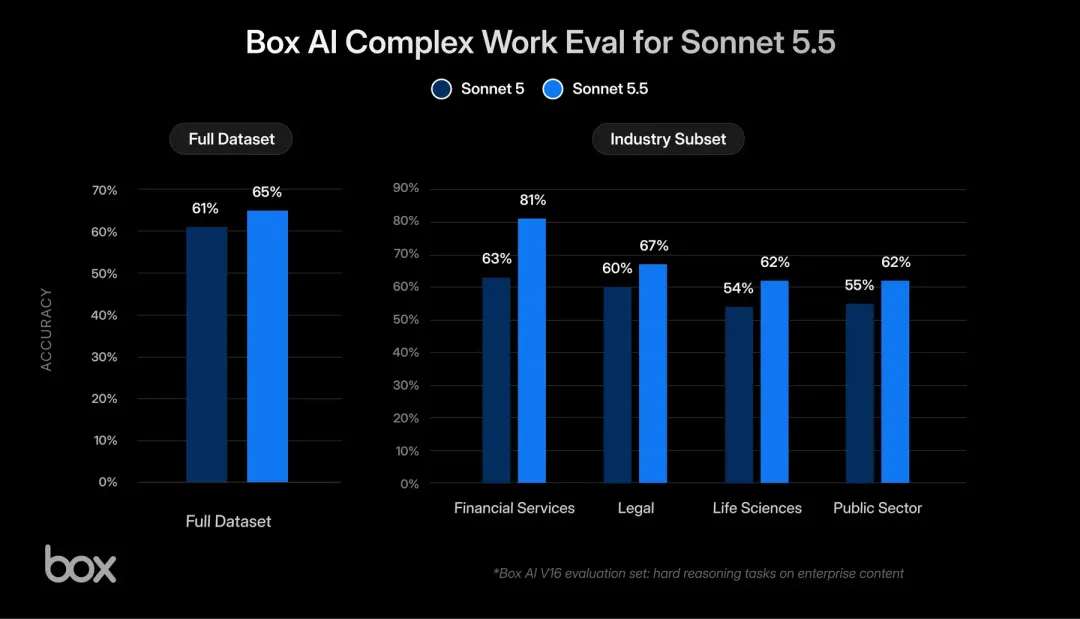
In the Complex Office Test Box, the overall accuracy of Sonnet 5.5 was 65%, while Sonnet 5 was 61%.
It is also about 2.4 times faster to complete the delivery results, with total token consumption reduced by 12 percent. In smart body work, speed and accuracy are often intertwined, so a model that can synchronize the two is indeed a real improvement.
Tests show that the Sonnet 5.5 is unpredictable.
AI blogger Matthew Berman received early test credentials for Sonnet 5.5, releasing a series of tests on the same day.
He had the Sonnet 5.5 built in a San Francisco real-life engine. The streets were full of traffic, and even cyclists crossed the street corridors.
Enter the phrase "Pan American Pyramid on Fire", and the system immediately rated the fire as a 4.6-degree (full-degree 10) and automatically dispatched five fire trucks and three police trucks.
In a distant building, black smoke began to roll, and the police cars, flashing lights, rushed to the street.

In the 3D version, sailing ships are bouncing in storms, and the skies are cut from dusk to night. The footage goes down into the water, with a swarm of fish swimming from the top.
There is also a game of sugar beans, where 60 characters are crammed onto the same map, a six-sided deck that is stepped on will collapse instantly, and a deck with rolling stones to climb to the top of the mountain to claim the crown.
Even the starship V3 has been made into an interactive explosion map. The entire ship is layered and has been dismantling the Raptor 3 engines at the bottom.

He also used Claude Sonnet to create online Lego games.

Matthew Berman feels that 3D simulation has been attacked by Claude.
However, some have expressed their disagreement.
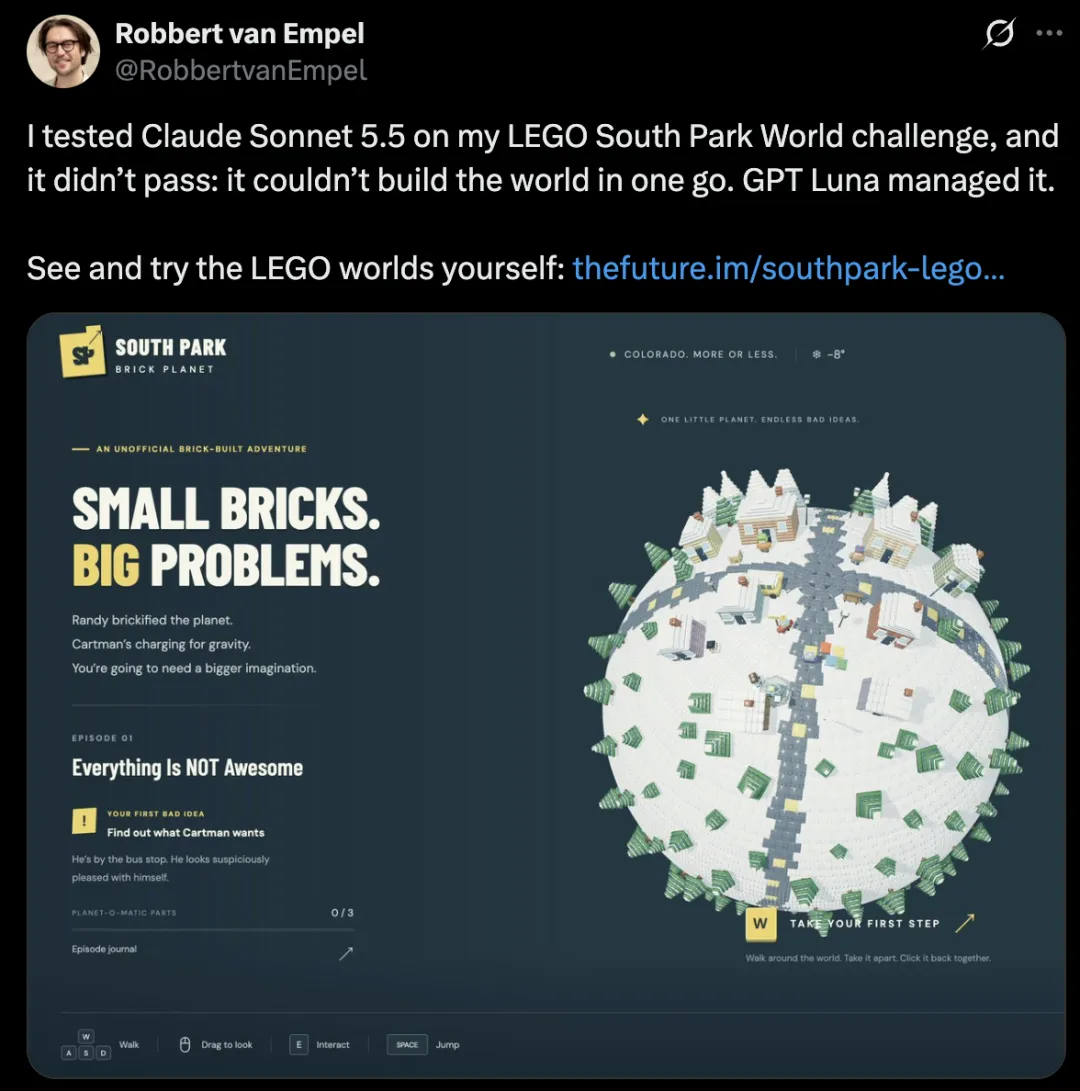
Robbert van Empel maintains a LEGO block planet challenge to create an interactive game with a South Park theme:
Create a 3D world as a globe with a South Park theme. I want to be able to walk through the world using WSAD, interact via 'e', and jump using the spacebar. I also want to be able to rotate the mouse and move objects. I want the world to be made of Lego bricks. Also, make it a game where the characters make typical South Park jokes, and the game must really have a South Park storyline.
Claude Sonnet 5.5 was tested, but it failed: it could not construct the entire world all at once.
Another selling point is fast.
Sonnet 5.5 completes the code, the bird group has flown for 9 seconds, and the previous generation is still on a journey to extract the code.
After more than a year of babysitting Claude, this time it's just a snapshot.Sonnet 5.5 also broke the record, becoming the first game-only shot to feature a mid-cap model of the Red Dragon.
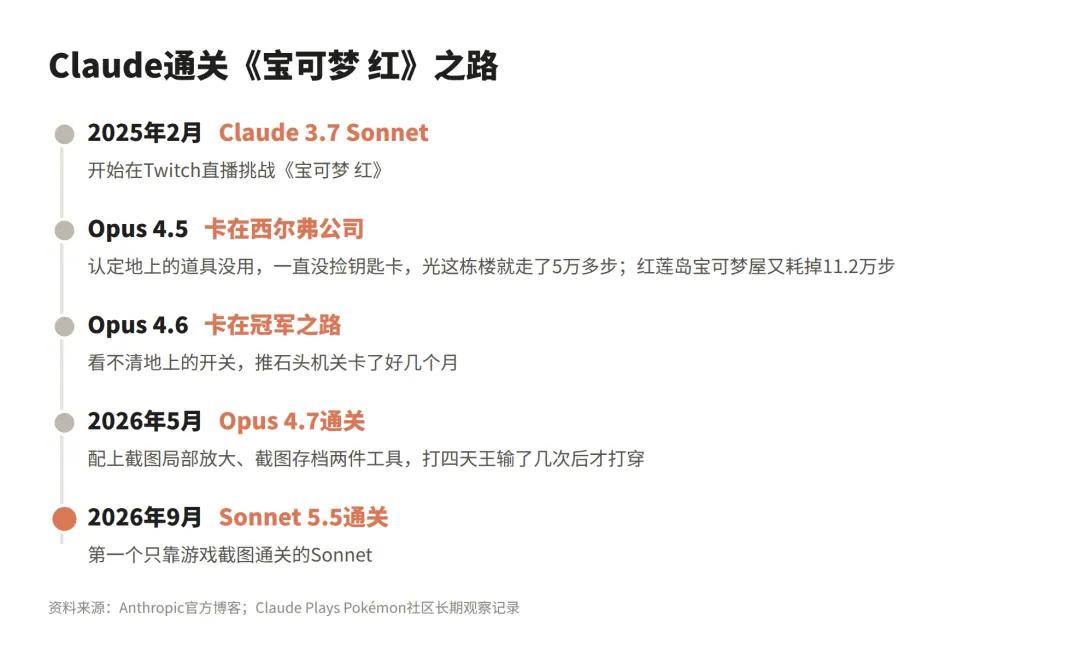
Claude had previously spent more than a year living with his grandmother.
In February 2025, the A's started letting Claude play the game of Dreamcatcher, and each generation was housed in a different cage.
Opus 4.5 was trapped in an apartment building for weeks, hardly trying to unlock the key card; Opus 4.6 was hit on its way to near the championship and was blocked for months by an engineer because it was unclear where the switch was on the ground.
It wasn't until May of this year that Opus 4.7 was finally released, with two overhangs: one capable of magnifying the shot, and one capable of storing the shot as a memory.
Four months later, Sonnet 5.5 was shut down once and for all based on a screenshot!
The key reason is that its eyes "grow out".
In the Chartography test, which does not use tools to read complex graphs, it has almost quadrupled from 15.6% of the previous generation to 61.6%.
In the OSWorld 2.1 test, which looked at screenshots to operate the computer, it scored 80.1%, and Opus 5.5's 81.8% scored only 1.7 points.
This inspired netizens Goody to develop Sonnt 5.5 for his own game.
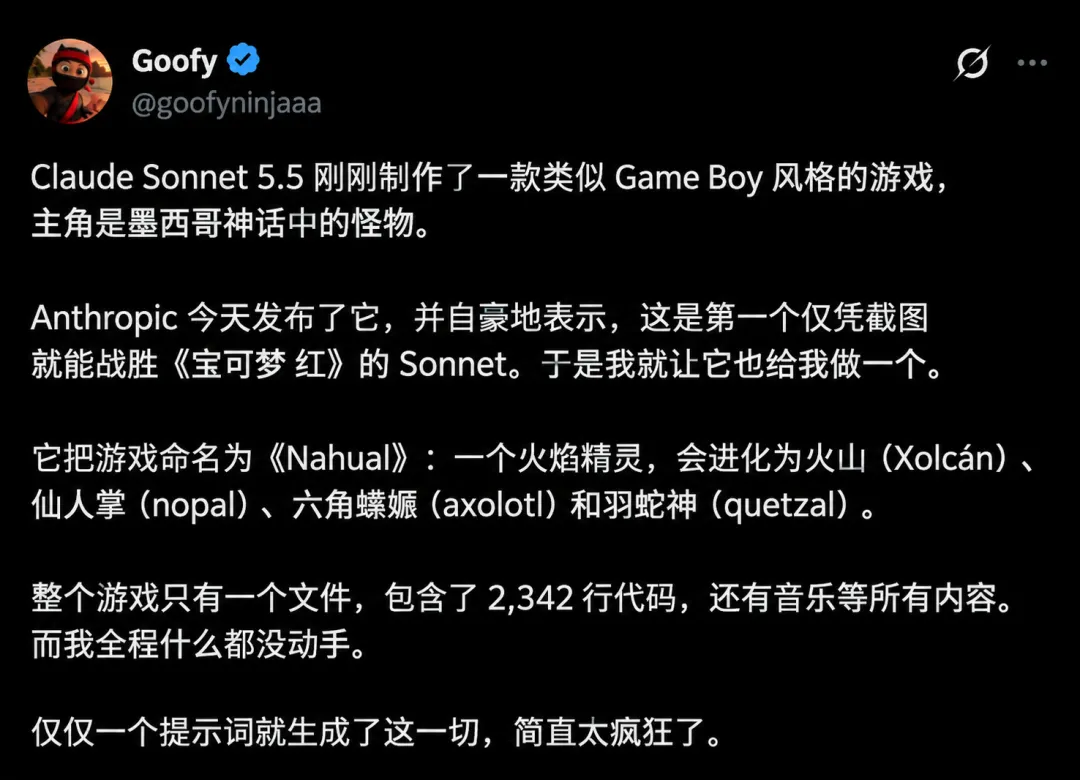
It's a Mexican monster-style game for the Game Boy.
Sonnet 5.5 names it the Nahual monkey: a species of Mexican hairless dog that can evolve into Xolcán, a strain of centipede, an American caterpillar, a green-tailed biting caterpillar.
The single file contains 2342 lines of code, including music.
One suggestion is that Sonnet 5.5 creates a new kind of dream game that is crazy.
And the middle cup is more expensive than the big cup?However, the Sonnet 5.5 is inexpensive, and you can't save money, depending on which class you open the "effort file".
Effort is the switch that Claude left to developers to regulate their brain power, from low to max in five grades, the higher the rating, the more money they burn.
As mentioned above, the official stated: compared to the previous generation, the Sonnet 5.5 single mission is at most 30% cheaper.
In many tests, the Sonnet 5.5 was only available in low or medium grades and was capable of breaking the previous generation's full grades at a cost of less than a tenth.
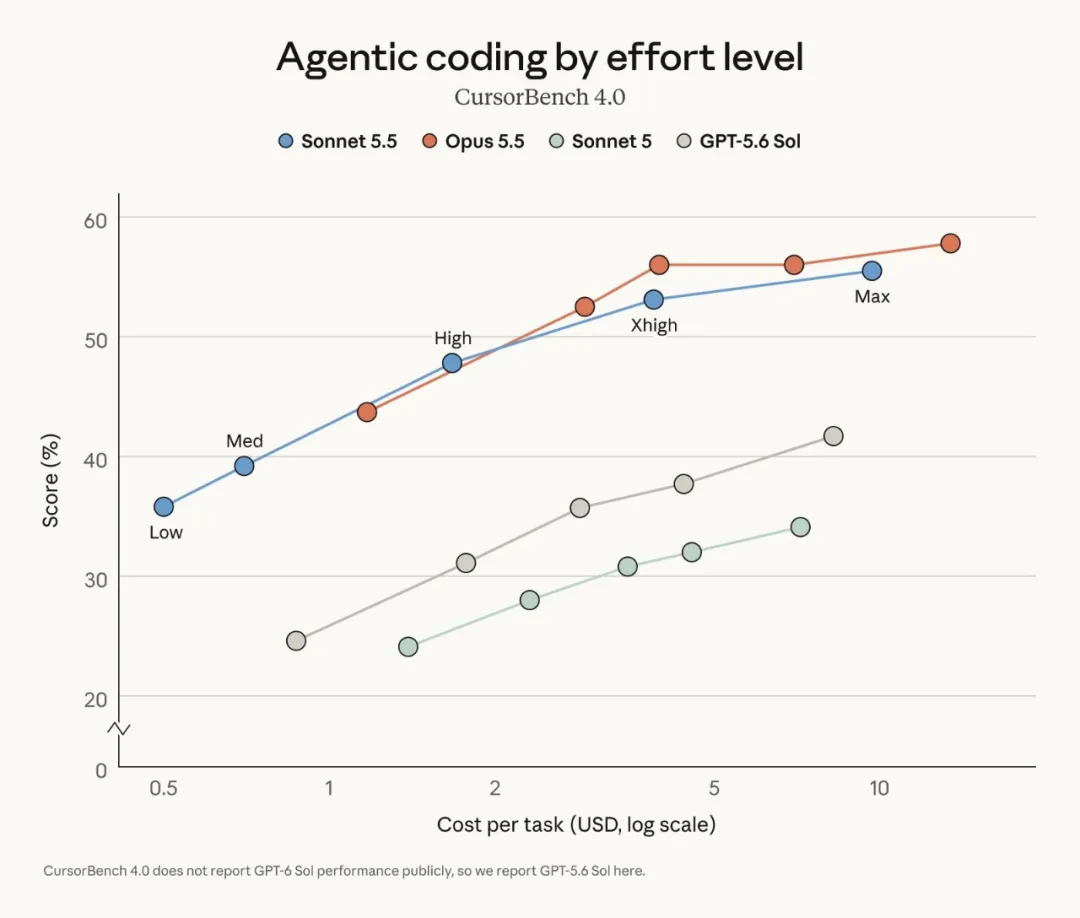
But Artificial Analysis pushed the ranking to Max once, and the results were a bit scary.
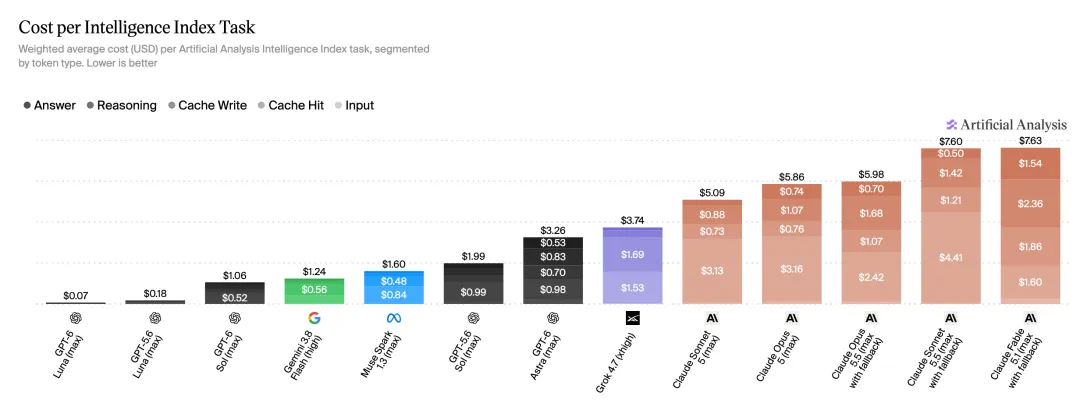
Under the Max rating, the Sonnet 5.5 produced an average of 19.3 million outputs per issue of Token!, the highest ever recorded by the agency. The Max rating of the Opus 5.5 was 60 percent higher than that of the Grand Prix, about seven times that of the GPT-6 Astra.
So even if the single price was cut in half, the Sonnet 5.5 would cost $7.60 to run a mission. Not only is it 50 percent more expensive than the previous generation, but it's even more expensive than the Opus 5.5 (£5.98) which is close to $7.63 for the Fable 5.1 Super Cup!
It's a great way to help out.
On FrontierCode, which combined the test code, Sonnet 5.5 received a Max rating of only 46.2%, which was lower than the Xhigh rating of 52.1%.
The reason for this is that when it's fully loaded, it likes to call in code review tools and give live packages to a large group of smart people. The result is that either it runs out of time, or it changes code that is outside the scope of the task, and is directly deducted.
So to save money, repair Bugs, write documentation like this everyday life, Sonnet 5.5 runs Medium or High is the cheapest. Complex long tasks, given directly to the big cup of Opus 5.5 High, don't mind filling the middle cup.
The Forbidden City River is upgraded and continues to prevent distillationThis time, Company A adopted the anti-distillation mechanism as usual.
The official slogan was: "Because Sonnet 5.5 has far superior capabilities to its predecessors, it is the first Sonnet model to feature a security classifier to prevent logical extraction".
This meant that the "thought process" in Claude's mind could not be disconnected from the account.
For real developers, you don't feel any change at all; but for those who want to use blockchain core technology, this path is completely blocked.
Moreover, due to the significant upgrades to the network security capabilities of Sonnet 5.5, it also became the first Sonnet model to be equipped with the same level of "cybersecurity protection and withdrawal mechanism" as Opus.
When encountering high-risk network security tasks, the system automatically returns to Sonnet 5.
In the field of biology, it also intercepts high-risk requests.
Now, the pressure is on OpenAI.Now, all the pressure is on this side of OpenAI.
On September 22, 90 minutes after the launch of Anthropic's Opus 5.5, OpenAI launched the GPT-6 Sol and Luna, both of which were directly hardened.
Six days later, Anthropic released the mid-range Sonnet 5.5.
OpenAI DevDay is scheduled for September 29, the day after the release of Sonnet 5.5.
Claude has drawn the price of the strongest fighting force to the price of white tea, what is OpenAI going to come up with?