If one word is used to summarize the first half of 2026, makeup is probably the consensus of most people. In the fog, everyone is looking for certainty, but there is a race track almost opposite to the winds of robots and physical intelligence.
In six months, 311 funding launches and 10 billion dollars in cash flows. From January's 72nd March tipping point to the June high of billions of giant super unicorns like Galaxy General, Intelligent Square, and Intelligent Thousand, the hard-tech racetrack has become one of the busiest and most expensive card tables in the world.
The Robotics Forum exclusively analyzed 311 robotics financing in the first half of the year, using six sets of core data, to unravel the underlying and dark streams behind the multibillion-dollar Capital Bureau.
01.
Folding of the track: the brain of the monkey looks up at the stars, the joints of the monkey sticking to the ground
On a physically intelligent card table, does capital prefer interesting soul mates or strong body mates? The answer for the first half of the year is a clear double-header curve mat.
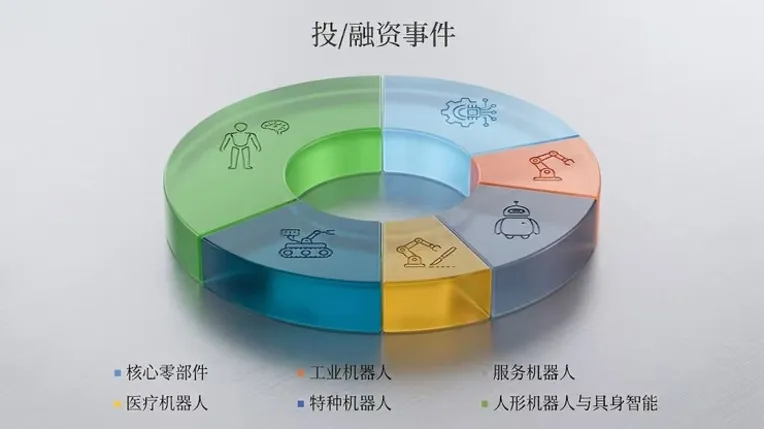
Robotics with physical intelligence is the largest gold-sucking black hole. 115 projects are funded, accounting for close to 37 percent, and are seated in C-seat.
Outside of the spotlight, money flowed in another direction. Core parts were financed with 68 parts, 21.8%, overwhelmed by specialty, service and industrial robots, and quickly became the second biggest race track. This in itself was a clear industry signal: there were no brilliant hand-powered, rectangular sensors, planetary rolling silks, and no clever brains could get out of the lab.
The first half of the robotic race, in this extreme folding, completed a complete map of the downstream of the industrial chain.
02.
Capital's aesthetic transformation: no love of old stories, heavy storage of new species
If you look at the racetrack, the sharper question is: what stage did the money go to the company?
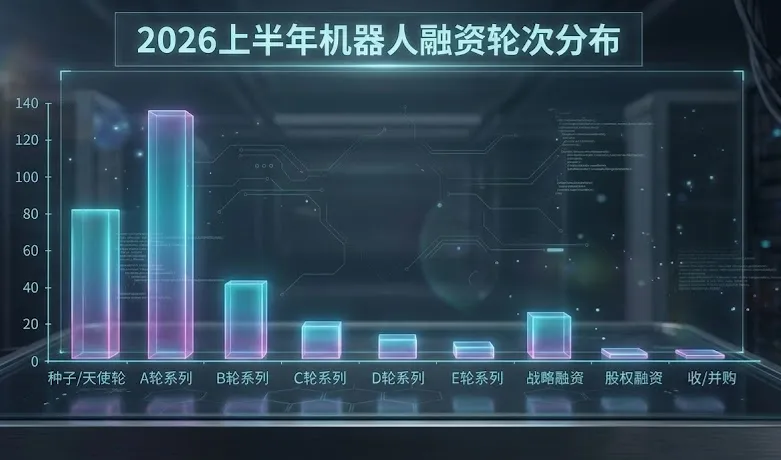
The financing cycle distribution presents an early dominant structure with a very narrow head, very wide bottom. The seed/angel cycle 84 and the A-series 138 combined account for more than 72% of the total market share. The mid- and late-term projects of the C-series, D-series and E-series plummeted to figures.
The fact behind this is that the robotics track is still in the early stages of the technological paradigm shift. Capital is already less willing to crawle through the traditional robotics cycle and pay for years of old stories, but instead takes the mirror and digs up the early teams with AI thinking in the circles of college labs and factory executives who resign.
So how new are these new faces that capital has bet on?
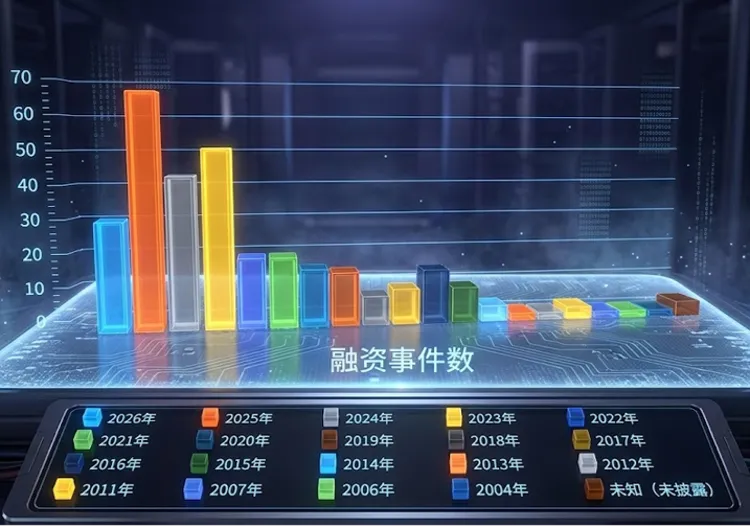
The year in which the venture was founded is a clear intergenerational portrait. Founded in 2025, first-year startups received the highest total of 68 financing; founded in 2023, 2024 and the first half of 2026, respectively, received 51, 43 and 30 firms. Founded in less than four years, new species of startups accounted for more than 60% of the financing events in the market.
On this card table, youth is an asset in itself.
03.
Who's paying the bills?
Where the money is going, where the entrepreneurs are going, and who's paying for this 10 billion-dollar cake?
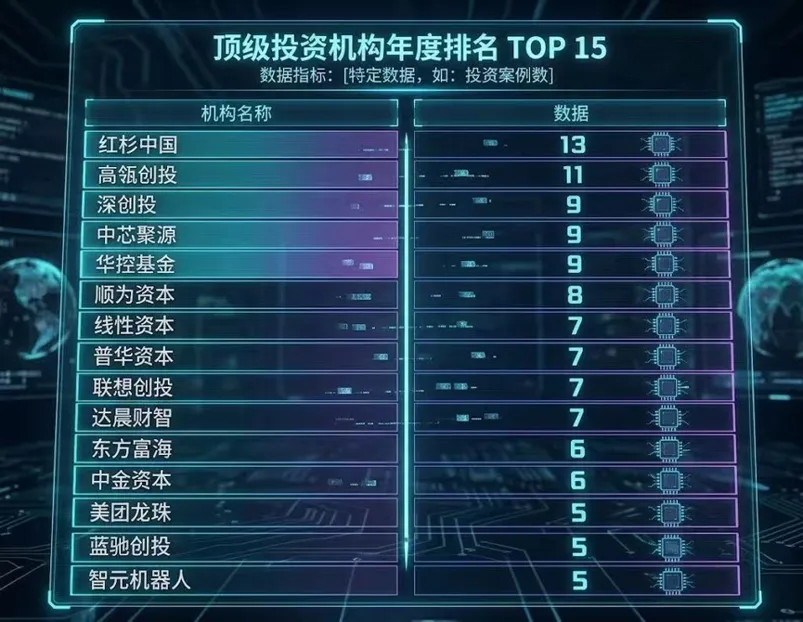
The answer is somewhat counterintuitive. The financial VC has not retired and is still sitting at the center of the table. The two forces that really changed the landscape: the industrial CVC and the national team, which are squeezing from the edge to the main table.
First, the financial VC maintains its C position, but no longer holds a monopoly. Red Bull China has started 13 times, and Qianlong has invested 11 times, with a breakthrough advantage in the top two. Behind it are a long line of local and US-dollar startups such as Line Capital, Universal Capital, Da Morning Financial, Eastern Fuji, Blue Jump Investments.
In the robot's most definitive hard-tech runway, the head financial VCs are not only not withdrawing, but are raising money. The change is that in the past they could be priced exclusively, and now the term sheet tables of every good project are sitting at the same time as industry and state funding, and financial VCs must accept the fact that the right to speak has been diluted.
At the second pole, industrial CVCs entered the middle segment. They bought not mere financial returns, but future scenarios, orders and supply chain card positions.
Their logic is highly consistent: central chip polynomials represent semiconductor chains, where robots replace chips with sensory domestic products; connected consumer electronics giants, which bet on robots as the entrance to the next generation of smart-terminal chips; and the Internet giants represented by Merriam-Webster, which are the cheap laborers in the distribution and warehousing scenes.
This is to correct a common misconception. In the market, the world-renowned Silicon Valley Internet conglomerate has gone crazy, with only the Merriam-Webster family ranked in the Top 15, and most of the companies are still in the process of adding small-scale trials.
It is also worth noting the emergence of the chain-owned CVC chain: the main core manufacturers, represented by Chiyo robotics, have self-financed and turned to downstream parts and algorithm companies, locking their suppliers into their own ecosystem. Today's investment, tomorrow's investment squad, has become the capital structure of the robot circle.
In the third pole, the Hungarian national team was completely eliminated. Deep investments were made 10 times, Chinese controlled funds 9 times, and Chinese gold capital 6 times, constituting a state-funded/government departmental camp. In a more macro narrative, humanoid robots with physical intelligence have been seen as the ultimate carrier of new-energy vehicles, after the new chip chips and new-quality productivity.
For state capital, financial returns are only byproducts, and the real goal is to seize strategic high ground and industrial chain security for the next decade. Deep investments to kill the top three of the list with 10 investments, which is the abbreviation of the local state-owned vote with real gold and silver.
04.
Trends and forecasts: How are the cards playing in the second half of the year, from Czar's net to the net's net?
Looking at the track's folding, entrepreneurial intergenerational and wealthy composition, the final question arises: where will the tide go?
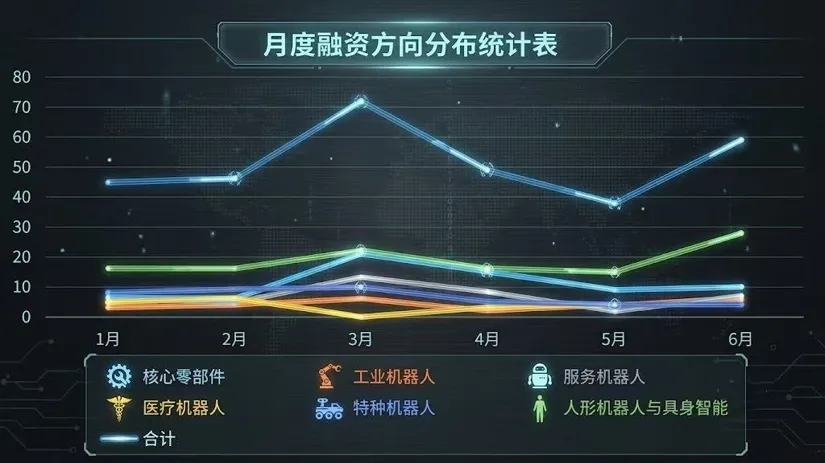
Trending one: Big Disc out of the M-type double-peaked slope, experiencing deep slope in May
A very standard silicon-M-type silicon structure leaped onto the paper to connect the total monthly financing line. In March, 72 pulses of policy expectations and emotional resonance doubled. The core components of the month were almost evenly matched with the human robot in autumn, and the entire track seemed to be pressed simultaneously on the accelerator. After the rave, April fell to 49, and May fell to 38, creating the lowest value in the first half of the year.
With the 59th rebound in June, the nature has changed. Blue dot touch, micro-billion-scale intelligence, micro-intelligence, cloud technology, cross-dimensional intelligence, crowdfunding... These leading companies have absorbed most of their money, talent and traffic with the neon effect, confirming their position at the top of the pyramid, while a large number of mid-sized businesses and startups have begun to bleed and marginalise themselves.
In the second half of the year, the bull market will probably no longer be a one-sided bull market, but it will continue to vibrate along the curve of pulse-digesting and pulse-digesting bull markets.
Trending two: two main lines, two temperamental temperaments
Human robots with physical intelligence are a hard main line that crosses the cyclical curve. One detail explains the problem: in May and May, when the stock market fell steadily, the robot remained stable at 15-16 and barely followed Shenzhen; in June, it exploded alone 28 times, creating a new high in the year. In the heart of capital, the robot has become a belief in positioning itself against the downturn in the stock market.
The core components were a dark line of pumped-window pulse pumps. The March/April wave of 21 and 15 concentrated explosions, which were essentially industrial capital's focus on policy and technology nodes, stealth, stealth, and planetary rolling stock. After the class was completed, May/June quickly fell back to the 9-10 digestive period. Its growth was event-driven: windows were opened, and there was a flood of money; windows were shut down, and immediately quiet.
By reading the characteristics of these two lines, the script for the second half of the year is pretty clear: humanoid robots will continue to vibrate at high altitudes, their tails will be high; the number of core parts financing events will decrease, the amount of single money will rise, and from Caesar's seed to the bottom of the pyramid.
Trending 3: The Old World of Pumped Out Pumps
The old world at the edge of the cardboard table is bleeding as the flashlight strikes the twin peaks.
Serving robots are typical of the pulse of the subject, the aftermath of the weakness. The growth of the March 13 wave was driven by backyard cleaning, swimming pool robots, distributing robots plentiful financing, but lack of sustained momentum.
Special robots are coming out of high and low curves: from 8-10 in the first quarter to 4-5 in the second quarter.
Medical robots have almost survived an independent mini-cycle. The month of March, when the disc peaked at 72, the medical robot was zero. It is completely detached from the disc, relies on surgery and recovery rigidity needs to heat the disc slowly, without hot spots, and not driven by heat bands.
Industrial robots have always been a forgotten corner, stuck in single digits for a long time.
Putting these four lines together, the trend is clear: money is being pulled crazy from the long tail to the pinnacle, and the Matteo effect on the track is accelerating in a visible way.
There are three prophecies:
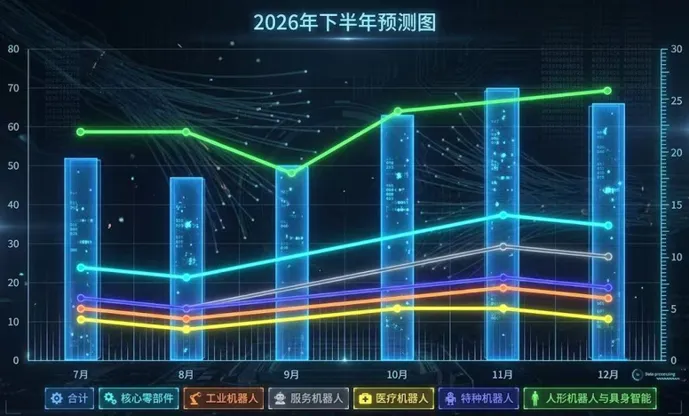
First, the 28 financing of humanoid robots in June has already spent some heat in advance, and the real turning point in Q4 is likely to come in August. When the main company's production line deliveries, scenario acceptance and goodwill data continue, capital will launch a second concentrated bet.
Second, the core components of the 3rd and 4th waves of the race were seedlings, the number of financing events will decline in the second half of the year, and the amount of money will rise. The decelerators, smart hands, silks, power sensors, these sub-race tracks, which may recreate the integrated path of power cells and photovoltaics in that year: the leading companies start to buy and buy small teams, gather technical backgrounds, and each race will run 1-2 ready-made unicorns.
Third, bankrupt robots like companionship, family, and general services will further freeze funding; while logistics sorting, park inspections, medical needs, and out-of-the-country yard machines can figure out the closing scenes of ROI and get life-long money.