In September 2026, Jeff screened the AI model around this direct-output judgement and probability, a discussion that has been going on for days.
From the demonstration on X to the developer's attempts to apply it, a question arises: Do you still need a long string of letters when AI is used to make decisions?
But what if we could go back a whole year?
As of September 2025, a study has been proposed to allow models to simultaneously generate multiple possible futures and directly give their probabilities.
Moreover, from the outset, the paper put "service decision-making" into the research motivation.
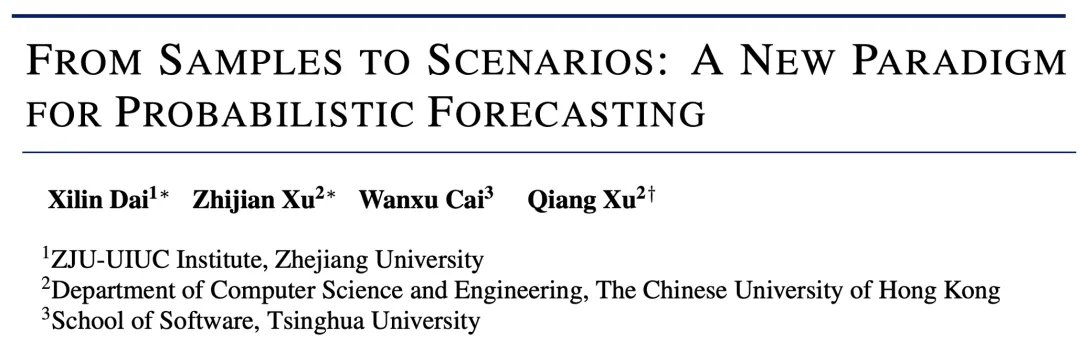
The study, from a team of Chinese University of Hong Kong professor Xu Zheng, published a paper titled "From Samples to Scenarios: A New Paradigm for Probabilistic Forecasting" (from sampling to scenario: a new paradigm of probability forecasting), was released to the public on September 24, 2025, and is now accepted by ICLR 2026.
Link to the paper:https://arxiv.org/abs/2509.19975
The code link:https://github.com/Fifthky/TimePrism
"Explicit probability", "parallel output", "decision-oriented", and the design ideas that Jev is now focusing on have long been used in this study to develop a set of methods for predicting probability.
Why are two different areas moving in the same direction?
Jev Why Fire: Let models directly give the information they need to make decisions
Jev turned judgments in everyday communication into the core tasks of the model: should this information not be retained? which action should be chosen next?
The developer provides text or program status, defines problems and options, and returns structured results such as probabilities, scores, by the model for the program to use.
These tasks typically do not require a long answer. Jev uses a judgement-oriented output method and supports the simultaneous processing of multiple questions for the same input.
This makes it distinct from the familiar token-by-token text generation, and makes the large number of small decisions that occur frequently in the Agent a natural application scenario.
On X, the founder's game and web-navigation presentations illustrate this change intuitively; subsequent developers' experiments extend the discussion. The focus of dissemination is on how AI enters software more directly into the decision-making process.
TimePrism answers the same question in probability prediction: What should the model deliver when the system needs to act in advance?
It provides a set of possible outcomes and the probability of each outcome. Thus, the follow-up system can compare the cost-benefit and action plans based on the different outcomes.
From the sample to the scene: Learn what's going to happen with what's likely.
Assuming a system plans for tomorrow's backup power. A single power generation forecast is not enough: normal power generation, a sharp decline in power generation, may correspond to different preparation schemes.
The system needs to know what possible futures are, and what each future might look like.
Common probability prediction methods express these possibilities by sampling: iteratively generating future trajectories and estimating distributions from sample sets. The more samples, the more statistical information is usually available, and the corresponding generation and processing costs increase.
The "probability scenario" paradigm proposed by TimePrism describes learning objectives directly as {scenario, probability}.
Models both study future scenarios that are representative and explicitly study the probability distribution of those scenarios; in reasoning, a forward-to-back computation can be used in parallel to the entire set of results.
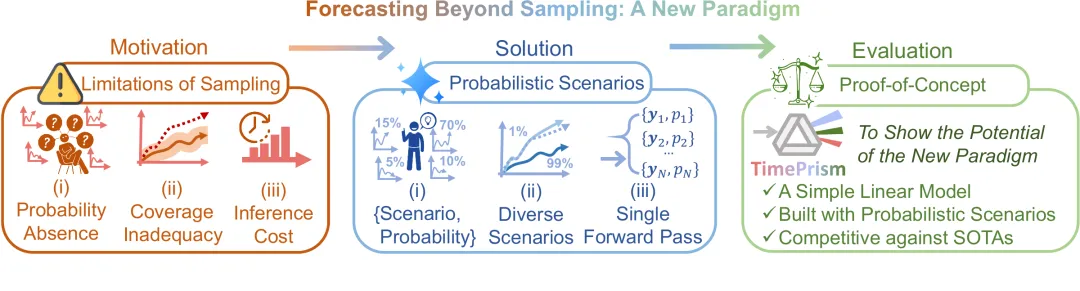
From sampling to scene: one output of a set of possible futures and their probabilities. Source: Paper Figure 1.
This means that probability no longer needs to be represented by the frequency of repeating samples.
Each scenario has its own weight, and decision-making systems can directly calculate the expected cost of different schemes in these scenarios, or reserve resources for higher costs.
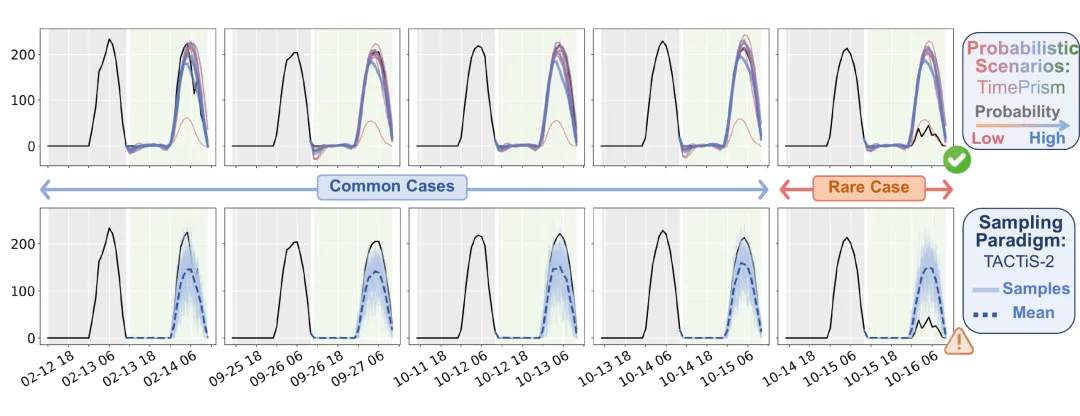
The upper row is the probability scenario of TimePrism, where the blue rough line represents a higher probability and the red thin line represents a lower probability; the lower row is the sampling results of the baseline TACTiS-2.
In the diagram, after a similar history, there may be both common peaks and rare peaks. The top row shows these different trends together with their probabilities.
The change from "sample to scene" is what makes the possible future an object that can be directly compared and used.
To validate this idea, the team used only three linear layers.
The core learning structure of TimePrism consists of three parallel linear layers: two branches generate future scenarios and one branch learns corresponding probabilities.
The team intends to use this concise design to test a key assumption: if learning objectives and output formats are designed correctly, simple structures can also make complex probability predictions.
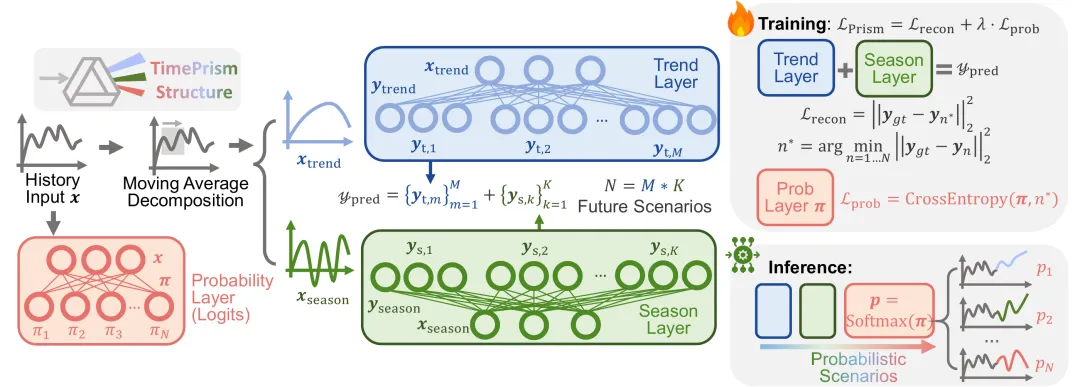
Time Prism architecture: scenario and probability modeling, with three branches computed in parallel. Source: Paper Figure 3.
The paper compares the two main indicators across five benchmark datasets, with TimePrism scoring nine best out of ten comparisons, outperforming many complex probability prediction models, including the spread model, the flow model, and the Transformer-based model, at very low computational costs.
This result provides experimental support for the paper's core idea: changing the learning paradigm, allowing minimalist structures to release a stronger capacity.
In 2023, the team published Are Transformers Effective for Time Series Forecasting? with a simple linear model that challenged Transformer's prediction method at the time, sparking a heated debate.
As of September 2026, it has been cited more than 6,000 times by Google Scholar. It is one of the most important papers in the field of sequential prediction in recent years and has profoundly influenced the development of the field as a whole.
The impact of this DLinear paper goes beyond specific predictive tasks: not all areas would be better off using Transformer directly, prompting researchers to re-examine the relationship between the task hypothesis and model structure.
Interestingly, this time, the team honored their own DLinear in order to validate the probability scenario paradigm, selecting a simple linear architecture and modeling scenarios and probabilities respectively.
What did Jev's encounter with TimePrism point to?
When the two works are put together, the most striking thing in common is the output of a model that is redesigned according to decision-making needs. Options and their probabilities, future scenarios and their weight can directly enter the judgment and calculation of subsequent processes. Probability thus becomes an interface between models and decision-making systems.
Both embody the value of parallel processing. Jev can answer multiple judgments in parallel around the same input, reducing the expense of generating word-for-word text; TimePrism can output an entire set of future scenarios and probabilities at once, saving repetitive sampling from the logical stages.
Each method of calculation is reorganized around the final results needed.
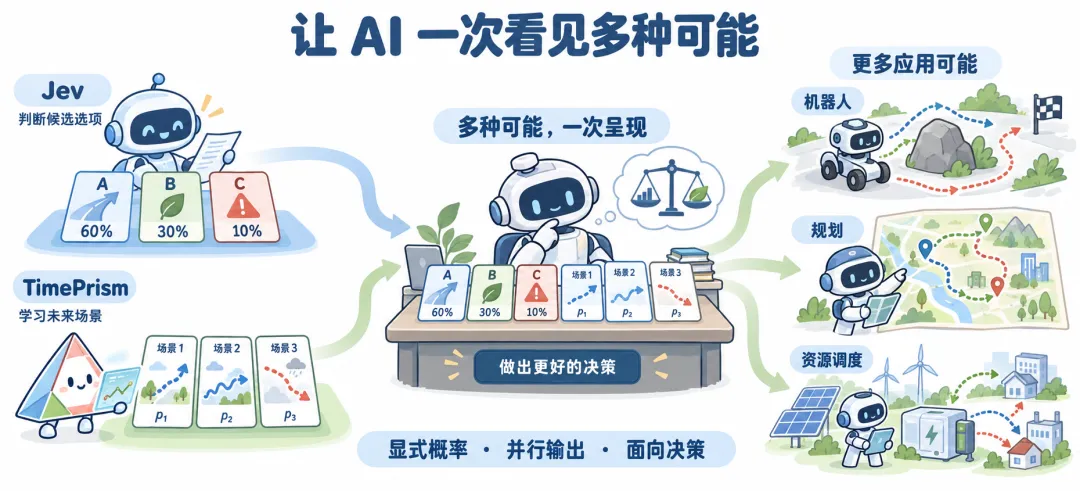
The difference between the two is equally interesting. Jev is geared towards the state of natural language and programming, typically defined by the developer as a problem or a candidate, and then judged by the model.
TimePrism focuses on the uncertainty of the future, and even "what future candidates" are given to model learning. The former focuses on judging given problems, while the latter focuses on generating future images with probabilities.
This allows them to demonstrate two different levels of universality: Jev takes on multiple semantic tasks with a unified judgement interface; and TimePrism proposes a learning paradigm that can be further expanded to allow models to study candidate outcomes and their probabilities at the same time.
Obvious probability, parallel output, and decision-making are design ideas that cross paths.
The potential of probability scenarios is also worth exploring in a broader task. Robots need to compare different movement trajectories, planning systems need to consider multiple follow-up states, resource scheduling needs to weigh different demand scenarios. These tasks can all benefit from the output form of "multiple candidate outcomes and their probabilities".
What is the meaning of this verse?
In the future, the probability scenario model could be combined with a stronger backbone network, more complex scenario representations, and planning and optimization methods. Time Prism provides a simple starting point: first clarify what information is needed for decision-making, and then design models to learn and deliver that information.
Looking back at the September 2025 paper, "From Sampling to Scenarios" by the Hong Kong-Chinese Xu Jing team, the same key proposition has been put forward in probability prediction: let AI see multiple possibilities at a time and hand them over to the next step of decision making.