One of theoretical physics holds a three-year computational record and is updated by AI.
A few hours ago, Anthropic announced: "Claude has been running for days in the scientific research platform Claude Science basically unattended, calculating the radius of nine circles of six particles scattered in the plane N=4 super-symmetrical Yang-Mills theory".
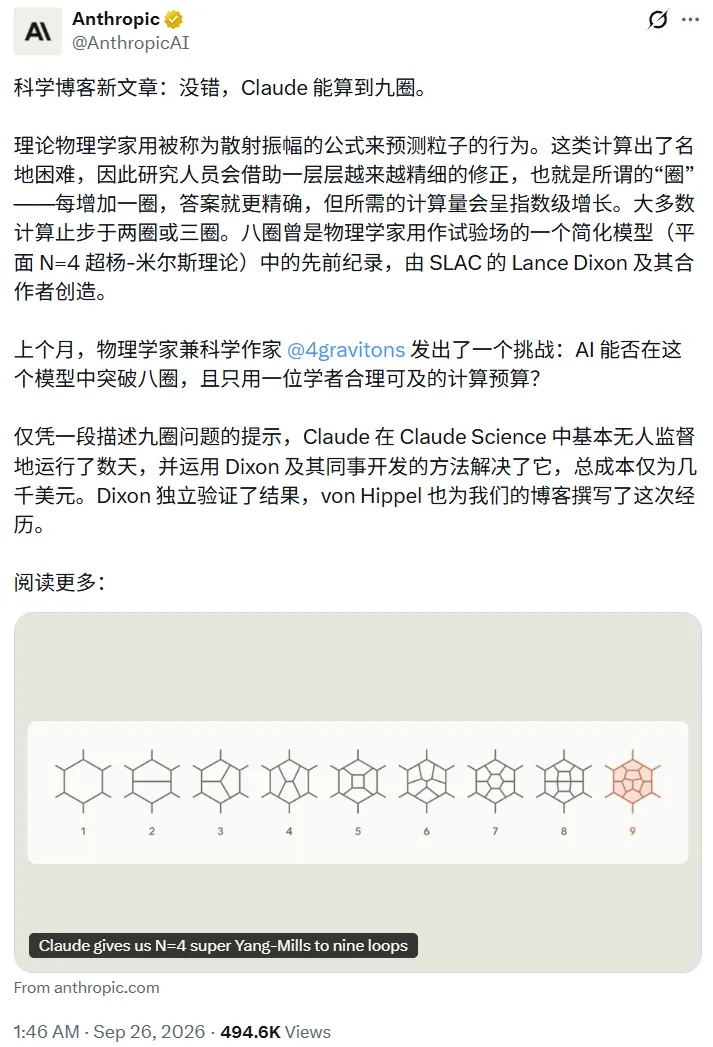
This is a pioneering problem recognized in the field of theoretical physics of "scatter amplitude", and the previous highest record in the model stood at eight laps, created by Lance Dixon of the SLAC National Accelerator Laboratory and colleagues in 2023.
Dixon independently verified Claude's findings, asserting that a large language model could execute every step of this complex formula and organize the calculus, which he saw as "a remarkable victory". He even went so far as to say that Claude knew his team better than anyone else except for his two papers in 2019 and 2023.
Even more surprising is the process and the cost. The researcher gave Claude only one task description, after which "guidance" was almost "continued"; the entire computation folded to about $1,000 or $2,000 for ordinary users, of which the part actually used for numerical computation was about $100, equivalent to 96 CPUs running a week.
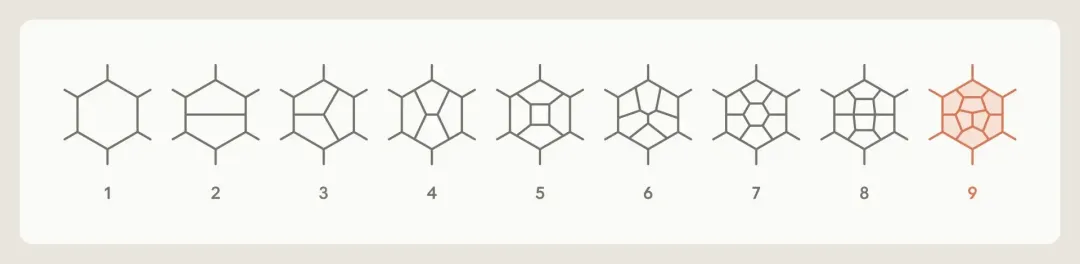
The beginning of this breakthrough was a public "war book".
On August 7, Matt von Hippel, a former theoretical physicist and Cypriot blogger, posted a provocative article on his blog 4gravitons entitled "Algebra is only AI in my field".
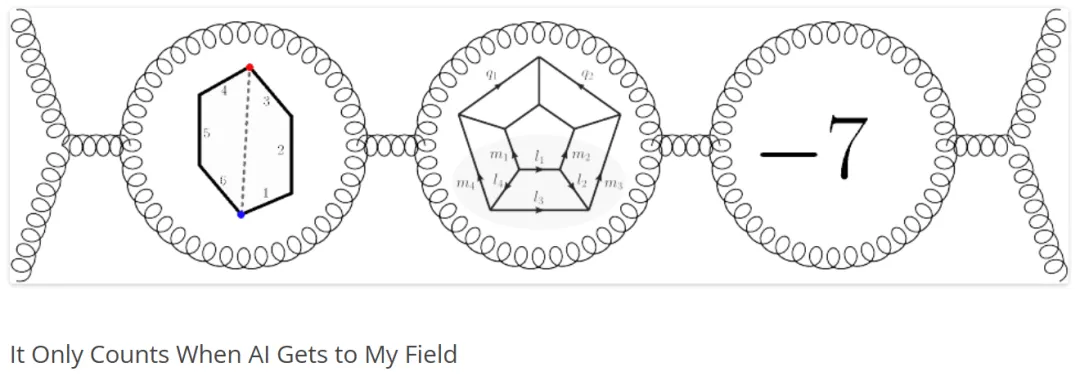
He gave two options: either count the N=8 supergravity as seven circles, or count the six-particle amplitude of the N=4 supersymmetric Z-Mills theory as nine circles.
A month later, AI completed the adjustment. Anthropic just published a guest article written by von Hippel himself, entitled: "Yes, Claude can count nine circles".
Nine circles, where hard?
In order to understand the scale of this phenomenon, we must first understand what physicists are calculating.
Particle physicists predict the behavior of particles using a formula called "scatter amplitude": given the energy and momentum of the particles involved in the collision, the scatter amplitude tells you the probability that they will react in some way.
The more accurate the predictions, the more accurate the results of experiments such as the Large Hadron Collider (LHC) will be. If deviations occur, it may be a clue to new physics, such as the nature of dark matter, or why matter and antimatter are not asymmetrical in the universe.
The problem is that scattering amplitude is extremely difficult to calculate accurately, and physicists can only do approximations. They divide the calculation into "circles" and loops, which roughly measure how complex the interactions between particles are allowed to be. With each addition of a circle, the answer gets closer to the real value, but the calculation also expands dramatically.
So in reality, the vast majority of the scattering amplitude is only two circles, and a few can be up to three. The most accurate prediction in particle physics, the electron anomalous magnetic momentum, is five circles.
The N=4 supersymmetry is a toy model that specializes in this field. The N=4 supersymmetry is a theoretical framework that describes the three basic interactions of electromagnetism, strong nuclear force, and weak nuclear force. The N=4 supersymmetry means that each particle has four supersymmetric partners. The theory is unrealistic and does not describe the real world.
The method used is called "bootstrap" by von Hippel, who divides it into a number: first write out all the possible forms of the answers, record them in a dedicated "letter tab" in a computer file, and then exclude all known constraints one by one, including the predictions given by other methods, the rules that the answers must follow, and the known results in the relevant questions. Ideally, only one candidate is left to pass all the checks, and there are plenty of checking conditions to confirm that there are no errors.
In 2023, he and Yu-Ting Liu used a peculiar symmetry known as "antipodal duality" to calculate the relatively easier "form factor" and then to calculate the circumference of the eight circles. For the next few years, his team looked at nine circles and planned to follow the same indirect path.
It is worth mentioning that Von Hippel himself was a veteran of this research route. He worked with Dixon and others to push the magnitude of the six particles to six and seven circles. In other words, he chose the bones he had cut himself.
A prompt, and then "continue".
In late August, two physicists at Anthropic, Liam Fitzpatrick and Siddharth Mishra-Sharma, contacted von Hippel and told him that the challenge had been taken.
They used the Fable 5.1 model, running on the Claude Science platform. Von Hippel explains in the text that Claude Science is a "harness", a set of structured rules and tips on the outer shell of a large model that make it appear more robust in scientific research tasks.
According to the article, the two first asked Claude which one of them was the best at challenging it, and then gave a very brief description of the task: calculating the amplitude of six particles (six-dimensional) of nine circles in the plane N = 4 SYM.
A typical instruction in the text is to go to sleep, stay away for the next few hours, and continue until I call a halt, reporting progress every four to six hours.
In the end, Claude calculated it in two ways: first, as a direct method of automation, and second, as an indirect route by the Dixon team through the shape factor. According to the article, the cost to the end user was about $1,000 or $2,000, the largest being the cost of running the model itself for a long time.
Von Hippel was impressed that a decade ago, when he was doing this kind of research, 96 CPUs a week were not a small amount of input.
The feeling of the verifier: like a collapsed shoe
At the end of the article, there is an appendix written by Dixon himself entitled "What it feels like to be preceded by a machine".
On September 1, he wrote, two researchers at Anthropic told him that Claude had calculated a nine-circle amplitude and asked him to verify the result. For him, that was the moment when the big language model "really fell upon itself" to change physics.
What impressed Dixon was not the scale of the computation, but rather the fragility of the whole process. According to his description, the computational formula would collapse as if something were wrong and the whole result would be like a failed comforter.
Due to the relatively easy reversal of the nine-circle shape factor from the nine-circle amplitude, Dixon mainly verified along this path. This also led to a somewhat subtle situation: he spent two weeks verifying what his team had been pursuing for several years.
He admitted that he was not disappointed, for two reasons.
His team used a custom Transformer model to predict the results of higher cycles, and they came up with the slogan that as long as the machine gave a candidate answer, they would have a complete set of tools to verify it.
It was Dixon and his collaborators who developed the method for solving the problem, and the presentation format of the results was based on their existing norms. In his view, while he was verifying Claude, Claude was also verifying all their past work. This is the origin of his phrase "Claude knows our paper better than anyone else".
But in addition to praising him, Dixon also said that he believes the real turning point will come when the model grabs new physical principles and insights before humans do.
The Chinese team arrived almost simultaneously
There is also a parallel clue to the story, which relates to China.
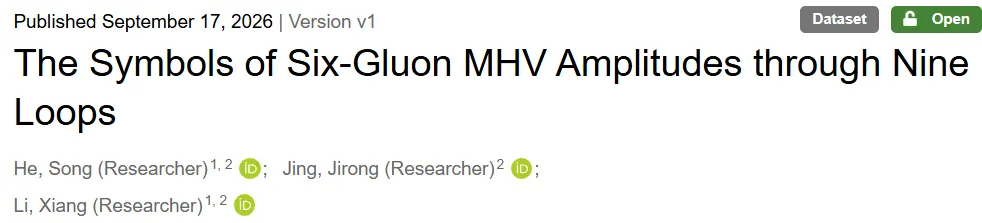
Within days of contacting von Hippel by Anthropic, Song He of the Institute of Theoretical Physics of the Chinese Academy of Sciences also found his way: his subject group had obtained most of the results of the nine circles. On 17 September, he and Jirong Jing, Xiang Li published a dataset on Zenodo, entitled Six-Tone MHV magnification of up to nine circles, covering two to nine circles of symbol data.
According to von Hippel and Dixon, the HoHo team also uses GPT-6-based AI aids, but is only used to calculate partial constraints, and the overall framework is still built by humans, which is in stark contrast to Anthropic's almost entirely automated route of "a prompt continuous repetition".
Dixon laughed at himself in the preface, and within two weeks he was robbed by a "machine" and a "human plus machine".
Von Hippel specifically mentioned that the atmosphere between the parties was quite friendly. Next, Dixon and his collaborators would publish the results and explain and analyze them in detail for later researchers.
Results of the Challenger: More fruit than expected
Back to von Hippel himself, who initially posed the challenge of answering the question in a field that he was familiar with: Can AI bypass the mathematical bottlenecks that people thought could not be overcome?
The logic of his challenge is this: the outside world is debating whether AI can actually produce new ideas, but how hard it is to find them, only after finding them; the difficulty of computing is more "real". Many of the fantasies about the future of superintelligence, from simulating the human mind to manipulating the human mind, to designing nanomachines based on the first-sex principles, are not mathematical enough. If AI can use resources at the level of academia to solve a problem that is considered to be mathematically limited, it is really worth worrying about.
As a result, von Hippel concluded frankly: this time there was not the kind of "breaking through arithmetic barriers in an unexpected way" he expected.
Claude used a known method, but only a little more computational than humans were willing to do before. It may have benefited from using Maple or Mathematica, which is used by physicists rather than Python, and software engineering practices may have been more standardized than human researchers, but not to the extent of "superintelligence".
The biggest lesson he learns from this is that even if the goal is simple and far-fetched in the eyes of experts, it may not actually be that difficult, and the results are lower than expected. A friend with a computer background told him over the years that amplification researchers could make a big leap if they hired more programmers, and von Hippel admitted that these people could now feel they were right.
But he also emphasized the other side. This kind of computing is fragile and confusing, and if he runs for a week on 96 CPUs, it will almost certainly take two weeks to run because of the first mistake. Claude Science runs for a week with little scientific oversight, without relying on any input from outside collaborators. He advises those who still think AI makes mistakes and is not very useful: this kind of work can now be done reliably.
He also made a vertical contrast. In a "vibe physics" experiment published by Anthropic in March this year, AI did a physical project like a student, the task was small, and it took a lot of hands to guide and make mistakes. Half a year later, it was done on the cutting edge of computing that only top experts in the field of amplification would touch. He did not rule out that this was a problem particularly suitable for AI, but he judged that the technology itself had indeed become stronger.
Von Hippel is cautious as to whether it can be promoted. N=4 This type of toy model is usually only part of a small circle of research, and there is much more competition for real-world amplification calculations, where low yields may be less. But he also warns that researchers who do these calculations should test and prepare solutions to verify the results if they have not tried to make a one-off impact on AI research platforms.
Written at the end
It would be more interesting to put this in the context of September.
Just this month, OpenAI announced its unpublished model of mobilizing tens of thousands of AI intelligences, giving an anti-example of the Navi-Stokes equation's existence and smoothness problem, one of the Millennium Grand Prix puzzles, which is still being examined by the mathematical community. The story of nine-circle magnification is much simpler than that of mobile mass computing: a commercial scientific research platform, a mission description, thousands of dollars, a few days.
It is also because of its simplicity that it may be more worthy of the attention of the academic community. Von Hippel finally confessed that he had hoped to take this challenge to the future, to see some unprecedented new method of computation, so as to obtain a valid judgment in the debate over superintelligence.
Dixon's question remains: What will physicists do when the big model is no longer just executing a formula written by humans, but begins to come up with new physical principles before humans?