Seven months ago, at CES, professional journalists were chasing the question: What model does this robot use?
Seven months later, when the editorial department of the Robotics Workshop again entered the WAIC's body-smart exhibition hall, it was discovered that the entire industry had switched languages.
On the stage, the words that come to our minds repeatedly are: deployment mode, WRAM, VLA, WBI, full loop closure... some words we even find strange.
Interestingly, these words were barely mentioned six months ago, but this year they have quickly become industry slang.
If new concepts are born every year in the robotics industry, what's special about 2026 is that perhaps these new words are no longer just academic and marketing concepts, but are actually describing a new stage of industrialization. Together, they document an industry that moves from paper to technical column, from demo to real deployment.
So we've divided it into four blocks, and we've crafted 22 keywords that are worth looking at in the robotics industry for the eight months leading up to 2026, hoping to help you read through this "theme chart" to help you understand this half-year of robots with physical intelligence.
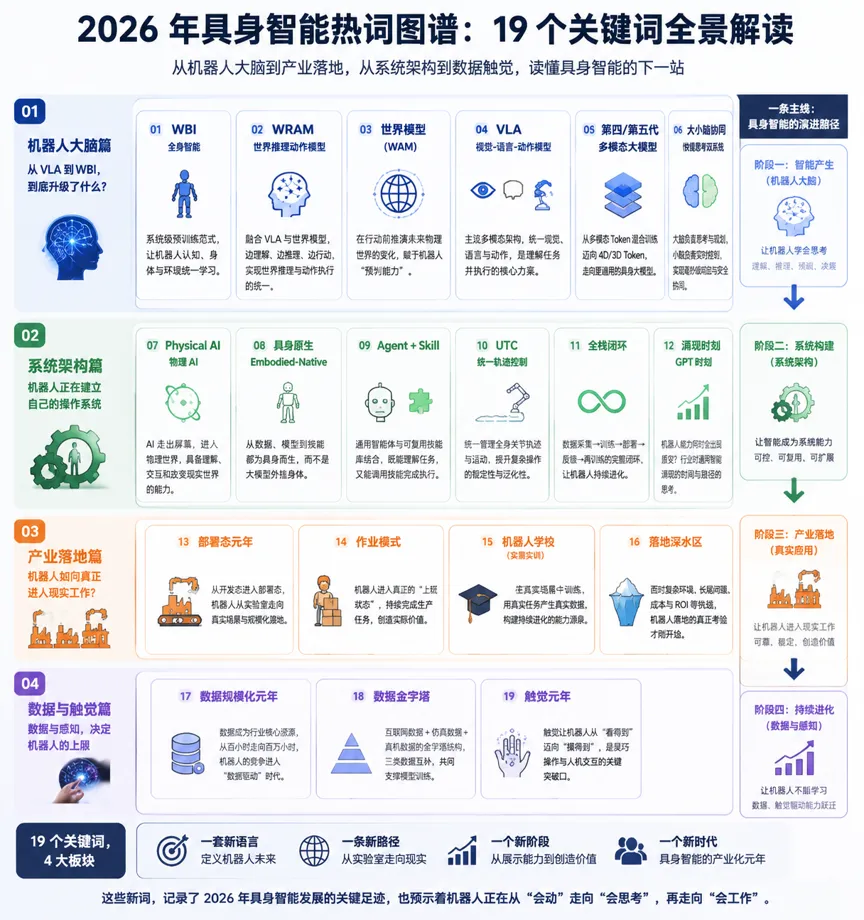
01.
What's upgraded from VLA to WBI?
In just six months, from VLA, WBI, WRAM, to world models, and then, almost every few months, a new technological concept is born in the industry. For many people who are not on the front line of contact with physical intelligence, these abbreviations are becoming more and more difficult to understand. But in fact, the Robotics Workshop believes that they are not interchangeable and are constantly answering the same question: what should robots think? along this line, we can also read the path of development of the robotic brain in 2026.
(1) Why is it that after WAIC everyone is talking about WBI?
After the end of WAIC this year, a concept not previously known to the general public quickly entered the field of view of WBI (Whole-Body Intelligence, Whole-Body Intelligence, Whole-Body Intelligence). Compared to the VLA, the world models have been discussing the technological path for a year or two, and WBI is more like a new way of thinking.
According to Archon Robotics founder Li Zhaoyang's definition in RSS 2026 Early Career Talk, WBI is not a standalone decision-making or execution model, but a system-level pre-training paradigm. In the past, people tended to disassemble the body's intelligent architecture, but in essence the brain is responsible for understanding tasks, the controller is responsible for movement, the end-end is responsible for perception, and finally put these capabilities together. What WBI wanted to do was put these capabilities together from the beginning of training to learning.
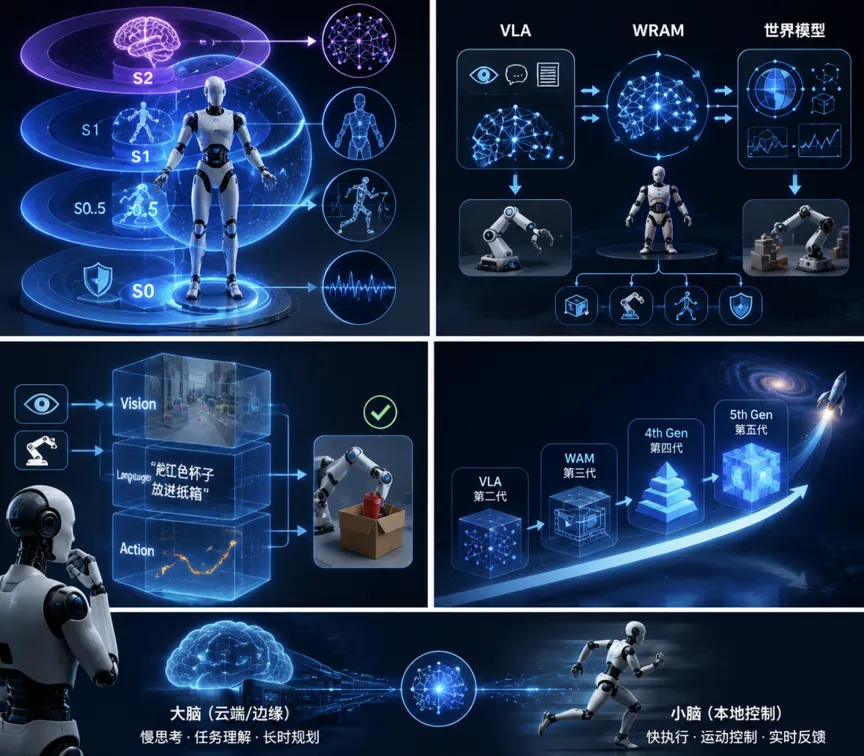
It divides robotic intelligence into four capabilities: S2 task semantics; S1 humanoid basic capabilities (body precedence); S0.5: Intent to full-body motion generation (UTC); S0: real-time balance, contact and control.
In other words, in this framework, robots learn not only "how to grab a cup", but also how to understand why, how to grab, and how the body works together after that. In recent years, one of the biggest controversies in the robotics industry has been that "the brain gets smarter, but the body can't keep up".
But instead of a new technological path, rather than what WBI actually proposes, it's a new goal: that future robots should have an intelligent body first to land better.
(2) World Reasoning Action Model (WRAM): Robots not only understand the world, but also drive the world
If the WBI is discussing what robots should ultimately become, then the WRAM response proposed by CTO Liu Xiaobo at the WAIC 2026 Smart Engagement Forum is how robots should think today. During this year's WAIC, the concept of WRAM (World Reasoning Action Model, World Reasoning Motion Model) proposed by Liu Xiaobo was so hot that it quickly became the focus of forum and media discussion.
Simply put, WRAM is a fusion architecture based on the VLA and the World Model.
Among them, VLA is responsible for understanding language, vision and mission meaning; World Model (WAM) is responsible for predicting the future state of the physical world; and WRAM tries to combine understanding with reasoning to allow robots to side-by-side understand tasks, side-by-side predict outcomes, and then execute actions.
For example, VLA is like an old driver who sees maps in action; the world model is like an old driver who can predict road conditions in advance; and WRAM is hoping to make the robot a driver who can both see navigation and flexibly adjust routes based on real-time road conditions.
Rather than proposing a new abbreviation, WRAM is more meaningful because it addresses one of the most hotly debated topics in the industry this year: will the VLA be replaced by the model of the world?
The biggest meaning of WRAM is not to invent a new architecture, but to tell the industry that the future of robot competition is no longer about who understands more, but who can predict farther.
(3) World Model (WAM): Robots are starting to have the ability to predict the future
If WBI represents the future direction of the robotic brain, then the World Model, or World Action Model, is one of the core technologies driving the rapid upgrading of the entire industry this year.
In fact, in the first half of this year, the world model has become an unparalleled topic at almost all robotics conferences. From ICRA to WAIC, from the Genie Envisioner-Sim 2.0 in Xi'an, to its Shigei Shigei Shigei, which has moved the entire line of assembly scenarios to the stage of demonstrating the ability to capture zero samples based on pure simulation, more and more companies are starting to see the world model as an important underpinning of the next stage of artificial intelligence.
In the past, most robots saw a glass and only knew how to "catch it". But the world model would think further, if it was caught from this angle, would it hit the bottle next to it? Would the glass slip? Where would it be placed after it was caught? This process is essentially a simulation of a series of physical changes that could happen in the future in the real world, including gravity, friction, collision, shape changes and interactions between objects.
In a lifelike metaphor, VLA is like answering a selection question, and a world model is more like doing a hypothesis. It doesn't just tell a robot mouse how to do a mouse, it's more important to predict what will happen after the mouse is done.
The reason for the WAM concept's explosion is simple. Over the past few years, large models have given robots a certain capacity for understanding, but after robots actually entered the factory, a new problem arose, which is that understanding is not the same as working. Because the real world is much more complex than an image on the Internet.
All of these require real-time robot prediction, rather than fixed-action execution. Therefore, the rapid rise in world models this year also means that the robotics industry is moving from language intelligence to physical intelligence, and that world models are actually simulated not by images, but by reality, just because the demand for simulators and chips will be increasingly high.
(4) VLA: The mainstream programming of the robotic brain
If we continue to go back in time, almost all robotic brains today do not get around the name VLA (Vision-Language-Action). Over the past year, it has almost become the most mainstream technological route with physical intelligence, and as we speak today, VLA remains a core direction for many companies.
VLA can be understood as a multi-modal architecture that unifies vision, language, and motion into a model. Robots first "see" the environment through a camera, then understand human language instructions, and ultimately generate corresponding motion.
Such tasks as placing red cups on a table into cardboard boxes, for example, require robots to simultaneously identify what cups are; understand which targets the red cups correspond to; determine the location of the cardboard boxes; plan out the action; eventually complete the placement of this series of steps. In the past, these capabilities were often accomplished by multiple independent modules. VLA for the first time unified them into the same model and thus became an important milestone in the development of physical intelligence.
Since this year, as robots enter increasingly complex real-world scenarios, VLA has also gradually exposed its limitations, as it is better at understanding and performing specific tasks, but lacks the ability to navigate the real physical world in the long term, with slight limitations on its performance in an open environment.
So this year, the industry has begun to explore new models around the world. But it's worth noting that the discussion about who replaces who has changed at WAIC.
In April, Jim Fan threw out a phrase that quickly spread across the industry: VLA is dead, WAM is in place, and WAIC 2026 is gradually being converted by consensus into fusion coexistence: VLA is responsible for understanding the world, world models are responsible for predicting the world, both of which are not competitive, but complementary. This also makes VLA not obsolete, it is just starting to take on its own better work, understanding, and better execution rather than predicting the future.
(5) Fourth and fifth generation multimodal models: the next stage of the robotic brain
WRAM's new concept of a fifth-generation multi-modal large model is that if the answer to WRAM is how today's robotic brains should construct a mouse, then the fourth and fifth-generation multi-modal large models are discussing how future robots should learn a mouse.
During the WAIC, Liu proposed the intergenerational evolution of the multi-modal basic model of robots. In his view, VLA is the second generation of the multi-modal model, which minimizes the movements of the multi-modal model that trains images with language combinations. The so-called World Action Model belongs to the third generation of the multi-modal model, typically a video generation model; two of this year's Best Paper CVPR, one pointing to the fourth generation of the multi-modal model, which trains video Token, text Token with image Token; another from DeepMind's D4RT, which implemented 4D Token, predicts that the fifth generation of the multi-modal model will be a mix of 4D Token, 3D Token, video, text and image Token.
The ruling reflects the industry's new exploration of the underlying training paradigm for the robotic brain: action data mitigation is only the last loop, the underlying mixed training of multi-modal Tokens, future robots' learning objects, no longer just images and language, but the real world itself.
(6) Big-brain synchronous systems: allowing robots to both think and act quickly
As the robotic brain gets smarter, a new engineering problem arises: Can large models think fast enough? In reality, robots that control joints, motors, and power feedback often require milliseconds of response; while large models may need hundreds of milliseconds to complete complex reasoning.
As a result, more and more enterprises have begun to adopt a large-scale synchronous architecture, also known as a fast-thinking binary system, in which the brain (cloud/edge) is responsible for world models/VLAs, task understanding, long-time sequencing; the brain (in-flight) is responsible for motion control, smooth control, full-body balance, emergency safety braking; solving the problem of the timeline incompatibility between large-scale 100-second reasoning and server real-time control. The two systems work in synchronous collaboration, enabling machines to both make complex decisions and meet real-time needs. This architecture is similar to the human neural system. The brain is responsible for thinking goals, the brain is responsible for coordinating movements, and the two complete behavior together.
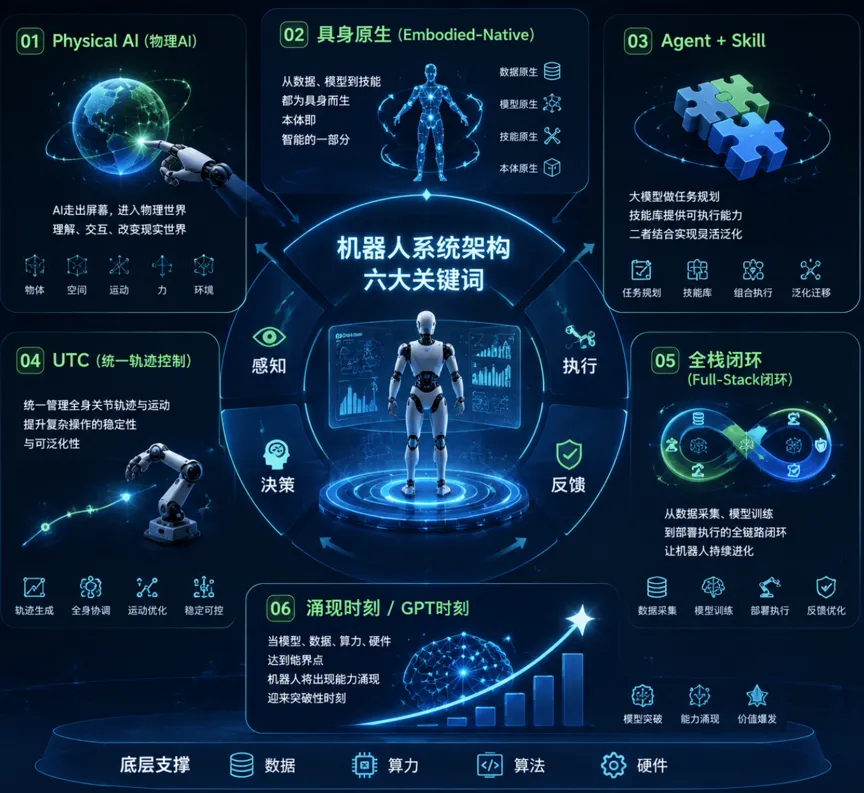
02.
System architecture: Robots are building their own operating systems
If the topic of robotic brains is how robots think, then the topic of systems architecture is another more realistic question: how can robots really turn intelligence into productivity and really land?
Over the past few years, the robotics industry has focused more on single-point capabilities, such as more flexible mechanical arms, more precise controllers, larger models, higher algorithms. But as physical intelligence enters the deep water, a new consensus is emerging that future robots will compete against a model that is entirely dependent on a complete system architecture.
1) Physical AI (physical AI): AI is coming out of the screen
It has been repeatedly highlighted by CEO Huang Jinping GTC and has become an important industry narrative in the field of physical intelligence in 2026. It means that AI moves out of the screen and into the physical body. It is the parent container of all new words.
Many in the industry believe that if the last decade of AI has been mainly in the digital world, then the next stage for physical AI is to bring AI into the physical world. Simply put, AI has the ability to understand, interact and change the real world.
Because traditional AI mainly processes text, images, code, data, etc., physical AI faces space, objects, movement, force, environmental changes. That is, it is no longer just answering questions, but it needs to complete real tasks. For example: how to lift a glass? how to avoid obstacles? how to understand a factory environment? how to complete repetitive work in the long term? These are all issues that Physical AI needs to solve.
Physical AI has not only benefited from large-scale shipments, but also from the development of large-scale models that give AI powerful cognitive abilities; the development of robotic hardware that gives AI a physically intelligent carrier that enters the real world. The combination of the two forms a new technological direction.
In the eyes of many, if ChatGPT is changing the way people interact with information, then Physical AI will change the way people interact with the physical world, and it will bring a grander future.
2) Embodied-Native: Robots can't just make models hanging out of their bodies
Embodied-Native was proposed by the Boeing wave team and sparked discussions in the industry about the routes of the robotic base model; Generalist CEO Pete Florence also proposed the idea of going beyond the world model and the VLA model in his keynote address at Going Beyond World Models & VLAs.
In the past, many people envisioned first training a powerful language model and then allowing robots to access the model, which would make the robot intelligent. But natives have proposed a different view that robot intelligence should not be based on a digital world model, but should be retrained from the physical world.
The reason is that Internet AI learns text, images and video, but robots are faced with weight, friction, collision, spatial relationships, physical limitations, etc. The data distribution of the two is naturally different.
An example of "open the door and see the cat" was given by Liu Bo Sheng-jun, who pointed out that only a cat can "see" the cat after the opaque glass door, but that the digital world's visual model is physically unable to do so because the design goals of the digital model (graphic quality/creativity) and the physical world (quick/reasonable) are inconsistent. But the real problem facing the robot is: Can the door be opened?
Native speakers actually pose a deeper question: should robots have their own large model kit, rather than become an application scenario of the Internet's large model? This also means that learning ChatGPT is a man-made world of text, whereas robots need to learn the physical world itself.
(3) Agent+Skill: the real-world path to robot landing in the coming years
During WAIC 2026, companies such as Sudo, Penguin Waves, and Nuclear Power Machines all showed similar ideas about atomic capabilities. If the end-to-end model represents the ultimate shape of the robot's future, Agent+Skill is more like an engineering program at the current industrial landing stage.
Simply put, when faced with complex tasks, the upper-level Agent is responsible for dismantling tasks and summoning different Skills to complete execution, the Agent is responsible for brainstorming, and the Skill is responsible for brainstorming skills. By turning each action into a generalized policy, the robot does not need to think from scratch for each task, but instead turns the action of grasping, pulling, wiping, moving, etc. into a replicable atomic capability.
Because the robot's greatest challenge is not to complete a single action, but to perform tasks consistently in different scenarios, such as requiring users to organize a table, the robot will not directly generate a complex action. Instead, it dismantles identifying objects, crawling, sorting, moving, placing. So each step of calling the corresponding Skill can be done more efficiently and accurately. This route is also rated as end-to-end poetry and distance, Agent+Skill is the best destination for the next 2-3 years, and upstream Agent scheduling with WRAM/WBI is expected to form a "short vs long-term" dual track.
(4) UTC: Unified Trajectory Control: the key layers connecting the cerebrospinal fluid to the cerebrospinal fluid
UTC (Unified Trajectory Control) originated in recent years from research related to robotic motion generation, and has become a key component of the WBI system. Work such as SONIC, BFM, was proposed in 2025 and is primarily responsible for transforming the intent into feasible full-body motion (Motor Generation + BFM Physical Prediction) linking the middle layer of "brain WRAM" to "brain WBC", the most engineered part of the WBI concept.
There has always been a disconnect problem with robots, where the big model knows what the mouse should do. The control system knows how the mouse joints move. But there is a lack of a middle layer between the two. UTC solves how to convert higher intentions into executable whole-body motion trajectories. For example: brain output instructions: pick up a cup of water from a table. UTC plans the arms, body, joints, how to coordinate movement.
Future robots will not just be mechanical to perform fixed movements, but will have to deal with complex environments. Therefore, there needs to be a middle layer that can connect task understanding, action planning, physical movement, real-time control. UTC is this layer. If the big model is responsible for telling the robot where to turn, then UTC is responsible for telling the robot how to turn around.
(5) Full shutdown: Robot competition, from one-point technology to system warfare
With physical intelligence entering the industrialization phase, during ICRA 2026, WAIC 2026, the industry gradually formed a new consensus: no one enterprise will be able to compete on a single capability in the future. The so-called full-circle shutdown, in simple terms, is to cover the entire chain of robots from research and development to landing: data collection→ imitation training→ model training→ real machine deployment→ impact assessment→ data flow→ re-training optimization.
In the past, the robot industry chain was more like a line, with hardware manufacturers in charge of the robot itself; software companies in charge of the algorithms; application companies in charge of the scenarios. Relatively split between the links. But in the age of physical intelligence, robots need to continue learning. One deployment is not the end, but the beginning of the next round of training.
Because the greatest challenge with physical intelligence is not getting robots to complete a single action. It's how robots continue to evolve. In the age of big models, Internet companies rely on the ability to generate massive amounts of text and image data. And in the age of robots, data comes from the real world. Every time they catch up. Every time they fail. Every move is biased. Every time the environment changes. They are important materials for robot learning.
(6) Emerging moment/GPT moment: When will the robot introduce its own ChatGPT?
One of the most controversial topics in the industry in 2026 has been the question of whether physical intelligence will lead to the adoption of ChatGPT-like chipset GPT. On the one hand, companies such as Chiyo Robotics believe that with the increase in data size and modeling capabilities, physical intelligence may emerge sometime between the end of 2027 and 2028.
The industry believes that the so-called GPT momentum is derived from the development experience of generative AI. In 2022, after the release of ChatGPT, people first intuitively saw that the capability of a large model is not linear growth. When parameters, data and training methods reach a certain scale, the model suddenly displays new capabilities that have not been seen before. This phenomenon is known as the surge. Thus, the robotics industry has also begun to discuss whether robots will appear at their own GPT moment.
But there is a fundamental difference between a robot and a ChatGPT: ChatGPT faces the digital world and a robot faces the physical world. Language models can learn quickly through Internet text; robots need to deal with real-world changes, complex physical laws, physical constraints, lengths, and long-term tasks.
Therefore, the field of robotics is more cautious about GPT timekeeping. Some believe that with the accumulation of millions of hours of robot data, a leap in capabilities may occur. Others believe that robot intelligence will not explode suddenly like chat robots, but will unlock gradually with different scenarios. It actually represents the industry's idea for the terminal that robots will eventually become a general intelligence? or that they will stay on a long-term basis in the automation of specific tasks? This is not only a technical problem, but also a large industrial possibility that determines how machines participate in the real world.
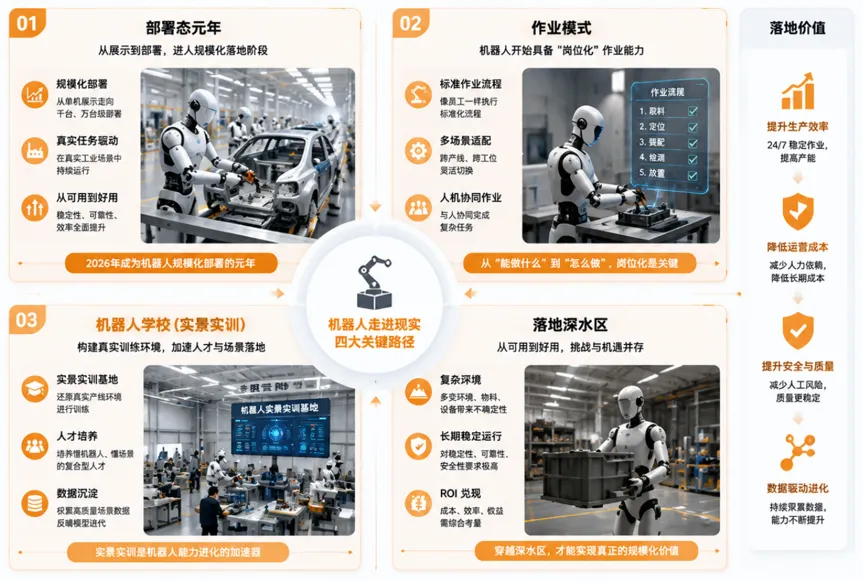
03.
Industrial Landscape: Robots start from hydrogen to demonstrate hydrogen to hydrogen
This is why since this year, a bunch of industry keywords such as Deepwater Horizon dredging have begun to emerge. Behind these words, the logic of the industry is actually moving from the technology demonstration stage to the industrial verification stage. If over the past few years the core of industry competition has been about who can build a robot dredge, then the next core of competition will be about who can create a robot that can create real value and become more valuable.
(1) Deployment Calendar: From R&D to operational phase of the robotics industry
In April 2026, at the Xi'an Partner Conference, Xi'an Robotics Chairman Tian Taiwa proposed that the year 2026 be defined as the calendar year of the Xi'an deployment status. Subsequently, during the technical cooperation activities held by Xi'an and AESDA in July, Xi'an deployment status was once again an important keyword in the industry discussion. The so-called Xi'an deployment status is not a simple delivery of robots, but represents robots from the R&D and verification phase to the long-term operation phase.
In the past, the robotics industry has focused more on robotics development. Companies need to prove whether robots have a certain ability: can walk, can clutch, can complete movements, can run in a laboratory environment, but after entering deployment mode, the evaluation standards have changed.
This means that the competitive logic of the robotics industry is beginning to shift. In the past, robots were more like a product; in the future, robots were more like a continuously operating production system. This change also explains why more and more companies are moving from simply manufacturing robots themselves to building complete solutions, including models, data, scenarios, and services.
After entering the industry, robots are faced not with a single show, but with thousands of hours, tens of thousands, or even longer cycles of continuous work.
(2) Operating model: The real challenge of the robotics industry is rising
In June 2026, the Ministry of Industry and Finance and the State Finance Commission jointly released the 2026 Joint Action Package for Human Robots and Physical Intelligent Real Estate Training, which proposes to push human robots and physically intelligent people into the robotic business model.
Because in the past, the most common expressions in the robotics industry were: demonstration, testing, verification, delivery. But the working model has changed language. It emphasizes not whether a robot has completed a single action, but whether it can continue to perform tasks like a real producer.
For example, in a manufacturing scenario, robots need to complete installation, testing, transportation, etc. on a daily basis; in a logistics scenario, complex orders and environmental changes need to be processed over a long period of time; in a service scenario, they need to face the ever-changing needs of human-machine interaction.
This reflects a shift in industry awareness: the real value of a robot is not in completing a surprising demo, but in completing 10,000 stable runs. Therefore, the introduction of the workflow model implies that the robotics industry has begun to move from demonstrating the capability of a chip to verifying the reliability of a chip.
(3) Robotics School: The real source of data for robots is moving into the real world
In the past, many people thought that the biggest challenge for robots was hardware. However, as large models entered the field of robotics, the industry gradually discovered that the real limit to the development of robots may not be a mere hardware capability, but a lack of reliable, high-quality data.
In line with the relevant policy planning, the real-world training space will be an important infrastructure for promoting the development of physical intelligence, training robots through real-world environments, and forming a closed loop for improving the capacity of robots to optimize the accumulation of data on the model.
In contrast to traditional laboratory research and development, real-world experiments emphasize that robots enter a real production environment. Because there are many uncertain factors in the real world that cannot be simulated by laboratories, such as changes in parts locations; material differences; environmental interference; failure of operations. These data are essential for improving robotics' generalization capabilities.
In a sense, competition between future robotic enterprises may be not just model-parametric competition, but real-world data competition. Whoever has more real-world scenarios, whoever has more failed experiences, is more likely to train more powerful robots.
This is why more and more companies are starting to deploy this year: robot training sites, data platforms, real-world production lines, simulation systems.
(4) Deep water landing zones: The real challenge of robots is just getting started
However, when robots actually enter the industry, a deeper problem is gradually revealed. Robots aren't going to move, but they're a long way from actually completing complex tasks.
In the past, it has often been used to describe the problems that robots face today. The robot's cranial body is becoming stronger: it can walk. It can move. It can do simple crawling. But there is still a distance between its cranial brain and cranial cranial cranial cranial cranial cranial cranial cranial cranial cranial cranial cranial cranial cranial cranial cranial cranial cranial cranial cranial cranial cranial cranial cranial cranial cranial cranial cranial cranial cranial cranial cranial cranial cranial cranial cranial cranial cranial cranial cranial cranial cranial cranial cranial cranial cranial cranial cranial cranial cranial cranial cranial cranial cranial cranial cranial cranial cranial cranial cranial cranial cranial cranial cranial cranial cranial cranial cranial cranial cranial cranial cranial cranial cranial cranial cranial cranial cranial cranial cranial cranial cranial cranial cranial cranial cranial cranial cranial cranial cranial cranial cranial cranial cranial cranial cranial cranial cranial cranial cranial cranial cranial cranial cranial cranial cranial cranial cranial cranial cranial cranial crani
This is why this year's industry is focusing on world models, touch, dexterity and data closures. Because robots are not facing a standardized process, but a constantly changing environment, which is also a persistent problem in deep water areas.
04.
Data and touch: The ultimate competition for robots, moving from models to data
In the past few years, there has been a very clear consensus in the AI industry: the bigger the model, the stronger the capabilities. In the era of the big model of the Internet, companies compete around the size of the parameters, the input of computing and the training of data. Those who have more data have more opportunities to train more powerful models.
But in the age of physical intelligence, the industry began to discover that the problems robots face are much more complex than the digital world. Because the object of robot learning is no longer just text and images, but the entire physical world. It needs to know how much weight a cup weighs, what the surface friction forces of different materials are different, how much force should be used when grabbing; how objects change after being subjected to external forces.
This information is not directly provided by Internet data. Thus, for the eight months leading up to 2026, the robotics industry has emerged with a set of very important new keywords: data-scaled millennium, touch millennium, smart hand industrialization breakthroughs, and the last centimetre. They all point to a change: the core of the robot competition is shifting from a bigger who-who model to a who-who has more real world experience.
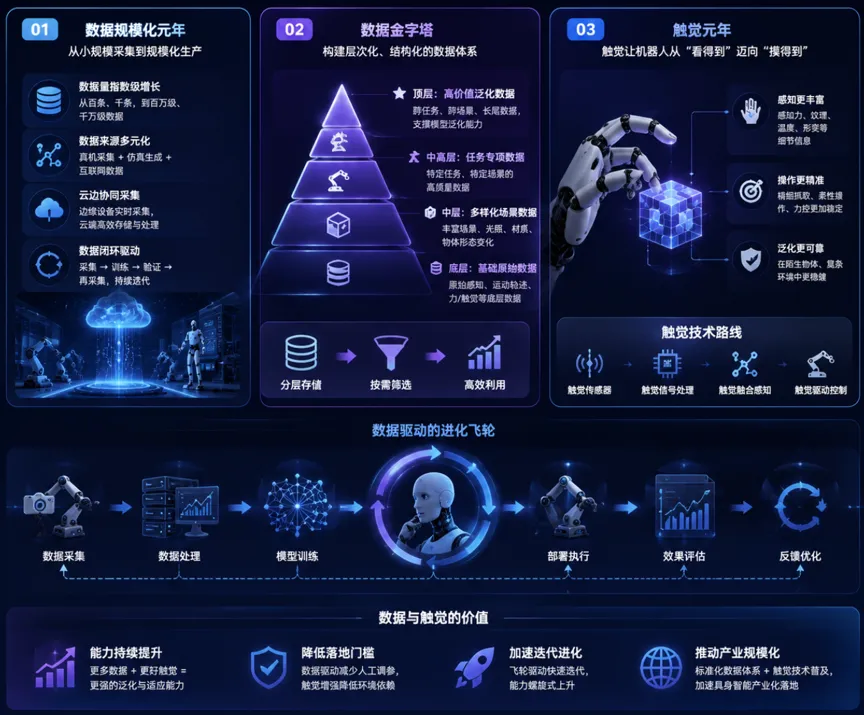
(1) The Age of Data Scalization: Robots are entering the bubble of data warfare
During the 2026 WAIC, Huawei, CEO of Wheel Intelligent, proposed that the year 2026 is the calendar year for the scale-up of physical intelligence data. At the same time, more and more companies in the industry are starting to view data capabilities as the core infrastructure for physical intelligence development.
In the past few years, the robot industry has focused on: models, algorithms, hardware. Then this year, a new keyword has begun to enter the center of the industry: data. The reason is simple. Robots are different from traditional AI. For language models, the Internet has provided a huge amount of text; for visual models, open image data is already very rich. But the data that robots need is another completely different data: how does the machine arm adjust posture? what feedback is generated when the fingers touch objects? how should robots recover when they fail? these data can only come from real interaction.
In the past, many robot trainings may have relied on only tens or hundreds of hours of data; now, the industry is moving to a million-hour level or even larger scale. For example, AI robots are releasing the Daimon-Infinity data set, which plans to continue to scale up physical data; at the same time, optical intelligence is gaining market attention thanks to its physical data infrastructure capabilities, further illustrating that data is becoming a new competitive resource for the robotics industry.
But the biggest difference between robotic data and Internet data is that it's not simply copying. It's constantly trying to make mistakes. A robot completes a successful grab, with limited value. But once it fails: why didn't it catch? why slipped? why crashed? why did action planning go wrong? these failures, these bad data, are important sources of improving model capabilities.
2) Data pyramids: robots will not learn from one data
As the importance of data increased, another concept began to gain attention: the data pyramid. The concept was first proposed by Agility Robotics CTO Pras Velagapudi in a GTC-related sharing, emphasizing that robot training requires different levels of data from different sources.
Simply put, robot training data is not a single source, but a pyramid. The bottom is Internet video, human behaviour data. The middle layer is data generated by simulated environments. The top is remote data collected by real robots. All three types of data are valuable. The Internet data is the largest in size and can help robots understand human behaviour.
This also means that future robot training will not simply replicate the ChatGPT model. Robots cannot acquire the ability to read Internet knowledge alone. Because many of the key experiences in the real world, such as how to control strength, how to recover from failure, how to adapt to different environments, must be acquired through real interaction.
However, at the same time as the size of the data expanded, there was also a quiet voice in the industry. During ICRA 2026, Ken Goldberg suggested that there is still a huge gap between data accumulation in the robotics field and the big model era, and that robots really have a data size similar to the Internet AI and need to accumulate for a long time. This means that the millennium of data scaling does not mean that the problem of robot data has been solved. On the contrary, it means that the industry is just beginning to enter the data competition stage.
(3) Year of Touch: Robots are starting to have touch sensors
If data solves how robots learn, then touch solves how robots perceive. In 2026, more and more voices in the industry believe that robots are entering the age of touch. In the past, robot perception was largely dependent on vision.
Human beings are able to perform complex operations, largely dependent on touch. When we pick up the glass, we adjust the force naturally, and when we hold the paper, we reduce the force; when we touch different materials, we adjust the movement immediately. These abilities are irreplaceable to vision.
This year, it is widely believed that robots with the potential to truly generalize in the future must have vision, language, touch, and action at the same time and ultimately form a complete perceptual loop. This is why more and more companies are starting to deploy touch sensors, touch chips, and touch data. For example, some companies like Huawei, Toyota, and others are pushing for the construction of touch datasets, because vision lets robots know what the world is like, and touch lets robots know what the world feels like.
05.
Synopsis: The robotics industry is redefining its language
Looking back at these new words that emerged in the robotics industry eight months before 2026, we find an interesting phenomenon: they are not simple conceptual updates, but they record structural changes that are taking place in an industry.
From WBI, WRAM, to Physical AI, to native-born; from deployment modes, operating models, to data-scalation millennia, to touch millennia, these previously uncommon words are now becoming the new language of communication in the robotics industry.
When the industry begins to talk about WBI (whole-body intelligence), which means that the focus of robot competition is not just to have a stronger brain, but to really integrate cognition, body, and environment; when the industry begins to talk about WRAM, the world model, which means that robots are moving from understanding the world to predicting the world; when the industry begins to talk about deployments, operating models, which means that robots are beginning to take the test of the real industrial environment rather than staying in laboratories and galleries.
This is why so many new concepts are emerging this year, which are essentially in the same direction that robots are being made out of aluminum and moving towards a body of intelligent aluminum that can continue to grow. Of course, today's physical intelligence is still in its early stages. Data size still needs to continue to accumulate, model capabilities still need to be broken, sophisticated operation and generalization capabilities are still an industry challenge, and robots still have a long way to go from true general intelligence.
But there's no denying that a major change has taken place by 2026: the robotics industry is starting to have its own technical language. In the past, robots have borrowed more from the narrative of the age of automation: accuracy, speed, freedom, load.
Today, it is beginning to establish new terms that belong to the age of physical intelligence: world models, full-body intelligence, physical AI, data loops, deployment mode. These words are connected by a complete path from the laboratory to the real world.
These new words will not be the end. Many years from now, when people look back at the real stage of industrialization of artificial intelligence, they may remember not just a robot product, not just a corporate event.
They may discover: it is these new words that are constantly emerging, documenting the crucial turning point in the robot's journey from the mouse movement to the mouse thinking to the mouse working to the mouse. The robot industry is changing a language set, and behind the language, an industry is changing the mouse.