An unknown company is writing a life-and-death book about the cost of soybeans for agricultural robots.
In July 2026, U.S. agricultural technology company Hippo Harvest announced the completion of a $30 million C round of financing (approximately RMB 200 million). The round was jointly financed by North American greenhouse operator Cox Farms, Congruent Ventures, and Hawthorne Food Ventures. The California-based startup expects to accumulate over $51 million in funding in just two years, totaling approximately RMB 345 million, compared to a $21 million B round completed in February 2024.
It is reported that this round of funding will mainly be used for capacity expansion, expanding from the existing 1 acre greenhouse to the planned 30 acre new facility, while promoting technological transformation and tunnel construction.
For indoor agriculture, this C-Round financing is not easy. In the past few years, the track has been the cradle of robots, AppHarvest went bankrupt after its peak in the market, Bowery Farming was forced to shut down, AeroFarms fell into bankruptcy restructuring mud, a number of star companies are in a state of dying floating mud.
According to EcoTech Capital, bankrupt vertical agricultural enterprises have accumulated about $2.2 billion in financing, while global domestic agricultural financing has plummeted from nearly $8 billion in 2018-2022 to less than $1 billion in 2024.
In the midst of such an industry's downturn, why is it that Hippo Harvest is still able to cash large amounts of industrial capital?
01.
Technical bottom plate, a set of rings attached to a reducing iron triangle
To understand why capital is turning around, we first need to break down the technical logic of Hippo Harvest. The company, founded in 2019, has a core positioning that can be summarized in one sentence: AI and robots will use greenhouse planting to bring the cost of hardened crops to the horizon of open fields.
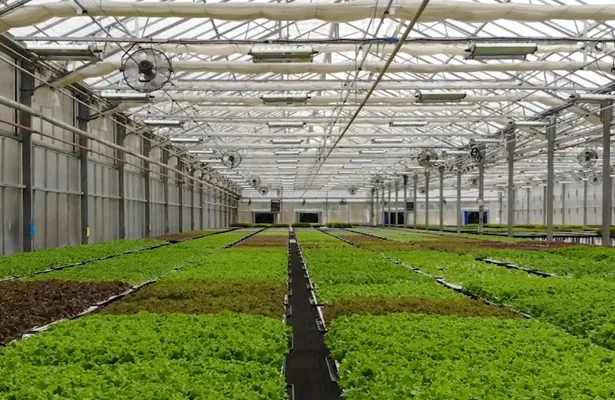
To achieve this goal, the company is currently operating a year-round stable production of indoor clean greenhouses, and its products are certified organic by the U.S. Department of Agriculture (USDA). According to official disclosures, its vegetable retail price is close to that of traditional open-air organic vegetables.
The technology system of Hippo Harvest is made up of three core modules:
(1) AI closed loop fertilizer system
Using a network of sensors to collect soil, water and crop growth data in real time, the algorithm model dynamically adjusts the water fertilizer ratio to achieve accurate supply and recycling. Official data show that the system can achieve 92% water savings compared to traditional outdoor cultivation.

(2) Autonomous mobile robots (AMR)
From planting, planting, to daily inspections, to mature harvesting, the company's autonomous robots within the greenhouse deployment encapsulate the entire process. The advantage of this deployment is the accuracy and consistency of the operation, even at 3 a.m., robots can still ensure that the depth of planting of the 1000th strain and the distance of the 1st strain are not different from the strain. This precision operation directly reduces plant loss rates and reduces the dependence of enterprises on seasonal labor.

(3) Growth regulation algorithms
Based on environmental data and crop growth models, the algorithm is able to adjust parameters such as lighting, temperature, CO2 concentration and humidity in real time. It is essentially a "customized growth scheme" for each batch of crops, so that production is no longer seasonal and weather-restricted, ensuring a stable supply throughout the year.
When the three levels are combined, the resource efficiency demonstrated is impressive enough, with enterprises disclosing that their land use is up 94% from traditional agriculture, meaning that the same output consumes less than a tenth of the cultivated area.
02.
The ultimate commercial proof of indoor farming
Unlike many in-house farming companies that are still in the technical verification stage, the pace of commercialization of Hippo Harvest's milestone is clear:
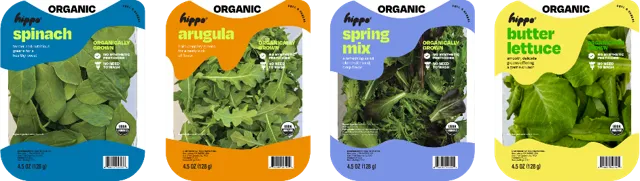
• In October 2024, the USDA launched a line of organically certified packaged salads, covering SKUs such as pickles, sesame seeds, blueberries, Roman greens and mixed salads;
• Beginning in early 2026, retailers will be able to supply items such as cream and vegetable dishes, formally entering mainstream retail channels;
On the market's most sensitive pricing dimension, its terminal retail prices have been able to positively counter the traditional organic vegetables grown outdoors. This is particularly critical. In recent years, the biggest culprit on the indoor agriculture/plantation plant circuit has been cost. Although the products are bright, but the high sales price makes it difficult for consumers to engage in occasional hunting and difficult to generate high frequency.
From its current performance, this hypothesis is nearing verification.
03.
Calculator of Industrial Capital, Why Choose Heavy Stocks
As a well-known large-scale greenhouse operator in North America, it is itself equipped with extensive facilities and mature downstream distribution channels. It is difficult to explain the subscription to Hippo Harvest using purely financial return logic, which is essentially an accurate industrial collaboration with war defense.
By bundling capital bonds, Cox Farms can prioritize embedding Hippo Harvest's mature AI decision-making systems and clusters of robots into its own greenhouses to improve the operational efficiency of its assets in the form of technological outsourcing; on the other hand, in a time of increasingly homogeneous competition in facility agriculture, Cox Farms is able to prioritize its cutting-edge smart schemes in order to build a barrier to future cost fluctuations and technological change.
While Congruent Ventures has a long-standing focus on climate science and sustainable agriculture, Hawthorne Food Ventures focuses on food and agricultural innovation. The investor's industry background suggests that they are using industrial logic to bet on the practical side of adding potassium reduction to potassium and reacting chemically with existing capacities.
04.
Agricultural robot racetrack is changing the script?
This funding from Hippo Harvest, in the context of a larger industry, reflects a profound shift in the entire agricultural robot trajectory that is taking place.
Looking back at 2020-2023, the industry has gone through a disastrous round of bankruptcy. The mores of the losers are highly consistent, energy costs are stagnant, unit production costs are always unable to compete with open-air agriculture, and scale-up instead adds to losses. Capital has paid for "technical faith", but the market refuses to pay for "high-priced vegetables".
After the turnaround of 2024, companies that survived and received a new round of financing adjusted their routes roughly the same way. They no longer pursued the extreme of full-closure, full-artificial lighting, but instead adopted a pragmatic path of semi-closed greenhouses + natural light supplementation; the core value of AI and robots shifted from "alternatives" to "reducing marginal costs".
From a global perspective, the agricultural robotics track is moving from a "single-point breakthrough" to a "whole chain penetration". Traditional farming machine giants are eager to expand their business gradually from plant protection to seeding and patrol, ground robots are trying to cut into the harvesting and weeding links, while startups like Hippo Harvest are running out of control in controlled scenarios such as greenhouses. Intelligent coverage of the entire "farming-tube-harvesting" chain is changing from concept to reality.
According to Research and Markets, the global agricultural robot market is projected to reach $25.85 billion in 2026, with a growth rate of 21.8%, and a compound growth rate of 18.9% in 2026-2030. According to Research and Markets, the global agricultural robot solutions market is projected to reach RM74.9 billion by 2029, with a compound annual growth rate of 53.3%.
05.
Agricultural robots don't need hero stories
Hippo Harvest's stage victory was, after all, a typical kick-start after the collective clearance of the farm-robot racetrack.
The tragic lesson of the previous cycle is already at the core: technological advancement is not equal to commercial feasibility. More sophisticated robots, if the crops grown are three times more expensive than outdoors, consumers will not pay for "technology sense".
The new industry consensus is rapidly gathering: the ultimate value of agricultural robots is not "cool" but "cheap".
Hippo Harvest's transition from 1 acre to 30 acre, good rate controls in the scaling process, supply chain management and channel expansion remain to be solved. But at least at the present juncture, it provides a worthy sample.
It's not selling concepts, it's selling dishes; it's not talking about the future, it's talking about costs.