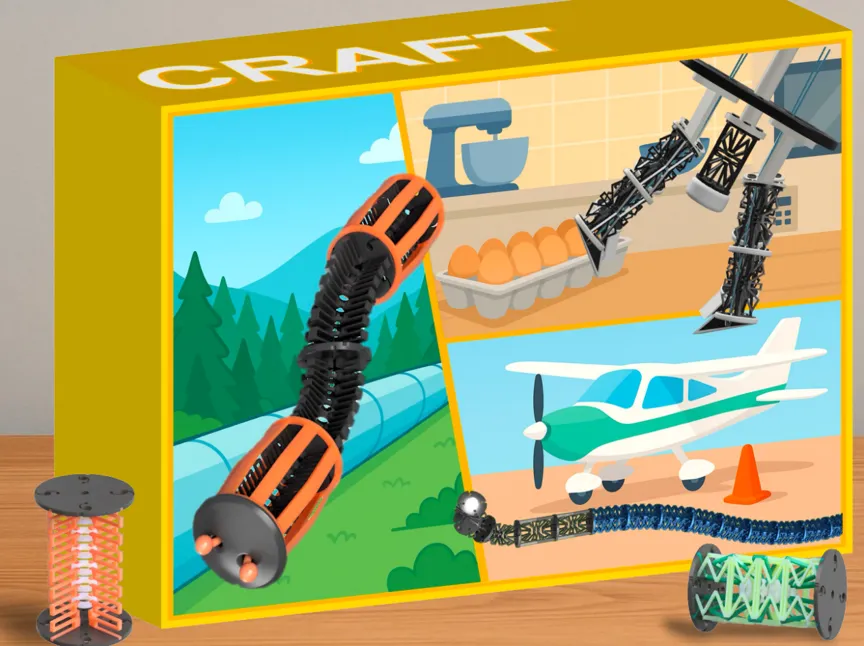
The same set of modules were designed to create three completely different robot bodies.
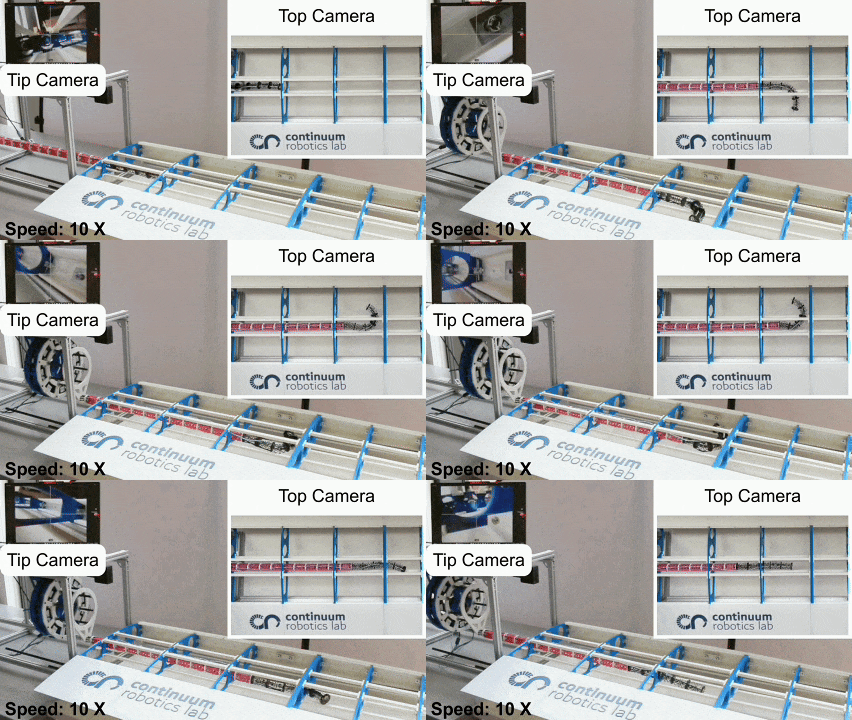
The first unit reaches the wing of the aircraft.
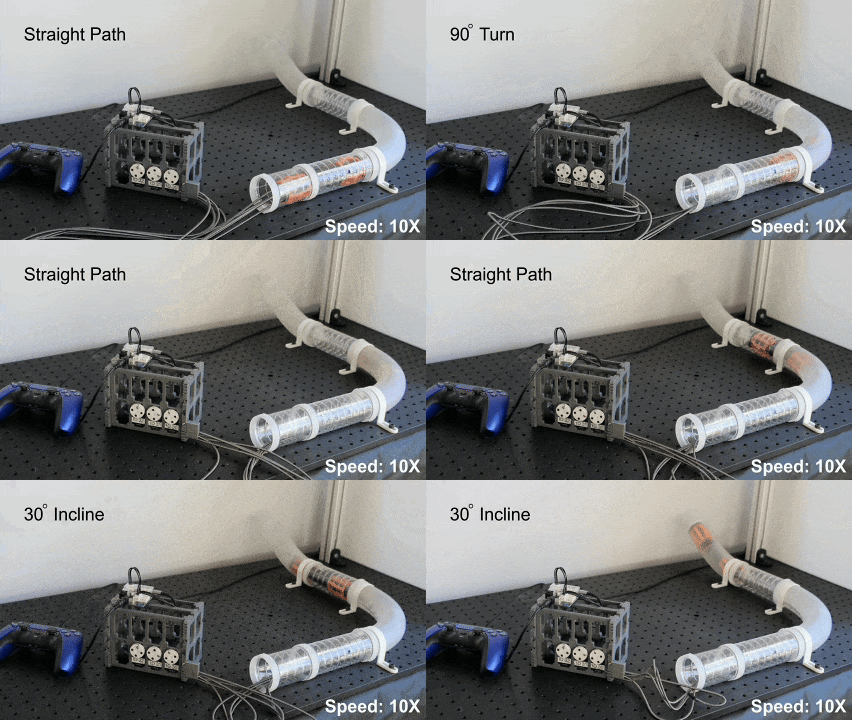
The second one is in a 90-degree tube.
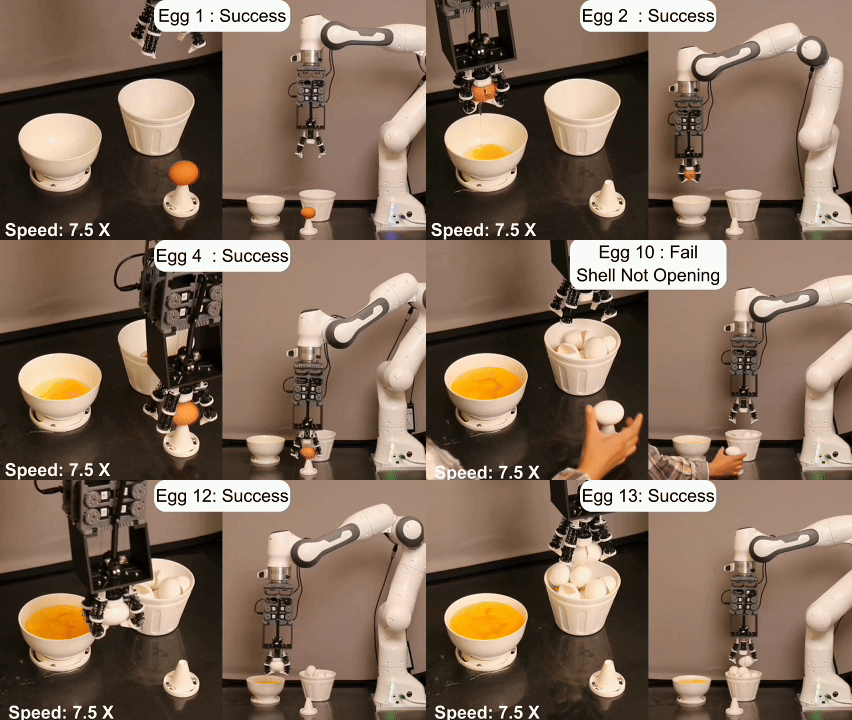
The third one is a soft hand that kicks eggs.
The three are not exactly the same thing, but the same set of mechanical blocks are used behind them: a modular design library for continuous robotics driven by mice.
The CRAFT design library, developed by the Continuum Robotics Laboratory at the University of Toronto's Institute of Robotics, contains 6 types of flexible chain-based 3D printing modules.
CRAFT: A 3D-printed Modular Design Library for Task-specific Continuum Robots was published in the journal Npj Robotics.
The problem that CRAFT wants to solve is straightforward: can a robot change its mission and not be pushed back?
01.
Why do you have to re-create a robot body instead of a task?
A continuous-body robot, unlike a conventional mechanical arm, has no distinct stiff joints, and the entire body can be curved continuously. It looks like a snake, like a nose, and like a soft tube that can twist itself.
This makes it suitable for drilling - inside the human body, aircraft wings, engines, underground pipelines, the narrower the space, the more curved the path, the more obvious its advantages.
The longer the robot, the more severe the self-inflicted downturn; the more difficult it is to attach the camera or tool to the end, to position and control it.
In the past, researchers mainly used two approaches.
One type is the addition of magnetic locks, heating materials, air blocks, and other rigidity devices to the robot. It needs to be soft when bent and hard when loaded. The rigidity is adjusted, and high voltage, high temperature, airway and additional devices may also come along.
Another more direct approach is to redesign the body. Changing the skeleton, changing the chain, changing the path of the rope, then re-printing, assembling and testing. The effect can be very fine for the task, and the cost is clear.
CRAFT took a different path: it made several commonly used mechanical properties into standard modules, which required performance, and then by mission combination. It did the pre-mission mechanical reconstruction. It first changed the modules, ordered them, and obtained new rigidity and shape.
02.
6 types of modules, 6 types of body character modules
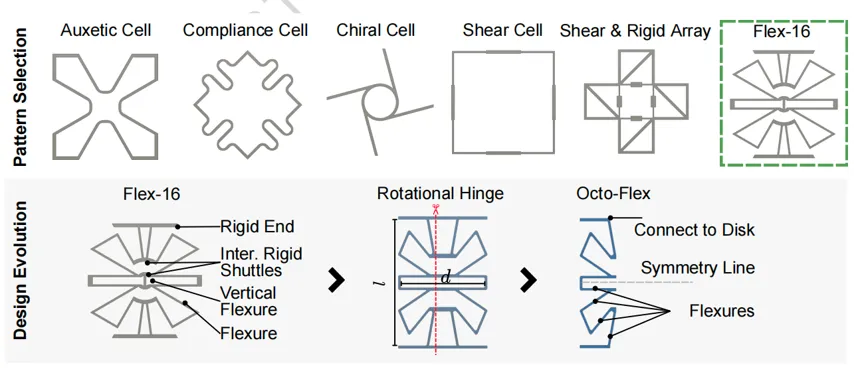
CRAFT currently has six members: low hardness, medium hardness, high hardness, oriented hardness, unidirectional hardness, and scalable modules.
The first three categories are intuitive.
Low-rigidity modules are the softest, suitable for bending at large angles through narrow bending angles; medium-rigidity modules are slightly harder, finding a balance between flexibility and momentum; high-rigidity modules are suitable for positioning at the roots of robots, specifically against gravity and larger torque.
In the next three categories, more games.
Modules of oriented rigidity differ in their resistance to friction in different directions. The robot can flexibly bend in one direction, making it significantly more difficult to press in another direction.
The single-directional rigidity module is more extreme. It has an equivalent anti-aluminium rigidity of 0.0057 N/m2 in the X direction and 0.061 N/m2 in the Y direction, which is more than 10 times the difference.
The effect is a bit like a scroll. It's easy to roll in one direction, and it's much harder to roll in the other.
At the same time, its equivalence axis hardness EA reaches 1150 N, the highest of the 6 class modules. That is, it is harder to stretch or compress along the axis.
The last scalable module was a complete replacement of a hydrogen gas. It uses parallel springs inside, with an equivalent lithium resistance of only 0.078 N/m2 and an axial resistance of 6.80 N/m2.
It's not good at holding, it's good at stretching.
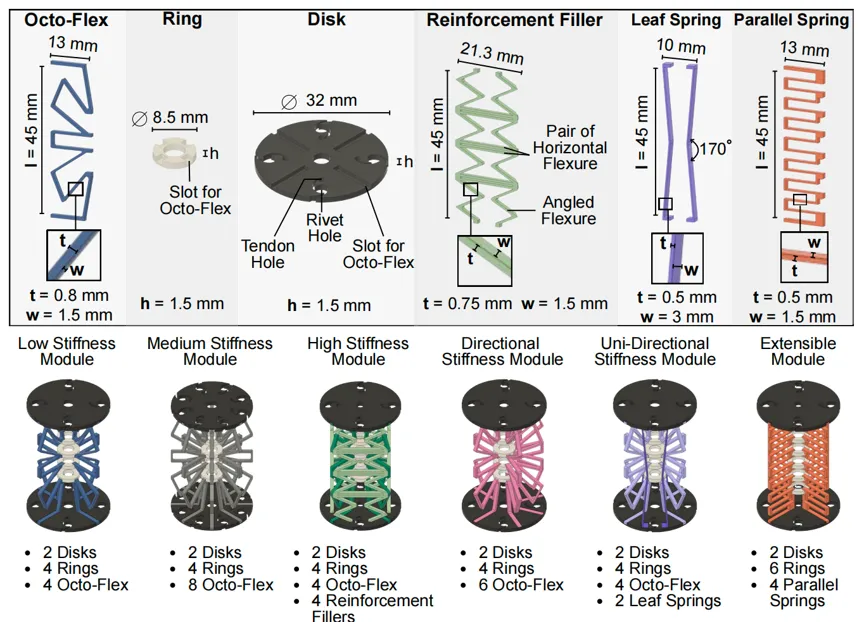
6 types of modules, with different internal structures, while the external interfaces remain compatible.
The cable passes through the arched slot at the edge of the terminal. When the adjacent slot is joined, the slot entrance forms a closed tunnel. When replacing one of the sections, it is not necessary to pull out the entire rope, only to process a small portion near the replacement position.
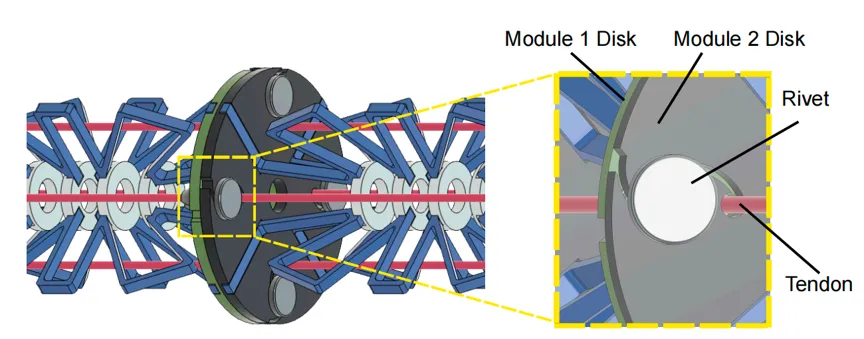
According to the study, the modules can be replaced and rearranged in minutes.


It's important to note that the real rearrangement is not just the parts, but also the degree of softness, transmission capacity and bending direction of the robot's body in different locations.
03.
A set of modules, spliced into three completely different bodies
In order to verify that CRAFT is not only applicable to a particular robot, the team designed the same set of modules and built three completely different systems of form and task.
The first body, stretched into the wings of the aircraft.
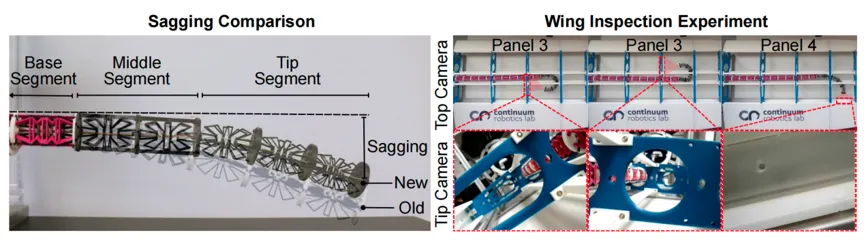
It is an 816 mm long steering continuum robot used to check the wing rims and wing beams inside the wings. In the original configuration, the mid-section uses a mid-rigidity module and the end uses a low-rigidity module. After the robot level is stretched, the mid-section and end are reduced by about 55 mm in total under self-weight.
The team did not replace the drive unit, nor did they modify the roots, circuits, and control interfaces, only replacing the middle segment with a single-directional rigidity module and converting the end module to a fixed rigidity module. In this, the size of the end module was parameterized to accommodate the resistance to gravity and curvature range.
Under zero thrust, the deceleration rate of the robot decreased from about 55 millimetres to 33 millimetres, reducing it by about 41 per cent. The scope of inspection was extended further by the third inner section of the previous wing to the fourth section.
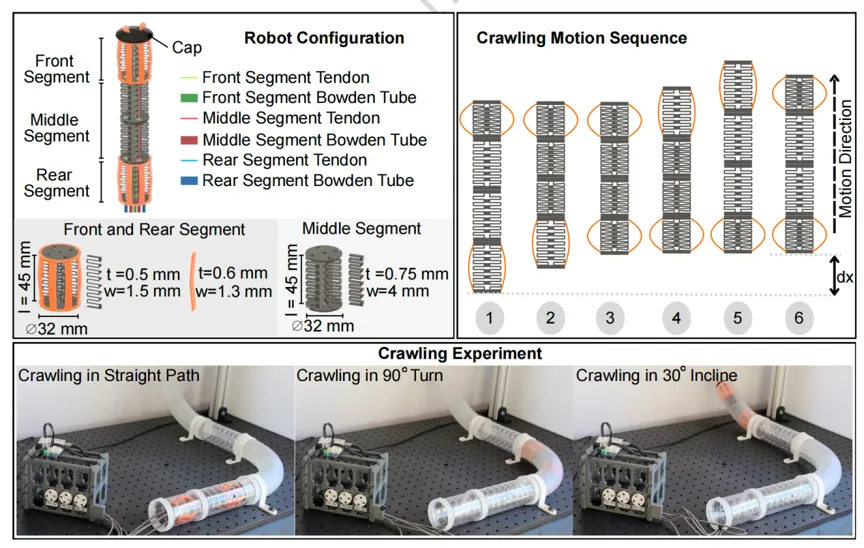
The second body was used to drill pipes.
The team will combine scalable modules with harder power modules, allowing robots to shrink and stretch in a scalar-like manner.
The experimental pipeline was 50 mm in diameter and 826 mm in length, and contained straight tubes, 90° pipes and 30° slopes, all of which were passed by robots.
In a representative experiment, it had an average speed of about 1.2 mm/s in a straight tube; about 1.0 mm/s after entering a 90-degree tube; and dropped to 0.53 mm/s when climbing a 30-degree slope.
It is not fast. However, it does not use active shape control. Instead, it keeps the body smooth and turns the pipe passively. The paper positioned it as a proof of concept and has not yet systematically assessed crawling efficiency and stability.
The third body is responsible for knocking the eggs.
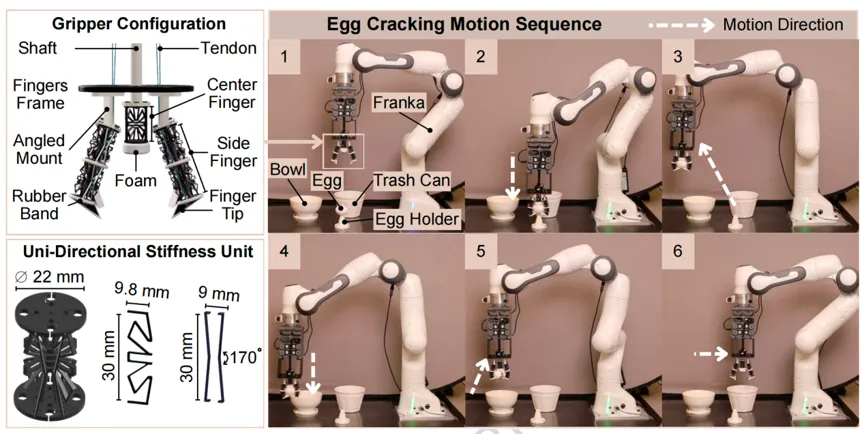
The team shrunk the modules to 22 mm in diameter, using a single-directional rigidity structure to create four bending fingers, plus a central finger that can move horizontally up and down, forming a five-fingered soft hand.
The four fingers gently enclose the eggs on the sides, with the middle finger pushing downwards. This structure can both prevent the eggs from being crushed in advance when grabbing, and can transmit the force needed to knock the egg along the axis.
In 13 consecutive experiments, the soft hand successfully cracked 12 eggs, 11 of which were separated from the egg yolk, with an overall mission success rate of 84.6%.
For the wings to fly, they need to be resistant; for the pipes to be drilled, they need to be stretched; for the eggs to hatch, they need to be both soft and forceful.
It is important to note that this is not the same robot that constantly shifts between three shapes. The three systems are not the same, they replicate CRAFT's modular design, interface principles and manufacturing methods, and scale and reassemble according to tasks.
04.
Single module, printing material costs less than 4 yuan
Another attraction of CRAFT is 3D printing.
The paper's regular-scale blocks mainly use FDM techniques, and the end discs and circles use PLAs, which assume a flexible structure with repeated deformation using a better impact-resistant polycarbonate silicon material. The printing time for 6 class modules ranges from 1 hour to 1 hour and 42 minutes.
According to the Canadian retail consumables used by the team, the cost of printing materials for a single module was 0.44 to 0.68 Ghana, roughly RMB 2.1 to 3.3 Yuan.
Of course, this is just a material fee. Printing equipment, man-made assembly, equipment wear and tear and the entire drive system are not counted in.
However, the low cost of materials still means that trial errors can be made faster. Performance is improper, one is changed. Order is not satisfied, rearranged.
The paper also shows different sizes of samples ranging from 10mm to 40mm in diameter. Larger modules are assembled after FDM printing, and smaller versions can be shaped by SLA processes.
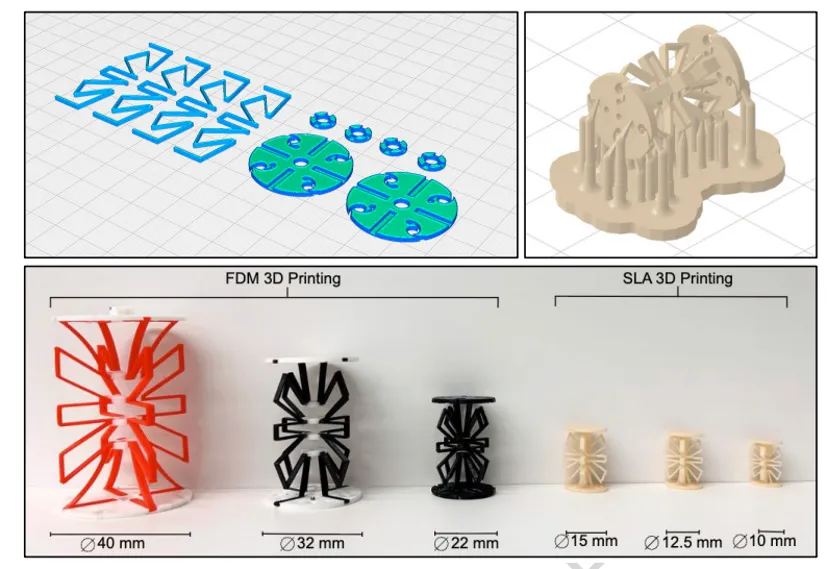
However, shrinking geometric dimensions does not represent duplication of the original performance. After material, printing processes and dimensions change, absolute hardness still needs to be re-tested.
05.
It doesn't mean that you've already earned all your money.
CRAFT is like Lego, but it's not a box of all-encompassing blocks.
To begin with, Curry currently has only 6 classes of pre-set modules.
They cover several distinct rigidity ranges, but do not satisfy any arbitrary mechanical requirements. Users cannot temporarily enter a target rigidity, allowing the system to automatically generate the most suitable modules. If they want to switch between the two types of modules, they still need to manually adjust the thickness, width and length of the flexible structure.
Second, the hardness data in the paper are all from single-sample tests. There are no multiple batches of repeated experiments and no error bars.
Therefore, the numerical values in the table are better suited for comparing which is softer and which is harder and cannot be directly used as a precision engineering design constant.
The absolute values of materials, sizes, printing directions and manufacturing equipment need to be re-labelled, and durability needs to continue to be reinforced.
The team only performed 10,000 bending cycle tests on low-density modules. During the experiment, the maximum force gradually decreased; after the test, multiple cracks appeared in the flexible chain area.
Civilization did position three sets of robots as proof-of-concept samples. They proved that this set of modules is capable of spanning three types of tasks: scanning wounds, moving, and operating, but it does not mean that they are already the best product in their respective scenarios.
So, CRAFT didn't turn a continuous robot into an overnight roller coaster. It really changed the way robots were made.
In the past, when faced with a new task, researchers first designed a new robot. Now, it is possible to open a modular library, which has to be a little soft, where it has to be a little hard, and in the middle add a stretchable structure, like building blocks, to piece together the mechanical properties of the robot.