In this paper, a team of researchers from seven universities, including the National University of Singapore, Tsinghua University, Beijing University, published the latest open-source OpenWAM, an open-source study of the global action model.
ArXiv:
The main page of the project:https://openwam-official.github.io/
The code is:https://github.com/OpenWAM-Official/OpenWAM
Models and data:https://huggingface.co/OpenWAM
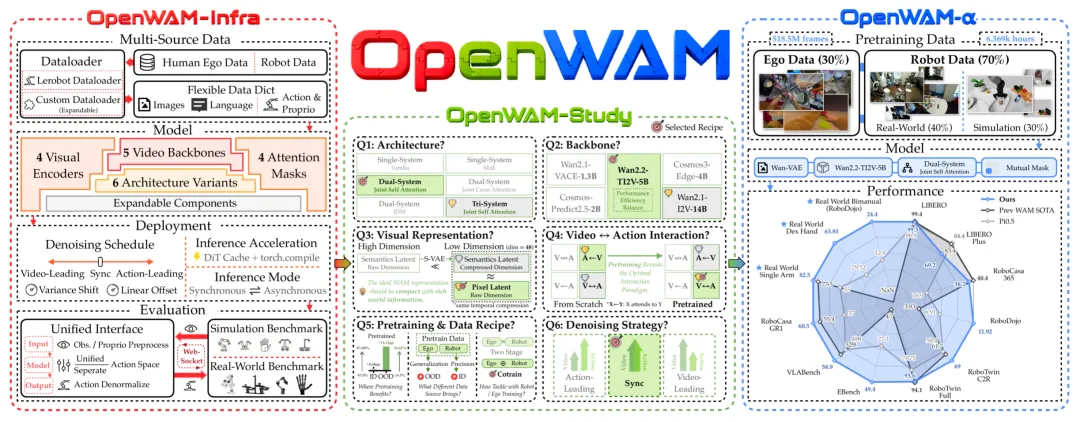
Figure 1 OpenWAM overview: OpenWAM-Infra provides a modular infrastructure, OpenWAM-Study refines design laws, OpenWAM-α validates programs in the first human perspective and on robotic data on a large scale.
When a robot needs to complete an action, it is not enough to simply identify objects in front of it. It also needs to predict how the environment will change and determine which actions will cause the change to happen. Video generation models are good at learning how the world evolves over time, while robot trajectories provide executable motion monitoring.
The core idea behind OpenWAM is to put these two capabilities in the same world action model, allowing the model to understand what might happen in the future while learning how to change the future.
The paper, titled OpenWAM: An Open, Modular Exploration Towards Systematic World, Action Model Pretraining. The research team divided the question into three levels: what knowledge is worth inheriting, how world modeling and action learning work together, and how this collaboration extends across data domains and physical formats. The full text was provided by OpenWAM-Infra, OpenWAM-Study and OpenWAM-α respectively.
Core Conclusion: OpenWAM translates world action models from a compact single implementation to a controllable, replicable experimental system through a modular infrastructure; the results show that adequate generative world leadership, compact and information-rich visual representations, clear world to action information flow, and cross-domain physical pre-training are key to building high-performance WAM.
Why the world needs a model of action
Existing robotic strategies typically learn visual laws and control signals directly from robot demonstrations at the same time. Visual language action models inherit more of the semantic and linguistic knowledge that image text pre-training brings. World action models choose another path: from video generation to pre-training to inheriting visual dynamic precedents and then acting in this world through experiential learning.
This path is faced with a real-world data asymmetry. There are many videos describing changes in the world, but there are relatively few robot tracks that can execute precise action labels. World modeling can complement visual coverage and dynamic knowledge, and action learning can target these knowledge to control targets, but whether the two can truly form a synergy depends on the model structure, information flow, reasoning methods and the common design of data formulas.
The paper divides the problem into three research questions: what world knowledge WAM should inherit; how inherited knowledge builds effective synergy with action learning; and how this synergy migrates between different fields and different robotic forms.
OpenWAM Infra disconnects the study variables
OpenWAM-Infra addresses the difficulty of extending existing systems, the problem of different modules interfering with each other, and defines four distinct interfaces: combinable models, training runtime, deployment runtime, and evaluation protocols. Models are composed of visual encoders, different data stream backbone networks, and a combination of visual attention masks; training, deployment, and evaluation use a unified operating method.
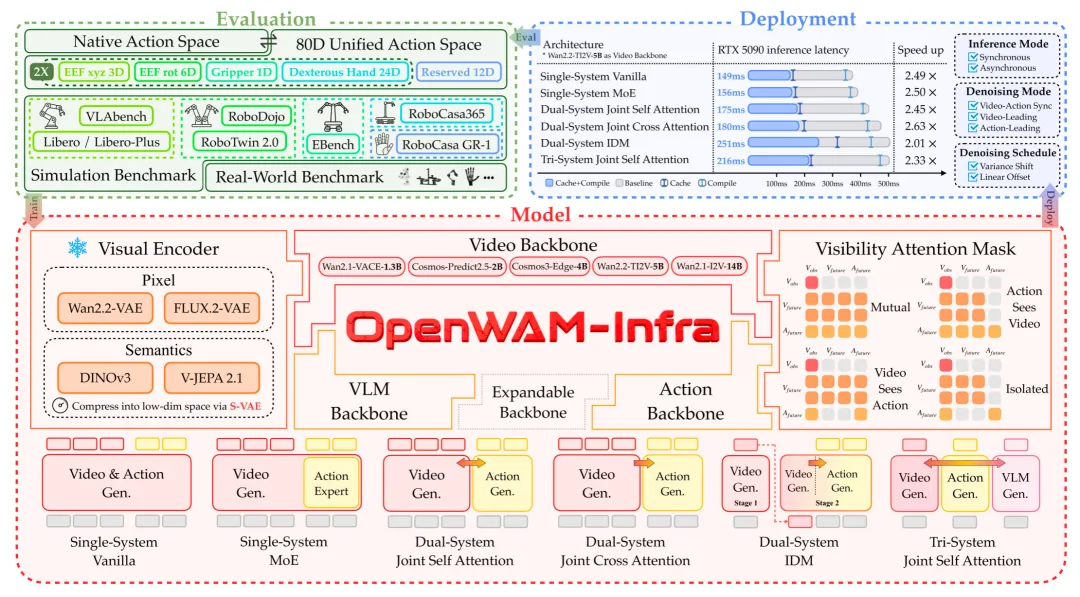
Figure 2 Modular design of OpenWAM-Infra. Visual encoders, data stream backbone networks and visibility attention masks can be independently replaced and combined with single-system, dual-system and three-system architectures.
At the model level, OpenWAM-Infra supports three types of architectures: single-system, dual-system, and tri-system. Single-systems allow video and action to share subjective networks; dual-systems configure video and action backbone networks separately, and then connect through combined self-attention, cross-attention, or inverse dynamics models; three systems add visual language model understanding flows on this basis. Different architectures are assembled by the same set of configurations and registration mechanisms, and trainers and strategy servers do not need to know which structure is currently running.
Unified operation also addresses the details of the experimental landing. Training terminals support pre-training, fine tuning and interrupt retracement, checkpoint preservation of complete configuration, module rebuilding information and movement integration statistics; deployment terminals carry different models with the same strategy server and provide synchronous or asynchronous reasoning, different de-noise schedules and multiple acceleration modes; evaluation terminals use lightweight client connectivity servers to simulate the environment and real-world robots following the same set of input, output and output interfaces.
The current rating protocol covers eight simulation benchmarks, including LIBERO, LIBERO-Plus, VLABench, RoboTwin 2.0, RoboDojo, RoboCasa 365, EBench, and RoboCasa-GR1, including single-arms, arms, mobile operations, and body shapes such as sleek hands.
OpenWAM Study uses controlled experiments to answer three questions
With a unified experimental underpinning, OpenWAM-Study uses fixed training budgets and assessments in RoboTwin 2.0 to gradually compare world precedents, architectural capacities, cross-modal information flows, noise-delaying schedules and physical pre-training formulations. The study does not attribute the results to an isolated superparameter, but follows the sequence of "inheritance, synchronization, synchronization, integration" and brings the conclusions to the next step.
It's time to inherit a strong enough world precedent
The study first compared the four video generating skeletons 1.3B, 2B, 5B, and 14B. As the skeletal capacity increased, the average success rate of WAM continued to improve: Wan2.1-VACE-1.3B was 90.14%, Cosmos-Predict 2.5-2B was 91.64%, Wan2.2-TI2V-5B was 92.39%, and Wan2.1-I2V-14B was 93.79%. Although the 14B model was best, the 5B model was only 1.40 percentage points lower, and training and deployment costs were easier to control, so the default skeletons were selected for subsequent studies. The paper also reminded that the four models were not exactly the same in terms of structure, data, and objectives, and the results illustrated the skeletal selection as important, but could not all be attributed to simple gain factor parameters.
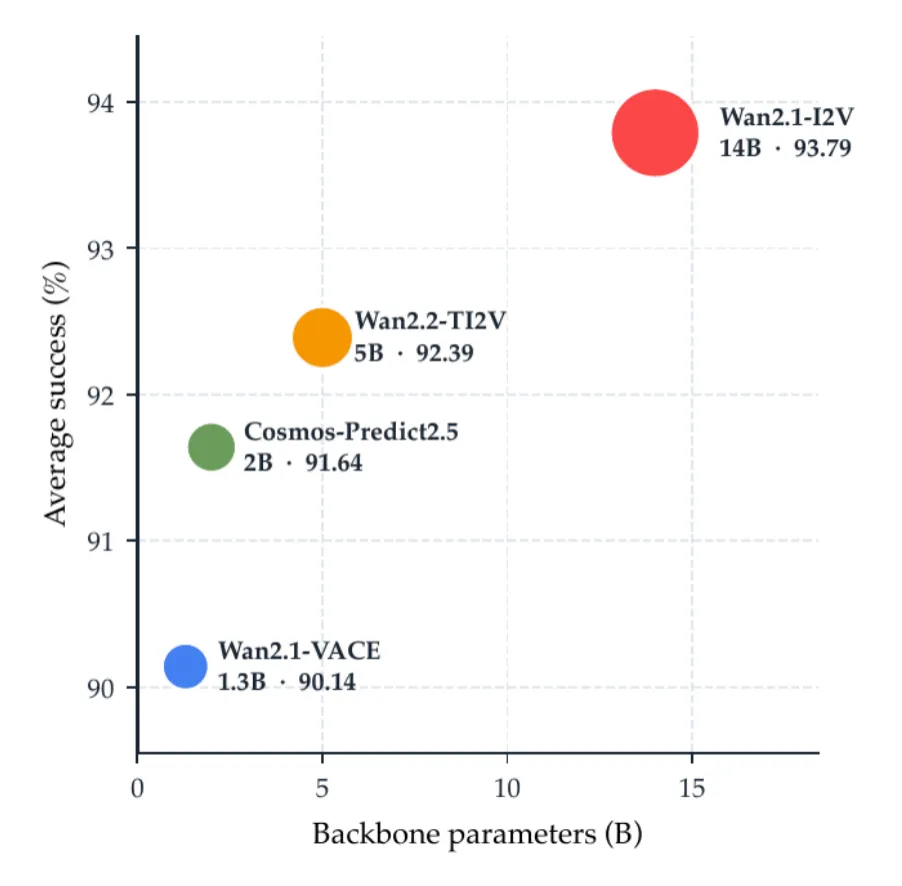
Figure 3 Changes in WAM performance caused by different video generating backbone. Larger generating world precursors typically lead to higher average success rates.
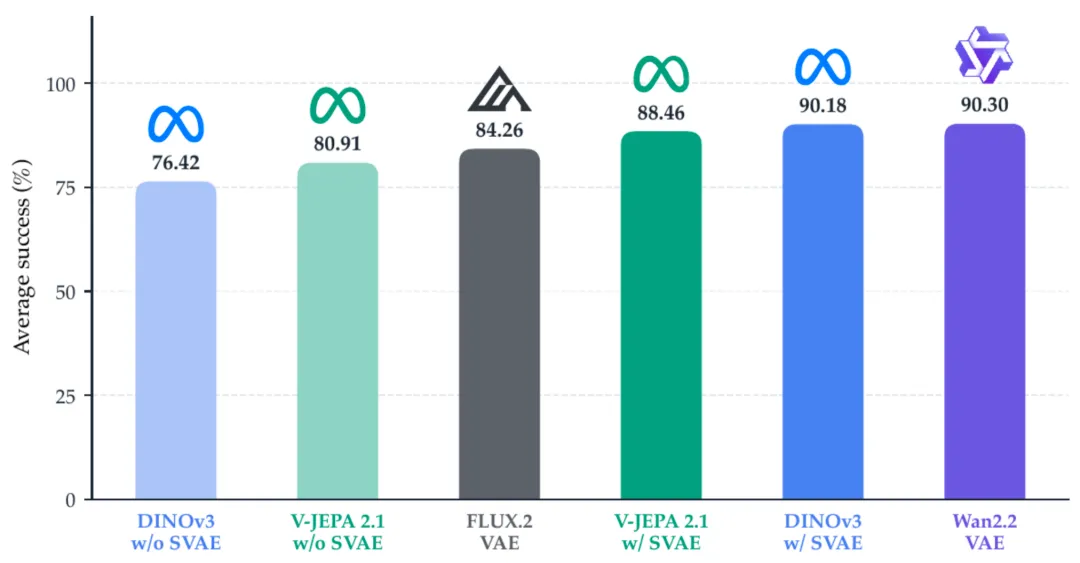
A comparison of visual representation precedents in the OpenWAM Study. After time compression and dimensional contraction, representation encoders can achieve WAM performance that is close to or greater than that of reconstructed encoders.
The visual characterization experiment further explains that the key is not whether the encoder belongs to the "rebuild type" or the "characterization type", but whether the underlying space is compact and retains rich world information. Characterization encoders such as DINOv3 and V-JEPA 2.1 perform less well when they produce high-dimensional characterization directly, but after S-VAE compresses the dimensions to space suitable for DiT processing, performance significantly improves; the results of DINOv3 plus S-VAE are closer to Wan2.2-VAE.
And let the world's information flow into action.
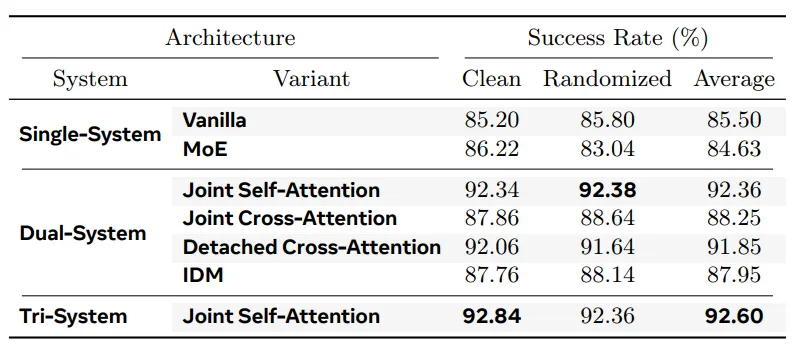
Simply disseminating world flows and movements into the same model does not automatically produce synergy. Structural decomposition shows that model capacity increases from a single system to a dual-system; the average overall success rate increases when the three-system model increases from a single system to a dual-system; the two-system combined attention span reaches 92.36%, and the three-system combined attention span reaches 92.60%. Following the separation of performance, complexity and variables, the study selected the two-system combined attention span as the basis for subsequent experiments.
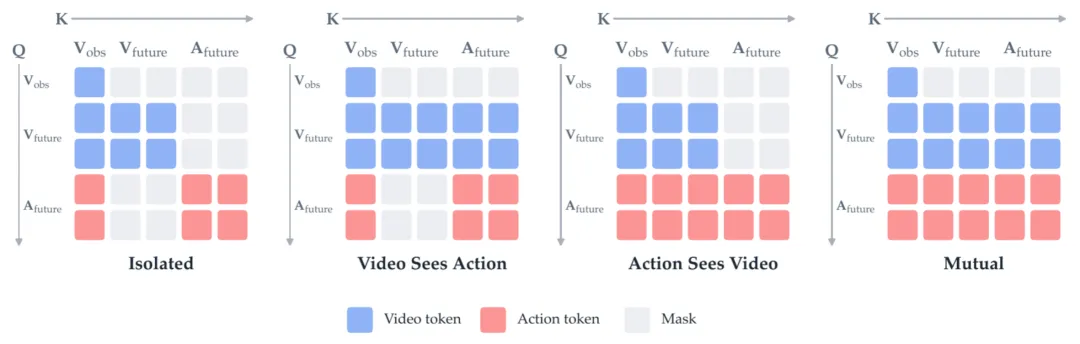
OpenWAM Study problem 2 mapping information flow masking in the training phase. To allow movement flows to see world flows is a necessary condition for effective global movement collaboration.
Information flow experiments provide a more direct answer. In RoboTwin 2.0-Full, the average success rate of isolating masks and "video-watching" is only 87.41% and 87.63%, respectively; the average success rate is 92.39% after the movement stream sees the world; the bi-directional interaction is 92.15%.
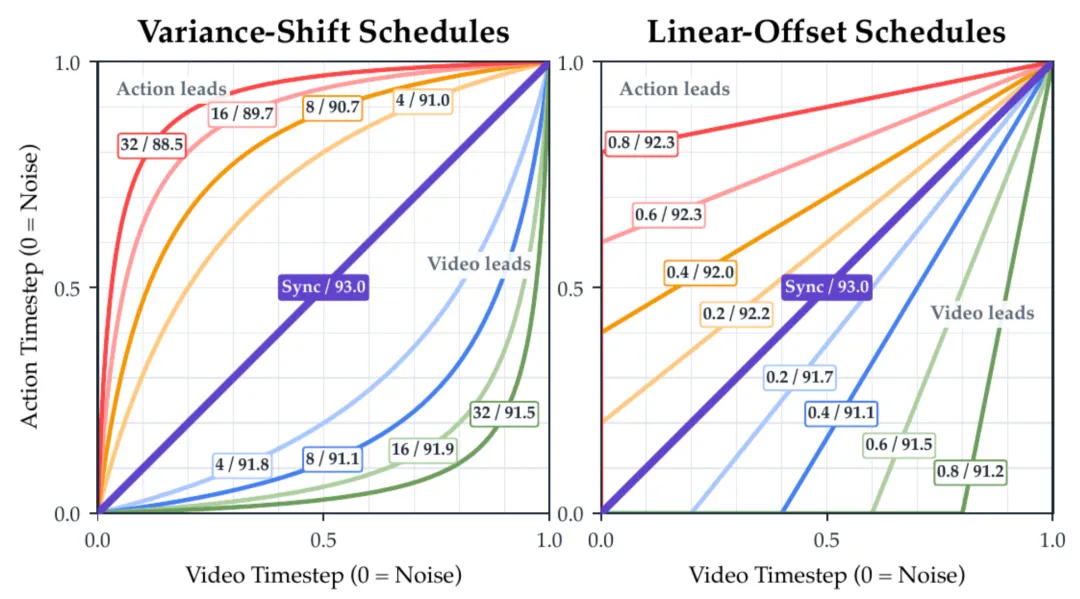
OpenWAM Study Problem 2 Distribution Diagram The reasoning phase of de-noise planning. Simultaneous de-noise advancement along a pair of angles along the combined noise plane, performed best in the experiment.
The sequence of de-noise of the reasoning phase was also included in the comparison. Experiments tested synchronous de-noise and asynchronous de-noise of the video stream or motion stream leading, and the results showed that synchronous de-noise performed best, with no asynchronous de-noise stability greater than the synchronous scheme. The second principle is derived from this: when training, a clear world must be established to the flow of motion information, and when reasoning, the synchronous de-noise of the world and motion should be maintained.
Physical pre-training mainly promotes out-of-distribution generalization
The third group of experiments extended the problem from a single task area to cross-domain hardware pre-training. Under the same 600-hour budget, the study compared zero-start, only robot data, first-person perspective and first-person robot data, and human first-person perspective with robot data single-stage synchronous training. The results showed that pre-training improved performance within the domain relatively limited, but significantly improved distribution performance under the Clean2Random setup: from start OOD success rate was 14.50%, robot data pre-training was 23.80%, pre-human robots was 26.50%, and human-robot synchronous training was 26.6 to 2%.
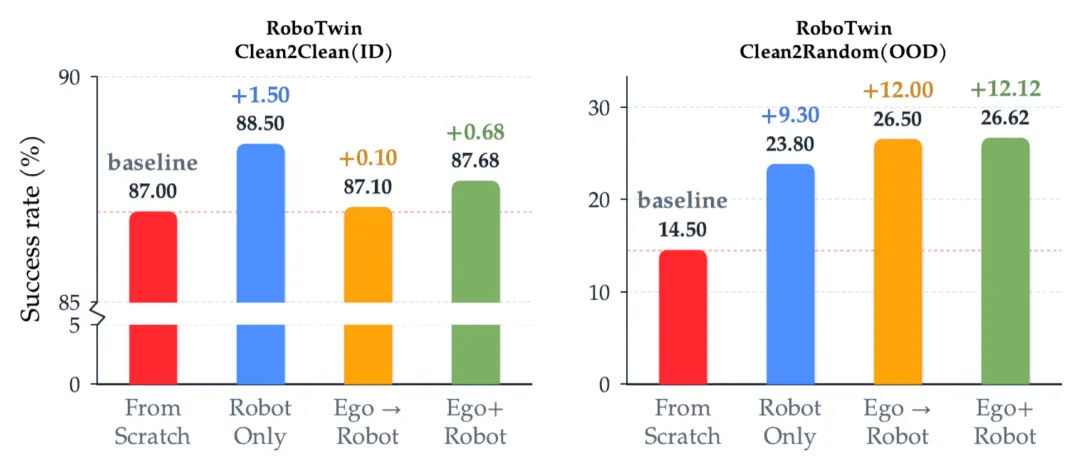
Figure 4 Physical pre-training mainly improves out-of-distribution generalization. Success rates in the domain change less, while in unprecedented randomization scenarios the improvement of pre-training is more pronounced.
Both types of data play a role. Robot trajectories result in executable motion grounding, so that robot data pre-training performs better within the domain; human first-person video results in a wider distribution of vision and interaction, so that the distribution of mixed strategies is better generalized. Single-phase synchronous training approaches the results of interphase training, but the former is somewhat superior and avoids switching additional training phases to become the default choice of the final program.
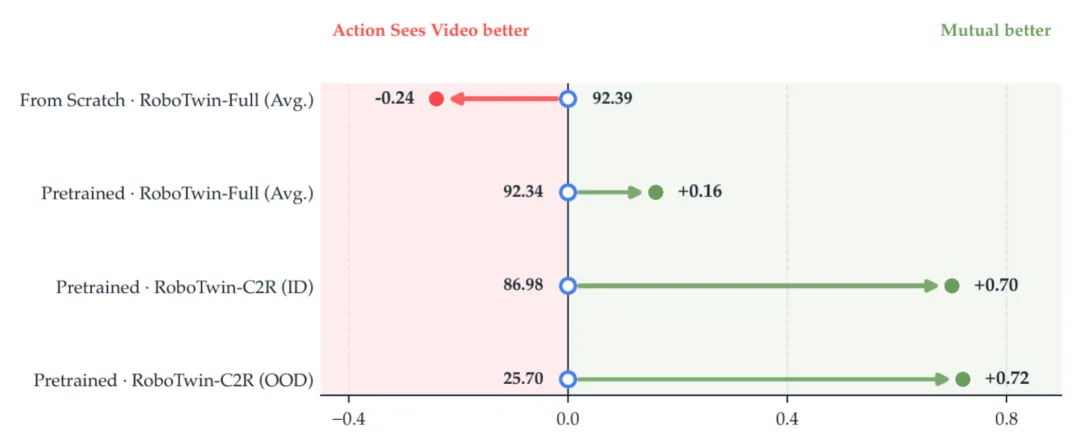
Figure 5 Physical pre-training changes information flow preferences. After pre-training, bi-directional interaction is improved from a one-way world to action in multiple settings.
OpenWAM Alpha extends the rules to mass pre-training
OpenWAM-α will combine the above conclusions into a publicly available basic world action model. The model uses Wan2.2-VAE as a frozen visual encoder, Wan2.2-TI2V-5B as a video stream backbone, and configures an ActionDiT processing action flow with a 1B parameter.
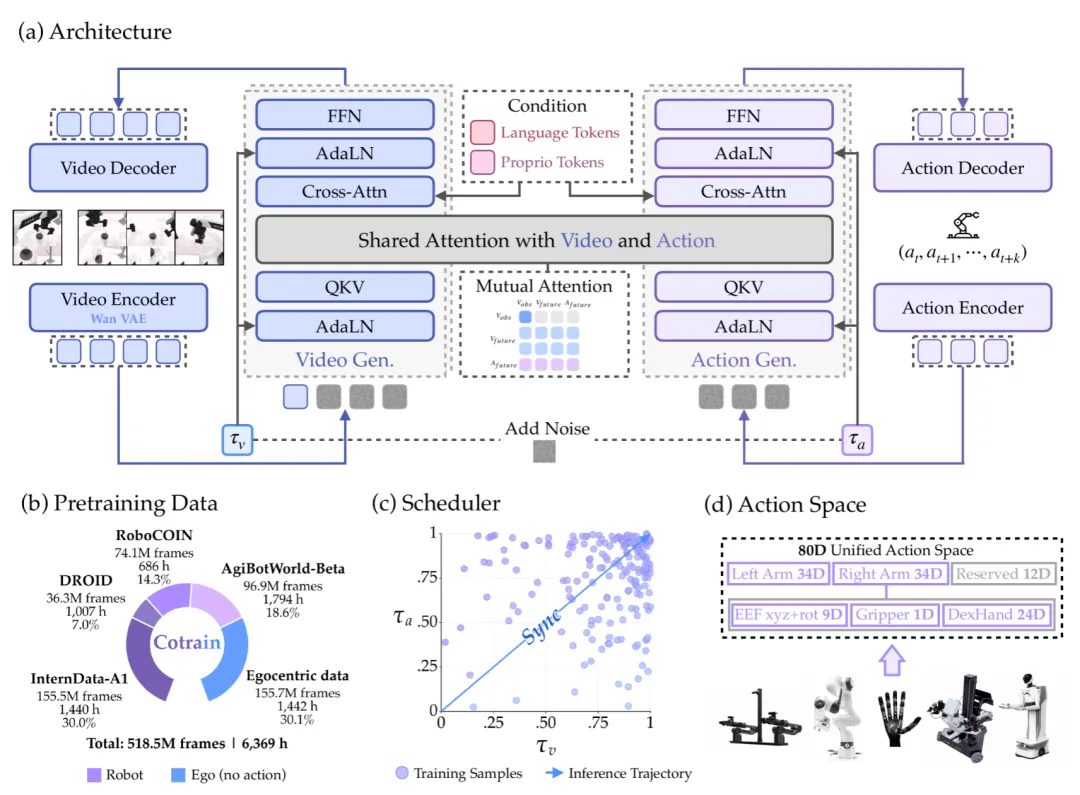
Figure 6 OpenWAM-α's architecture, data and training reasoning schemes. The model predicts future visual states and movements together in a unified action space and makes noise along parallel angular lines during reasoning.
In order to allow different robot formats to share a single action head, OpenWAM-α uses an 80-dimensional unified action space: 34-dimensional arm blocks of two lenses, each containing an end position, 6D rotation, claw and clever hand path, and 12 reservation slots carrying specific channels such as a mobile dashboard. Each dataset maps its own motion and state to a fixed-dimensional position, with unused dimensions not participating in training via an effectiveness mask.
Pre-training data comes from five sources: human first-person video, real robot data, and synthetic robot data. The original data is about 13.33 billion tonnes, about 14,300 hours; after visual quality screening, robot signal cleaning, and source sampling, the actual training is about 5.185 billion tonnes, about 6,369 hours. The data is composed of: human first-person data is about 30%, synthetic robot data is about 30%, and trivial real robot data is about 40% combined. Human data contains 7.16 million long-term first-person records, covering 3,006 class daily operations tasks; real robot data covers 17 physical platforms.
When deployed, OpenWAM-α uses synchronous reasoning and 10-step combined noise. With fixed shape compilation, CUDA Graph, speed caching, prompt embedded caching, and VAE decoding across control paths, a single action block is completed in about 170 milliseconds on RTX 5090.
Simulation performance on the benchmark
OpenWAM-α is rated on eight simulation benchmarks, covering five categories of body shapes. The paper reports that it ranks first on LIBERO, VLABench, RoboTwin 2.0-Full, RoboCasa365, and RoboCasa-GR1; achieves its current best on the mobile-arms benchmark EBench, with SR and Score leading second by about 4 percentage points; and on RoboTwin 2.0-Clean2Random and RoboDojo, although it still has a gap with the best VLA, both are the strongest performers on the WAM method.
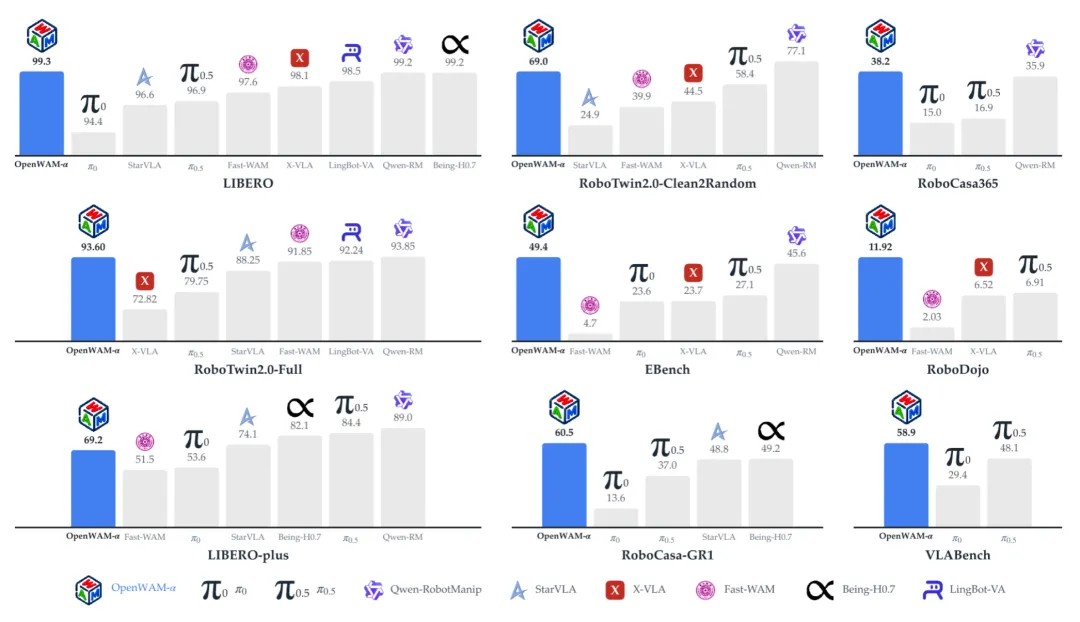
Figure 7 OpenWAM-α compares scores on eight simulation benchmarks with the representative VLA and WAM methods. Each panel marks the actual score, which is easy to read by the benchmark.
LIBERO-Plus is an exception that deserves a separate explanation. The decline in OpenWAM-α is mainly focused on camera and noise disturbance, as well as background and layout disturbance. The paper summarizes the reasons for this in two ways: first, the limited proportion of data in pre-training data that approaches single-arm disruption testing, and second, that long-term predictions on the pixel sub-space are more sensitive to changes in viewing angle and noise.
The paper also compares VLA to WAM. The overall success rate is not entirely one-sided: WAM with future video sub-variable monitoring makes it easier to match training distributions on in-distributed tasks; VLAs that do not undertake long-term forecasts are usually more robust in out-of-distributed disturbances. Both types of deficiencies are data-related, rich enough to cover environmental changes and pre-training data with accurate action-labeling, while being able to improve adaptation and generalization.
True robot verification
Further experiments were carried out in three real-life robotic shapes: the Franka-Research-3 single-arm platform, the RoboDojo two-arm platform, and the Wuji Flexible Hand and Tianji mechanical arm agile operating platform. The single-arm experiments included three types of stacking, crawling, placement and hanging tasks; the two-arm experiments covered the three ARX X5, Piper and Piper X platforms for a total of 18 tasks; the Flexible Hand experiments tested the interaction of the two arms, long-time tasks and precise operations.
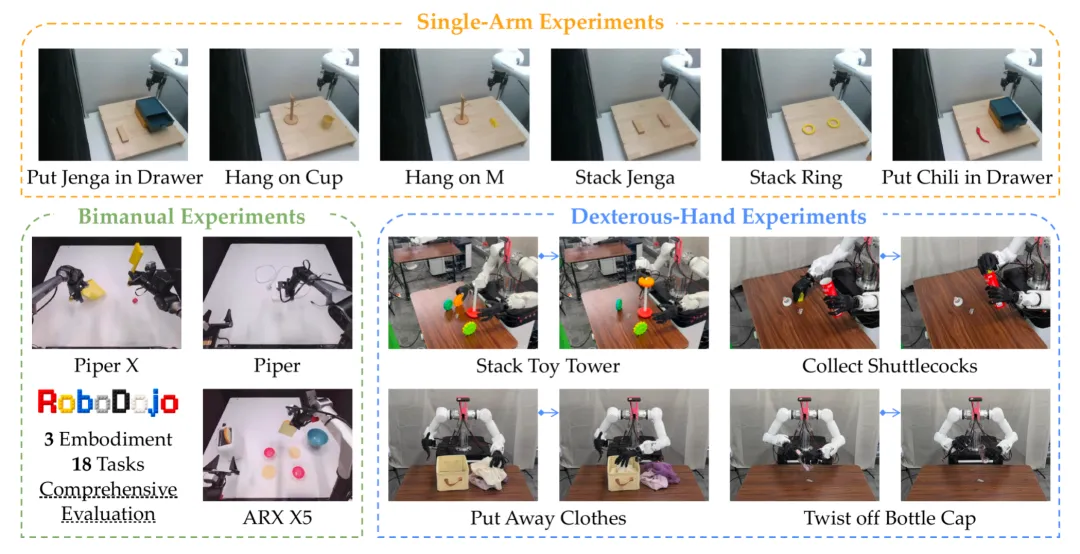
Figure 8 Setup of three types of real robot experiments. Above is the Franka-Research-3 single-arm mission, below is the RoboDojo two-arm platform, below is the Wuji hand and Tianji mechanical arm mission.
In single-arm experiments, OpenWAM-α's six missions had an average success rate of 82.5%, up from LingBot-VA's 77.5% and π0.5's 55.0% respectively. Of these, the two "putting bricks in the drawer" and "putting bricks in the drawer" achieved a 100% success rate. On the real-arm RoboDojo track, OpenWAM-α's overall average score was 37.6, and the average success rate was 24.4%, reaching the current leading level on all three platforms and most missions.
Flexible hands experiments in particular test unprecedented body shapes. Wuji's Flexible Hand and Tianji's mechanical arm, as well as the 9D terminal posture with 21 Flexible Hand Freedoms, do not appear in OpenWAM-α's pre-training mixed data. After fine-tuning, OpenWAM-α significantly exceeds π0.5 in both in-field and off-field settings for toy tower stacking, pen ball collection, clothing collection, and bottle cap rotor quadrants, indicating that unified movement space and pre-training preconditions can support models adapting to new robotic shapes.
What is the meaning of open study of mushrooms
OpenWAM's contributions are not just a set of model scores. OpenWAM-Infra puts models, training, deployment, and evaluation into a unified interface; OpenWAM-Study uses controlled experiments to convert experience judgment into testable design principles; OpenWAM-α extends these principles to multi-source, multi-domain, and multi-body data. The three together constitute a complete link from research problems, experimental methods, to replicable models.
The paper publishes infrastructure, assessment protocols, pre-training weights and data formulas to provide a replicable common ground for the study of the world's motion models. The study also makes clear that follow-up is still required, with more physical data with precise motion labeling, more compact and robust visual representations for environmental change, and end-to-end design that integrates the advantages of WAM and VLA.