The 2026 UN General Assembly is underway...
When Agent Native became the new mainstream narrative of AI, the industry focus shifted from cloud-side AI infrastructure to edge-side, with the other half of Chinese AI surfacing.
Qwen Intelligence is released into AI phones; AI glasses, AI earphones, AI recording hardware, and native desktop terminals are released simultaneously.
Zhengming, chief product officer of Alibaba Group's Zebra Smart, said: "Compared to smart phones and glasses, the demand for AI, especially Agent, is more pressing, and it will be the best physical smart terminal to experience AI".
A turning point in AI competition
Earlier this morning, the Hangzhou International Exhibition Centre hosted a forum entitled "Agentic AI, the next-generation terminal to grow from the ground up". Eight cars from various brands, including Zhengzhou, Shenzhen, Red Flag, Zhejiang, MG, were parked outside the venue, one of which was the first mass-produced car with the Qualcomm Snapdragon 8397 platform and the Zhejiang Intelligent AutoOmni.
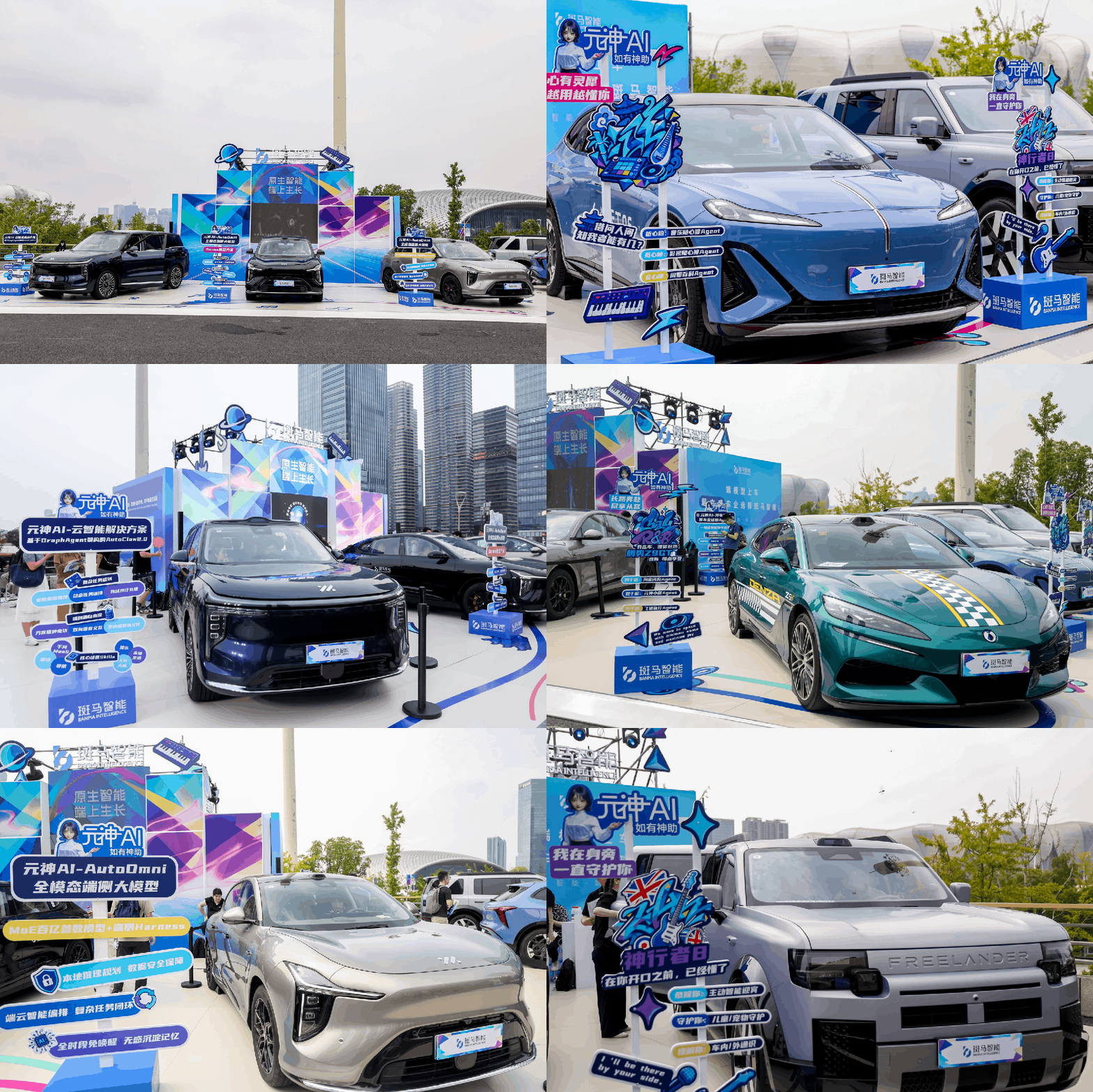
The core highlight of the car is that its smart seat model runs on a vehicle specification chip rather than the cloud. According to the definition of Zema smart, AutoOmni is a full-mode edge-side model series for smart terminals, responsible for listening, seeing, understanding and tuning in the seat.
Two weeks ago, the Ministry of Industry and Information Technology (MoI) released the implementation of the AI + Software Package Special Action Package specifically pointed out that supporting software enterprises with smart phones, smart homes, smart grid connected cars and other terminal manufacturers to jointly innovate, accelerate the deployment of lightweight models and the integration of terminal software, and explore the development of smart system software.
Here, we see a shift in AI competition from national policy to industry choice: the downside of competition is shifting from the ability of cloud models to the edge, where models cannot do things in a stable and secure manner under limited memory, computing and networking conditions.
On September 18, Kangke, Chief Technology Officer of China Information Technology (TSIN) Ltd., released the 2026 China Fiber Intelligent Industry Development Report at the Tata Forum, which presents three key judgments:
First, physical intelligence has passed the technical verification stage and is currently in the value verification stage;
Secondly, the automotive industry is highly similar to physical intelligence in perception, decision-making and execution of underlying logic, the industrial chain is highly versatile, and the automotive industry is a key pillar of the physical intelligent landing industry scene;
Third, the reduction and commercialization of the closed loop will determine the large-scale application, especially in the toC sector.
Conkey emphasized that "smart cars are the biggest testbed for smart cars, a large-scale pressure measurement platform".
The first stage of the big model ride is a model question, the central focus of which is "the connection between the model and the car". The second stage is the system engineering question, which is to be answered after the installation of memory, delay, jailbreak injection and European certification audits.
Today, the first phase's results are happening at the same time as the second phase's difficulties.
AI is in the car, and then what?
Let's take a look at some of the data.
The first group is the penetration rate. According to data disclosed by the Ministry of Industry and Information, in the first half of 2026, the penetration rate of new passenger cars with L2 combined driving assistance capabilities reached 70.5%, with more than 30% of the vehicle loaded with NOA capabilities.
The second group is the pay rate. According to several industry surveys, domestic high-end smart driving pay subscriptions have less than 10 percent overall penetration, and most autonomous brands have less than 30 percent self-driving pay activation rate, while in passenger cars below 200,000 yuan, the pay rate is even less than 2 percent.
It is also worth noting that there is a mismatch between accuracy and willingness to pay. McKinsey's 2026 China Automobile Consumer Insights Report shows that about 80% of respondents view urban NOA as an important option when buying a car; and the results of several research institutes such as Rolandberg show that most users believe that the basic functionality of core intelligent driving and seating should be free of charge.
"The core reason is that the industry has not yet developed a true super-intelligent interaction model". Zema Smart's chief strategist, Liu Yi, explains why paid software conversions are so low.
According to data provided by Zebra Intelligent, from the start of its comprehensive AI transformation in mid-2024, the company has achieved 68% service coverage for mainstream automotive companies and 63% market share in the field of end-side smart and end-model applications.
But the installation is not the same as the use. Zema Smart's chief product officer said: "AI is not the end, it's the beginning of a much more important problem: deep user use".
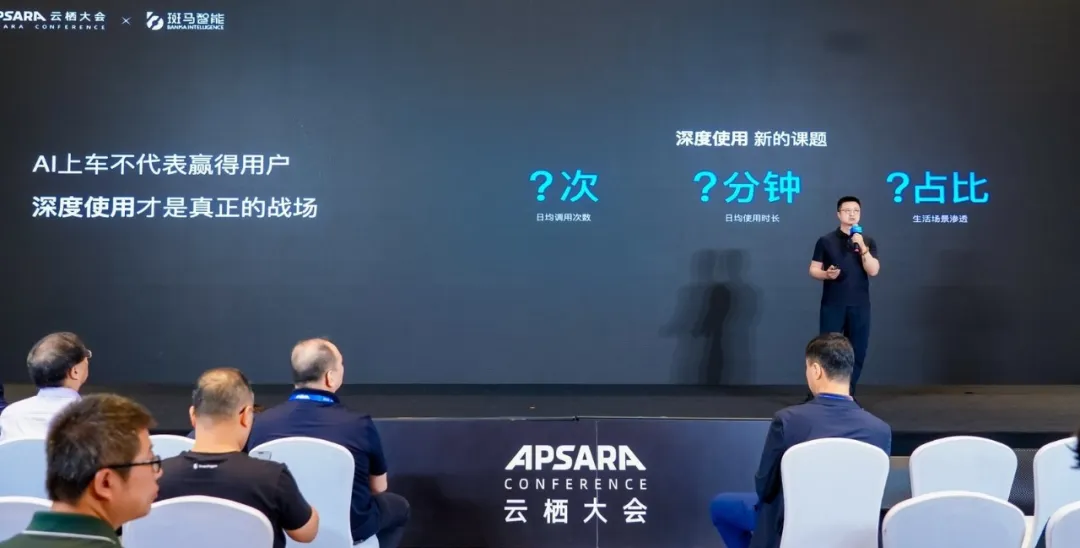
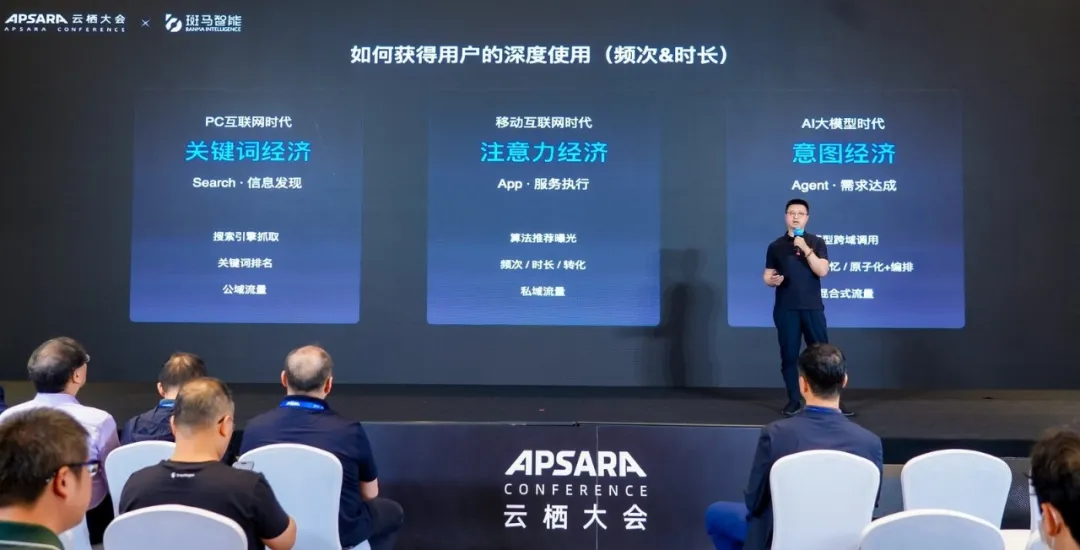
Zema Intelligent's chief product officer, Kim Ming, believes that the core of deep use is that intention-driven AI truly understands "my world", and that this will require an interactive paradigm shift on the end-side, with context and memory connections on the user-centered cross-end.
As a result, the second stage of the competition after the AI boom took place at the intersection of the model and the hardware, namely the edge.
The three walls on the edges of the wall are industrial boundaries.
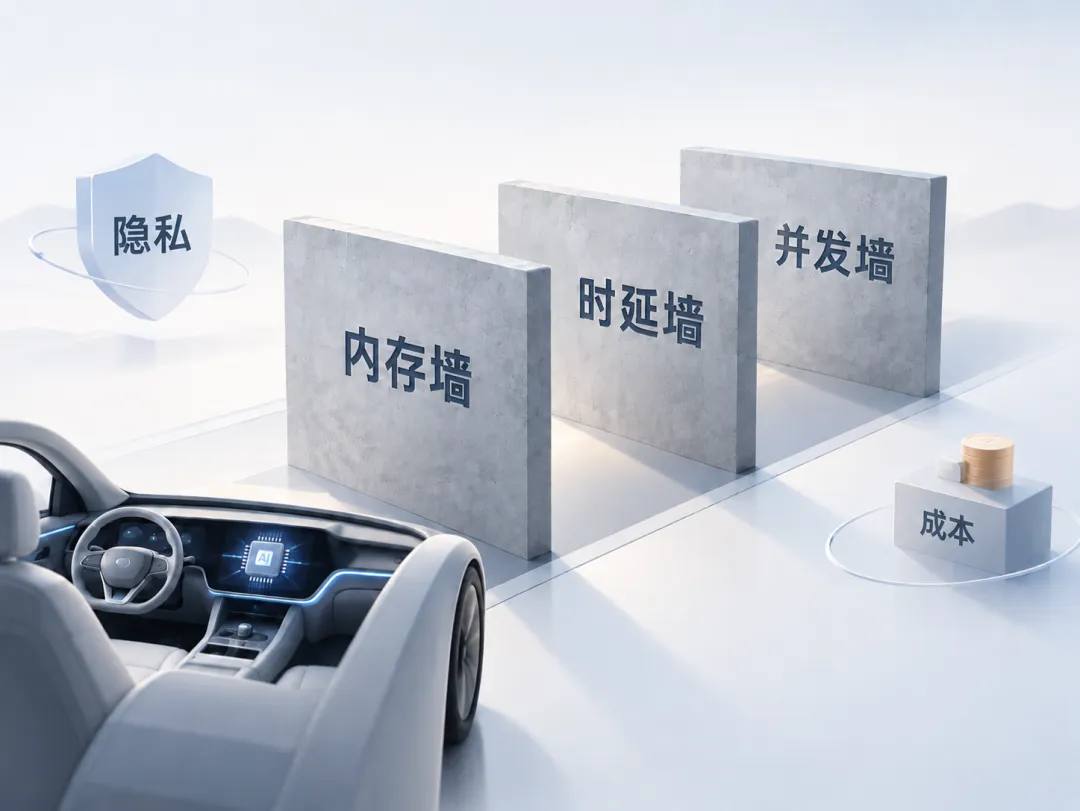
Understanding the edge as "a scaled-up version of the cloud model" is the most common misconception in this field. The edge constraint is not size, but three walls:
Memory wall: The running memory of a vehicle-specific chip is much lower than that of a server and is shared with other processes in the console system. The ability of a model to run is often not dependent on the computational peak, but on the ability of the weight to stay.
Delay Wall: The tolerance of interactions is 100 milliseconds, with active security warnings shorter. Network vibration back and forth in the cloud could eat up the entire budget.
And walls: real seats are not single-task environments, voice, vision, vehicle control, navigation, and music are often online at the same time, and models need to be stable in multi-tasks rather than scoring high on single-task benchmarks.
In addition to these three walls, there are two other restrictions from the industry:
Privacy, speech, images, and location in the seats belong to highly sensitive data, and full cloud computing is no longer available in most markets. Siro judged: "A car is a very important semi-closed scene that needs to protect privacy".
Cost, Agent-era token consumption is a sustained expense, all of which is borne by the cloud, which means that car companies have to pay the long-term bills for each vehicle they use.
Zebra Intel's chief technology officer, Ziro, believes that car owners and OEMs have spent a lot of money on the chip capability of the car itself, and the value of the end model is to release the hardware value of that part, "turning the capability on the end into a token factory on our real end", thereby greatly reducing cloud traffic and cloud token consumption.
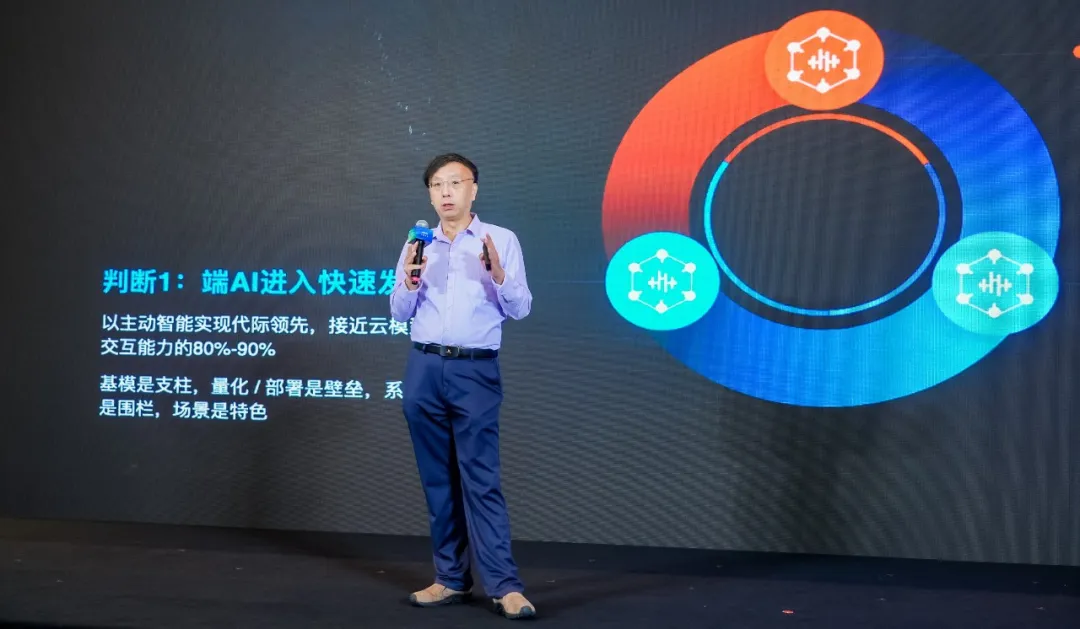
Following these two constraints, Cyrus gives three trend judgments:
End-to-end AI enters a period of rapid development with the rapid rise of end-to-end computing and resources, and end-to-end does not merely migrate cloud capabilities, but differentiate capabilities;
Cloud-side AI moves from a hierarchical small model chain to a larger model-driven one, and the overall architecture of end-to-end cloud integration will emerge in 2026 and then become mainstream;
In 2026, the two systems will be able to communicate with each other in a form that will lead to a model-level integration.
The first is the starting point for this article: the end-side value is doing what the cloud can't do: long listening, long blinking, good memory, thus forming an active service.
This trend has another important significance at the industrial level. It is closer to a level of infrastructure where AI entities such as automobiles, robots and other industries have to pass through the full loop of perception, understanding and execution.
From the perspective of global AI competition and industrial competition, Zema's goal is to build end-to-end AI infrastructure at industry or even national level, the value of which lies in bringing operating systems, end-to-end models, execution frameworks, chip logic and cloud ecology into a mass-produced whole.
The end-side solution may be dilution.
The presence of a memory wall makes the significance of a rare architecture on the edge more important than it is in the cloud.
In the cloud, MoE's primary solution is the economic problem of training and reasoning, i.e. using fewer activation parameters in exchange for larger total parameter capacities.
On the extreme side, the nature of the thing varies greatly, as it determines whether a model can be put into a chip. The total parameter determines the maximum capacity, activating the parameter determines the memory and arithmetic expenses of a single reasoning, and after the two are solved, the extreme side only has the opportunity to obtain the ability of a medium to large model on limited physical resources.
In his speech, Siro summarized the competitive elements of the end model in four phrases: "First, the base model is a pillar, while quantification and deployment at the end are barriers, the system is a fence, and scenarios that can be differentiated are very important characteristics". The four words point to one layer: the base model determines the limits of capability, quantification and deployment decide whether it can actually be installed in the car, the system determines the boundaries of its behavior, the scene determines it is not worth using.
In engineering indicators, the Zema Intelligent end-to-end scheme can be generalized into four things: more, faster, better, better, more than eight routes, more than eight routes, more than five to six times faster, more than 99 percent quantitative accuracy, and less than 50 percent less memory.
Of these, the last two are the ones that best illustrate the nature of end-side engineering. Quantitatization is the inevitable path to end-side deployment, but it costs a loss of accuracy, and the measure of reliability indicators is "how much remains after compression"; halving memory occupancy directly determines whether the model can coexist with the other processes of the assembly.
Prior to this, Zebra's edge-side focus was on the compact model 4B. According to Siro, AutoOmni-4B improved its overall scenic average performance by 20% compared to the larger model in the general area, with a 22 percent improvement in the understanding of the seating text (car control, navigation, entertainment, etc.), a 17 percent improvement in visual-related scenic understanding, and a 122 percent improvement in the understanding of audio, especially emotions and speech, while keeping the overall capabilities in the general area consistent with the larger model in the head.
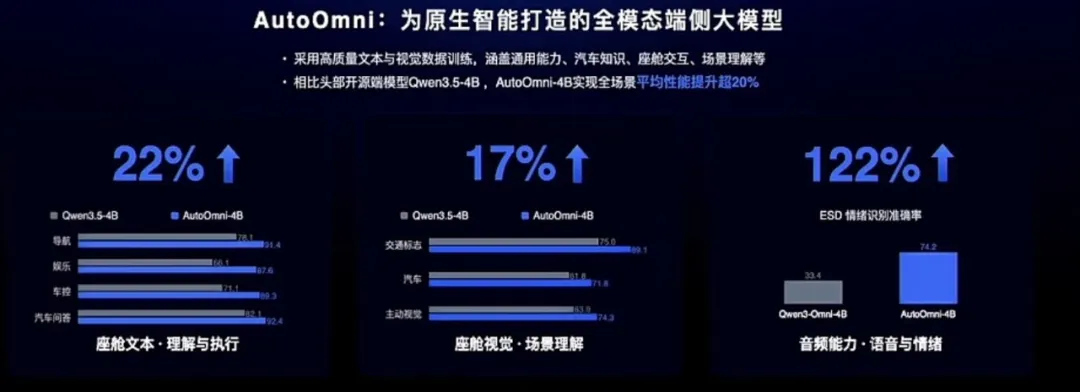
Where is the ceiling of the end model?
4B has a lot to do. In the live video released on the spot, it accomplishes multi-purpose and cross-purpose continuous vehicle controls, and it also operates instant messaging, reads and transcribes messages directly via mobile phone interfaces. But Siro poses a more critical question: where is the ceiling of the end model?
This is exactly what AutoOmni 2.0-23B-A3B has to answer. According to his caliber, this MoE end model with 3B activation is basically equivalent to a cloud side model with 10 times the parameters, and the processing capacity of complex tasks is between 80% and 90% of a cloud model with 10 times the parameters.
The evaluation covers four categories of complex tasks, with end-to-end performance approaching the cloud-side model:
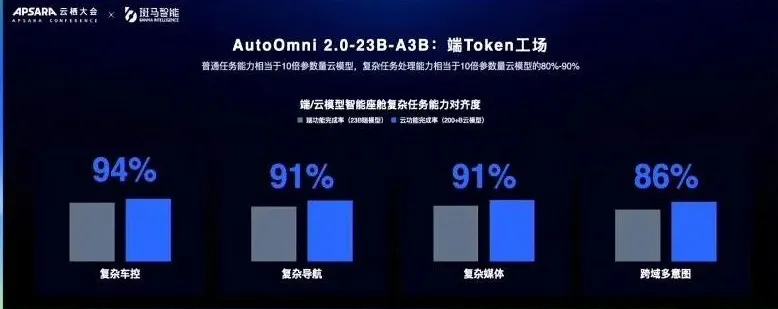
In the live video, a sequence of instructions included adjusting the seat position, opening the front row massages, opening the entire car's ventilation three movements; the subsequent navigation mission was followed by a multi-round addition and re-scheduling of "Go to the Prince's Headquarters", "First connect the Prince's sons and daughters", "Find a nearby gas station and add to the route".
More persuasive than the numbers is Cyrus's statement about the speed of evolution: "Just a month ago, three weeks ago, when I first assessed our own model's capabilities, the gap was very, very large, and my judgment was that we couldn't do a demonstration in a quarter. But in just a few short weeks, through our rapid evolution and improvements in our capabilities, we have been upgraded to very close to a cloud-side model".
A CTO at the site admitted three weeks ago that he had judged "impossible to show" the amount of information revealed: end-model capabilities are improving faster than practitioners themselves expected.
According to reports, Zebra Smart has collaborated with 10 chip manufacturers including Qualcomm, InVeda, Ultraviolet Showcase, and Chevrolet Turing; this path began with the first 8397-seat AI end-to-end program released jointly by Qualcomm in 2025 and Qualcomm in 2026.
End-cloud collaboration with large brain splits
End-to-end reinforcement is not the same as cloud retreat.
The division of Zema's intelligence is the separation of understanding and execution: AutoOmni assumes multi-modal understanding and planning, equivalent to a brain; AutoClaw, System Agent and Harness assumes intent to dismantle; task routing and control execution, equivalent to a small brain.
In his speech, Siro clearly outlined the role of the framework: the end-side model as the underlying end-cloud integrated framework, in addition to model capabilities and the upper-level Harness Engineering framework capabilities, is to uniquely arrange what tasks are placed on the cloud, what tasks are placed on the end, and how data is allocated (e.g. which privacy data must remain on the end, which memory data can be put on the cloud after being summarized).
In this way, end-to-end cloud collaboration is no longer just a vision, but two problems that can be solved in practice: by what criteria are tasks broken down and data stored?
Under this, the Agent Group at the end is divided into branches such as navigation, media, proactive vision, GUI, which are unified by SystemAgent responsible for sub-domains and denial, proactive participation, memory signal extraction, and after-cloud arbitration between the end-side and cloud-side respectively. Memory is layered separately, completing real-time information extraction through the Memory interface, personal information registration and memory enhancement, with SQLite and RAG landing storage at the bottom.
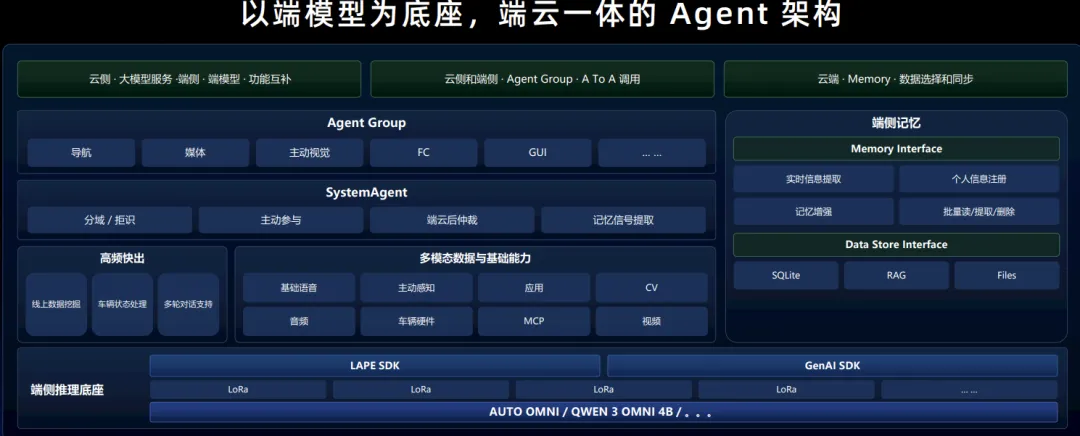
In the video, the two passengers are talking, and the car is always listening, but not making a sound; until one of them says, "It's too quiet outside, you can close the car window", it responds. The driver explains: "It can tell when it's human conversation, when it's human conversation".
While edge memory runs SQLite and RAG, the "my world" is the landing point in the implementation of what Liu Ming says is a layer: the vision is to make AI know every user, the code level is a local database plus a set of searches. According to the figures given by Siro, Zema has now built dozens of active intelligence scenarios with partners, the ability to generalize to "long listening, long observation, good memory".
The role of the cloud is knowledge and complex reasoning. Shen summarizes this set of cloud-integrated architectures into three connections: "First, the connection of computing and services at the end and in the cloud, which is the essence of the supernatural AI; second, the connection of all the smart terminals around the users, all the data and scenarios are opened, and AI can truly fully understand my world; and third, the connection of users and services around all the services can be fully realized across scenarios, cross-end, cross-APP integration and connectivity".
Next step: Push this execution framework to the driver's side
In addition to the seats, Zebra has extended the same set of ideas to smart driving. It is reported that the company is working with the leading smart driver manufacturers, the first phase is to use the seats' natural language understanding and planning capabilities to call on the API interfaces provided by the intelligent driving system to achieve a better travel experience; the second phase is a deeper integration of the seats and smart driving at the model level.
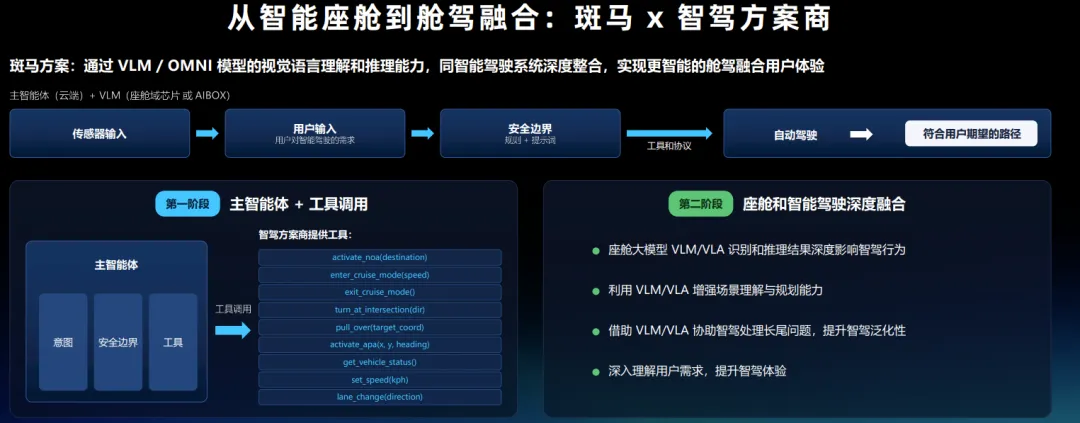
According to the description of its technical program, the link starts from sensor input and user needs, first passing through a security boundary consisting of a rule-added pronoun, and then calling for autonomous driving capabilities through tools and protocols, the intelligent programmer packs the capabilities into activate_noa (destination) ‒lane_change (direction) functions. The second stage, the VLM/VLA recognition and reasoning results of the large-scale model will directly affect intelligent driving behaviour to enhance scenarios understanding and planning, and assist in processing long-tail scenarios.
The most remarkable feature of this design is that the safety boundary is drawn separately into a link. The model is responsible for understanding "a little far from the truck in front", while the system is responsible for ensuring that this understanding does not turn into a dangerous turnaround, which is precisely the form of the execution framework described above on the driver's side.
Security and compliance issues for end-to-end AI
In the end, deploying the model to the car would lead to two problems:
One thing is for sure: after the model gets the executive power, can the system control it?
One way or the other: can this set of things not be recognized by a third party and enter different markets?
The former decides how much AI can do in the car, and the latter decides where the car can go. In Siro's words, "As end capabilities emerge, end safety becomes an emerging critical function".
Putting the uncertainty of the model in the system
"Data doesn't leave" is one of the most frequently cited security arguments on the edge, but it only answers the question of where the data goes, not what the model does in the car. The Agent in the driver's seat has the right to call, navigate, pay and communicate, and a jailbreak or tool hijacking can have serious consequences. Real security is not offline, but keeping data, models and execution within controlled limits.
According to Zema Intel, its AI security system is divided into three layers:
Environmental layers use models to load reliably, to reason process sandboxes, to isolate resources, to force access controls and intrusion detections while running, to ensure that the operating environment of the model itself is isolated and auditable;
The framework layer uses identity transfer and authorization, MCP security protocols, context and memory isolation, risk monitoring and full-cycle auditing, binding on every call Agent makes to tools and services;
The content layer deploys a lightweight security model on the edge, completing compliance testing on the generated side.
At the top of the three layers is a layer of cloud security operations, responsible for training updates of security models, the operation and information security perception of content security strategies, and connecting to the end of the vehicle through a trusted cloud channel. The existence of this layer naturally answers a question: how the end-side security model will respond to emerging new attacks if it is not connected.
The results of the tests are striking: the system has a recall rate of more than 98% of escaped prison attacks.
The cost-effectiveness of the end-side model is more pronounced than the defense effect: in the cloud, the expense of the security model can be absorbed by resilient computing; on the end-side, it has to take in the same amount of memory and computing as the business model and have to feed itself.
Since the scrutiny is all done on the end-side, sensitive data can be scrutinized without uploading, and more importantly, the security scrutiny itself is no longer dependent on the network and will not fail as network conditions change.
Certification is a prerequisite for going offshore
Today, the BMW iX3 and international brands such as the all-new car, Volkswagen, and Porsche have entered China's smart technology system. Siro previously said: "China's smart seats have been ahead of the European and American market in one to two technological generations, with key advantages in the scenery mining, resource integration, and full landing capability of service locks".
Access to the European market has a stringent set of requirements: data on the GDPR side, cybersecurity and software upgrades on the UN R155 and UN R156 regulation side, and driver control assistance systems on the UN R171 side, with the relevant requirements of China's national standards coming into force in 2027.
According to Zema Intelligent, domestically partly based on native Linux-developed intelligent driving models are still unable to fully meet the aforementioned vehicle safety standards, for which the company has developed its own security-enhanced Banma Safety Linux operating system, which has passed the ASIL-B vehicle safety function certification; on the AI engineering side, the company has been certified with ASPICE 4.0 CL2 in January 2026. The standard was developed by the German Automotive Industry Association together with more than twenty major European car companies, and version 4.0 significantly strengthens the adaptation to AI and machine learning.
In the AI industry, certification has long been seen as a process work, but in cars it is an access prerequisite: a model can't get into a car, depending on whether the software engineering system in which it is located can be proven controllable by a third party, which has nothing to do with where it is on the list.
In fact, it also constitutes a landmark example of edge-side technological sovereignty, with the core of the issue being whether the entire chain of trust from core to application can be mastered and proven externally.
It's just the first stop.
Back to the eight cars parked outside the venue.
They represent different expressions of the same judgment: the cloud decides how high China's AI can reach, and the edge decides whether AI can be allowed to do things in the real world. In a speech, Ming said that in the intention economy, "tokens are the fuel AI intends to understand, demand is reached, hydrocarbon is the new currency that meets consumer wants; and this currency is going to really flow in the car, provided that the edge can understand, execute and secure all three things in this closed loop".
Therefore, the edge is increasingly being discussed as an infrastructure. If the cloud's competition is about the height of China's AI, the edge is about its depth and security boundaries, whereas the technological sovereignty will ultimately fall on this layer, in the quantum-produced terminal.
As Siro says, for the entire end-to-end AI track, "smart cars are the largest mid-range testing ground and scale-compression platform with physical intelligence". At the same time, it proposes five constraints on memory, latency, concurrency, privacy and cost, which are repeated in different capacities on mobile phones, goggles, wearables, and robots.
Yesterday's forum delivered a phased answer to this question.