Today, the startup was officially announced on the same day by a group of AI entrepreneurs, including Jiaxing, Jiaxing and Sonia Joseph (a core researcher in the Meta FAIR JEPA team).
Three founders, three completely different racetracks.
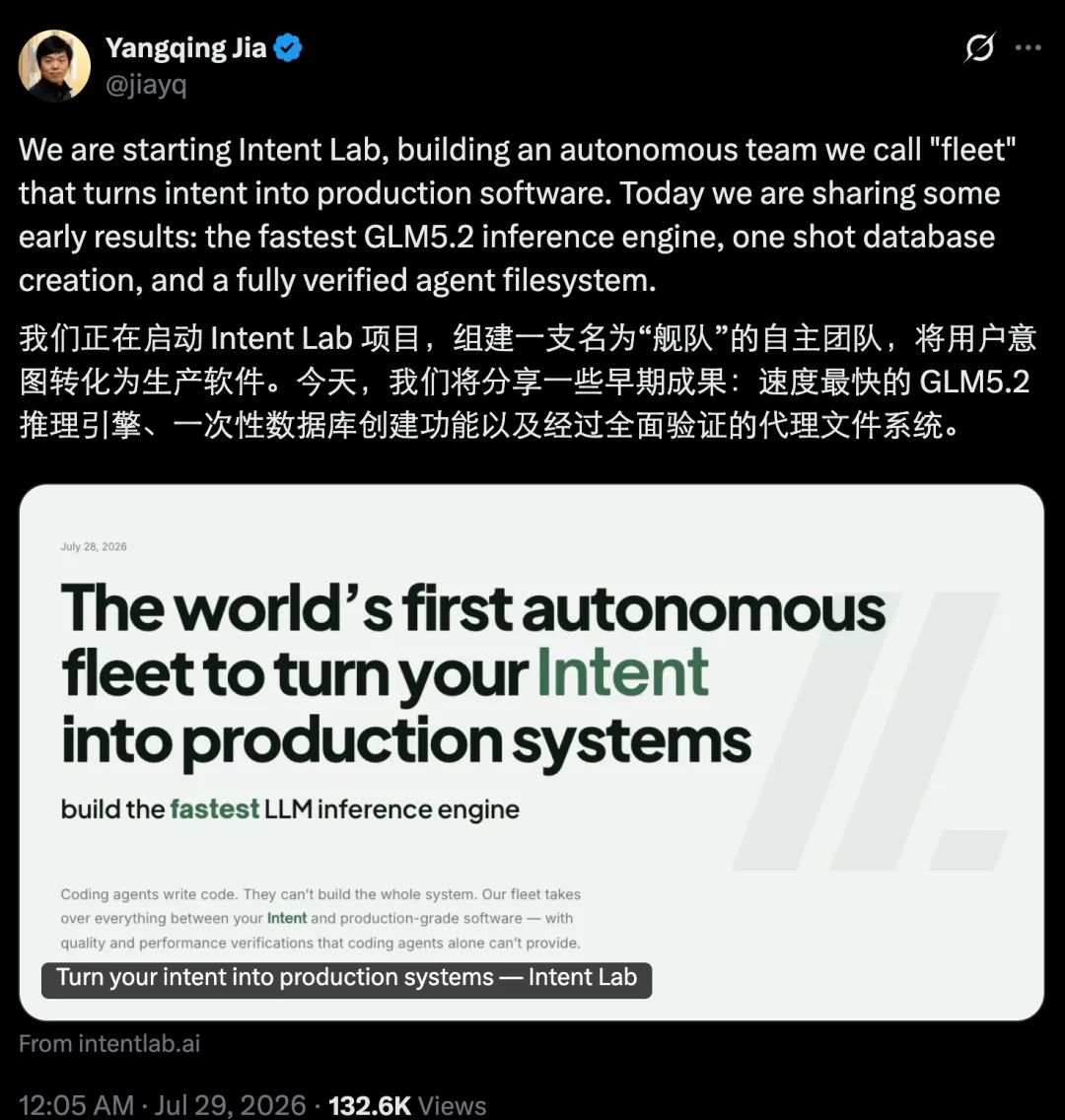
Jiang Qing's startup project is called Intent Lab. What they want to do is not just a stronger coding agent, but a software engineering AI team that understands needs, designs architectures, delivers and continues to evolve, and gives the entire lifecycle of software development to Agent.
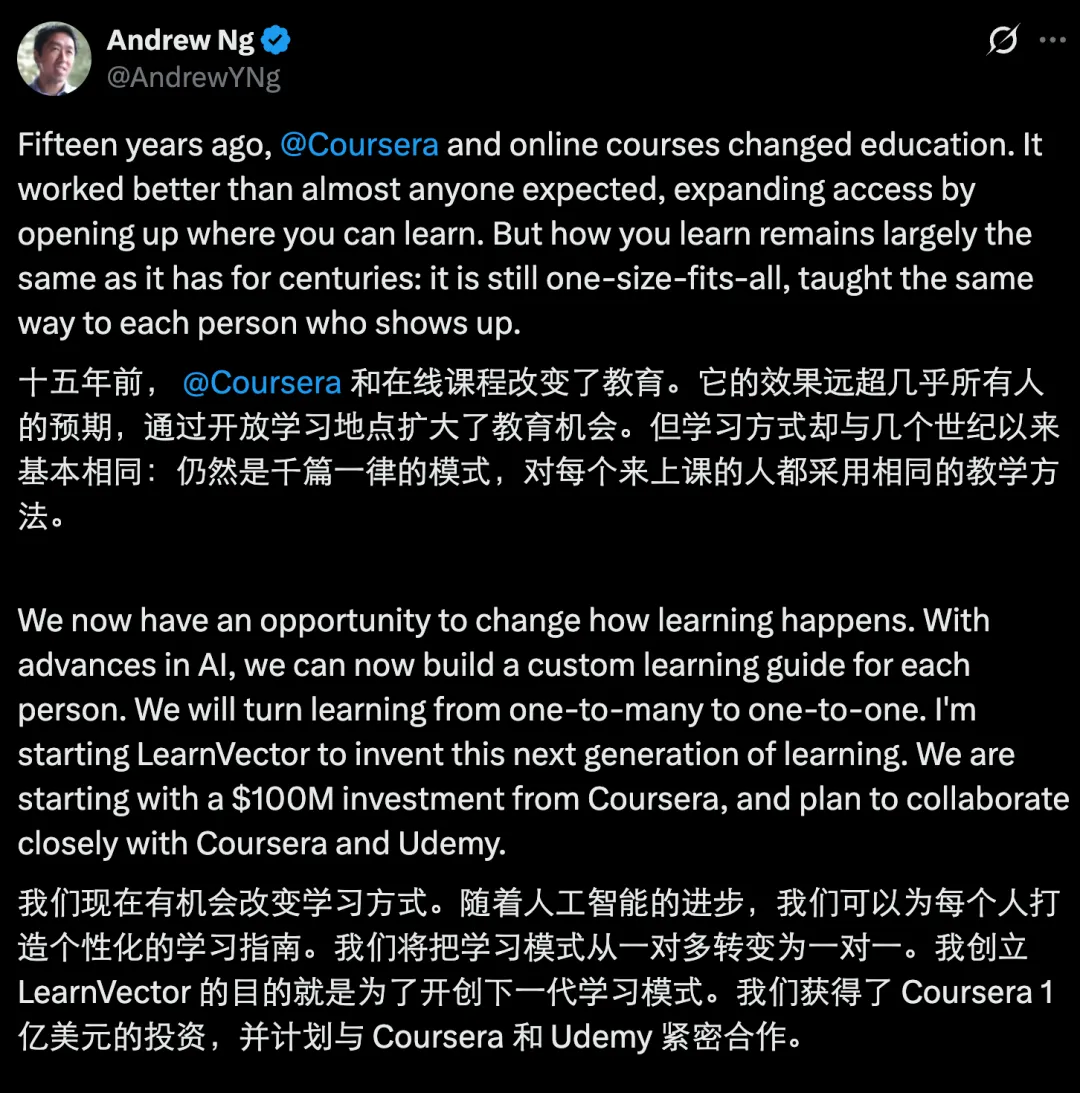
LearnVector, a new company from Honda, is focused on education, and hopes to use AI to break the boundaries of "one-to-many" teaching models, to provide everyone with trustworthy, truly personalized learning guidance, and to transform AI from "giving answers" to "helping them grow".
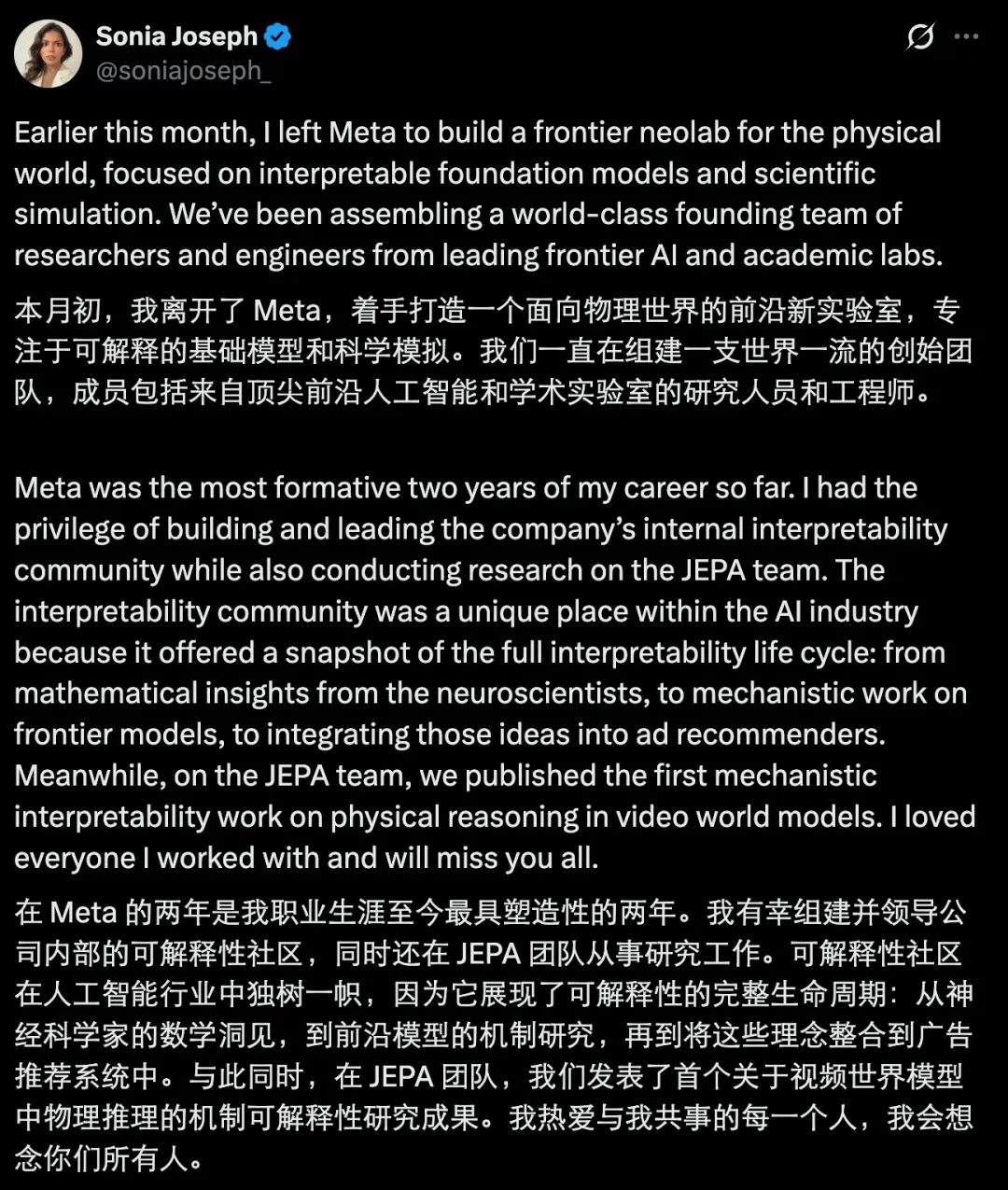
World Mechanics, founded by Sonia Joseph, targets the physical world and tries to build an explanatory basic model for complex systems such as scientific simulations and robots that allow AI not only to understand the digital world but also to reliably understand and predict the real world.
In the worlds of software engineering, education, and physics, the three companies chose three very different entrances, but each represented their team's judgement of the next generation of AI applications.
Below, let's see for ourselves.
Intent Lab: I want to make a request.
To become a software system
Intent Lab's core claim is not to "make another agent that writes more code", but to take over a path that the coding agent does not cover: from a vague Intent to the production-level software landings, including clarifying goals, designing, dismantling tasks, collaborative dependency, implementation, verification, and continuing post-online evolution.
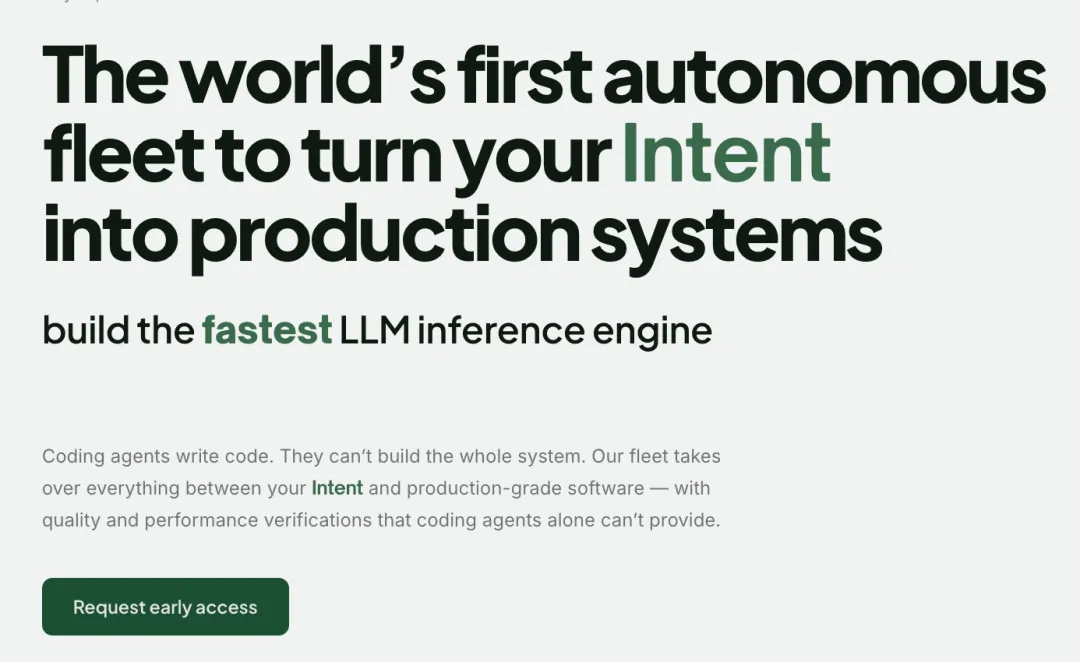
Intent Lab calls it an "autonomous fleet" and emphasizes that coding agents will write code but cannot independently build the entire system; the value of the fleet lies in the addition of quality verification and performance verification, and the closure of intent to production-level software. In other words, it sells not a single code generation, but a "engineering organization outsourcing to agent teams".
To prove that Fleet is not a simple code-generation tool, Intent Lab presents three different experimental cases that correspond to three stages in the software lifecycle: optimization of existing systems, modernization of old systems, and creation of a whole new software infrastructure. These three cases show the same trend: AI Agent is moving from "writing code as an assistant developer" to "taking on a complete software engineering task".
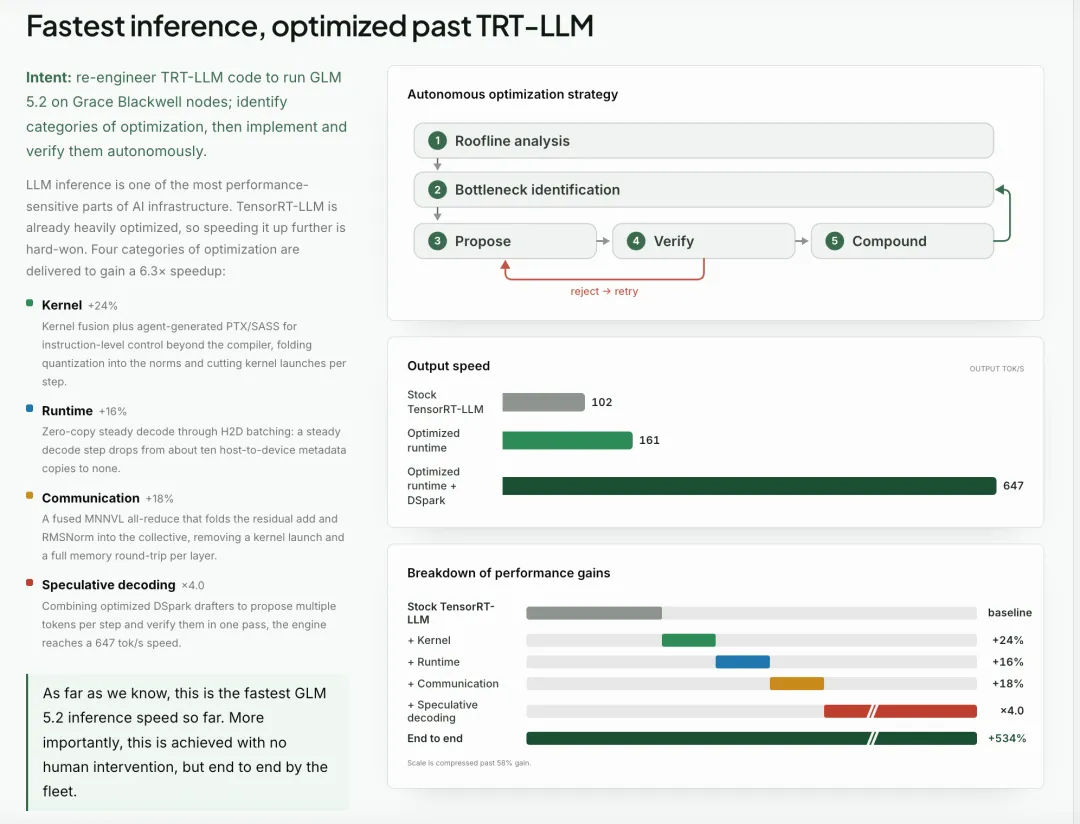
The first example is Optimization: allowing AI to autonomously optimize highly mature TensorRT-LLM reasoning systems.
Intent Lab chose TensorRT-LLM as an experimental object, not because it was easy to optimize, but rather because it was a very demanding challenge. TensorRT-LLM is already a high-performance reasoning framework that has been refined in the NVIDIA ecosystem through a lot of engineering experience, with multiple complex interfaces involving GPU kernels, running time scheduling, and communication efficiency. For human engineers, continuing to improve performance on such systems requires an in-depth understanding of the entire technological framework and a large number of experiments.
Fleet's mission is not to accept the optimization direction designated by the engineers in advance, but to receive only one goal: to redesign the TensorRT-LLM code to make it run faster. Subsequently, the agent completes performance analysis, finds system bottlenecks, proposes optimization solutions, modifies the code, and continuously iterates through verification.
In the process, Fleet found four main optimization directions. The first class is kernel-level optimization, which reduces the extra costs of computing through kernel fusion, generating underlying code such as PTX/SASS; the second class is runtime optimization, which improves operational efficiency by adjusting logical execution processes; the third class is communication optimization, which makes computing chains more seamless by reducing communication and memory exchange costs; and the fourth class is speculative decoding, which improves generation speed by predicting multiple tokens in parallel.
Ultimately, Fleet increased the output speed of the TensorRT-LLM from about 102 tokens/s in the original version to 647 tokens/s, achieving a performance improvement of about 6.3 times. More remarkably, Intent Lab emphasized that the process was not completed gradually by human engineers, but by Fleet itself discovering the optimized space, performing modifications and completing verification. This meant that the AI Agent began to have not only the ability to generate code, but also the ability to analyze, experiment and continuously improve complex software systems.
The second example is Modernization: allowing AI to build a SQLite-compatible database system from scratch.
If the first case is looking for performance breakthroughs on an existing system, the second case faces a more difficult problem in software engineering: how to understand and reconstruct a complex existing system.
In the real world, a large number of enterprise software faces similar challenges. Many core systems have been running for years, accumulating a large amount of historical code and business logic, but lack complete documentation and are difficult to maintain by the original team.
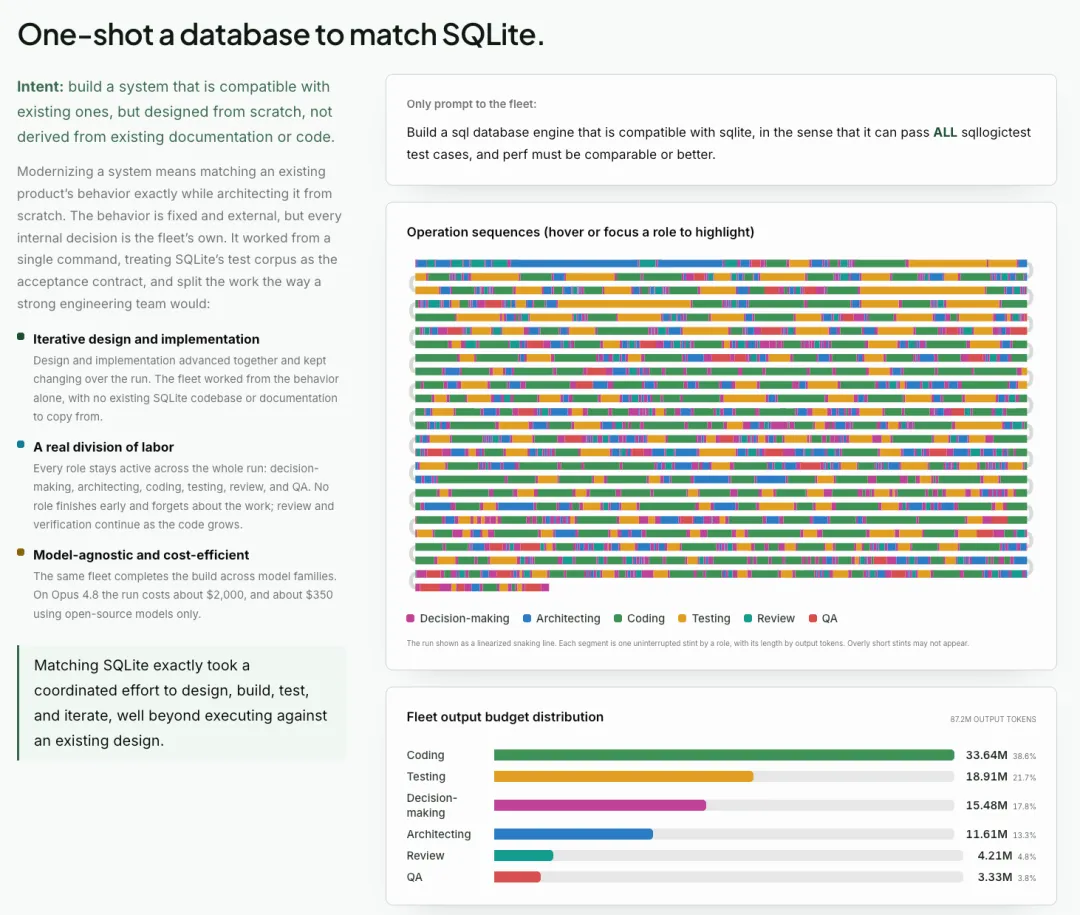
Intent Lab challenges Fleet to a more extreme task: to reconstruct a database engine that is compatible with SQLite by external actions alone, without any SQLite source code, without any internal design documentation.
Fleet's only goal is to build a database system that can be used in all SQLite test cases and that performs at or above the original system.
This means that Fleet cannot simply replicate what has already been implemented, but must, like a real software team, understand the system from its behaviour. It needs to continuously analyze the relationship between input and output, design architecture, implement functionality, and test to see if it meets expectations.
Throughout the process, Fleet has developed a collaborative approach similar to that of a real engineering team: Agent responsible for architectural design, Agent responsible for coding, Agent responsible for testing, auditing and quality assurance. The different roles are not one-time tasks, but continuous collaboration and feedback throughout the development cycle.
In the end, Fleet successfully completed the construction of a SQLite-compatible database. This case demonstrates another ability of the AI Agent: it not only modifies existing code, but is able to recreate a new system with the same behavior by understanding the external behavior of a system.
A third example is Creation: Creating a new distributed file system for the AI Agent era.
The first two cases correspond to "optimization" and "transformation", respectively, and the third case goes further into creation: if future AI Agents themselves become important users of software systems, then the software infrastructure they need may also be completely different from the past.
Intent Lab chose the direction of distributed file systems.
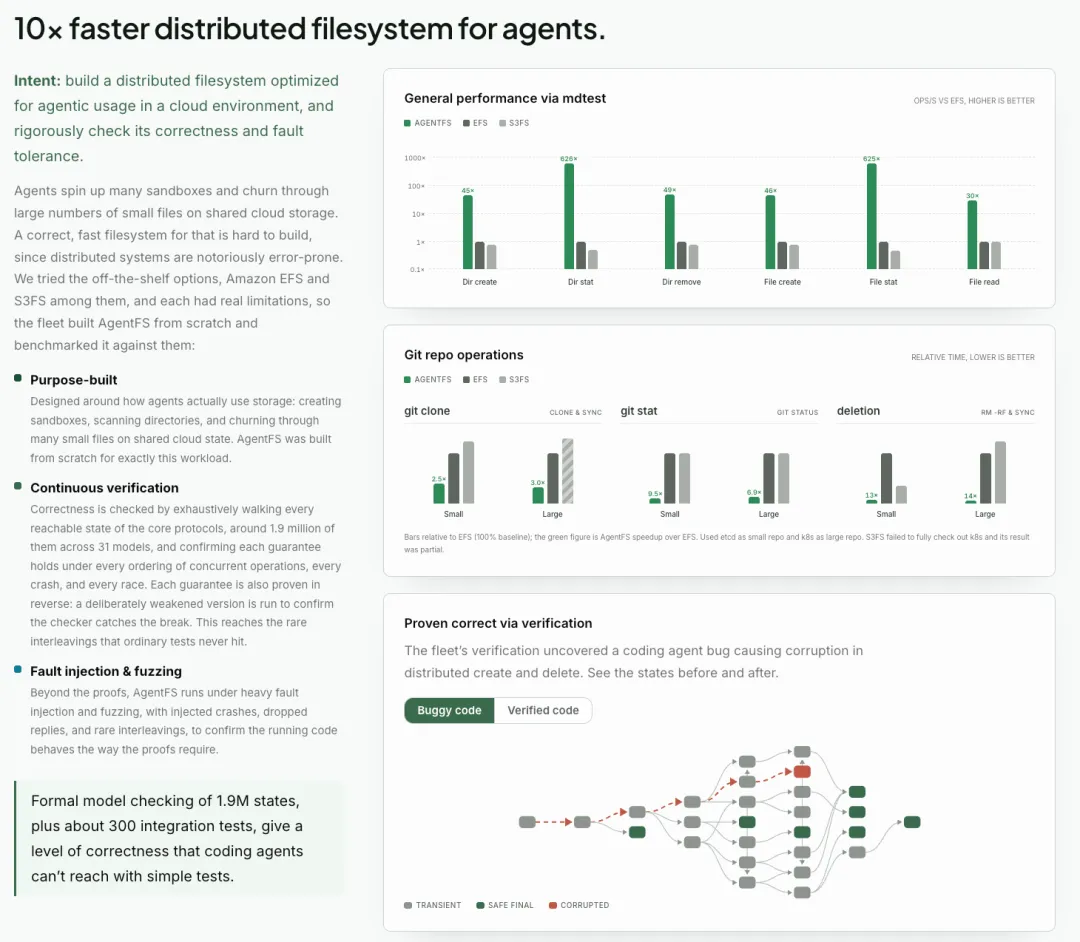
Traditional file systems are primarily designed for humans and applications, but AI Agents work in completely different ways. In the future, an Agent may run a large number of sandboxes simultaneously, frequently create, read, modify a large number of small files, and perform high-intensity data operations in a cloud environment. Existing storage systems such as Amazon EFS, S3, although mature, are not optimized for such Agent workloads.
As a result, Fleet's goal is to design a distributed file system for Agent from scratch.
The system needs to address not only speed issues, but also accuracy and stability issues. Fleet needs to design storage architectures, verify concurrent behaviour, and ensure that the system remains reliable in exceptional circumstances.
Experimental results showed that AgentFS built by Fleet achieved quantitative improvements in multiple file operation scenarios. For example, in some directories and file operation tests, it was upgraded to tens or even hundreds of times higher than traditional programs. At the same time, Fleet also ensured system accuracy through formalized verification, fault injections, and a large number of tests, including checking about 1.9 million state spaces, and running hundreds of integrated tests.
The significance of this case is that it shows a more futuristic possibility: AI will not only help humans develop software, but it may also begin to create infrastructure dedicated to AI.
From TensorRT-LLM optimization, to SQLite rebuilding, and to AgentFS creation, the three cases represent Fleet's three capabilities: it can optimize existing systems, understand and reconstruct complex systems, and create new software from scratch.
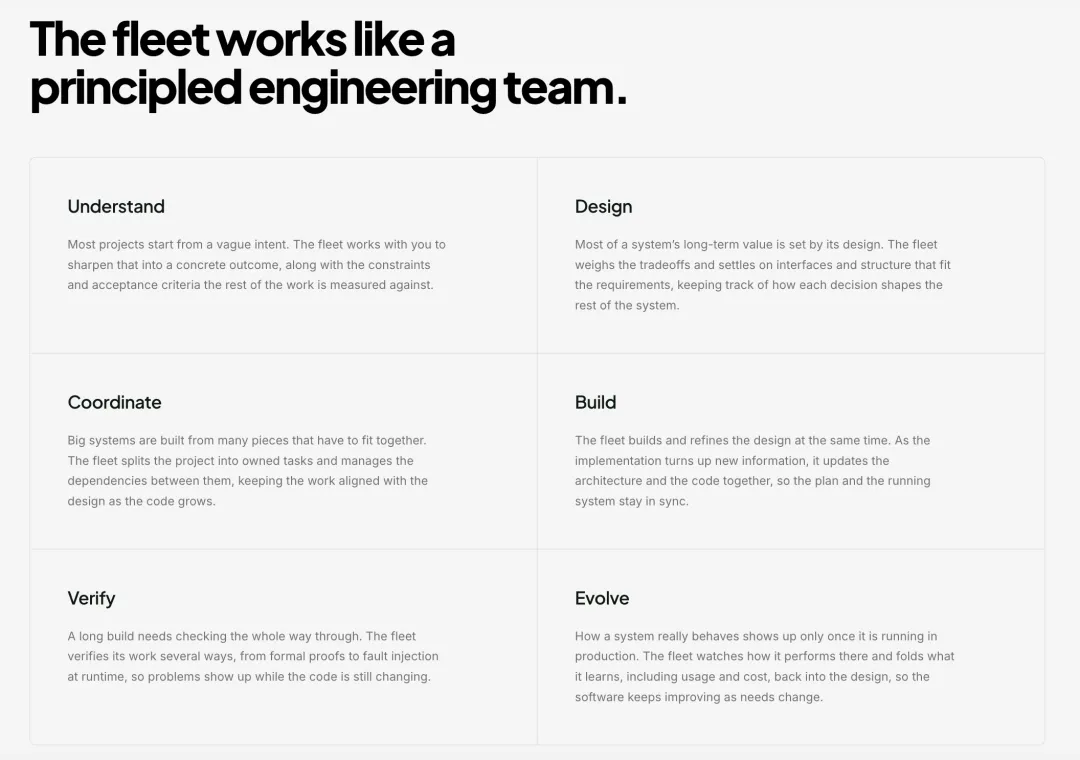
Intent Lab's methodology is summarized in six verbs: Understand, Design, Coordinate, Build, Verify, Evolution.
It's like giving "what you want" to a renowned engineering team:
The first step is not to rush to work, but to make it clear to you what it is, including the limitations that can't be touched, and finally the criteria for acceptance.
The second step is to redesign the interface and how it is structured.
The third step is to dismantle the big and big into a bunch of small tasks for which someone is responsible, to sort out who comes first, who comes next, who depends on who, to avoid fighting each other.
The fourth step is to really move, but not as hard as the dead plan, but to write the code while reversing the scheme according to the new findings, so that the drawings and the running system are not disconnected;
The fifth step, from the start to the end of the runway, is to test it with both rigorous proof and intention to manufacture failures while running, and to make sure that the problem is exposed before it goes online;
After the sixth step is completed, it will look at the performance, usage and cost in the real world and repackage these experiences into the design so that the more the system is used, the more it suits your needs.
In other words, it's your intent and acceptance standards that are responsible for refining vague ideas into programs, dismantling programs into engineering, making projects into systems, and continually testing and changing them before and after delivery.
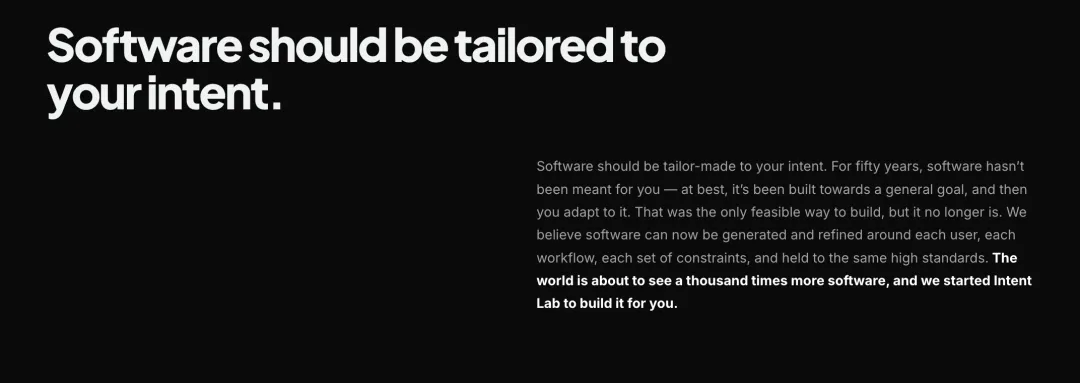
From a vision perspective, Intent Lab is opposed to the default software form of the last fifty years: software is created for a general purpose and users adapt to it. The team believes that it is now possible to surround each user, each workflow, each set of constraints to generate and continuously grind software, while maintaining high standards.
The founding team wrote on their official website, "The world will soon see software grow thousands of times, and Intent Lab is here to build it for you".
Education, AI wants to move from "give answers" to "teach you".
LearnVector focuses on a problem that has existed for thousands of years: good education has never been a scarce commodity. It has long been known that a student who learns one-on-one with a good teacher is more effective than sitting in a classroom with two hundred people, but limited by cost, geography and time, humans can only choose to build a classroom.
What's even more remarkable is that AI has changed almost everything, but only the way it learns: today's learning experience is still "one-to-many". And today's popular chatbots don't complement this lesson.
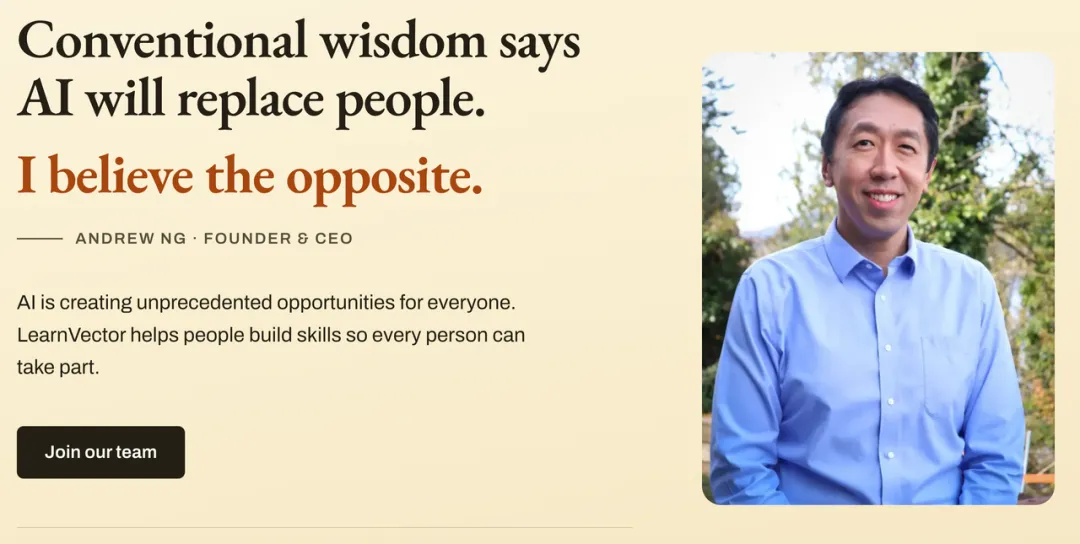
LearningVector's solution to these pain points is a fundamental shift in a learning model:
From "one pair more" to "one pair one", allowing everyone to have their own personal chemistry learning experience;
From "hard work" to "joy in it", make learning something you want to do instead of having to do;
From "occasional for it" to "everyday habit", make learning as natural as instinct.
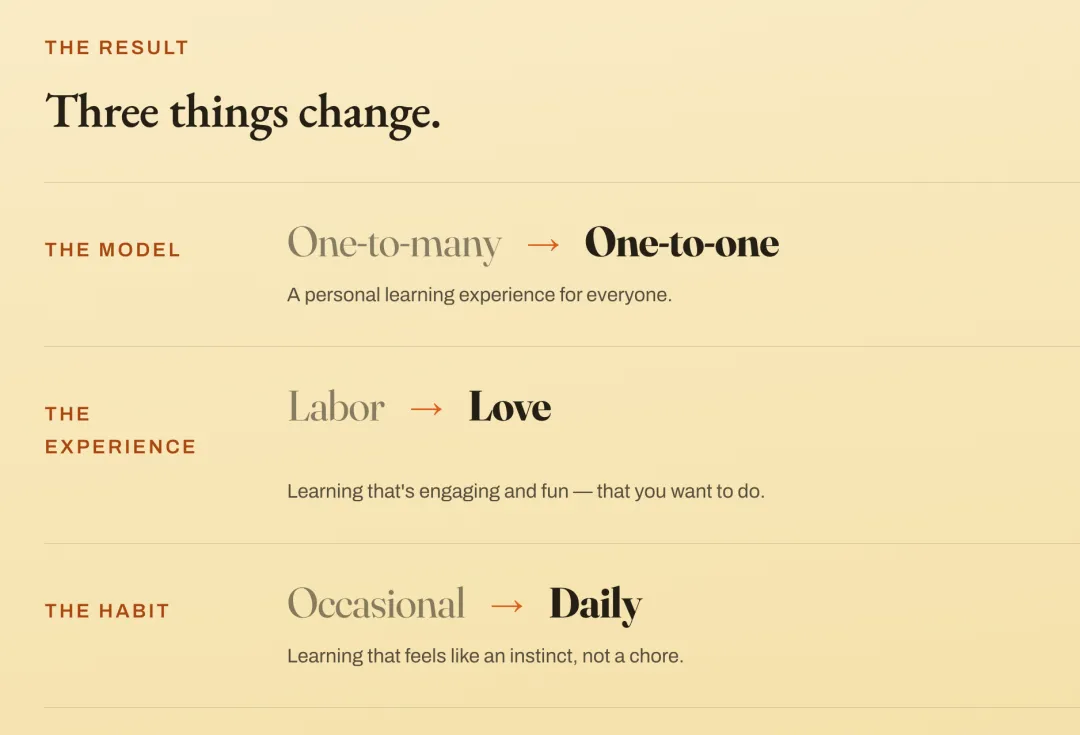
Their mission is to make AI the biggest accelerator of human development.

When it comes to the product, it's about building a "trusted learning guide" that, unlike chatbots, plans a learning path with you, adapts to your unique way of learning, and patiently accompanies you to your true mastery.
The company was founded and is headquartered in Mountain View, California. The company was launched in a special way: Coursera, which was founded by Coursera 15 years ago, invested $100 million in the Coursera strategy and, according to the full dilution calculations, will acquire about one-third of the shares.
In an open letter, Jonda recalled all of these connections: fifteen years ago, Coursera and online courses changed education, opening up "where to learn" that exceeded almost everyone's expectations; but "how to learn" remained the same as it was centuries ago.
He also emphasized that what people want is always reliable learning, accurate, important, time-consuming content, because the most valuable thing for learners is time. For this reason, LearnVector plans to work deeply with authoritative content libraries Coursera and Udemy. The company is currently building a small and sophisticated team to recruit AI engineers and learning scientists at the same time. According to the official schedule, the first products will be launched in early 2027.
World Mechanics:
Building an explanatory basic model for physical AI
Unlike the first two entrepreneurs who detailed their vision and path, Sonia Joseph's company, World Mechanics, is still in a "hidden state".
The company's goal is to build a frontier neolab for the physical world, with a core focus on interpreting basic models and scientific simulations. The founding team has quickly assembled a group of senior researchers and engineers from leading AI institutions and academic laboratories.
Sonia Joseph spent the most formative two years of her career at Meta. Not only did she lead the explainability community within the company, she worked on the JEPA team and published the first explanatory work on the mechanisms of physical reasoning in video world models. These two experiences led her to a deep realization that explainability is not only used to model physical models, but that it should go through the entire lifecycle of model training, verification and trust.
It is worth noting that the company was specifically registered as a public benefit corporation (Public Benefit Corporation) because physical AI, once it made a mistake, would have its consequences directly mapped to the real world. The cost of faulty production lines is high, and the "illusion" of home robots is even more unacceptable. They build on decades of accumulation in the fields of explainability and AI security, and extend these ideas to physical reasoning, robotics and scientific simulation. At the same time, while physical AI, due to the strategic value of data, is often heading towards closure, they are moving in the opposite direction: actively supporting open research, strengthening collaboration with universities, investing in scientific literacy, and building broader ecosystems that allow the public to keep up with the pace of technological development.
For the founding team, researchers need multiple first-author conference papers, and engineers need a hands-on experience in a startup. However, the company also attaches great importance to ecological cultivation, such as providing guidance to high-level PhD students in research videos, world models, and physically explainable materials, working closely with academia and other businesses, and making research processes as public as possible.