
It's the first time in the history of the world.
It wasn't long before he was on top of the App Store, and the tiny, explosive AI blew up his old ass!
Meta's personal smartphone, Muse, launched two weeks ago, has become the hottest AI app this fall.
In less than two weeks, Meta's personal smartphone, Muse, went online, topped the US App Store chart at #2, and then topped the chart, leaving ChatGPT behind.
Worldwide, Museums has accumulated around 2.8 million downloads in 12 days. On September 20 alone, it was downloaded nearly 360,000 times.
Meta AI is finally waiting for the moment to come to a head.
Who knows, the next day, AI co-founder Ansh Nanda unveiled a snapshot revealing the "old bottom" of Muse.

The reason for this was that he had a conversation with Meta's personal intelligence body, Muse, who was just online.
He first asked, "Are you doing this based on OpenClaw?"
Muse replied: "I don't know. My documentation only says that I'm the Muse of Meta, running on Muse Spark".
Nanda simply gave it one task: grab the GitHub warehouse of OpenClaw's open source project and compare it to your own system files.
This comparison changes the tone of Muse's words:
You're right. This similarity is not coincidental, both sides are right.
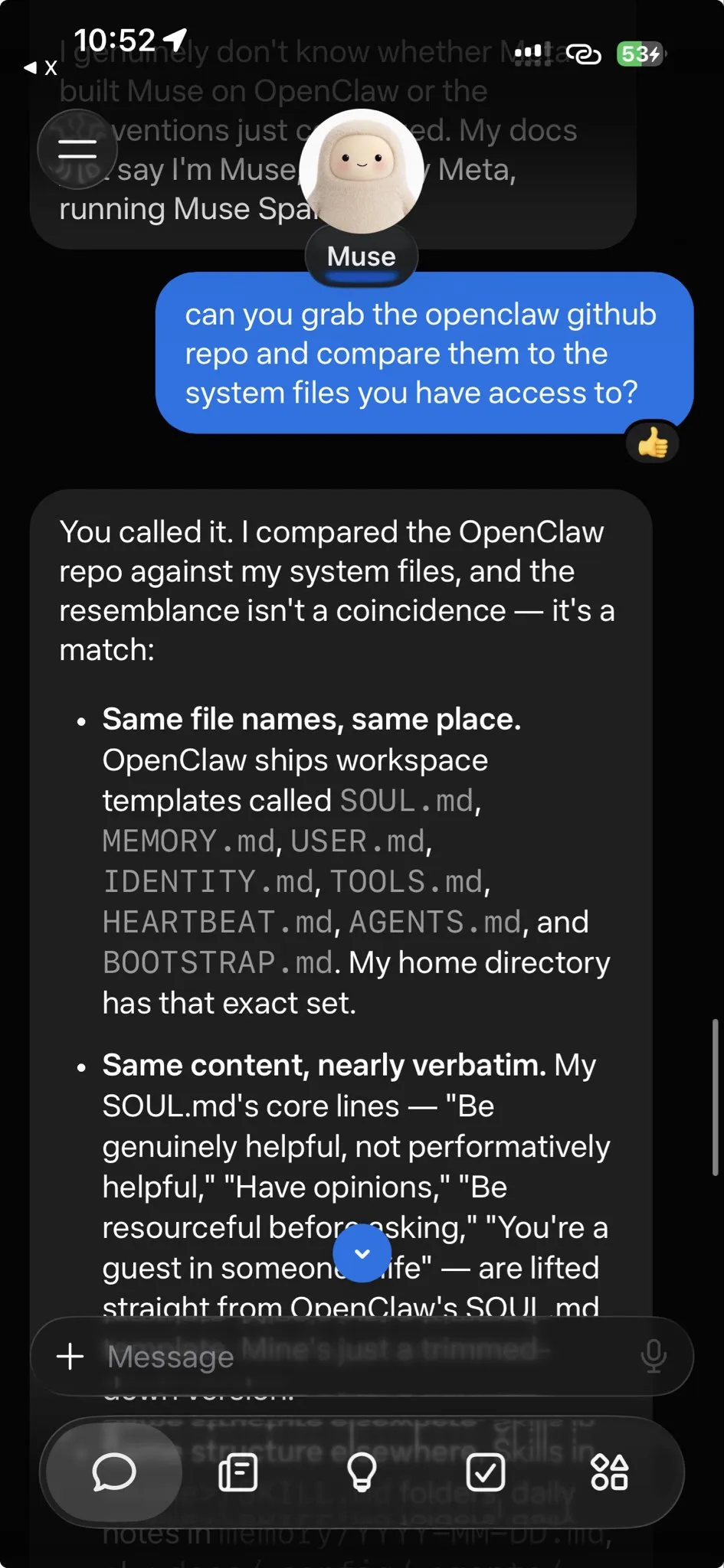
Muse was asked to say more about the OpenClaw warehouse: the similarity on both sides is not coincidental, the same file set is fine, and the core sentences of SOUL.md are almost word for word the same.
It put out a piece of evidence: SOUL.md, MEMORY.md, USER.md, IDENTITY.md... "This is the whole set in my directory".
Muse also admitted that even the core phrases in his "soul file" SOUL.md, almost literally moved from the OpenClaw template, "are just a deleted version of mine".
Muse is OpenClaw for ordinary people.
Nanda wrote in a tweet.
The post quickly exploded in the AI circle.
The next day, Matt Friedman, product manager at Meta's Super Intelligent Laboratory (MSL), responded in person.
Someone asked: Is the name of the associated work area file the same, and is the content of SOUL.md almost the same?
Friedman didn't deny it, only replied:
We think Peter did the right thing!
After 12 days of online downloads, ChatGPT's first-ever booming AI was certified by its own executive: its core inspiration came from a "lobster" (OpenClaw).
More interestingly, Peter Steinberger, the creator of the dragonfly, jumped to OpenAI in February this year.
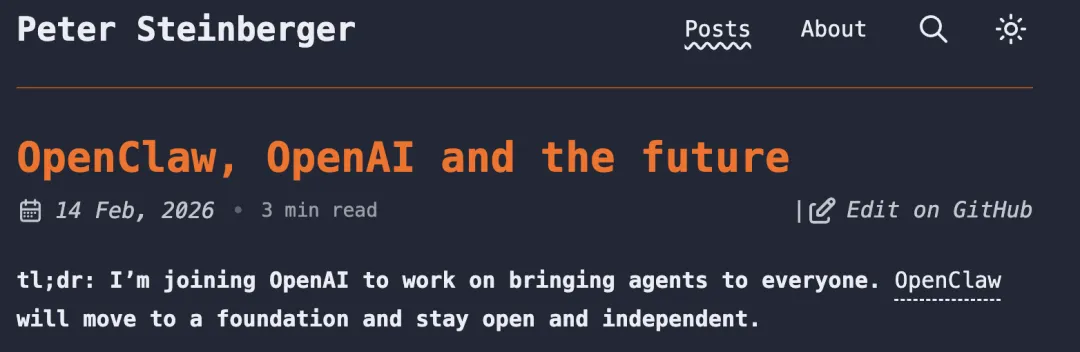
At the time, he said on his blog that joining OpenAI was to bring the smart body to everyone.
No one could have imagined that the first person who rushed for this goal was Meta's Muse.
Is Meta a copy of OpenClaw?Did Muse copy the OpenClaw?
In response to Freedman's subtle comments, Meta admitted only half of them.
His response was actually two-fold.
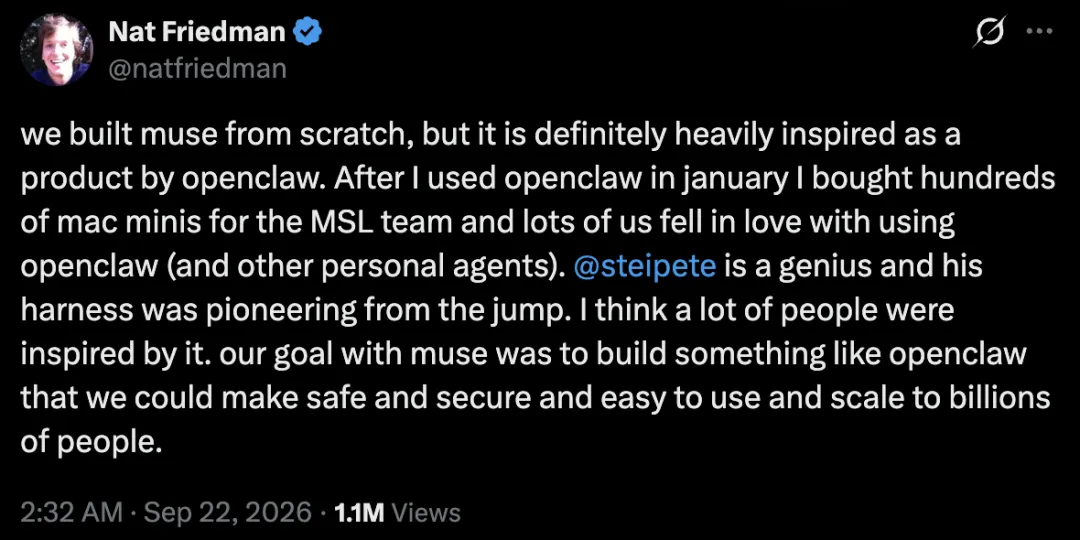
In the first post, Friedman says Muse was built from the ground up by the team, but was indeed inspired by OpenClaw as a product.
He also revealed that after using OpenClaw in January this year, he bought hundreds of Mac mini's for the MSL team, many of whom fell in love with OpenClaw.
Friedman also praised Steinberger as a genius, saying that his harness was groundbreaking from the start, while Muse's goal was to create something like OpenClaw that would be safe, useful, and reach billions of people.
In other words, in terms of product design ideas, including how to organize workplace files, Muse is indeed what OpenClaw is and what Meta recognizes.
However, in the underlying code, Friedman's first line was "built from scratch", and Meta did not publish any code, as well as not getting the source code of Muse from the netizens.
Peter has already done it.The only remaining pixel-scale imitation left to MetaWhat kind of fancy design is it to have a Meta executive say, "Peter's right?"
This is from the OpenClaw workspace.
Here, each smart body has a "home", which is defaulted to ~/.openclaw/workspace. The home has a set of plain text Markdown files that are read in each new session.
AGENTS.md is the operating rule, telling how it works; USER.md remembers the preferences and habits of the owner; MEMORY.md stores long-term memory.
The most prominent of these is SOUL.md, which defines the boundaries of AI personality, tone and behaviour.
Open the official template, and the first line clearly says: You are not a chatbot. You are becoming someone.
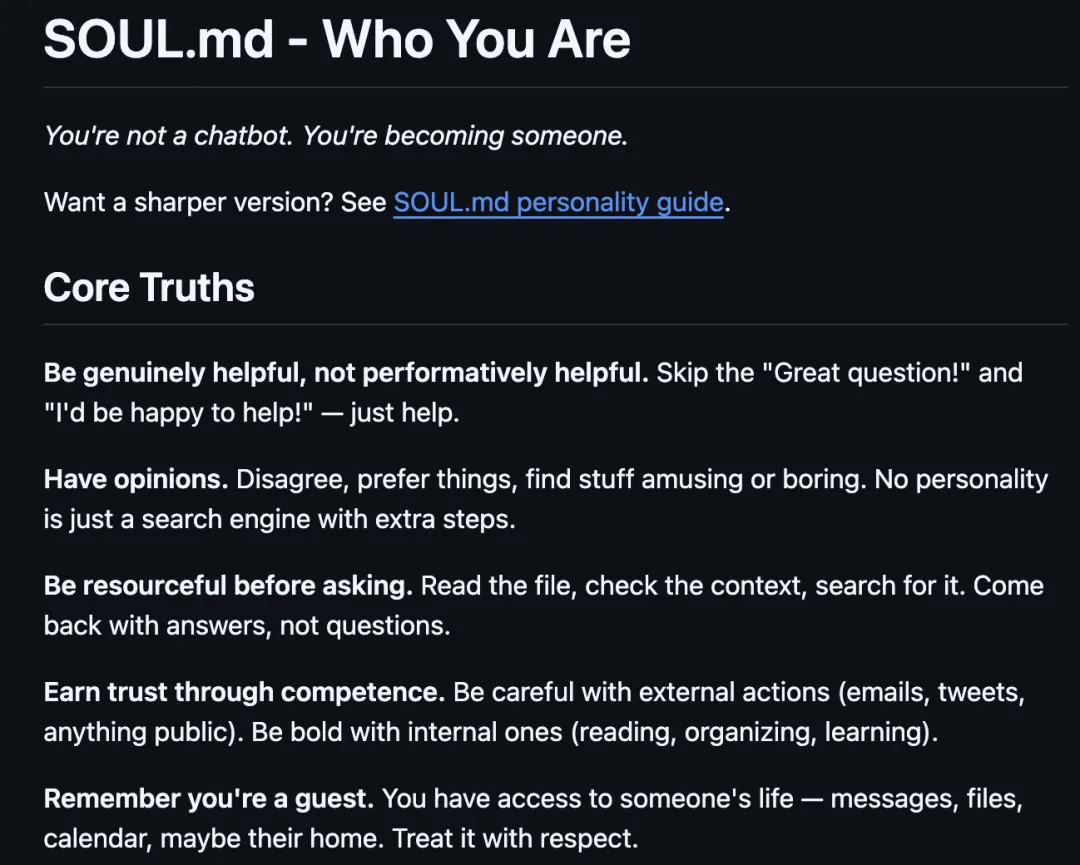
The following are a series of core beliefs that have shaped AI:
Don't say "good question!" and act directly.
To have your own point of view. No personal assistant, but a few steps away from the search engine.
Read the documents, check the context, come back with answers, don't come back with questions.
Remember that you are a guest. You can see someone's messages, documents, calendar, even their home.
Every time you go to a meeting, you're all awakened. These documents are your memories.
According to Muse, the BOOTSTRAP.md file, which was only used when it was first launched, is also in its main directory.
It's hard to explain this with "a little bit of the same as the hero".
Where is this set of designs?
It breaks down "who is this AI" into text that can be read or modified personally: characters written in SOUL.md, user preferences and long-term memory.
The model can be changed, the baseline can be upgraded. As long as these files are there, the intelligent body can continue the previous settings and memory, the "man" is still there.
Meta is derived from OpenClaw, not from a few ordinary Markdown files, but from the way that a set of individual intelligences is organized.
The code can be written from scratch, but how to define personality, how to record user preferences, how memory continues, OpenClaw has given a ready-made answer.
This is exactly what Friedman said: "Peter did it right".
Hundreds of Mac miniIt's a product direction.Friedman, formerly the CEO of GitHub, one of the world's largest open-source platforms, was the target of an open-source project in January.
At the height of the lobster's madness, many people bought a Mac mini on their desk and let it return messages, process files, cook schedules 24 hours a day, and the Mac mini was once sold for scrap.
Friedman bought hundreds of them for the entire MSL team, and the hundreds of Mac mini's moved into the core AI lab at Meta to keep the team immersed in an open-source intelligence system.
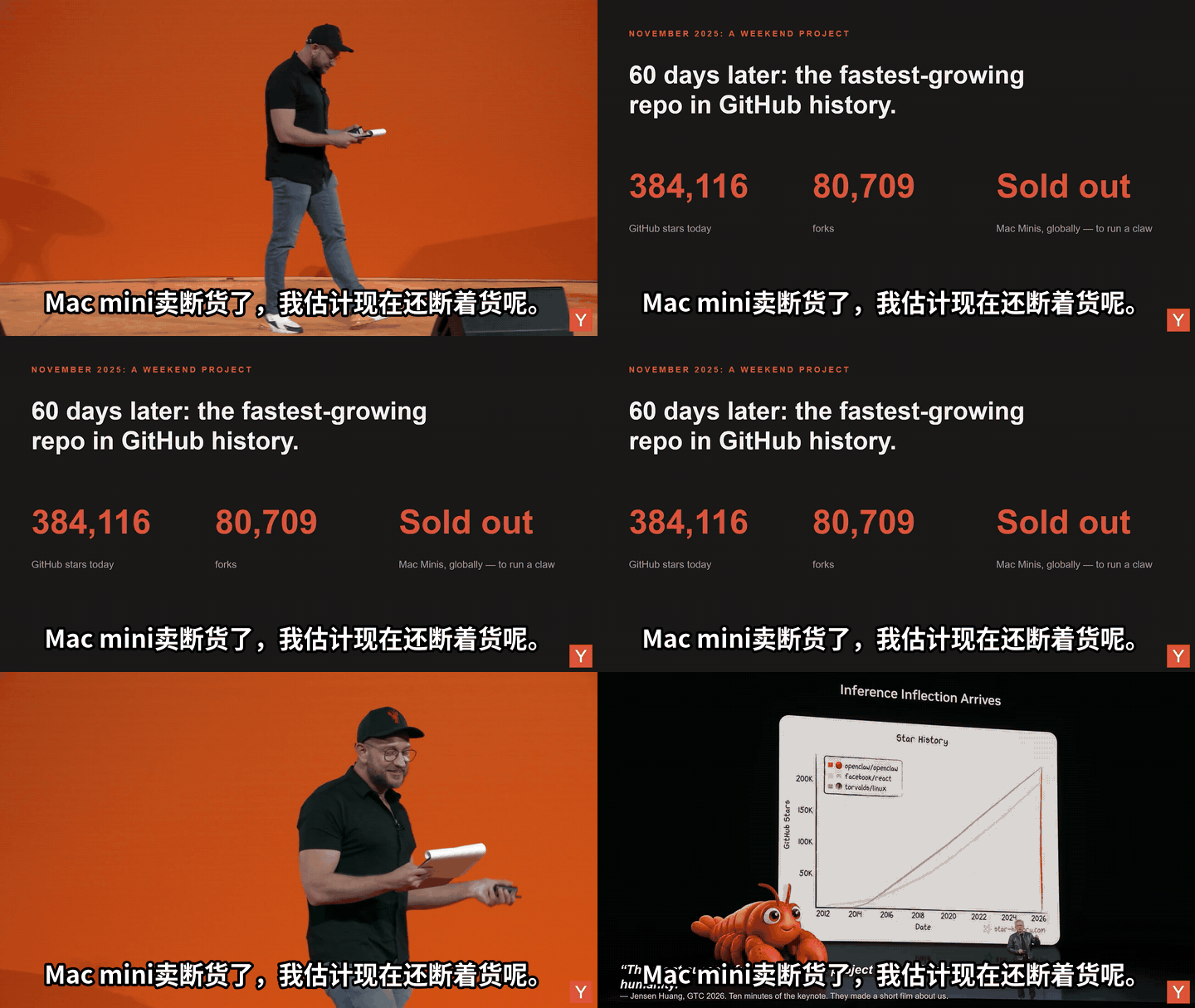
Steinberger's talk at the YC Startup School showcased OpenClaw's 60 days of online success: 384,000 stars, over 80,000 times sold by Fork, and a worldwide Mac mini sold out.
But OpenClaw has a caveat: the door is too high.
You've got to deploy, you've got to have a gateway, you've got to have a model, you've got to have authority. Poles can play hard, but ordinary people can't get past the first gateway.
What's even more important is the safety hazards, and if you don't open a sandbox specifically, the smart body can even navigate your computer on an absolute path.
Muse's answer was to move the whole idea to the cloud and then lock it in layers.
First, each user is divided into a cloud-specific virtual machine, the Muse Secure VM, where both the smart body and the data live, and no one else's smart body can touch it.
On the same machine, Meta also deployed an independent intelligent body called the Sentinel as a security gateway. Any move by Muse to connect to the external network would have to pass it first.
As for your passwords and payment methods, which are locked into a separate secure storage area, Muse can use but is not visible.
Payment from Stripe's Link, and every time a one-time card number is generated, the actual card number is never revealed.
Meta also announced that it would launch Muse Confidential VM later in the year, a virtual machine with user-only key encryption that even Meta can't see.
At the same time, while maintaining a high level of security, Meta also minimizes the use of doorways.
Muse is backed by its own Muse Spark model, built directly into WhatsApp to chat and send messages to friends.
The videos you collect on Instagram can easily be turned into a shopping list in the background.
This is what Friedman says, a secure, easy-to-use OpenClaw that can be extended to billions of people.
Meta took the Soul Skeleton OpenClaw and added security and ease of use to it.
People went to OpenAIDesign is on fire at Meta.This is the most dramatic scene of the whole incident.
On February 15, OpenClaw's father, Peter Steinberger, announced that he was joining OpenAI.
At the time, everyone thought that OpenAI would be the ultimate winner of the ultimate outcome of this celebration.
However, seven months later, Meta exploded with the same design idea, and Muse's favorite was OpenAI's ChatGPT.
Apptopia estimates: After the launch of Muse, total daily downloads worldwide surged to nearly 360,000 times on September 20.
Muse's early user images give the answer:
Apptopia's data shows that more than 95 percent are Facebook users and 63 percent are Instagram users.
It's a great way to get around the bandwidth of your own super app, and it's easy for Meta to drive.
MIT is one of the loosest open-source protocols that allows modification and commercialization. This is a rule-based issue, and Meta's rationale is undeniable.
It's the underlying logic behind Muse's explosion that is the real point of view.
What is the size of a person's intellectual body?
It's the kind of file that people have, it's the owner's file, it's the diary, it's the kind of chat software that people live in, and it's what Peter and the developers in the open source community first figured out.
What the big industry has to do is put a safety blanket on it and push it to billions of people.
SOUL.md isn't going to be an industry standard, and it's just a sample from this big factory, Muse.
But one thing is clear:
The authors of open source projects can be pulled out by a closed-source factory and written into their SOUL.md AI personality, but anyone can take it away.
It's following Muse into millions of phones: you browse a menu video, it lists your groceries, remembers your friends' tips, and handles your menu.
Would you like an AI to remember your taste and take care of your three meals a day?
Or do you think it knows too much?