High-tech robots have mastered the core technical indicators of the four mainstream programs Exotec Skypod, HaiPick Climb, Bird ZeeBot, UltraWise RS Hyper, and observed the technological evolution of crawling robot tracks.
1、Mobility and Single Efficiency
Climb speed is the most basic measure of performance for crawling robots. At 1.5m/s in the first ladder, ZeeBot, HaiJoo innovates HaiPick Climb at 1.4m/s, 1.0m/s respectively, and the latest data from Exotec Skypod is 1.5m/s (according to data from Exotec 2026 exhibition site and third-party evaluation platforms).
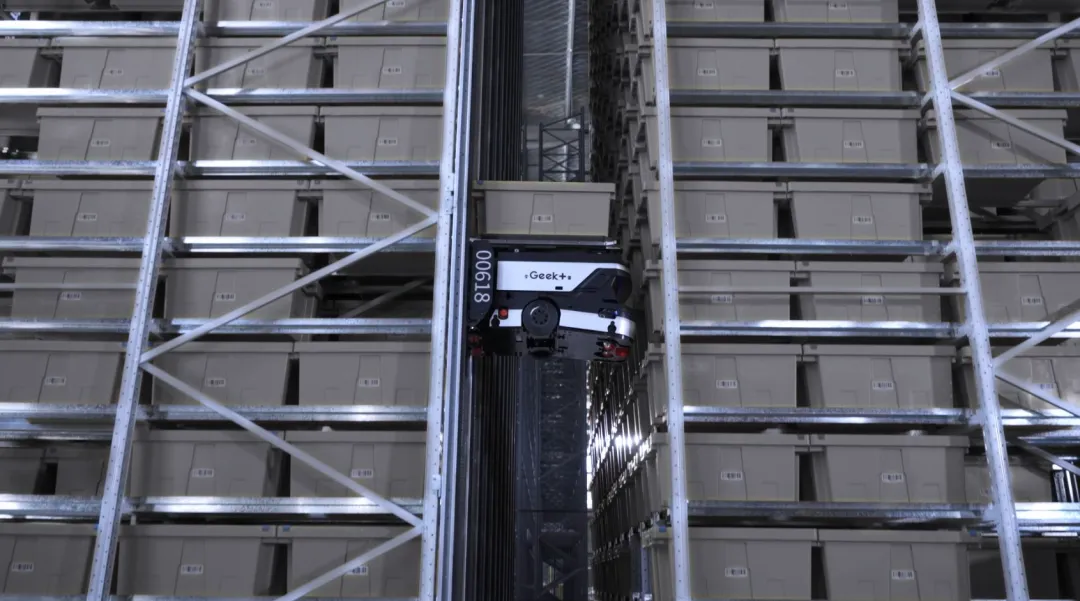
It's called RS Hyper.
In terms of walking speed, the four crawler robots each reached 4m/s; in acceleration, the AI is at 2.5m/s2, leading the industry; the other three did not publicly disclose acceleration data. The high-speed design can be adapted to frequent shutdowns and retreats under high robot density scenarios, thus improving overall efficiency.
In stock response time, Hyundai RS Hyper was 1.5 minutes, Haiju innovated HaiPick Climb for 2 minutes, and Exotec Skypod for 2 minutes.
In terms of charging ratios, the RS Hyper reaches 1:10, which means that 12 minutes of charging can only support about 2 hours of operation, and the other three have not publicly disclosed the charging ratios.
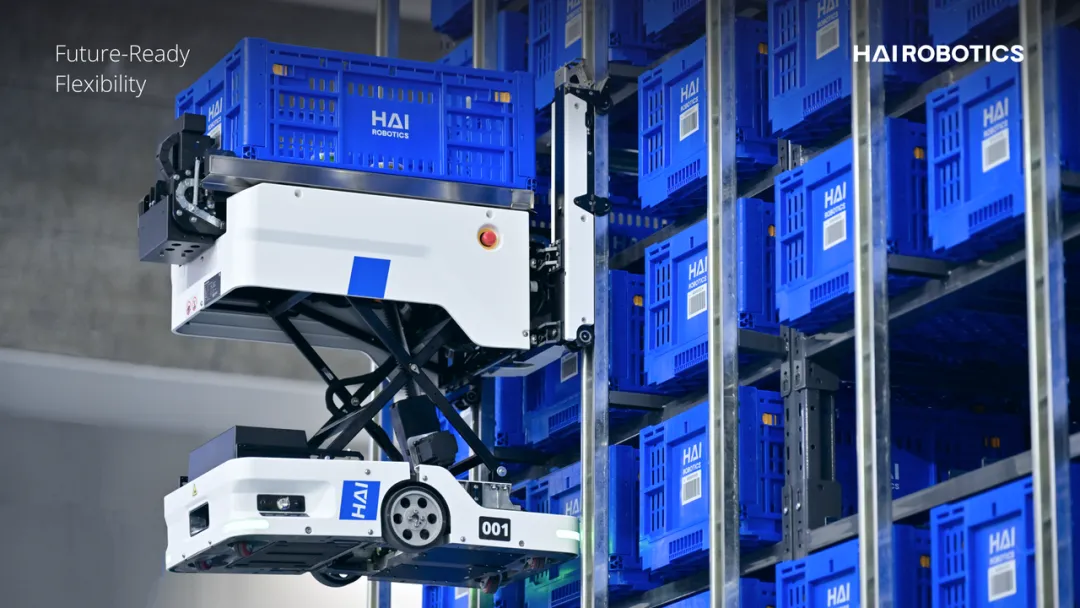
HaiPick Climb is an innovative flash system.
2、System throughput and workstation efficiency
The speed of a motorcycle is not equal to the system's high throughput, which is the central premise of crawling robots moving from crawling technology verification crawling to crawling real-world scenarios.
On the system throughput of 1000 m2 standard units, Hyundai RS Hyper reached 6000 boxes/hour, and Haiju's innovative HaiPick Climb and BirdZeeBot were 4000 boxes/hour.
In terms of the efficiency of the workstation, the Tai Chi-Jia-Max workstation reached 800 boxes/hour, and the Heijou Innovation workstation consumed 600 boxes/hour, which was not disclosed by Bird. Exotec officially labelled its workstation as 600 boxes/hour, which measures the pitch of the boxes and differs statistically from the system level.
Different data calibers differ, and there are gaps in system throughput and workstation efficiency, reflecting different approaches to robotic scheduling strategies and workstation collaborative design.
3、Simultaneous capabilities and locking mechanisms
Crawling robots need to lock a certain range of shelf rows when accessing boxes, the fewer rows of locks, the higher the reuse rate of space, and the greater the operational capacity.
In adjacent column parallel crawling capabilities, Hyundai RS Hyper and Exotec Skypod both support adjacent parallel crawling capabilities, and Hyundai's innovative HaiPick Climb and Bird ZeeBot allow for spaced parallel crawling capabilities. The ability to crawle in adjacent columns doubles the number of robots on the shelf that can operate simultaneously, which is the core reason why Hyundai RS Hyper leads 30%+ in throughput.
Hyper has reduced the range to just 2 columns, whereas industry routines typically lock 4 to 6 columns, resulting in a significant increase in the number of shelf-level robots.
In terms of the same number of robots, the Zhejiang RS Hyper can deploy two robots at the same time for upgrading operations, while the open data of Exotec, Haiju Innovation and Bird does not reveal the same capabilities as the train.
In terms of dual-directional dual-directional operation, Hyundai RS Hyper supports dual-directional dual-directional transceivers, which Exotec officially describes as a dual-directional transceiver, and Hyundai Innovation officially describes as a dual-directional transceiver.
According to industry trends, improved compression and concurrency capabilities in the range of lock columns are promoting the spatial replication of crawling robots.
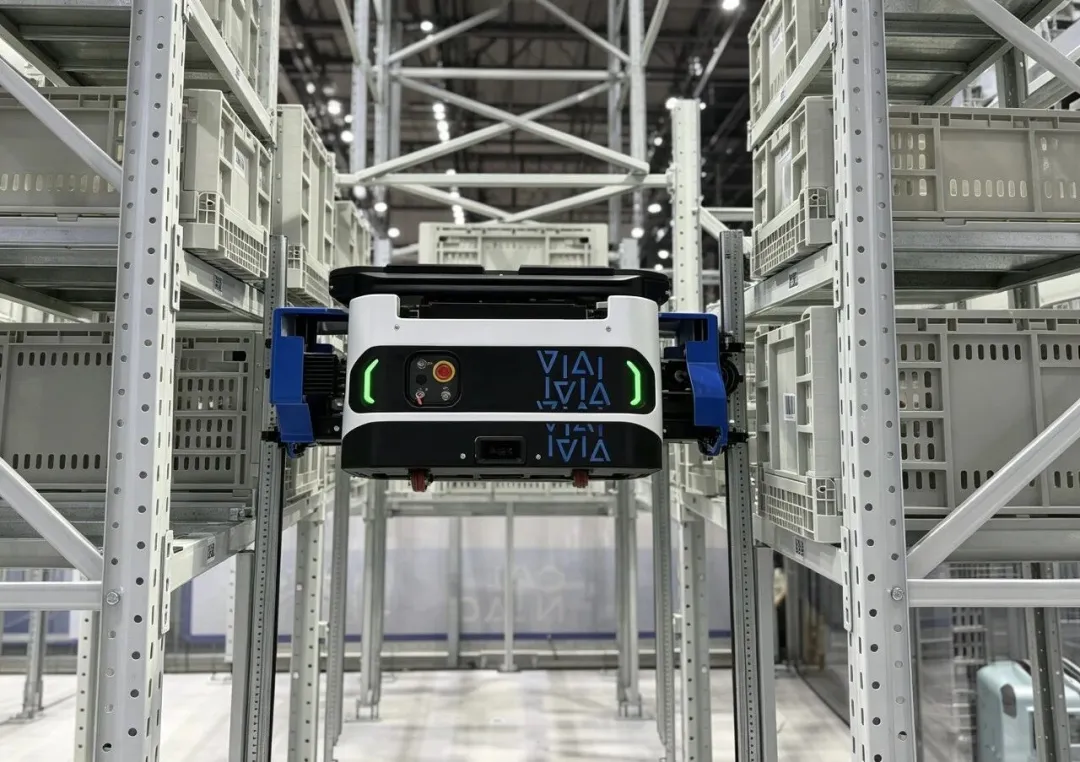
The bird ZeeBot
4、Storage density and use of space
In terms of storage density, the maximum storage density of the Hyundai RS Hyper is 50,000+ boxes/1,000 m2, Haiju's innovative HaiPick Climb is 45,000 boxes/1000 m2 (double-depth upgraded version).
In terms of shelf height, the Hyper system supports 15 meters, the Exotec Skypod supports 14 meters, the Bird ZeeBot supports 14-15 meters, and the HaiJoo innovative HaiPick Climb supports 12 meters.
Different variations in storage density and shelf height reflect a different understanding of situations such as forward storage, cross-border storage.
5、Road network design and scheduling
As the number of robots expanded from dozens to thousands, the scheduling system became the key bottleneck in determining system limits.
In terms of ground road network optimization, the Hyper RS is narrower due to the robot bottom, allowing two cars to walk simultaneously under each set of double stretch shelves, with road network density exceeding 30% of the industry, and the channel upgraded from a cobblestone bike path to a cubic high-level bridge; Haiju innovates HaiPick Climb; Bird ZeeBot supports only one robot walk under one shelf; Exotec's public records do not disclose the specific configuration of the shelf's next main path.
On the scale of the scheduling, the single RMS system with 5000 robots, 50,000 square meters of space, super-large synchronous operation capacity of 3 million seats, Hyundai innovation maximum support of 3,000 units, Cajun publicly disclosed its flexibility of the 1000-level synchronous scheduling capability, without disclosing specific limits, Exotec did not disclose the data.
Scheduling algorithms also need to support dynamic wavelength valve adaptation, and the disadvantages of scheduling capabilities directly determine whether the system can deliver on hardware performance commitments.
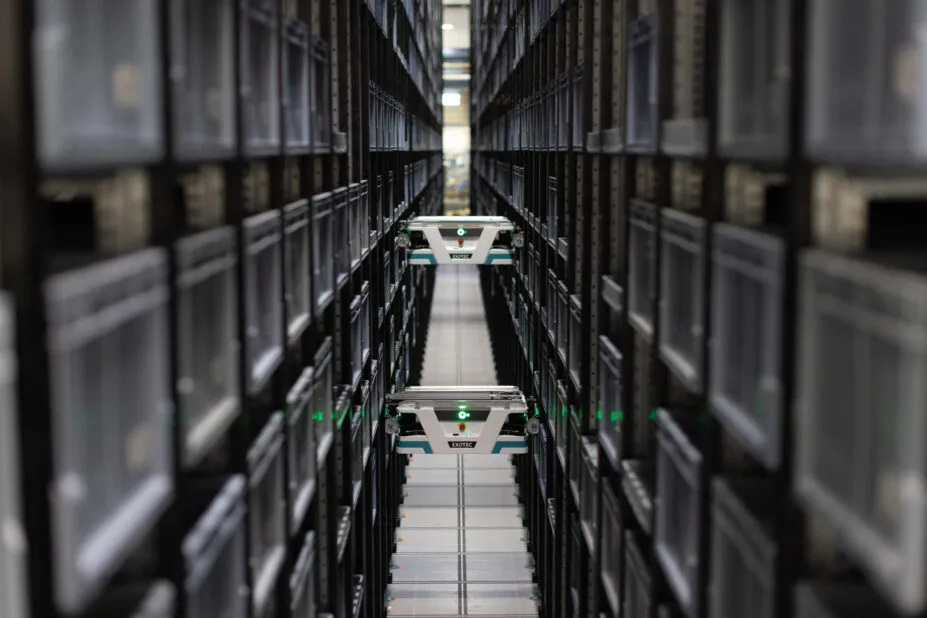
Exotec Skypod
From various performance indicators, it can be seen that the competition of crawling robot racetracks is shifting from the comparison of single performance to the comparison of system-level efficiency.
Global crawling robot mainstream program parameters
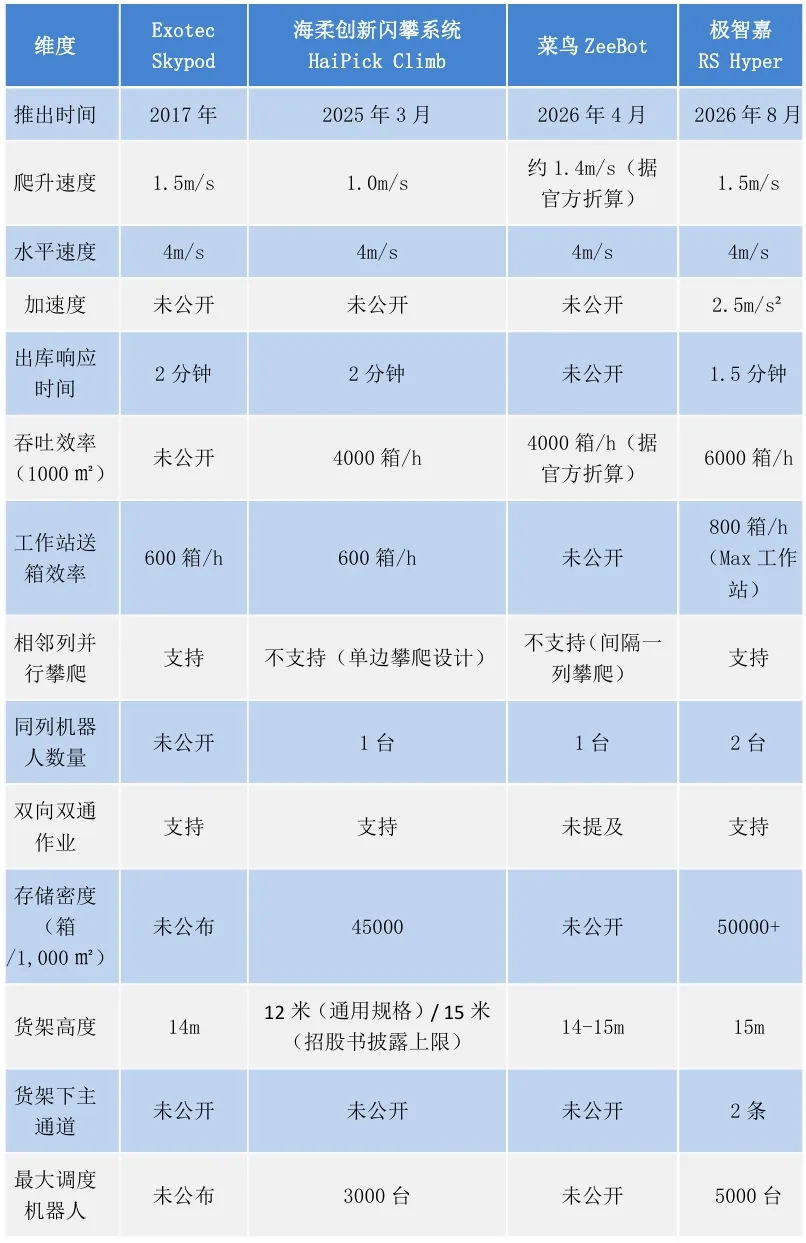
Data sources: Corporate public information; manufacturing tables: high-tech robots
Stability and security: the underlying security behind high energy
The requirements for structural stability and safety protection in high-speed vertical cycling exceed the requirements of ground-based robots. As the racetrack moves from technical verification to large-scale deployment, the industry is rapidly increasing its emphasis on stability and safety.
Trajectory designThere are two main routes: a track mounted on a rack rack beam, or an integrated design with a rack stand. The latter is equipped with a vertical robot load bearing the rack, the track is not easily deformed and requires lower installation accuracy.
Avoid fallingOn the other hand, all four have an anti-drop design that combines the robot with the physical bite of the orbiter. The Intelligent RS Hyper uses multiple anti-drop protection, which controls the crash course within 50 mm; Haiju's innovative HaiPick Climb features multiple self-locking anti-drop mechanisms; Exotec and Bird's public records do not reveal the robot's anti-drop mechanism itself.
Standing orientation and boundary designOn the other hand, the ultra-intelligent RS Hyper is designed to position the container with the shelf limit, increasing the orientation, rear limit and rear inclination, preventing the container from tilting due to vibration and reducing the frequency of abnormal processing. The robot is also equipped with an upper detection sensor, which can automatically position the outstanding container; the other three open documents do not reveal the same structural design.
Safety of personnelOn the other hand, Hyundai RS Hyper supports safety workwear, Hyundai innovation provides a safety bra scheme that allows people to enter the system without disrupting its operation; Exotec Skypod system immediately stops the robot activity when people enter the safe area; No clear disclosure of the mechanism of emergency shutdown is found in the public records of the Bird ZeeBot.
For customers, choosing crawler robot schemes focuses not only on crawler upper limit crawler indicators such as unit speed, system throughput, but also on crawler downper limit crawler capabilities that determine system availability in long-term operation, as in high-density, high-throughput storage scenarios, the loss of efficiency caused by an accidental shutdown often exceeds the speed gap of a few seconds on the parameter table.
Landing map reshaping and shaping
From the point of view of the commercialization of the landing of key players in China and abroad, the crawler crane robot track has passed the concept-verification stage and has been verified by customers in various industries around the world, and customers' real needs continue to be met, with plenty of imagination.
As a racing pioneer, Exotec has sold approximately 14,000 Skype systems as of February 2026, and operates in more than 200 customer sites around the world, serving brands such as Gap, Uniforms, and Family Foods.
HaiPick Climb launched in March 2025, and the global collaboration has surpassed 10,000 units in the fields of landing shoes, fast wear, cosmetics, pharmaceuticals, cross-border 3PL, and more.
Launched in April 2026, the ZeeBot has completed a series of delivery launches around the world, covering several countries and regions in mainland China, China, Hong Kong, the Netherlands, Spain, cumulative deliveries of crawler robots to more than 1,000 stores, project application scenarios covering e-commerce, cross-border e-commerce, electronics manufacturing, clothing manufacturing, and other industries.
It was released in August 2026, has completed 180 days x 24 hours full process testing, it is reported that several projects worldwide are in the stage of feasibility verification, market demand is strong. After the validation of the related projects, it is expected to receive continuous orders at scale. It has been accumulated for eight years in the container to the human runway, from 2020 with a large car crusher to the human package, to 2024 with the launch of the RS Air container to the human package, and to 2025 with the launch of unmanned workstations, this year with the latest release of the RoboShuttle Hyper shuttle crawler robot program, has formed a matrix of the entire product of container robots, its subsequent performance is noteworthy.
Currently, there is a focus on the technical routes of global players, but the focus of competition has shifted from crawling to crawling faster, higher and more stable systems.According to current public technical indicators, the tech ceiling in the industry is continuously being raised, as the industry continues to grow.Scalable landings, continuous release of cross-industry customer demands, continuous improvement of product performance, real demand for the crawler box robot track market is clear.The future of the track is huge.
—END— Recent Activities
 On September 29th, the first direct-drive stock was put on the market! The first direct-drive stock is coming to the end of execution as a landing card point, not because the hand is not agile enough, but because the industry has reversed the order.