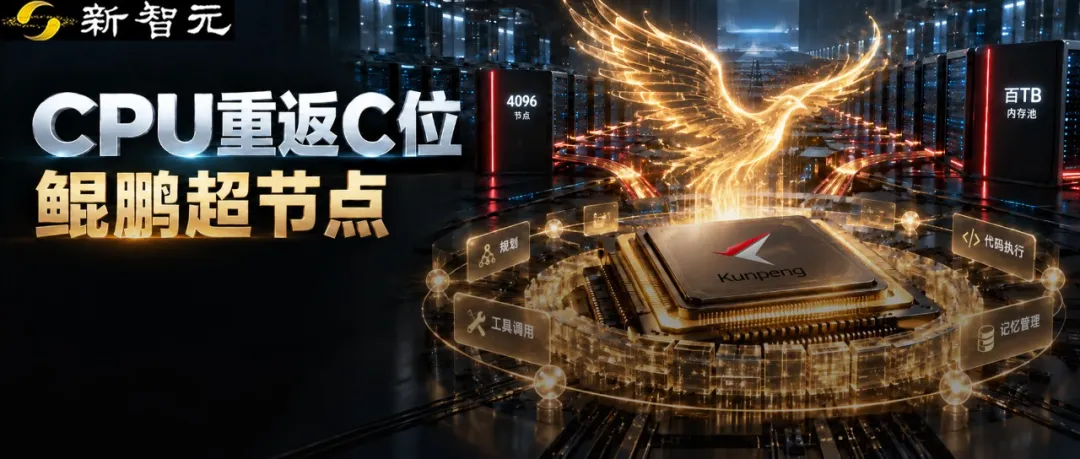
It's the first time in the history of the world.
In 2026, the CPU will become the "hard currency" in the AI world.
Global server CPU collective price hike, extended delivery times, most exaggerated when orders will wait for six months.
The reason is simple: AI is no longer just a question-and-answer conversation machine.
Agent intelligences begin to plan their own tasks, call tools, run code, and manage memory, all of which are powered by the CPU.
The CPU, the "old soldier" once obscured by GPUs, is returning to the center of the computing scene in the wave of Agentic AI.
At this junction of the bones, the monkey dropped a heavy bomb on Shanghai.
On 17 September, the 11th HC 2026 congress was held at the Shanghai Expo and Expo Center.
Three keynote speeches, 20 summits, more than 60 forums, with an exhibition area of more than 22,000 square meters.
On the day of the Silicon Computing Industry Summit, Li Yi, president of Huawei's Silicon Computing product line, stood on the podium with a clear signal:
Ahead of AgenticAIIn this era, you need to be the foundation of a leading, open, secure smart body.
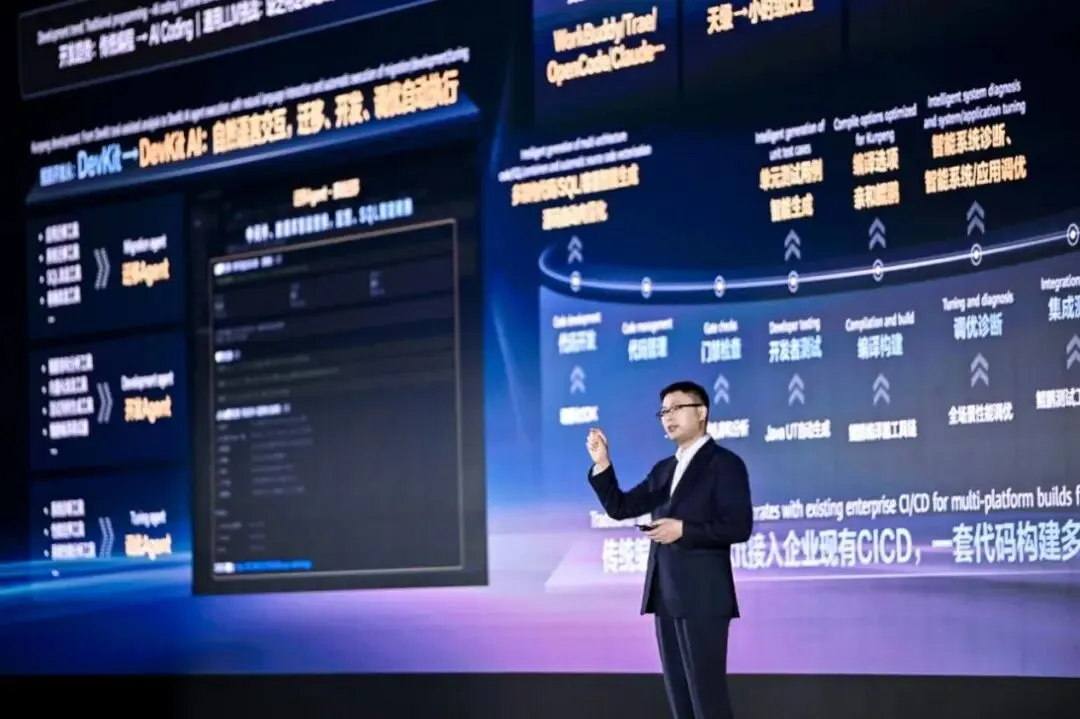
The newly upgraded super node, air-cooled, liquid-cooled dual flagship, with maximum support for 4096 node group networks, builds a 100TB unified memory pool.
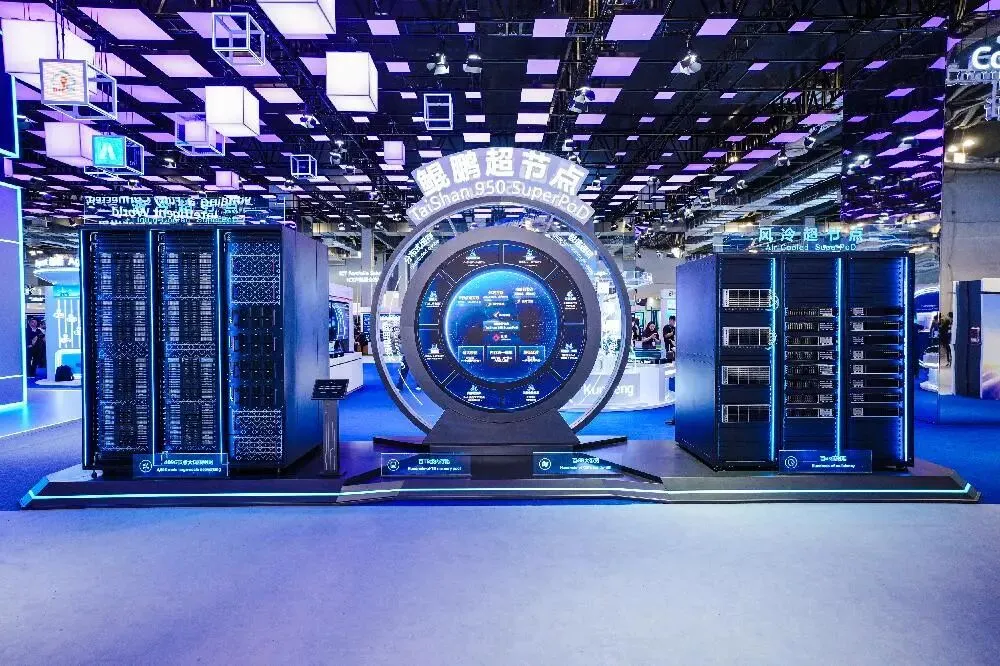
One sentence summarizes the ambitions of the upgrade:Building new options for the world through architectural transformation.
 Seven years of deep cultivation.From the "New Choice" to the "Main Power Force"
At the time of the announcement of the Chinese computing industry strategy in 2019, many people were still watching:
Do you have a self-developed ARM architecture processor as a server, can it work? can it be built ecologically?
Seven years later, the numbers give the most direct answer.
Thirteen OEM partners have launched more than 300 integrated systems, built more than 28,000 industry solutions with more than 7,200 ISV partners and more than 4.16 million developers globally.
openEuler and openGauss have become one of the most influential operating system and database open source communities in the country.
There is a clear logic behind these figures:Instead of trying to "disrupt" anyone, China has drawn in partners from the industry chain through open-source hardware, open-source software routes, and together they make big cakes.
It's a shadow of its former self.
Since its inception in 2020, the company has been steadfast in choosing the pipeline, launching more than 50 pipeline products in six years, taking the first batch of pipeline finance applications, and generating revenues in stages of billions for two consecutive years.
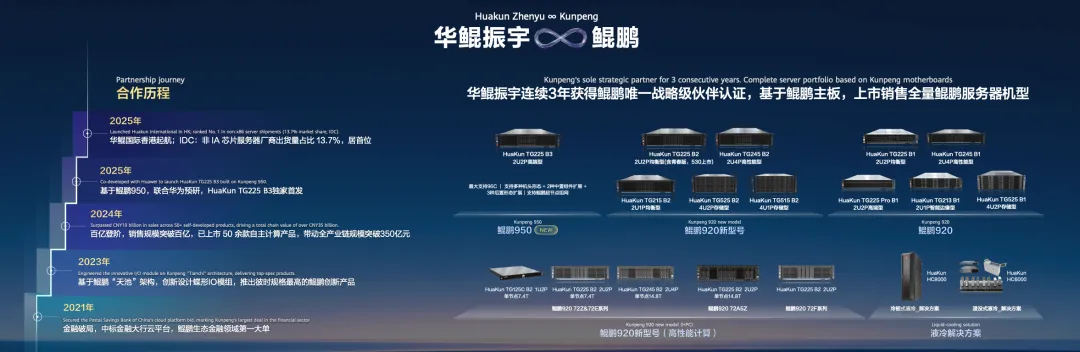
The same is true for Kunming Technology, which has built a full line of server products based on Kunming, with revenue expected to surpass $10 billion this year.
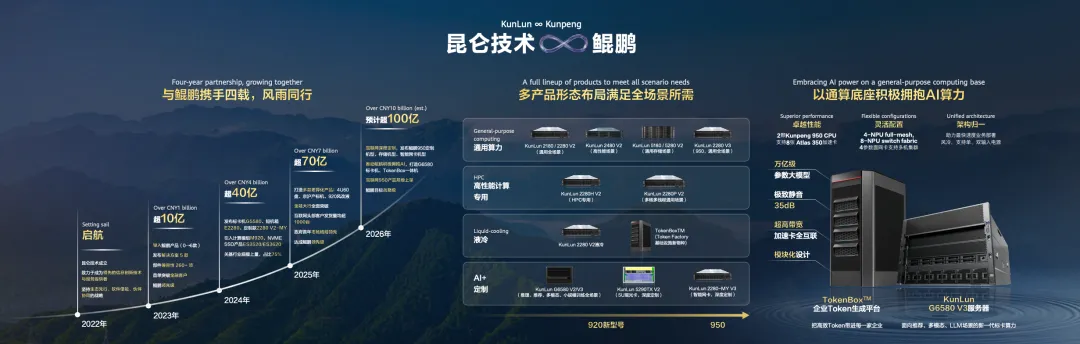
It took seven years to move from a technology that needed to be "convinced" into becoming the mainstream computing choice in the industry.
And now there's a bigger variable.
CPU back to CAgentic AI rewrites the computational formatIf the story of AI in the last few years belongs to the GPU, then the script is being rewritten starting in 2026.
The logic is simple: the big model is no longer just "ask a question and answer a sentence".
When AI evolved from Chatbot to Agent, it needed to autonomously plan tasks, schedule tools, execute code, manage memory, and run sandboxes.
These kids, the GPUs can't work, and the CPU needs to be turned on.
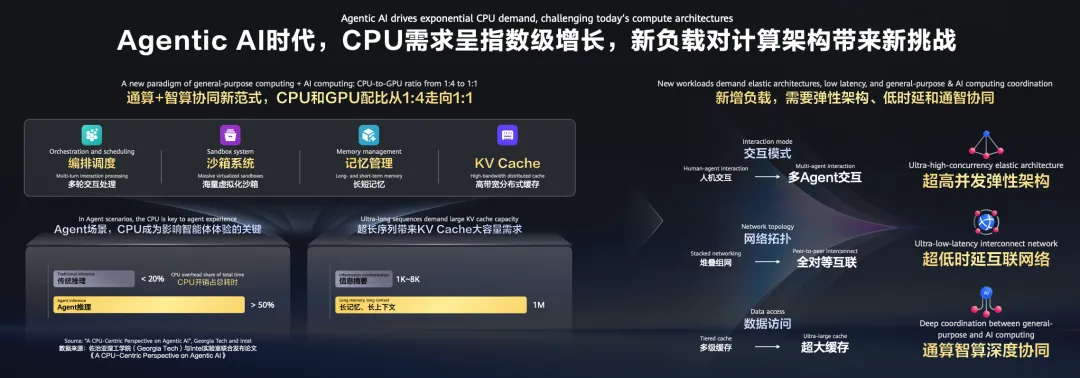
According to a paper published jointly by the Georgia Institute of Technology and Intel, A CPU-Centric Perspective on Agentic AI, CPU time in the traditional AI reasoning scenario is less than 20%, while in the Agent reasoning scenario, it has risen to more than 50%.
The GPU-CPU ratio has also historically moved from the previous 1:4 to 1:1.
This is a paradigm shift in computational architecture.
It's the first time that I've ever been in a situation like this.
In his speech, Li Yi pointed out that the newly added loads of the Agentic AI era pose three challenges to the computational architecture: human interaction moves towards multi-Agent interaction, requiring ultra-high and resilient architectures; traditional stacking networks are difficult to meet the demand for ultra-low time extension connectivity; large capacity KV Cache caches require computational and integer depth synchronization.
In other words, a powerful GPU array isn't enough.
At the heart of the Agents era of computing must be a new architecture of "accounting + intelligence" collaboration.
This is the core logic behind the upgrade.
Hardware Light Sword: Full upgrade of the hyper-nodeThis infrastructure-level upgrade can be summarized in two key words:The processor evolved, the hyper-node fluctuated.
In terms of processors, the new Type 920 is currently the only CPU in the industry that is compatible with both DDR4 and DDR5 dual memory specifications.
This means that users can switch to the new platform with a smooth transfer of memory, saving a true gold and silver.
The V950 is a high-performance route, high-nuclear-width ratio, and scenic performance industry leader.
The combination of the two products covers all scenic needs, from price to high performance.
But what's really striking is the massive upgrade of the supernatural node.
The previous server was an independent machine connected to the Ethernet network.
The idea of hyper-nodes is different:A super node is a computing system that is physically composed of multiple computing nodes that are tightly connected via efficient linking protocols, with unified memory encoding capabilities across physical nodes, and logically has "one computer" characteristics.
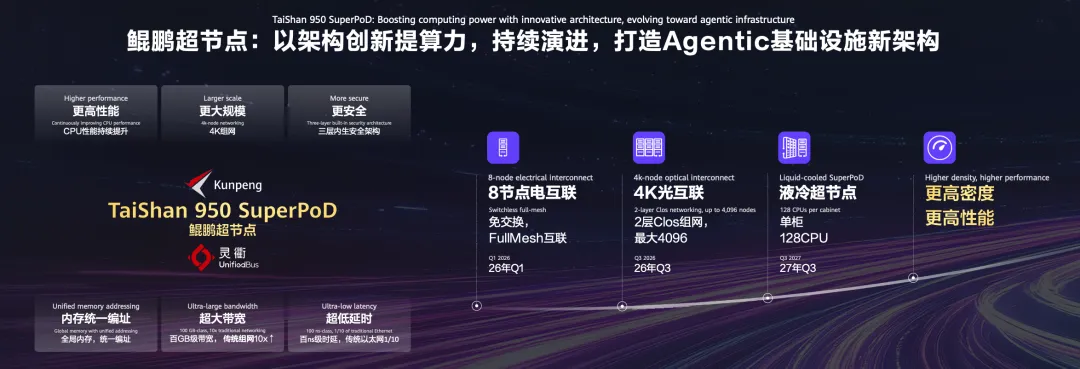
The three main core characteristics of CPU memory unified addresses, ultra-large bandwidth, 100 GB, 10 times the traditional group network, ultra-low latency, 100ns, 1/10 of the traditional Ethernet network, define what is a "true super node".
Li Yi emphasized one thing in his speech: the ability to connect to protocols such as RoCE that do not support "memory unified addressing" is not a super node in the true sense.
Although the phrase is unnamed, the orientation is clear: Fu defines track standards using technical specifications.
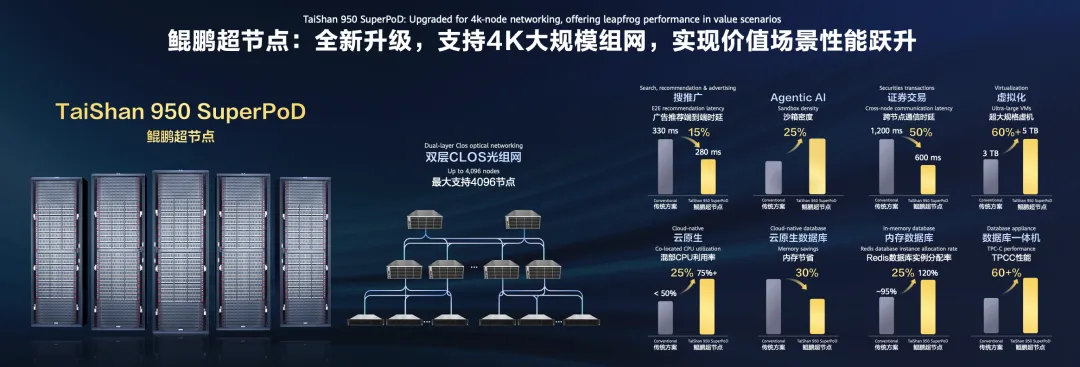
In fact, the evolution of the hippocampus is a clear "three-step leap" path.
At the beginning of the year, the Power Interconnected Runway 8 node FullMesh free-swap group network was used to verify the core capability of "memory unified addressing".
Then it was the flagship of the 4K optical network, which was unveiled at the conference, with a two-tiered CLOS architecture that brought the scale to 4096 nodes, and a 100TB memory pool officially landed.
What's even more exciting is the next leap: in Q3 of 2027, all new liquid-cooled supernodes will be installed in 128 CPUs, achieving higher deployment density and higher performance improvements.
From electrical connectivity to light connectivity to liquid cooling, each step is not a simple "other way of dissipating heat", but it screws at the same time in density, scale and energy efficiency.
The pace is clear: first run the architecture, then scale, and finally push the energy efficiency to the extreme.
Software navigation: The four basic software builds the basis of heterogeneous integrationHardware is stronger, and software is lacking.
Around the four directions of operating systems, databases, clustered software, and compilers, Liu constructed a complete heterogeneous fusion clustering system that led to the realization of core, hard, and software collaboration, and horizontal integration of computing, smart computing, networking, and storage hardware resources.
openEulerKV Cache is a multi-second access capability through polarized memory and high-speed communications.
In the Agentic AI scenario, this means that the "memory" of the intelligent body can be read and written almost in real time, no longer limited to the bandwidth bottle of traditional storage.
openGaussThe industry's first open-source hyper-node multi-write database. Two-node multi-write can achieve 5.7 million tpmC, with performance improvements of 60% compared to traditional programs.
This is a real competitive advantage for financial and e-commerce scenarios that require high concurrency transactions.
openFuyaoAs a diversified computing cluster management software, it opens up hypernode and cloud-based ecosystems. Depending on URMA high-speed communications, business container communication latency has dropped by more than 40%.
The simple fact is that the containers in your Kubernetes cluster run almost half as fast on hypernodes as they do on traditional servers.
BiSheng compilerIt combines dynamic changes in Agent loads, real-time optimization of entire links, and 20% improvement in operational efficiency.
It's not a traditional "compiled no matter what", but an intelligent compilation system that keeps going online, senses load, and adapts itself.
The four core software forces work together to transform the hypernode from a hardware concept into a truly accessible software platform.
Real-time testing: when the hypernode encounters real businessThe architecture is beautiful, and in the end, we have to look at one question: Can you resist the pressure of a real business?
I'm going to tell you about a scene that we all know.
You open up a shopping app, you look for a pair of sneakers, you turn around and you see a short video of the ads.
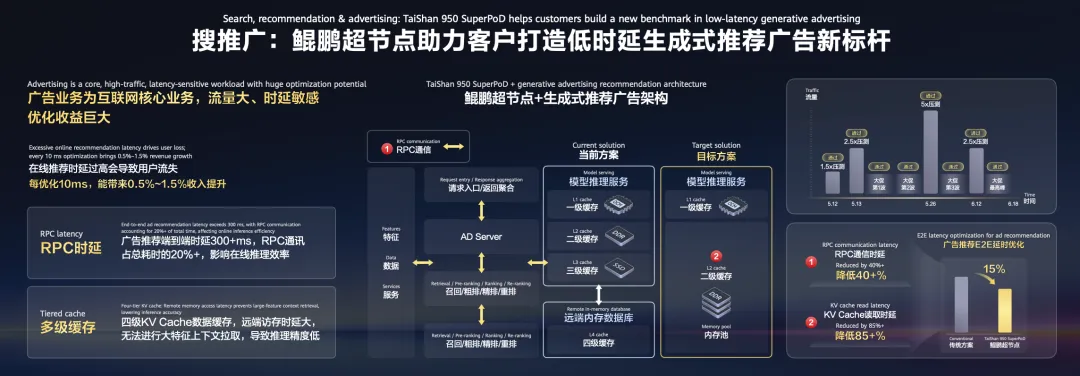
The system is extremely time-sensitive, and every 10 millisecond of optimization represents a revenue increase of 0.5 percent to 1.5 percent, which is true gold and silver.
In the traditional architecture, RPC communication in the recommended system takes the lead in end-to-end timing, while remote KV Cache access in the four-tier caching architecture is slow and unauthorized.
The solution to the hyper-node is that the hyper-node connectivity speeds up the RPC communication, and the memory cells pull hundreds of TB of KV Cache all "around" the end, bringing the remote nearer to the end.
The effect was remarkable: end-to-end online referrals dropped by 15 percent. The program, which has already gone through real-world battles in the 618th Beijing hurricane, is truly experiencing a surge in traffic flooding.
The recommendation system solves the "quick" problem, while the big model reasoning for the challenges faced is more complex, not only to be quick, but also to be able to "set down".
Since this year, the big model's upper context window has been extended from 128K to millions of Tokens.
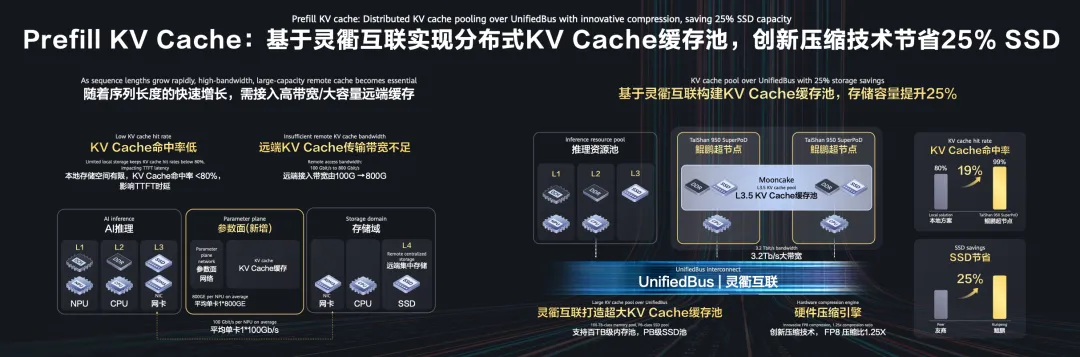
The longer the context, the more KV Cache that needs to be cached, the more local storage will quickly become unstable.
In the traditional scheme, the hit rate is less than 80%, which means that one in five queries has to be re-calculated remotely.
Supercharged nodes build super-large caching pools with supercharged connections, directly pulling the hit rate to 99%, while saving 25% of the storage space with hardware compression engines.
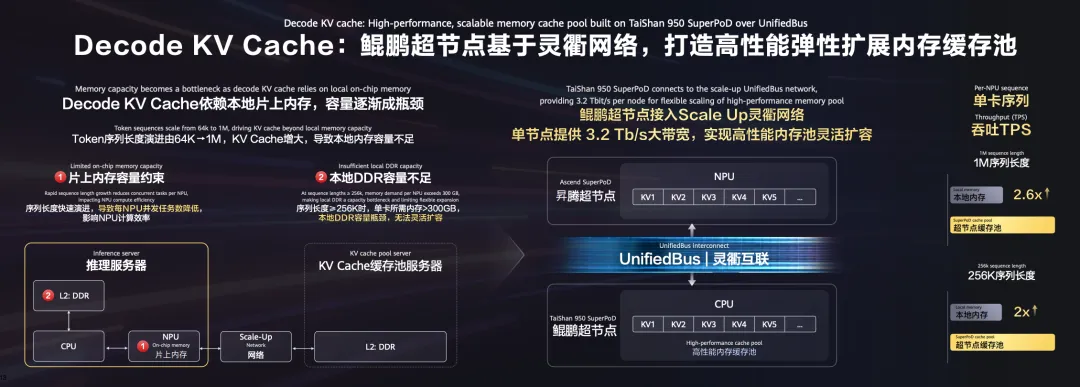
When it comes to the Decode stage, the problem is even more acute: when the context is drawn to 256K or even a million Token levels in a conversation, the memory required for a card exceeds 300GB, which is not enough for a single memory bar.
The hypernode takes in hundreds of TB of memory pools, which is equivalent to a direct "cloud warehouse" highway for each card, generating two to three times the speed directly, and the longer the context, the faster.
If the logical scenario test is "memory", then the Agent Sandbox test is "explosive".
An AI Agent needs a safe, isolated sandbox environment to execute code and call tools while working.
When using reinforcement learning to train the Agent, the power pump must simultaneously pull up 100,000 sand boxes to make parallel trials and mistakes.
The traditional server program takes 5 minutes to start the sandboxes, which is unacceptable for a training process that requires rapid iteration.
This process is compressed to 10 seconds using the lens pre-load and RemoteFork technology.
There's also an old problem: the more cores a CPU has, the more it stacks up, but the memory of a single unit keeps growing.
One hundred TB of super-nodule memory pool is equivalent to opening a huge shared workspace, with sandboxes coming in when they're used, and sandboxes coming out when they're stopped, and the same resources running up to 25 percent of sandboxes.
However, when Agent began to enter the core production system on a large scale, a more fundamental problem arose:
What would happen if the agent was "out of control", and if private data was leaked from the agent's memory?
The answer given by Liu is a three-tiered internal security architecture:
Chip layers, processors with built-in secure and reliable roots, supporting state-secret algorithms;
The system layer, secret virtual machines, plus a secure gateway, also locks data transmissions inside the hypernodes.
Application layer, safe sandbox along with state perception, real-time interception of abnormal behavior.
Under three-tiered interception, Agent abnormal behavior interception accuracy reaches 99%, while the performance losses caused by confidential computing are only one-fifth of traditional programs.
Safety is the bottom line, but keeping the bottom line can't come at the expense of performance.
Lastly: A contest about "choice"Looking back at this post, it's clearer that Liu's intentions are:
In a historical window of global CPU supply tensions, Agentic AI is reshaping its computing architecture to become "another option".
It's not about replacing who, it's about giving the market a new way to go.
This road has been under construction for seven years.
More than 300 integrated systems, more than 28,000 solutions, 4.16 million developers, and the thickness of the ecosystem is not overnight.
Today, the supergroup technology roadmap has been published, and computing is making a breakthrough from single-point to systematic competition.
The 4096 node cluster network and 100TB memory pool of hypernodes are not just a set of technical parameters.
It represents an architectural way of thinking, not simply stacking more servers, but through underlying network innovation that allows thousands of machines to work together as one supercomputer.
In the age of Agentic AI, thousands of industries are being redefined. Who can lead the way in building infrastructure that is run by intelligent agents will be the first to take the lead in the next round of competition.
The answer to that question is:It's an architectural transformation that gives the world a variety of choices.