It's the first time in the history of the world.
Just recently, the AI circle has welcomed a whole new black horse.
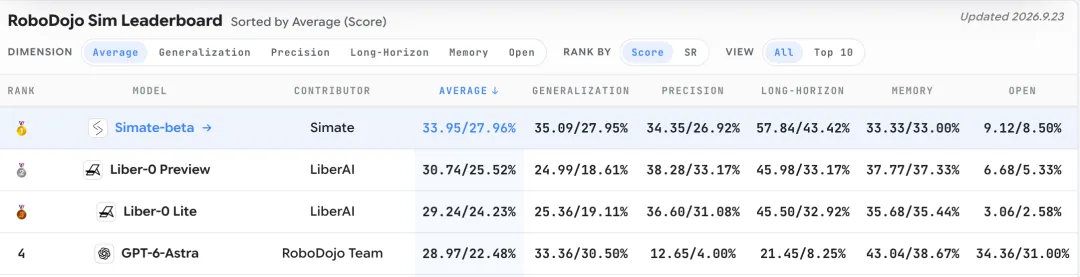
In the authoritative public rating list RoboDojo, a mysterious start-up founded in just a few months suddenly kills the surroundings, taking the world's number one.
This is a company called Simate, which has just completed a series of rounds of multi-billion yuan financing, with VCs, Internet factories and industrial capital breaking the threshold.
As one of the core technology heads of one of the world's leading autonomous driving companies, and one of the youngest rivals to the Ali P10 technology giant, Simate founder Zhang Yi participated in the development of the country's latest Tesla FSD intelligent driving system. Today, he is turning to Physical AI with a team of "industrial x academics".
In just three months, their responses shocked the industry: not only topped the list, but they also ran the Engineering Closing Circuit of Physical RSI.
It touches directly on the ultimate proposition that excites everyone: "What if the study of physical AI itself could be automated by AI?"
The "Sahi Monk" turned aroundWhen industry veterans meet academic geniuses
Why did Simate get hundreds of millions of dollars in funding in just two or three months and give an answer that shocked the industry?
The answer lies in its genes.
Anyone familiar with autonomous driving knows that in the past few years, the domestic smart driving route has been undergoing a brutal slaughter: from graph to no graph, and from one end to the other with pure vision.
Zhang Xuan was one of the most central "attackers" of the campaign.
Killing from a self-driving "sea of zombies", Zhang Yi knew how terrible the uncertainty of the physical world was, and how to combine cutting-edge AI algorithms with extreme engineering abilities. This time, he turned his attention to the broader general physical intelligence.
What's the experience when someone who's at the top of their self-driving "end-to-end" business decides to do physical AI?
The answer is to put the "brain" of the car into the "body" of the robot.
For this reason, Zhang founded Simate, where he is the founder and CEO.
With him, the "Dream Team" fought side by side, with a dual industrial and academic background.
As an assistant professor at the Hong Kong University of Science and Technology, he is the head of the World Mind Lab. He is a leading scholar who has made his mark at Harvard and MIT and is a world authority in the field of model and physical AI, having published over 50 high-profile papers at major summits.
He was one of the first representatives in the industry to implement universal humanoid controller authentication and was a founding member of ARI (later acquired by Meta), a Silicon Valley physics AI star startup.
A combination of top-level mass-production engineering capabilities × international cutting-edge research horizons × talented teenagers, allowing them to not only take first place on the RoboDojo, surpassing the GPT-6-Astra, DeepMind, but also demonstrate remarkable generalization in the long-range task execution, memory, and high-precision operation of real robots.
However, for Zhang and Simate, climbing to the top of the Robo Dojo is not the end of the line, it's just a "byproduct".
They're down, it's a big game.
Physical RSIIt's not "God", it's a machine that makes "God".
At present, physical AI research faces a huge pain point: physical experiments are too slow, too expensive, and too easy to fail.
Physical AI research is often dead in the middle of nowhere, not because of the lack of a great idea. Modeling, data washing, environment mapping, running evaluation... Human energy is being consumed by mass engineering.
Simate's solution is the RSI.
For a long time, the RSI has remained in the discussion of LLM. Simate, for the first time, has systematically landed the RSI and proposed a long-term path to Physical RSI.
What is a Physical RSI? Simply put, it's about letting the whole system run steadily, accumulating experience, making their own assumptions, experimenting on their own, improving their own methods to improve the intelligence of robots.
Simate is the first company in the world to systematize RSI to Physical AI.
They built a system of continuous evolution towards Physical AI. In this system, research is not a series of well-written dead tasks, but a continuously modified organism based on experimental feedback.
Currently, Simate has pragmatically chosen the "weak RSI for co-driving" as a phased starting point.
Human researchers are responsible for guiding, setting goals and constraints, and controlling macroeconomic decisions.
AI agents combine existing knowledge bases to independently make assumptions, plan experimental pathways, modify code configurations, perform verification and analyze results.
It was under this "weak RSI" paradigm that Simate introduced its killer AutoResearch automated research system.
It succeeded in breaking the bottleneck of human fitness, making the scale and speed of research explode exponentially, topping the RoboDojo global rankings!
Disclosure of AutoResearchHow does AI do its own research?
Simate was able to take first place in the public rating of RoboDojo, and it was supported by a set of autonomous research infrastructures that allowed ideas to continue to be grounded, validated, and generated.
Let's take a closer look at how AutoResearch actually works.
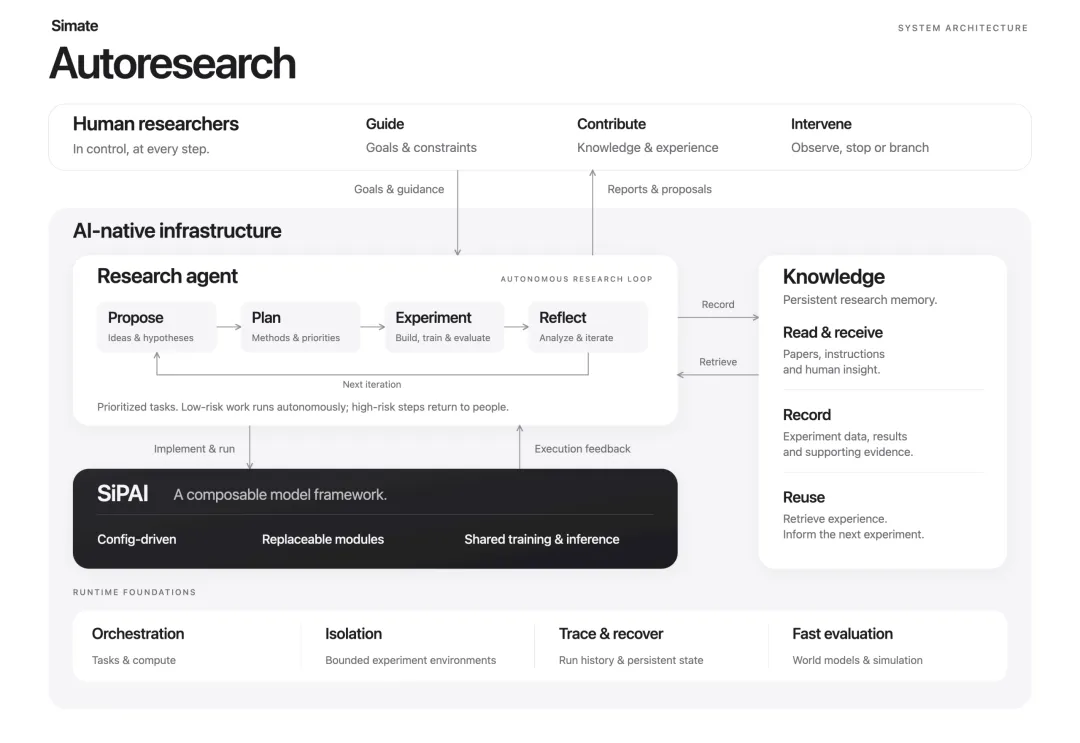
In this set of system graphs, we can clearly see a cycle: "Propose hypotheses, plan experiments, perform verification, analyze hypotheses, iterate".
1. Implement research ideas as model changes with SiPAI
In order for Agent to be truly involved in the research, the model must be understood, dismantled and assembled like a Lego brick.
Simate has built a plug-in model framework called SiPAI. It supports various architectures such as World Models (WM), Action Models (WAM), VLA (Visual Language Action Models) and others.
When faced with a specific problem, the agent can directly replace the components, adjust the configuration to perform experiments, without having to rebuild the entire project each time. This gives the idea of research a clear "landmark".
2. A rock-solid AI-native infrastructure foundation
Supporting a large number of automated experiments simultaneously is an extremely powerful infrastructure.
It supports multi-agent sorting and docking scheduling, training and reasoning are unified scheduling, and supports dozens of research directions to be conducted simultaneously.
Even if an agent writes a code with a bug that causes the crash, environmental isolation can ensure that it does not affect the whole, and the interrupted work can be restored instantly.
In addition, world models and simulation environments provide Agent with second-level quick feedback to help the system quickly determine which changes should be retained.
3. Overview of the research process: making evolution traceable
When hundreds of experiments are running in the cloud at the same time, how can humans control the whole world? AutoResearch provides an amazing visual interface.
Through the "Research Spectrum Map", researchers can see the pulse of each attempt: how the program is continued, adjusted, or stopped. Through the "Running Timeline", they can accurately track the trained and evaluated state, which becomes a dynamically expanding "tech tree" map.

What is even more terrifying is that the subjects of AutoResearch research are not only the models themselves, but also the research processes themselves.
At the data level: it does its own data comparison experiments, comparing which combinations of actions improve the weaknesses of the model, thus answering "what data to train next".
At the model level: in the face of long tasks, it will autonomously experiment to find the perfect balance between "memory capacity" and "running costs".
At deployment level: it even studies the length of execution of predictive actions, exploring the best strategies between model prediction and real deployment.
Each round of experiments improves the model while also paving the way for the next round of research.
The most powerful general-physical acceleration system on the Earth
In addition to this powerful automated research system, Simate is developing a "monster-level" model: a generalized, zero-sample accelerated general-physics system.
If you've seen their latest reality show, you'll be shocked.
In complex long-range missions, the mechanical arm exhibits incredible memory, high-precision operation and generalization capabilities. It can be said to "understand" the physical world.
Behind this are the two core souls of the Simate model.
The first is 4D physical perception.
For robots to function, they must understand physics.
Simate is deeply embedded in the model in the variations of depth, geometry, motion, shadowing and interaction between space (three-dimensional) and time (one-dimensional). They significantly reduce operating expenses through efficient visual coding and time-space modeling.
This means that they are pushing the size limit of the end-to-end deployable models to the extreme.
The second is the layered timing mechanism.
A lot of robots are working and have forgotten how to do it before, or because they process too much historical information, which causes the system to become a cartoon. Simate has created an excellent screening mechanism around "task progress memory", "continuity tracking" and "immediate change feedback".
The model can both remember what just happened and react quickly to current emergencies.
Based on a single suggestion from the context above, the model can be replicated in new tasks, new objects; fails to self-adjust using historical information; elaborate operations of up to dozens of steps, complete.
This is the transition from "demonstration learning" to "long-range execution". In future plans, the strongest "physical fast system" on the map will also be coupled with the "slow system" that dominates reasoning, launching a total offensive to zero samples, fewer samples and general operations.
How big is the model? How many parameters? Simate revealed that it will be revealed in a recent in-depth report.Calculator invites you to come.
Looking back over the past few months, Simate's rise has been remarkable.
A bunch of big cattle gathered together and pulled out hundreds of millions of dollars' worth of real gold and silver, and instead of rolling up video footage of a machine arm, they pulled out the deepest pain in the industry, creating an RSI system.
Simate is a Chinese name that means "companion".
Their vision reads: Silicon evolving with humanity.
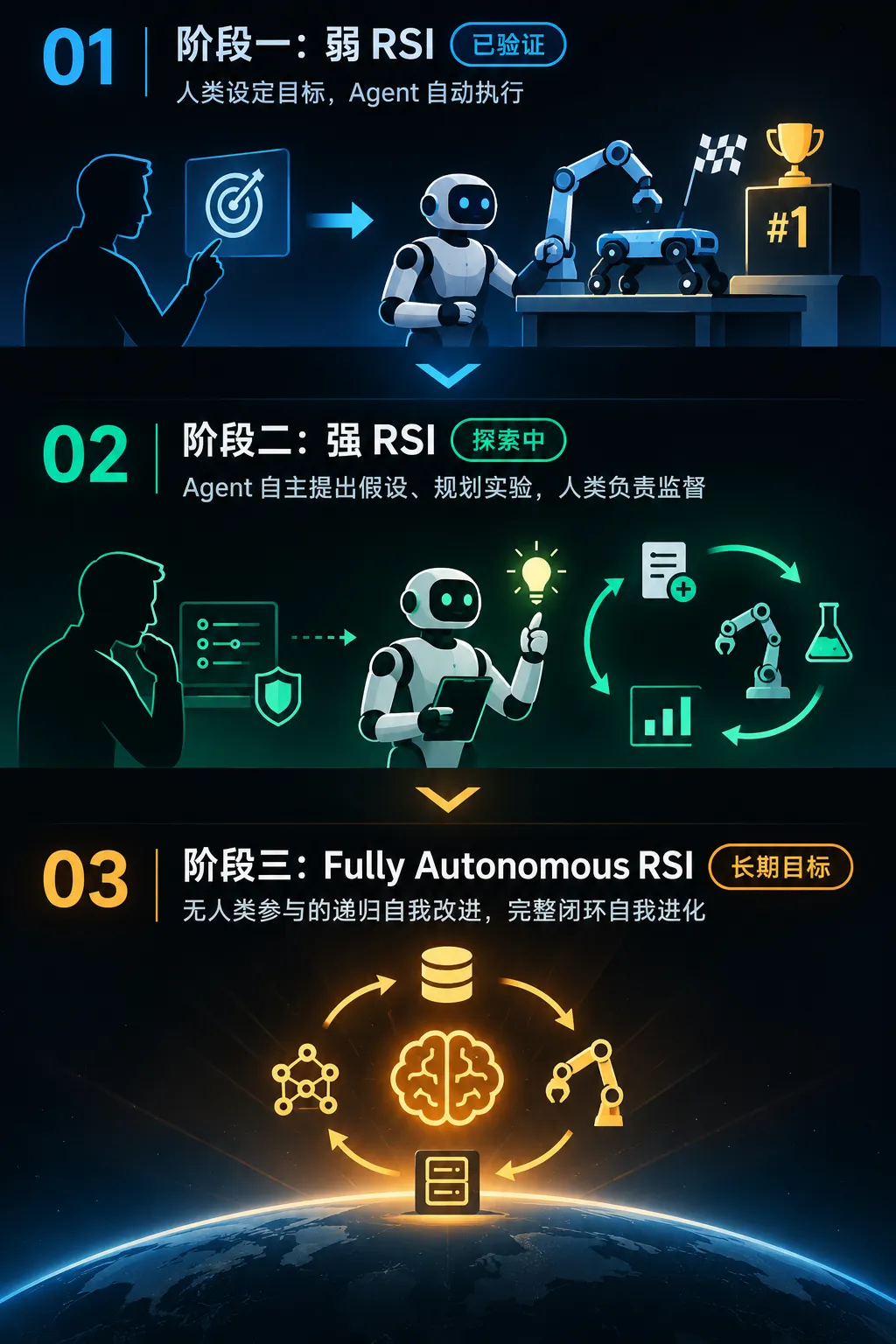
Simate's roadmap has a clear three-step strategy.
Stage One: Weak RSI (validated) Human set targets, Agent automatic execution RoboDojo 1 is the best engineering proof
Phase Two: Strong RSI (in exploration) - Further reducing artificial intervention. Agents will independently come up with research hypotheses, plan experimental pathways, and humans will only be responsible for target governance and critical decision-making oversight.
Stage Three: Fully Autonomous RSI (long-term goal) Recurring self-improvement, research, data, models and real deployments without human involvement are fully autonomously operated by systems, with physical intelligence achieving true self-evolution.
For them, the weak RSI validation is just the beginning.
"Every time data is collected, every time automated experiments are conducted, every time a real robot is deployed, it is accumulating replicable experience for this route. We will continue to explore until we achieve RSI without human involvement".
The good news is that AutoResearch, the world's leading research platform, has officially launched in-person recruitment!
Currently, students from over a dozen of the top universities in China, North Korea, MIT, California Tech, Harvard, and Kochi have taken the lead.
If you've had enough of this, if you want to experience the thrill of letting AI help you do research...
The Simate AutoResearch research platform is currently in the process of recruitment.
This is the first time I've seen this.
RoboInd editorial channelResearch, robotics companies and market intelligence for cross-border sourcing.Explore the channel ↗
Share this
End of editorialExplore more from Global Robotics News ↗