
It's the first time in the history of the world.
I don't think it's a good idea for Claude to be put to shame by his own "A.I. Boy".
This morning, Anthropic released a hardcore engineering review.
They threw an internal study version of Claude into the Slack Channel, and it took two weeks for Hardcore to accelerate the overall speed of the claude.ai web version and desktop edge by three times.

One of the most bizarre performance bottlenecks in this set of operations occurred in Claude's own speaking habits.
It's called the "ChatGPT Connected Character" by netizens, and many writers have had to manually delete crack codes to prevent AI detection.
Good guy, it used to be that "A.I. Boy" not only blinked his eyes, he could actually use a web drag card.
What's worse is Chinese users.
According to the official discovery principle, there is no need to break the code at all, as long as there is one character in the response, the response with the code will be directly limited...

"A.I. Sweetie", is that Claude's life?That's the way it is.
During the performance rush, Claude carved out the entire station's CPU cartridge and noticed a strange phenomenon.
Some code responses are just finished, and when the page begins to give the code a high-pitched syntax (i.e. to give the keyword a colored comment), the entire web page "shuts down" for almost a second.
The last person to find the culprit, Claude Shonda, was the breaker.
The reason for this is that the V8 engine (the JavaScript core of the browser) has two stored string formats, the single-byte format runs fast, but only with English letters, numbers and a few Western European characters (a set of Latin-1 characters); the double-byte format can load anything, but it is slower to process.
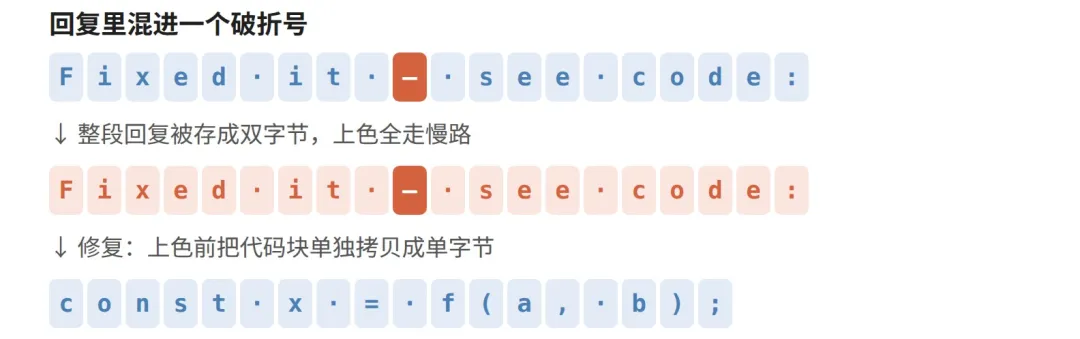
The rules are simple and rough, as long as a single-byte character is not embedded in a text, the whole section must be stored in pairs.
Claude wrote a breakdown number by hand, so that the entire response was limited in speed, and the normal expression on the code was slowed down.
And the way to fix this bug is simple, with only 20 lines of code.
Each block of code is copied separately and stored as a single-byte string.
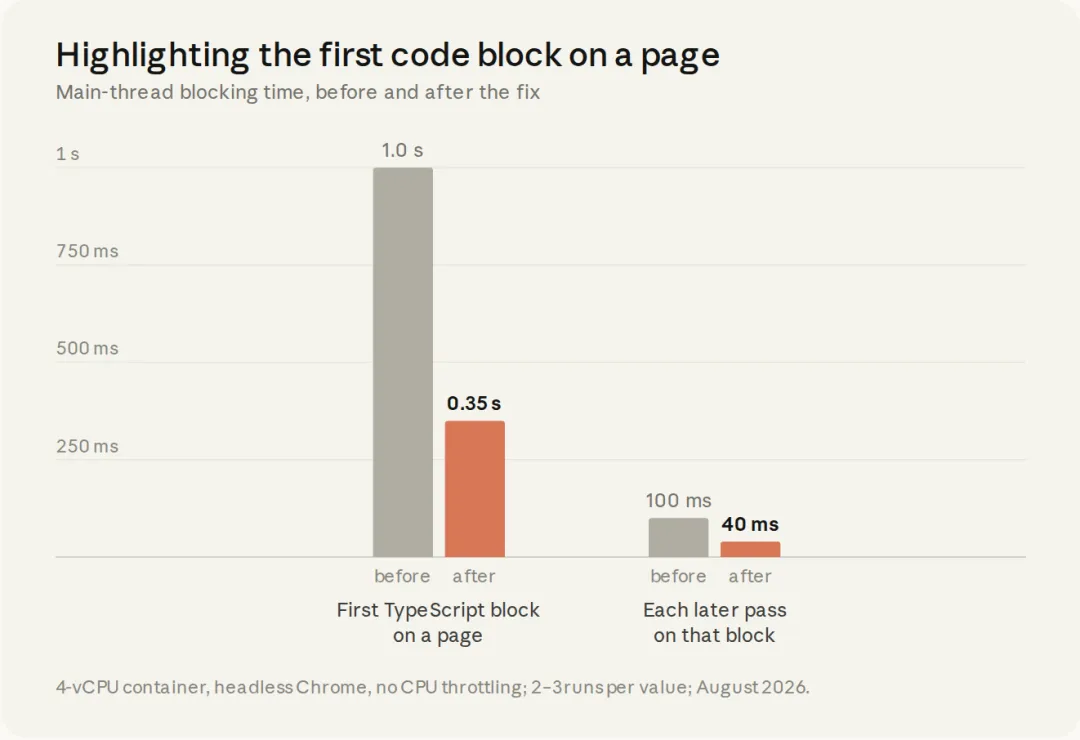
As a result, the coloring time of the first block of code decreased from 1.0 seconds to 0.35 seconds.
Breaking the code as a symbol of "one-eyed AI" has long been criticized by netizens.
OpenAI was dedicated to ChatGPT last year. This month's statistics show that the GPT-6 Astra has only one-eighth of the frequency of breakdowns in humans, and the Gemini 3.1 Pro has almost completely stopped.
In contrast, Claude Opus 5 is still my masterpiece, based on the frequency of human writings.
Anthropic's brain circuits are also amazing, and AI's speech habits are constantly changing, directly changing the underlying code of the web page, so that the entire web page adapts to the breakdown number!

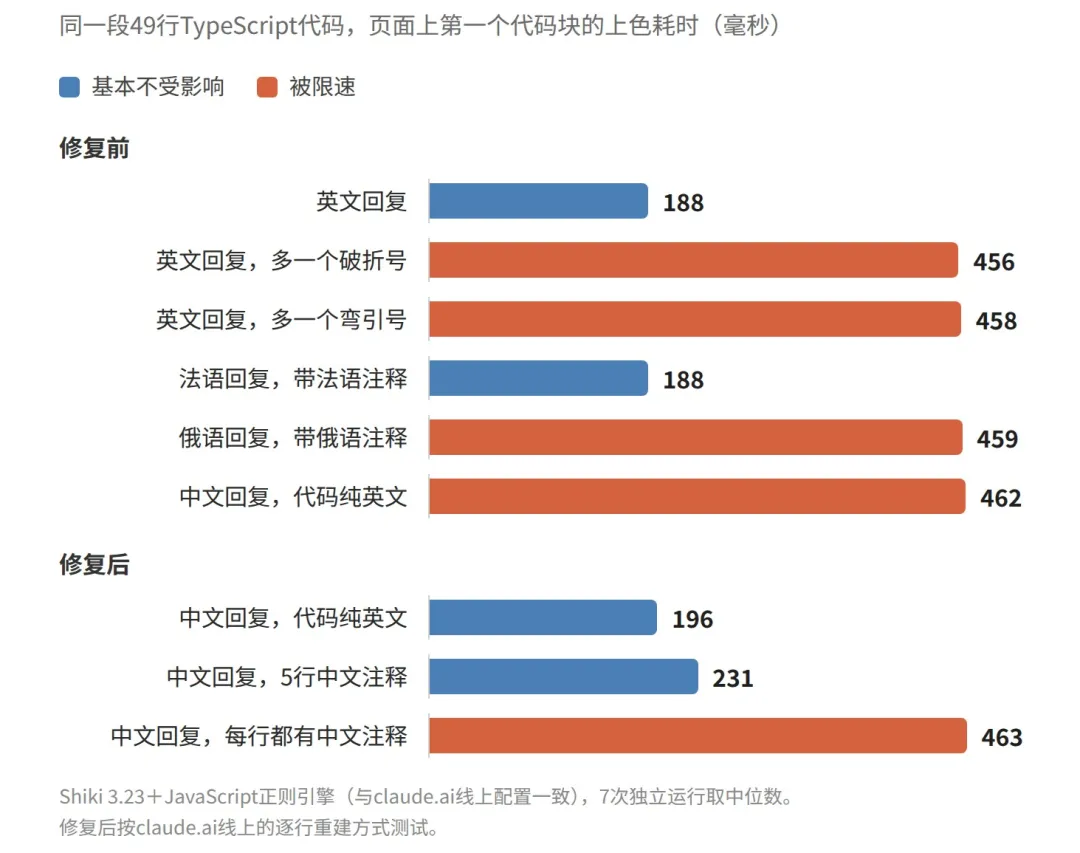
To verify, we flipped the front-end code on the claude.ai line. They used the Shiki high-gloss library, the bottom of which was the normal V8 self-propelled engine.
We color the same code according to this set of environments.
If the answer is purely in English, the first block of code is only 188 milliseconds; but as long as it is mixed into a breakdown number (((or a comma number), the time directly falls to 456 milliseconds.
The Chinese response was even more desperate. The code did not change a single letter, taking as long as 462 milliseconds, about 2.5 times slower.
In other words, English users don't intervene to see if there is a "breakdown number"; and Chinese users, as long as there is a "character" in the answer, can't run every line.
As long as the code is entirely in English, even if the answer is in Chinese, the speed can be fully restored.
A Slack channel, three times faster in two weeks
As a result of this performance impulse, the breakdown is actually just an appetizer dish.
In August, Anthropic built a name#claude- the Slack channel of the apps-perf, pulling an internal research version of the model (capacity approximately equal to Opus 5.5) as the on-site workshop.
Claude came up and set 13 acceleration targets. The human team thought he could do it for two weeks, and by the third day, 13 targets had been cut off by Claude.
It's just a matter of time before the page is loaded and you can start typing, which is the landing in the last few days.
 The left side is 2.93 seconds before the correction; the right side is 0.36 seconds before the correction.
Since the human team had just opened their hands and left Claude alone to find a blind spot, the more outlandish the idea was.
As a result, the machine is completely insane.
At its peak, the channel ran more than 150 threads simultaneously, and one thread prompted 50 to 100 code merger requests.
The later the more the threads were simply created by Claude himself.
Each time the switch is switched on, the speed limit is locked, and the switch is switched off again.
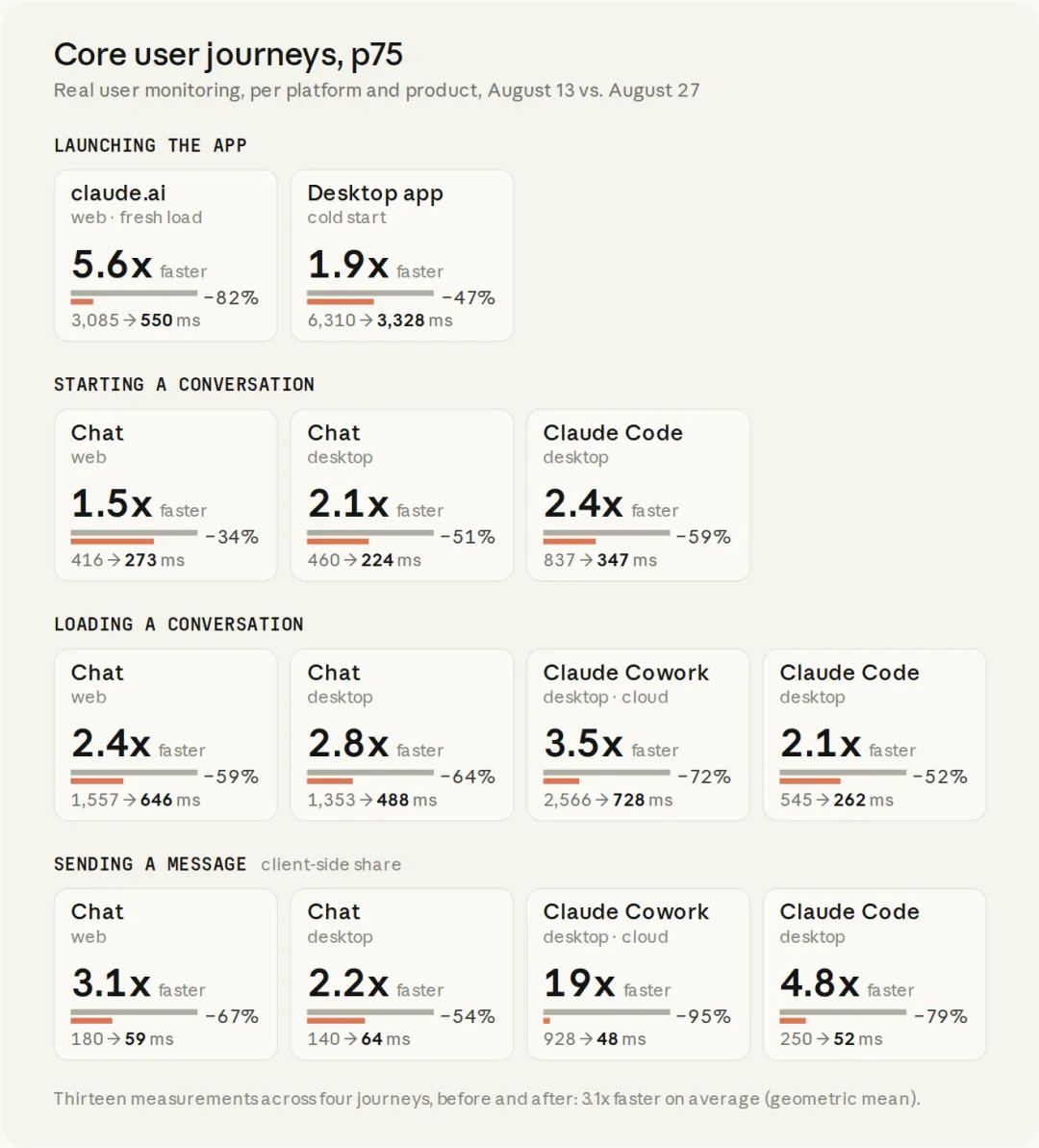
Eventually, the web page shortened from opening to typing by 3.1 seconds to 0.55 seconds, 5.6 times faster.
There have been more than 3,000 underlying changes, and according to official reports, there has never been a single user-perceived accident, zero rollback.
AI is slow, humans are crazy about stepping on the gas door next to it.
In this frenzy, the role of humans and AI has completely reversed itself.
The child was basically Claude's, but with a "rule sense" in his bones, he found that the problem had to be solved first, and that there was still enough left to evaluate the work period.
It's humanity that drives it to accelerate.
At one point, Claude said it would take several days for a performance monitoring code to come up this week, along with merging, deployment, and baseline data.
Human engineer Raymond went straight back to Slack and said, "You're right, I'll give it to you right now.
A minute later, Claude snapped a second and replied, "Well, an hour of in-PR".
The brake rights are still in the hands of humans. Whenever the changes are visible to the naked eye, Claude must attach a recording screen and human patch to the front and back counterparts.
Finally, the input box for "pre-typing", which Claude assigned to it, required 14 screen sizes, and static versions and real React rendered interfaces aligned to within 1 pixel.
After four hours of online internally, a colleague discovered that when a new tag page was opened, the input box would occasionally go downwards.
Claude saw the recording screen and went straight to the Google Chrome browser, and with good reason.
In the background, Chrome pre-rendered the page with a 56-pixel prompter at the bottom, and the rendering height was shortened. When the page pops out, the prompter disappears, the height is instantly extended, and the input box is located at a height of 18%, which will drop 10 pixels (0.18 x 56).
It's not bad at all, it's 10 pixels.
Finally, even Anthropic announced this optimization in a tweet that left the "two-byte crater" behind.
The tweets were probably intended to prevent "claude.ai" from becoming a link, filling a zero-wide gap that is invisible to the naked eye; the words were used as "crowd dropping".
If it hadn't been for a heart attack that changed the code, Claude would have cited the tweet in his reply and then followed it up with a code that would have been limited.
RoboInd editorial channelResearch, robotics companies and market intelligence for cross-border sourcing.Explore the channel ↗
Share this
End of editorialExplore more from Global Robotics News ↗