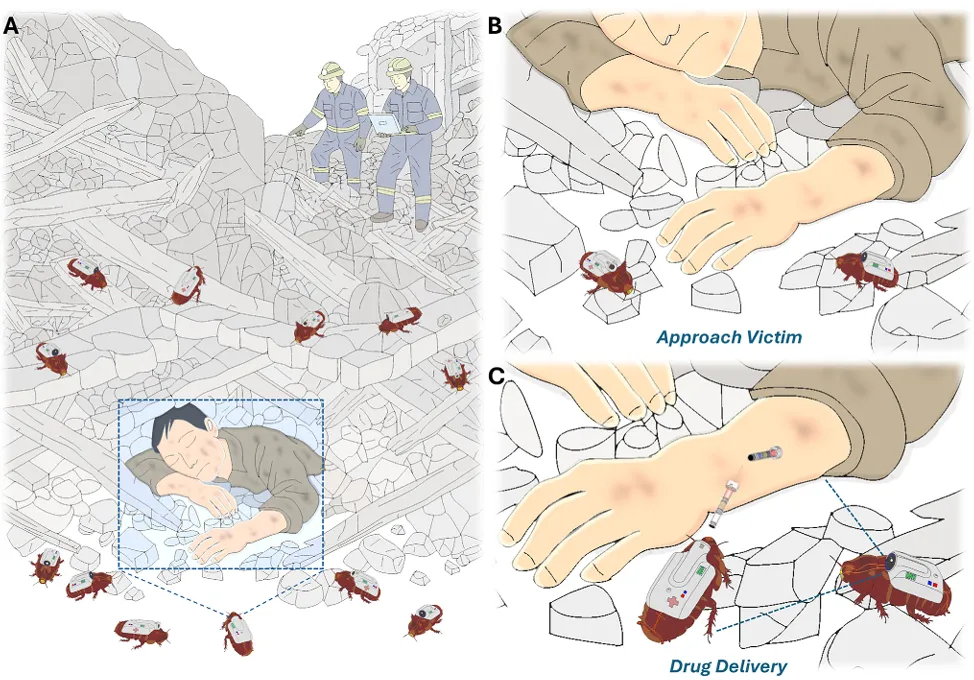
“ It is also possible to use the injector on the back to rescue people from the ruins, and two groups of people can work together.
A team of researchers from the University of Queensland and the University of New South Wales, Australia, recently published an interesting finding in the journal Advanced Science: They installed automated injection devices and cameras on living insects to transform them into "half-mechanical rescue insects" (Paraborg) that can dig into the ruins and deliver drugs to injured people.
Over the past two decades, insect robots (cyborg insects) have been searching for cities after disasters such as earthquakes. They are low-powered, physically tough, and also carry sensors that can drill into the narrow gaps that robots can't access. But an inevitable question is: after finding survivors?
This time, Paraborg is trying to move insect robots from "search" to "rescue on the ground".
01.
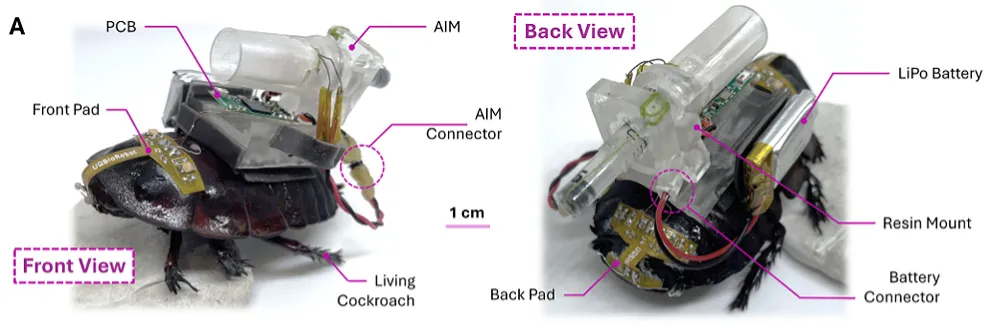
One pumpkin can carry an injection system.
The study selected the giant cavity rhinoceros (Macropanesthia rhinoceros), which is about 84 millimetres (87 in) long, weighs 34 millimetres (40 g) and has a lifespan of up to 10 years.
Studies have shown that zinc can weigh about 1 tonne and 2 times its own weight without affecting normal operation. The team set a hard benchmark according to which it is important to control all integrated components within about 50 g (about 1.5 times the weight). In the end, this type of device (injection modules, resin racks, circuit boards, etc.) only allowed zinc to increase in weight by about 15 mm, adding about 17 g, and experiments showed no significant effect on its operating ability.
The core automatic injection device (AIM) is designed with a more sophisticated design. It uses a compressed spring to "launch" the injector, and the release of the spring is triggered by a hydrogen alloy to generate electricity, disconnecting the attached fishing line. After the injector disconnects from the launch tube, the internal diaphragm is cracked and the originally separated sodium hydroxide and carbon monoxide mixture reacts, generating carbon dioxide, producing pressure, which drives the syringe to inject the drug into the target.
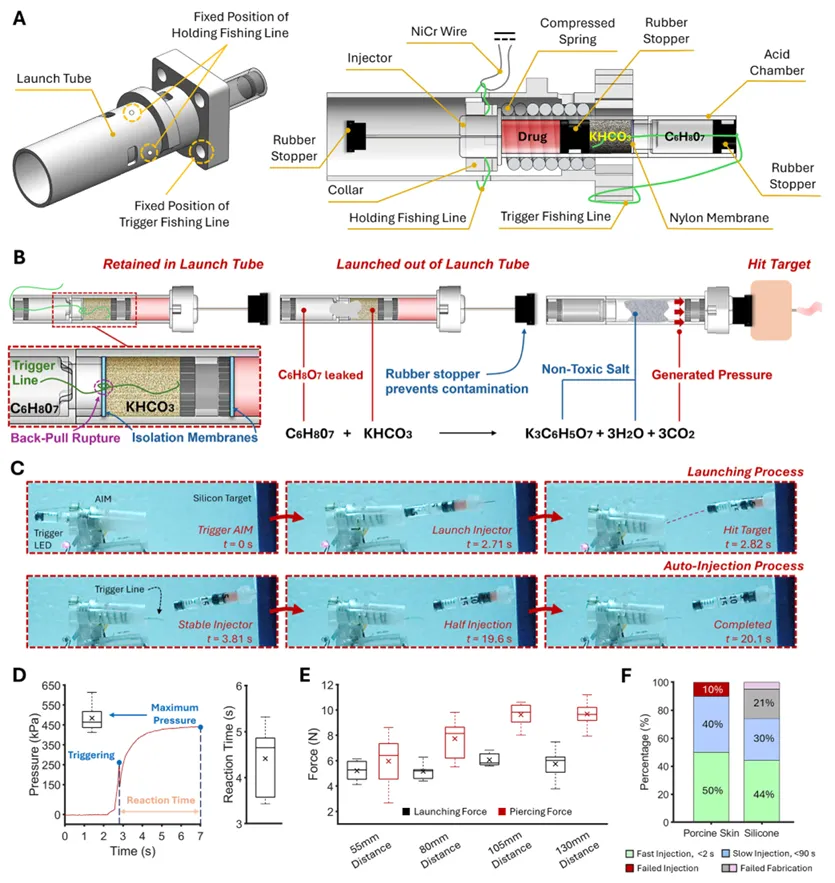
The test showed that the chemical reaction reached a peak pressure of about 470 kPa in about 4.5 seconds, and the emission was stable at about 5.6 tonnes. In the off-body test, the success rate of the injection to pig skin was 90%, penetrating to a depth of about 5.5 mm; the radiation to silk was 74%. The trigger could only be completed with an electrical signal of about 3.5 seconds from the circuit board.
However, the currently measured penetration strength of 6 tonnes of 10 cows is significantly higher than the typical insertion required by human skin needles, so these data on the cows are not directly equivalent to the safety of the human body.
02.
How did you "open" the door?
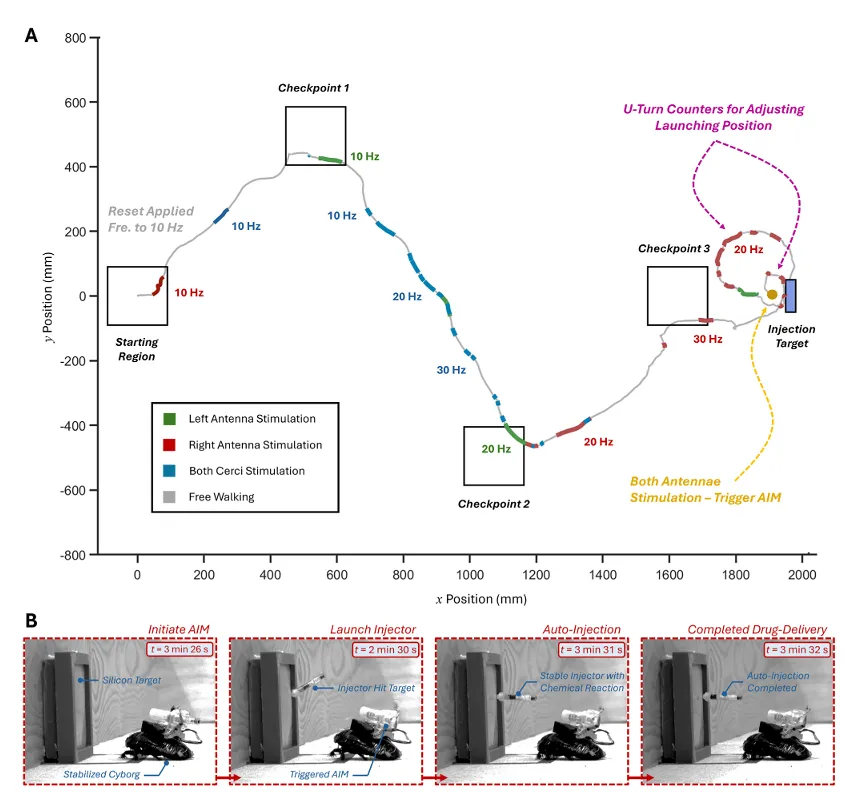
The Paraborg is essentially remotely controlled. The team controls it by applying electrical stimuli to the tail and tailbone (cerci): it stimulates the left tailbone, turning right; it stimulates the right tailbone, turning left; it stimulates the two-sided tailbone, accelerating forward.
Within the 10 Hz 50 Hz range, unilateral tactile stimulation can lead to a steady increase in the angle of rotation (the left tactile increased from about 27.7 degrees to 59.5 degrees). While tactile stimulation can also be accelerated, the correlation is weaker, not linearly controllable, and the team recommended that tactile stimulation be more appropriate with 10 Hz 40 Hz.
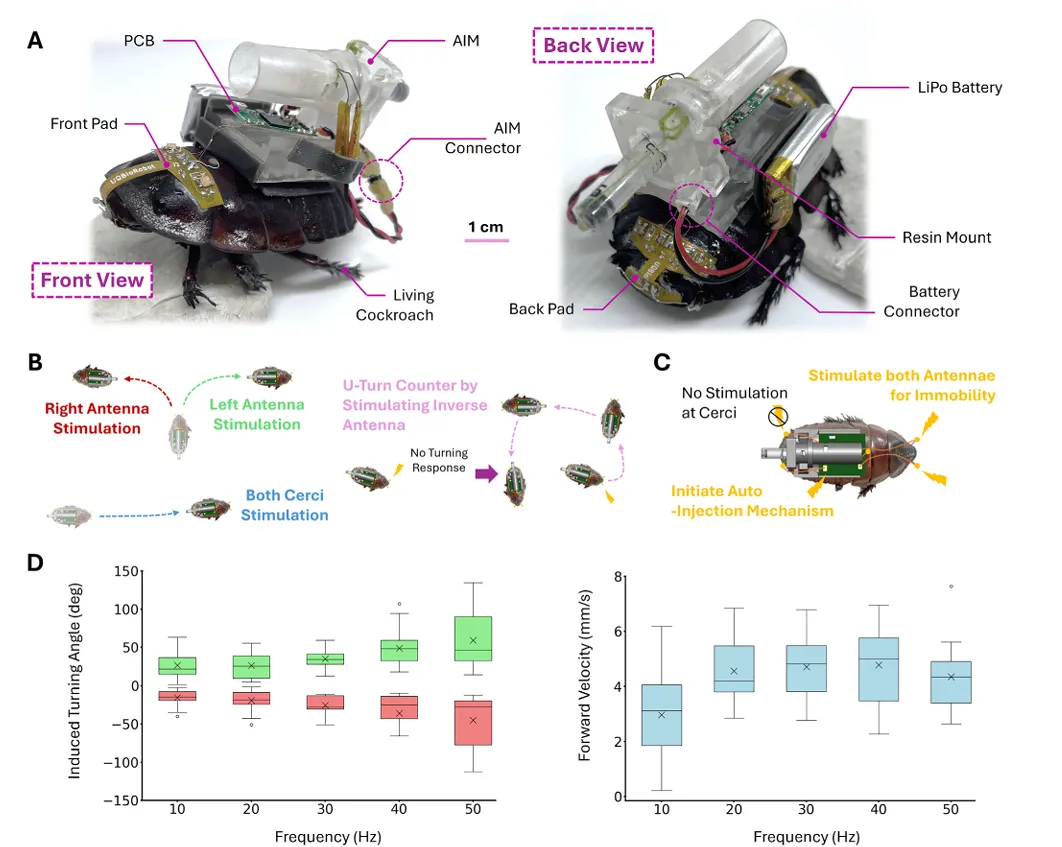
After all, insects are alive, and for a long time they become "habituated" to electrical stimuli and become unnoticed. For this team, two new tricks were devised: first, a "U-type inversion counter", which gives the other side a series of low-frequency stimuli when the one-sided taper does not respond, inducing it to turn its head towards recovery; and second, to increase the stimulation frequency by 10 Hz when both sides are delayed.
At the critical moment of the punching, there is a special stability strategy: after the third checkpoint, after entering the launch range, stop the tail needle stimulation, only use a low-frequency unilateral touch to stimulate the dimming direction, and finally use a two-sided touch stimulation to "settle" and trigger the injection.
Using this set of controls, Paraborg passed 100% of all trials at three checkpoints. In 25 injection trials, 72% successfully injected the drug into the urine. The study further notes that the success rate of the injection can be about 95% when triggered at a distance of 150 mm from the target; while at a distance of 150 mm to 250 mm, the failure rate increases significantly.
03.
One with a knife and one with an eye: Twins Collaborate
Plugging the camera and the injection device into a hose would increase power consumption and drag dynamics. So the team came up with the idea of a "team operation": sending at least two Paraborgs together.
One is an "observer", behind a wireless Wi-Fi camera (2.4GHz, about 24 watts, lasting about 2 hours), who is responsible for finding the wounded and providing real-time imaging; the other carries AIM, who is the real "drugman".
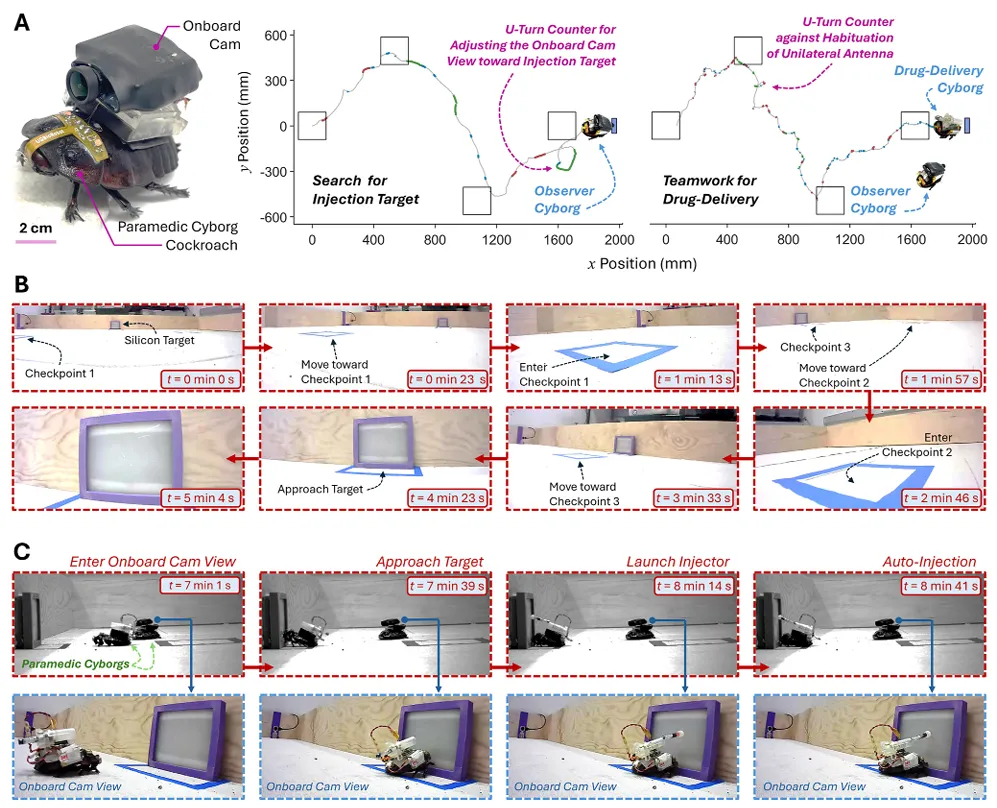
The study also verified the simultaneous scenarios of the two monkeys: the observer provided the image and could act as a "navigator" overseeing the other. When the two temporarily lost visual contact in a narrow environment, the pharmacist was allowed to stay alive, and the observer bypassed the obstacle to find it again.
It is worth noting that the team has repeatedly pointed out that the final decision on whether to inject the human-in-the-loop vaccine was made by a person, and that it was always given to trained medical and rescue personnel rather than to the insects themselves.
The researchers also did not shy away from limitations: the experiments were conducted in controlled environments, not yet faced with debris, sand, and complex terrain in real ruins; the blue signal would be greatly degraded by concrete and soil; and more rigorous studies were needed on drug compatibility, clinical dosage, and so on.
Despite this, the work is still considered the first systematic verification of the concept of "rescue insects", moving insect robots from "search" to "on-site medical intervention". In the future, there may indeed be a "rescue team" made up of a group of semi-mechanical insects in their respective fields.
The link is as follows: