This morning, the most powerful model Grok 4.7 from SpaceXAI arrived.
At the beginning of the publication, there was only one highly "aggressive" position: the most powerful model for programming and knowledge work, reaching twice the speed of the convertible model, at only half the price.
The upgrade didn't stop at the running scoreboard. Groc 4.7 replaced the larger base model, reinforced long-term tasks, self-checks and improved context management capabilities, and incorporated specialized work such as documentation, demonstration documentation, law, medical, and engineering into focused testing.
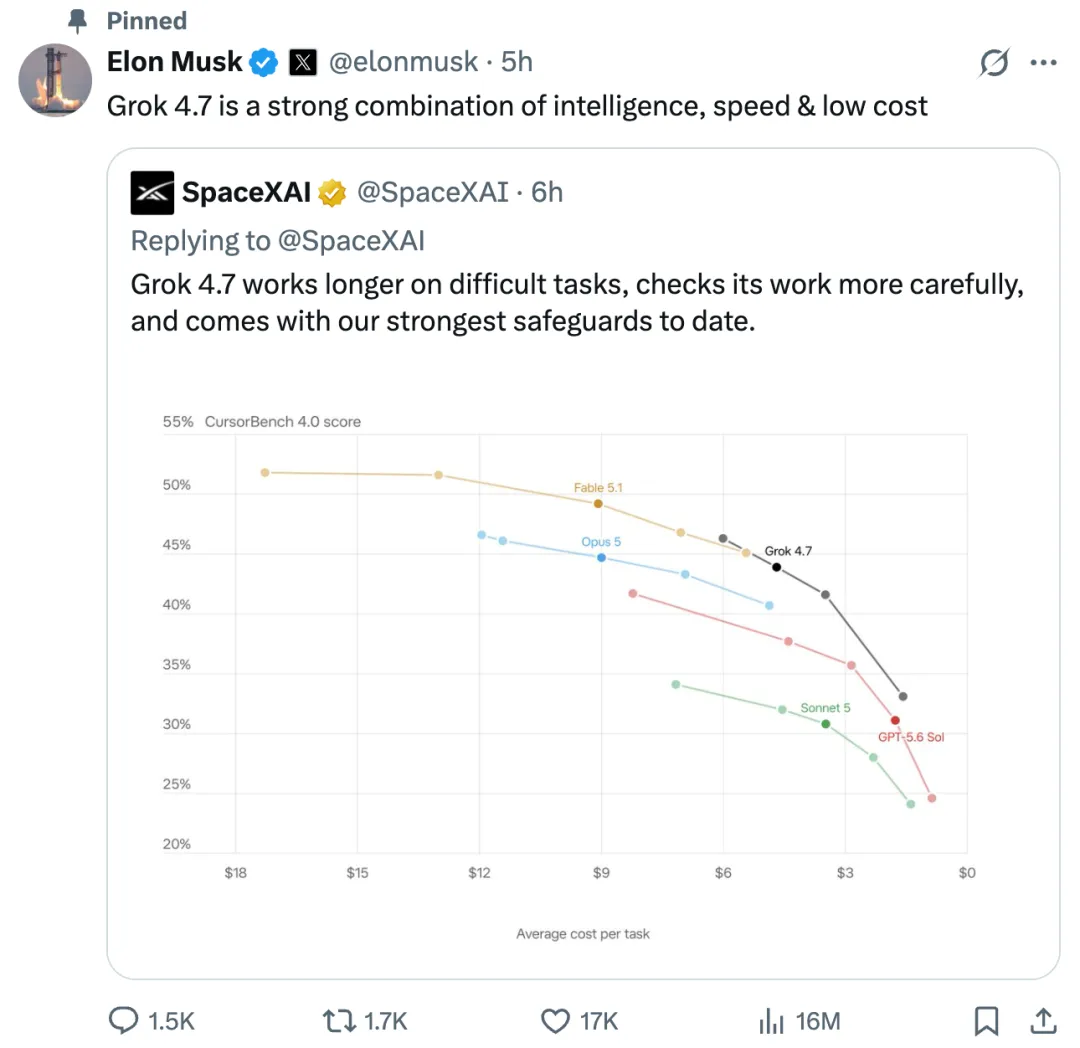
According to Musk, "Grok 4.7 has achieved a very competitive balance between the level of intelligence, running speed and cost".
Long-term mission to become the main battleground of this generation of models
Grok 4.7 uses a larger basic model than Grok 4.6. The training phase extends the reinforcement learning cycle and further complicates the task portfolio, with more samples taking hours to complete. SpaceXAI says the new model has improved both in terms of checking its own work and managing the context.
This type of improvement is one of the most tricky problems facing current programming intelligences. Short code generation often requires only local judgement, but truly complex software tasks involve reading repositories, dismantling requirements, modifying multiple files, running tests and repeatedly correcting errors. Whether a model can keep targets in a long execution chain, finding errors, is often more important than writing beautiful code at once.
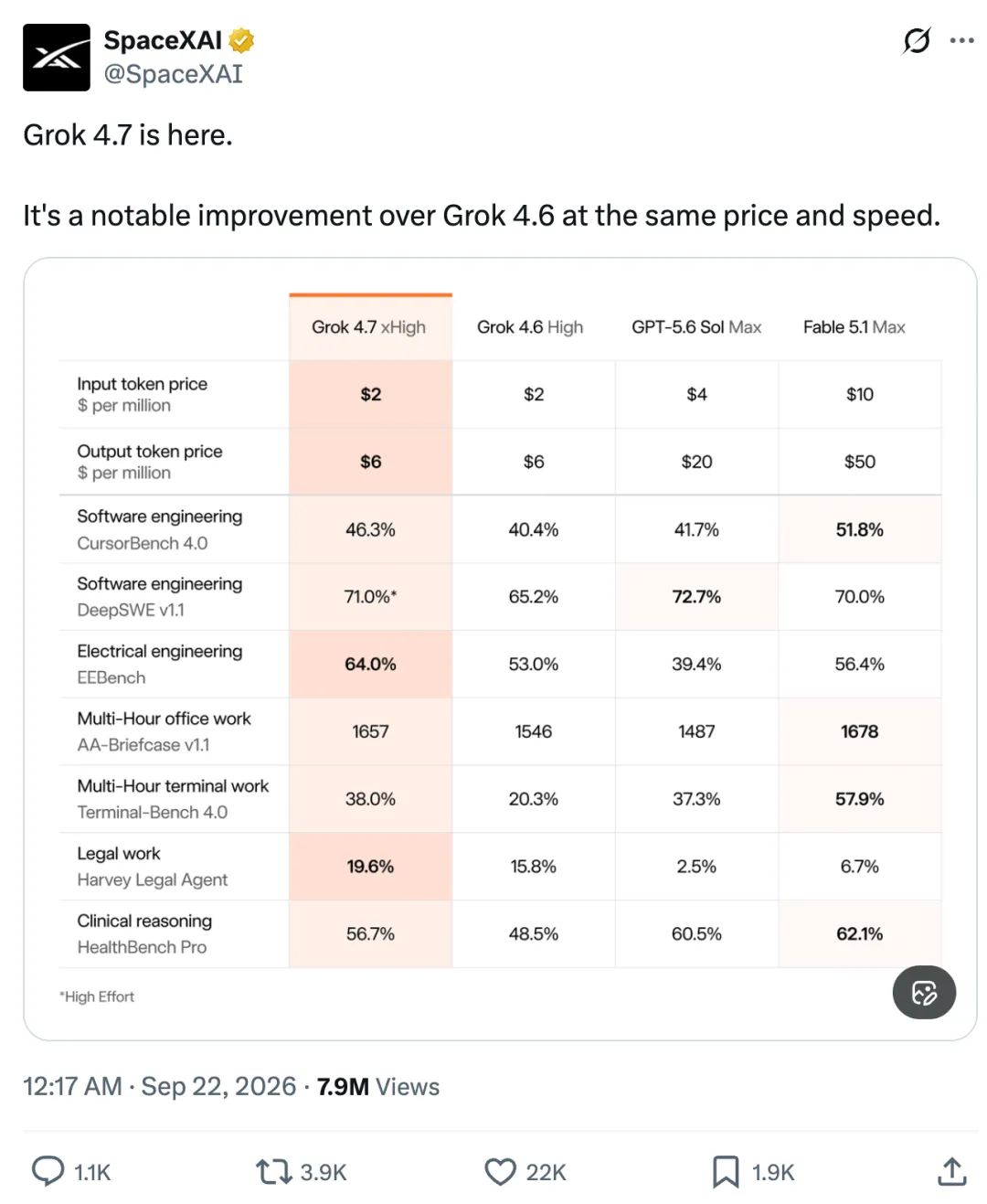
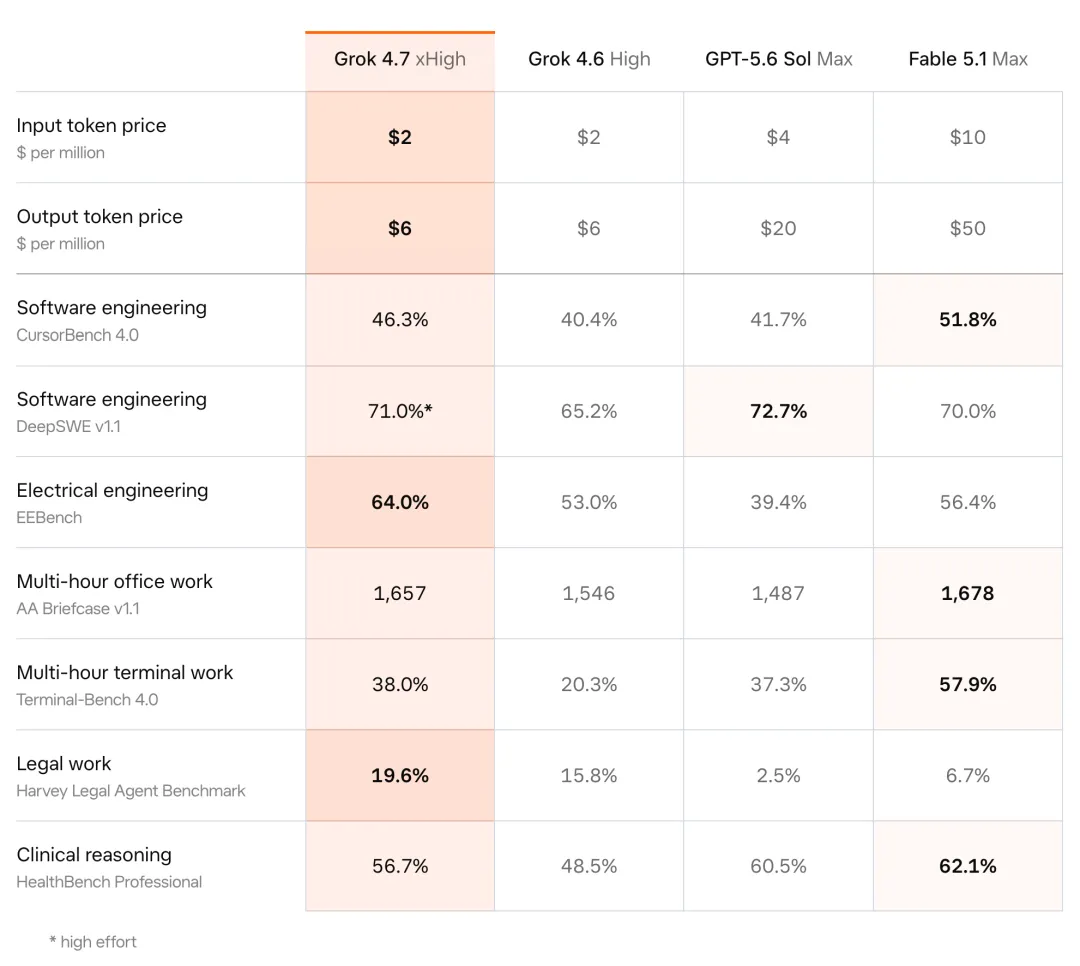
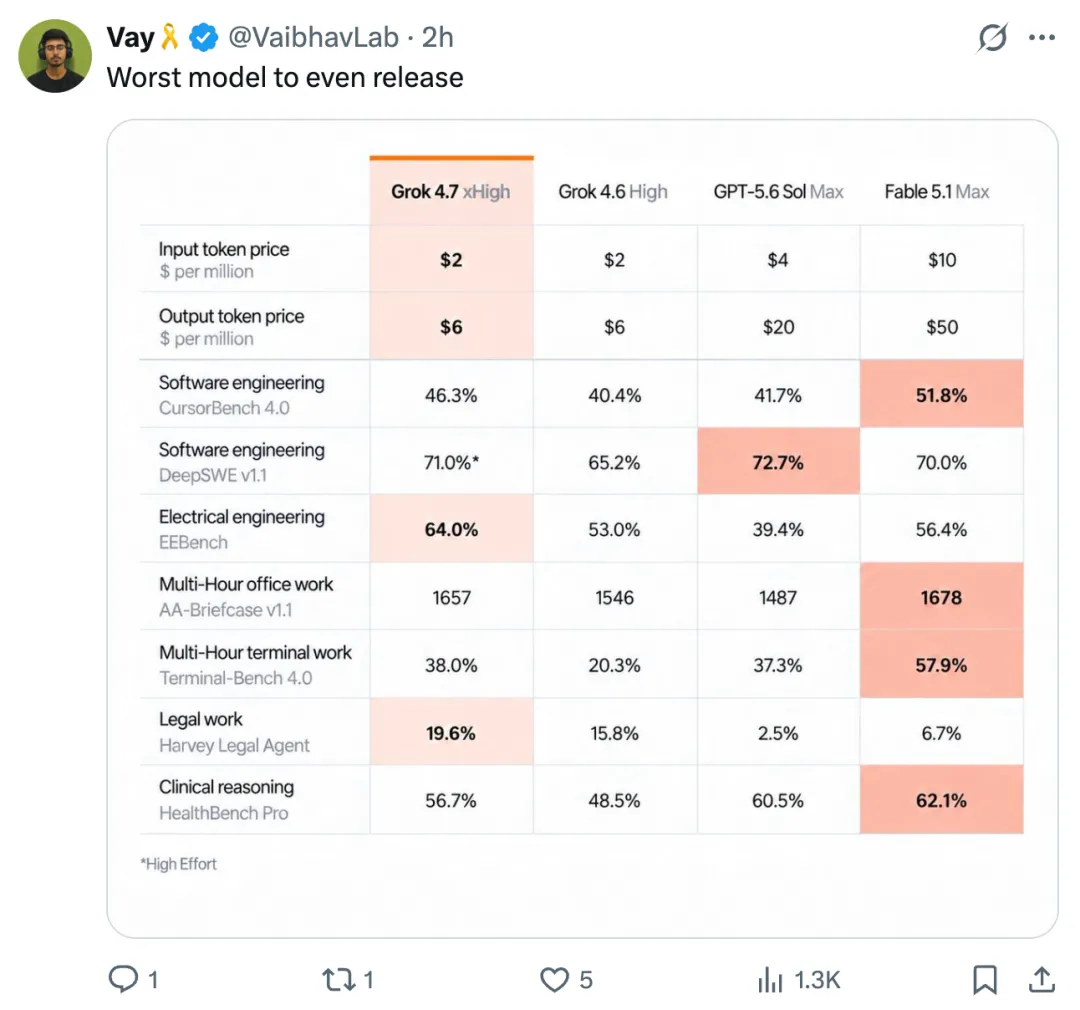
CursorBench 4.0 specifically examines long-term coding tasks. In official data, Grok 4.7 scores 46.3%, Grok 4.6 is 40.4%, an improvement of 5.9 percentage points. In DeepSWE v1.1 Grok 4.7 has a high reasoning intensity score of 71.0%; Terminal-Bench 4.0 has risen from 20.3% to 38.0% from the previous generation.
Grok 4.7, known as CursorBench 4.0, is a model at the forefront of both price and performance.
The model was also trained to be a native understanding of the operating framework of the Grok Bot. According to the official, this adjustment improved the performance of conversational tasks and general knowledge work. In other words, the upgrade focus of the Grok 4.7 has extended from single response to continuous collaboration between the model and the tool and the execution environment.
From writing code to working with complete knowledge
Programming is still the most prominent label of Grok 4.7, but the scope of evaluation given by SpaceXAI is significantly broader. AA Briefcase and GDPval focus on the multi-step work that professionals do on a daily basis, covering routine positions such as lawyers, nurses, financial analysts, and documentation and presentation documentation production.
On AA Briefcase v1.1, Grok 4.7 scored 1657 points, up from 1546 points on Grok 4.6; the GDPval Elo score increased from 1605 to 1695. In the official chart, it approached 1735 points on the GDPval of Fable 5.1 and up from 1542 points on the GPT-6 Astra. SpaceXAI concluded that Grok 4.7 was superior to the previous generation in both tests, with overall performance comparable to other front-end models.
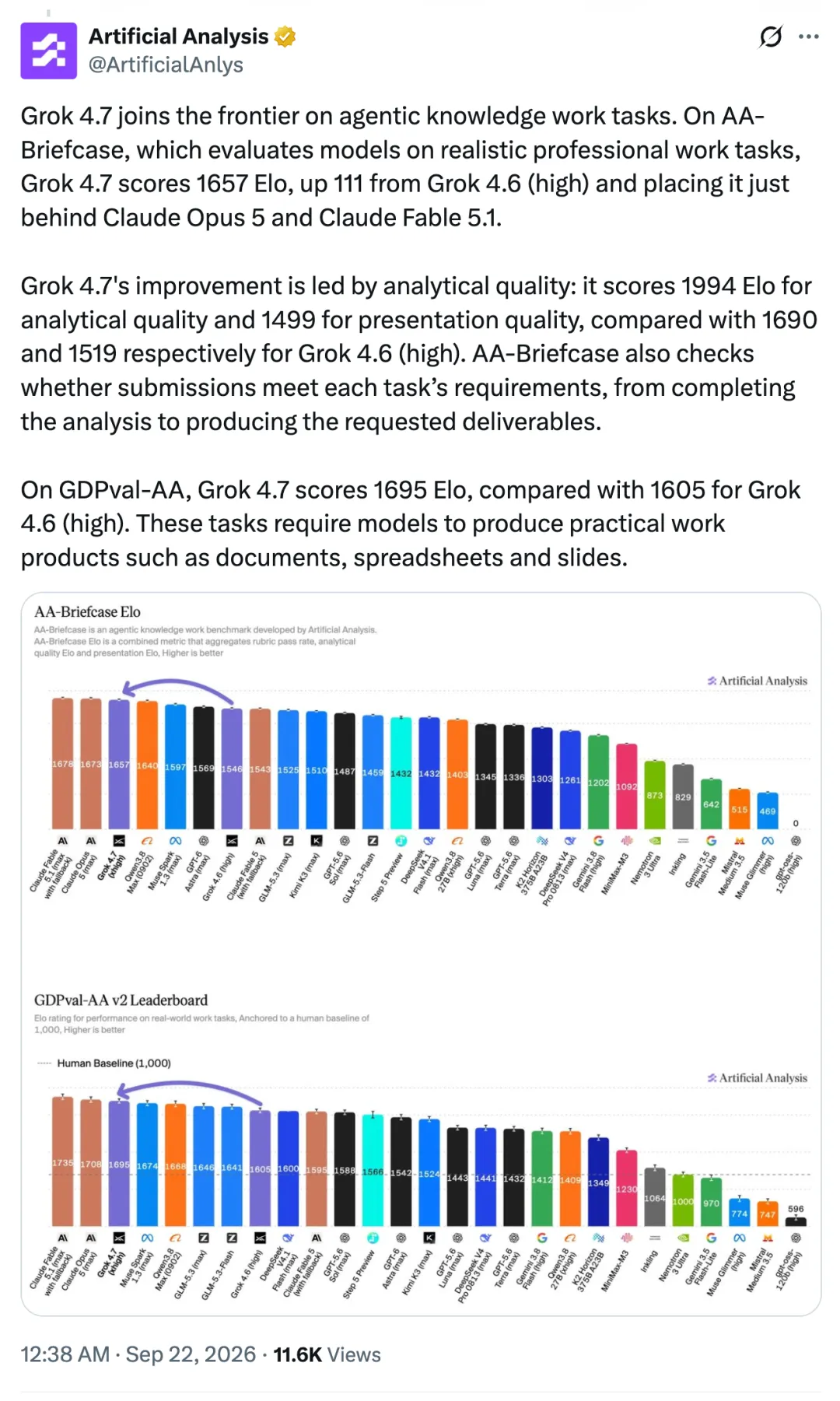
The improvement in the professional field has also appeared in several directions. The EBench score has increased from 53.0% to 64.0%, the Harvey Legal Agent Benchmark has increased from 15.8% to 19.6% and the HealthBench Professional has increased from 48.5% to 56.7%. These results come from the internal comparison published by SpaceXAI, which can illustrate the changes between the new and old models; cross-model comparisons will still be influenced by the strength of reasoning, tool configuration and testing environments.
The composite results reveal a clear trend: the competition for the front-end model is entering a phase of "completing the whole project".
Models need to understand tasks, call tools, produce files and self-review, a single question-and-answer capability is just one of them. Grok 4.7 extends the duration of training tasks and reinforces self-validation, which is a complement to this type of workflow.
Safety and Prices
In addition to the enhanced capabilities, Grok 4.7 enables a completely new security protection system. According to SpaceXAI, this is the strongest model it has ever tested in terms of resistance and resistance to jailbreak.
In terms of bio-security assessments, Grok 4.7 tops the LatchBio benchmark with a score of 62.4%. The cybersecurity test HackerBench v0.3 mainly covers high-risk and malicious tasks. According to official data, the model offers only 3.3% high-risk dual-use hints, while rarely misinterpreting normal security research requests.
SpaceXAI has also begun to open up Red Team capabilities for defense research to a small number of cybersecurity partners.
The standard edition continues its original price, doubling the speed of the fast edition
Grok 4.7 is available through the Grok API, third-party programming frameworks, model routing services, and cloud platforms. The standard version starts at $2 per million of Token input and $6 per million of Token output, consistent with Grok 4.6.
The pricing strategy makes this upgrade even more impactful. Developers don't have to pay extra for the standard version of the Token, but they get stronger long-term performance, self-checking capabilities and professional performance.
For programming smart objects and intellectual work products, the single cost of each call of the model is important, which determines the actual cost of completing a task.
Finally, I would like to summarize a wave of upgrades:
From training to assessment combinations, Grok 4.7 reinforces the same thing: staying on assignments for long periods of time, doing complex work. Programming is just the first mature input, documentation, demonstration, legal analysis, clinical reasoning, and engineering tasks have been put into the same capability graph.
But netizens don't seem to buy the bill, "this model dares to be released, it's just too bad it shouldn't be released". It's only fair to say that this Grok 4.7's selling point is not a full-fledged squeeze, it's a far lower API cost than some of the flagship models, and in return, it's pretty close, and it's leading the way in individual professional tasks.
The link is as follows: