More than 100 long-term open problems have been solved by internal models while the answer to the Millennium Grand Prize puzzle is still under review by the mathematical community.
This morning, OpenAI announced a collaboration with an independent mathematical advisory group called the Advisory Group on Mathematics and Artificial Intelligence (AGMAI), hosted by the Princeton Institute for Advanced Study. One of its current tasks is to evaluate, review and publish recommendations on the large number of mathematical results generated for OpenAI's internal models.
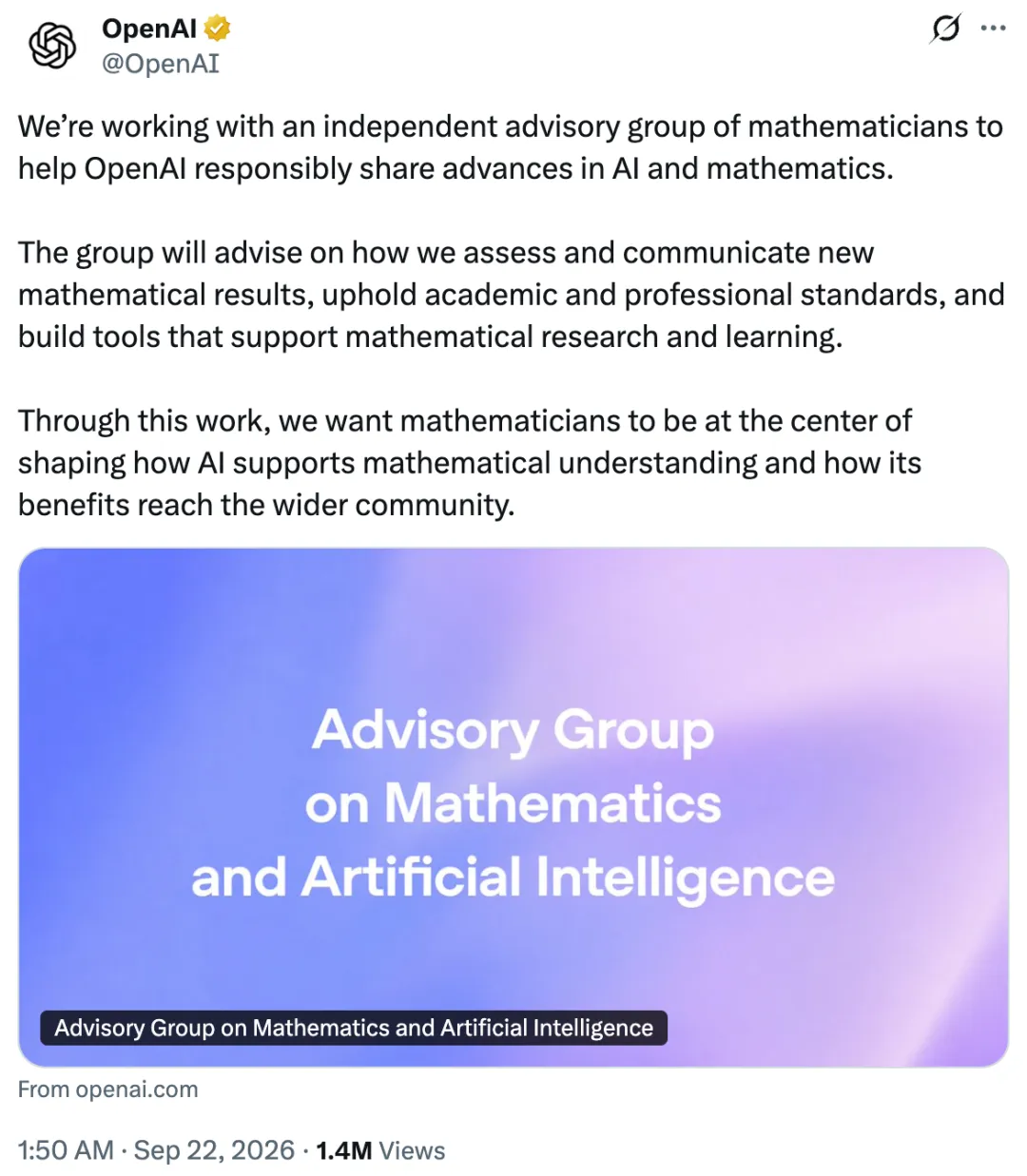
OpenAI's move answers a more tricky question: How should the mathematical community embrace these results when AI produces mathematical results faster than peer review and academic dissemination can handle?
It's a problem that suddenly becomes a problem for publishing.
According to OpenAI, the company began training a new internal model on August 28. In addition to the previously announced answer to the Millennium Prize puzzle of the Naveen Stokes equation, the model has solved more than 100 long-term open problems across multiple fields of mathematics. Its progress has even surprised mathematicians within OpenAI.
On September 8, OpenAI released a paper on the Navi Jon Stokes problem and a formalized proof of Lean. According to the company, the internal system constructed a solution that formed a strange point in a limited amount of time, thereby proving both the C and D scenarios in the Cray Mathematical Institute's official statement. OpenAI also stated that it had no intention of applying for the Millennium Prize.
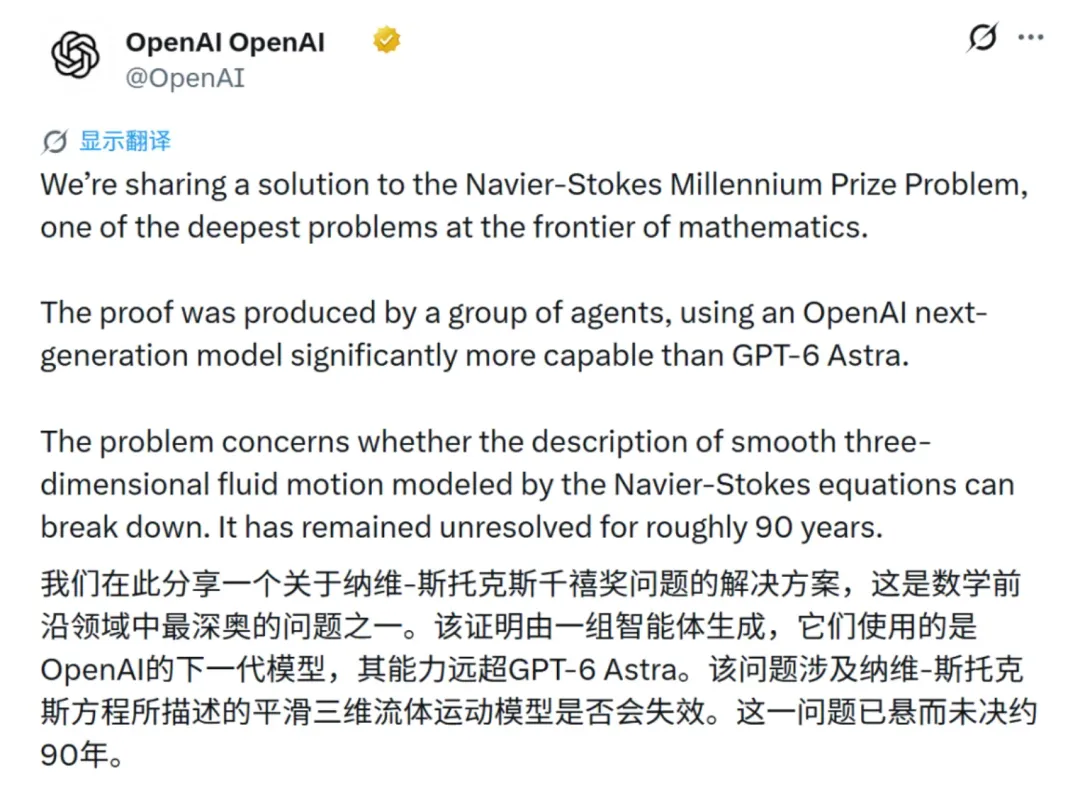
An important limitation needs to be maintained here. "Solving the 100+ Open Problems" is currently OpenAI's statement of internal research results, which have not been fully publicised or fully reviewed independently by the mathematical community. The advisory group's own wording is equally cautious: these results are "reported" by OpenAI from its internal model.
The reason for this caution is realistic. From the generation of a proof to the recognition of a mathematical result, it must also be subject to expert verification, supplementary arguments, trace-related work and open discussion. Even if formalized tools can examine the inference process, they cannot answer alone whether the results are genuinely novel, what ideas have been adopted, and how to translate the proof into knowledge that mathematicians can understand and continue to use.
The faster the model solves the problem, the easier this seemingly traditional academic process becomes a new bottleneck.
Mathematicians fear that the problem will become the "consumption" of AI.
Before this collaboration, the mathematical community had already publicly expressed concern.
On September 11, multiple Fields Award winners participated in a public letter announcing a serious misunderstanding of AI in mathematics. In the letter, they criticized AI companies for using open questions as a benchmark of competence, believing that this competition could negatively impact mathematical research and the mathematical community.

At the heart of the controversy is not to put AI outside of mathematics. The public acknowledges that AI is expected to accelerate real mathematical research and understanding. Mathematicians worry that the continued pursuit of "how many more problems to solve" could overwhelm conceptual understanding.
An important result often needs to be matured in reporting, discussing and repeatedly revising. Researchers identify new approaches to it, insert it into existing knowledge systems, clarify relationships with previous work, and organize complex proofs into a form that peers and students can master. If an answer center appears, it is difficult for the academic community to complete the work in a timely manner.
Open questions also have educational value in mathematical research. Many questions are carefully selected and used to train the judgment and creativity of young researchers. When they are converted in bulk into model test sets, the original research ecosystem is also affected.
OpenAI responded directly to this open letter in the announcement, acknowledging the need for AI companies to communicate more carefully with the mathematical community.
Nine mathematicians will be involved in deciding how the results will enter the public domain
The first nine members of the advisory panel included François Charles, Camillo De Lellis, Timothy Gowers, Martin Hairer, Nikhil Srivastava, Ulrike Tillmann, Ravi Vakil, Edward Witten and Melanie Matchett Wood. They were from institutions such as the Paris Graduate School of Education, Princeton University, Cambridge University, the Federal Institute of Technology Lausanne, the University of California, Berkeley, the University of Oxford, Stanford and Harvard.
In accordance with the arrangements published by OpenAI, the Advisory Group will assist in judging the importance of new results, discuss how to coordinate publication of results, and provide advice on the academic and professional norms to be followed in mathematical research. It will also focus on how AI tools support mathematical research and teaching so that mathematicians can continue to develop their own problems and ideas using these tools.
The Advisory Group's website gives a clearer arrangement of independence. Members do not receive remuneration from AI companies and recommendations to AI companies will be made publicly available; its services are not limited to OpenAI, and the Advisory Group is willing to make recommendations as long as a company's model may have a significant impact on mathematics. The organization can self-adjust members and invite the mathematical community to submit comments on the publication of these OpenAI results.
This independence also has clear boundaries. The Advisory Group has no decision-making power for any AI company, and ultimate responsibility remains with the company.
In other words, mathematicians have the space to speak, review and publicly criticize, have no veto power to issue results, and are unable to control the pace at which models continue to advance their research. The extent to which this arrangement plays a role will depend on whether OpenAI adopts the recommendation, and whether information is fully disclosed when differences arise between the two parties.
Mathematical research is introducing a new issue of governance
In the past, discussions of AI and mathematics have often focused on whether models can prove a problem.
A machine-generated proof needs to be verified by who, how the validation work gets academic accreditation, how relevant ideas come from, and in what order the results emerge will be made public will affect the ability of the mathematical community to digest the leap.
According to AGMAI's founding statement, the open problem can no longer continue to serve as a simple model of competence. Behind every problem that is "solved" is a link between research tradition, talent development and knowledge dissemination. The answers are faster and do not automatically lead to deeper understanding.
This advisory group is just the first step. The real test will take place after the first results are made public: whether the mathematical community can independently verify these proofs, whether researchers can develop new ideas that are understandable and replicable, and whether AI companies are willing to leave enough time for rigorous academic processes.
If OpenAI's judgment on the question of open access is finally confirmed, mathematical research will face a rare speed shock. The most scarce resource may be no longer the ability to give answers, but the time it takes for humans to understand, review and accept them.
The link is as follows: