What is the most noticeable improvement in efficiency in AI now? Writing papers can definitely lead the way.
This year, ICLR's summary submissions amounted to a staggering 60,000+ posts, more than the ICLR's total from 2013 to 2026.
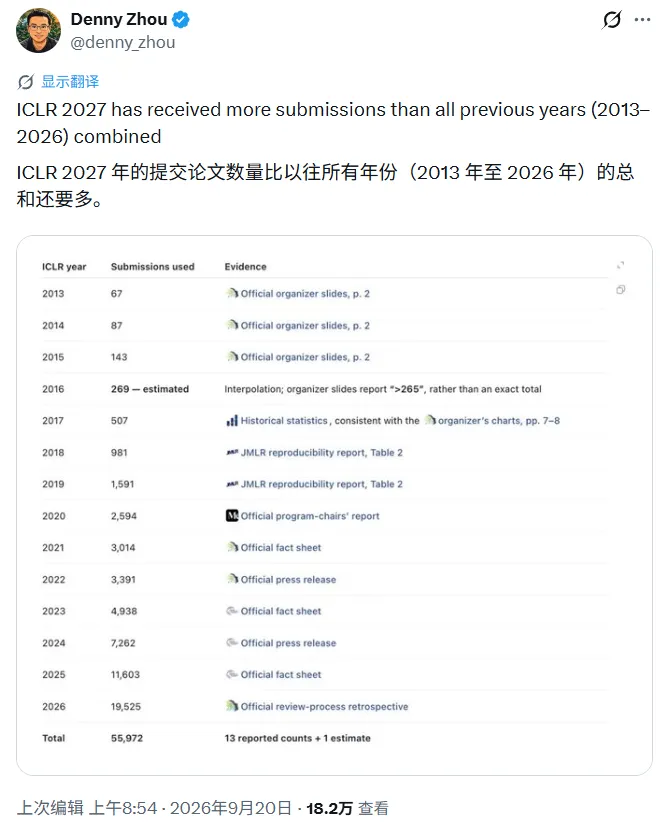
Specifically, the first ICLR received a total of 67 posts, bringing the number of ICLR 2026 to 19525 posts.
Now, an ICLR 2027 is done.
When the authors of the post saw this figure, they were probably shocked, as if they had seen an atomic bomb explode.
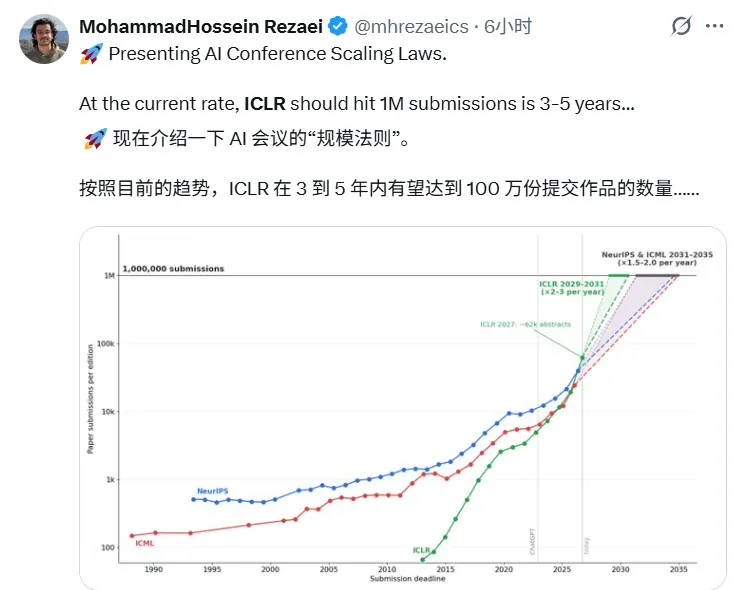
Some netizens have tweaked that the number of posts could reach the million level in a few years...
Some netizens counted a check: even with a 20% subscription rate, 60,000 corresponded to 120,000 papers.
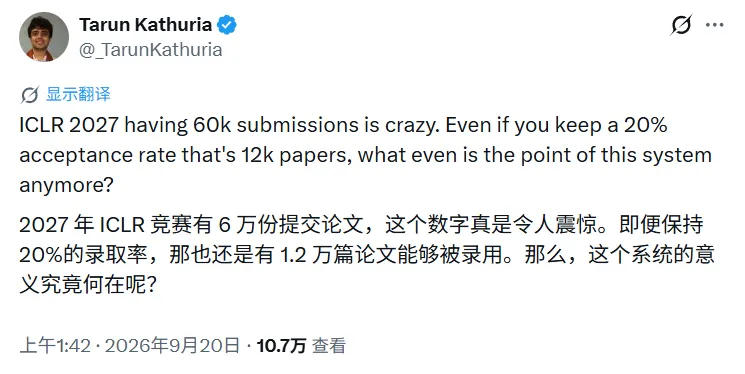
What is the concept of 120,000 recordings per session?
The last ICLR 2026 finally recorded 5355 papers. NeurIPS 2025 recorded 5290 papers, CVPR 2025 recorded 2872 papers, and ICML 2025 recorded 3260 papers.
According to this purely mathematical scenario, the number of entries that could occur in an ICLR 2027 is equivalent to two NeurIPS 2025, four CVPR 2025, or close to four ICML 2025.
Of course, the "60,000+" that is currently being discussed in the community, more accurately, is the amount of submissions that emerged after the ICLR 2027 summary deadline.
This year, the deadline for ICLR's abstract is September 18 and the deadline for official papers is September 25. The official requirement is that the abstract must be authentic, valid, repeated abstract and occupancy abstract will be cleared, followed by a full submission, withdrawal, format check, etc., so the number of papers that will eventually enter the official review will also change.
But the figure of 60,000 is already out of date, and the resulting review pressure is obvious.
Yesterday, we reported on the recent outbreak of an ultra-efficient judging model, JEV, and readers in the comment section chanted, "The ICLR review has been saved".

One of Jev's recent highlights was giving Agent when Judge: give an execution result, allowing the model to quickly judge whether the task was completed, whether the results met the requirements, and what the next step should be.
In fact, over the past few years, this has become a common problem for AI leaders.
ICLR 2026 received a total of 19525 valid posts, of which 779 were rejected by the desk, 5042 were subsequently withdrawn, and finally 13763 papers entered the acceptance or rejection decision stage. In order to handle these papers, 18054 reviewers submitted a total of 76139 reviews.
In other words, when the number of posts reached the 20,000 level, a network of reviewers of nearly 20,000 was needed.
At the beginning of September this year, ICLR 2027 Program Chairs published an article about the new posting policy and emphasized one word: limited flow.
For all authors lacking the qualification of a qualified reciprocal reviewer, each author participates in a maximum of one paper. At the same time, authors appearing in 3 or more posts are required to undertake review work on at least 6 papers; in principle, each post also requires at least one author to register as a reviewer.
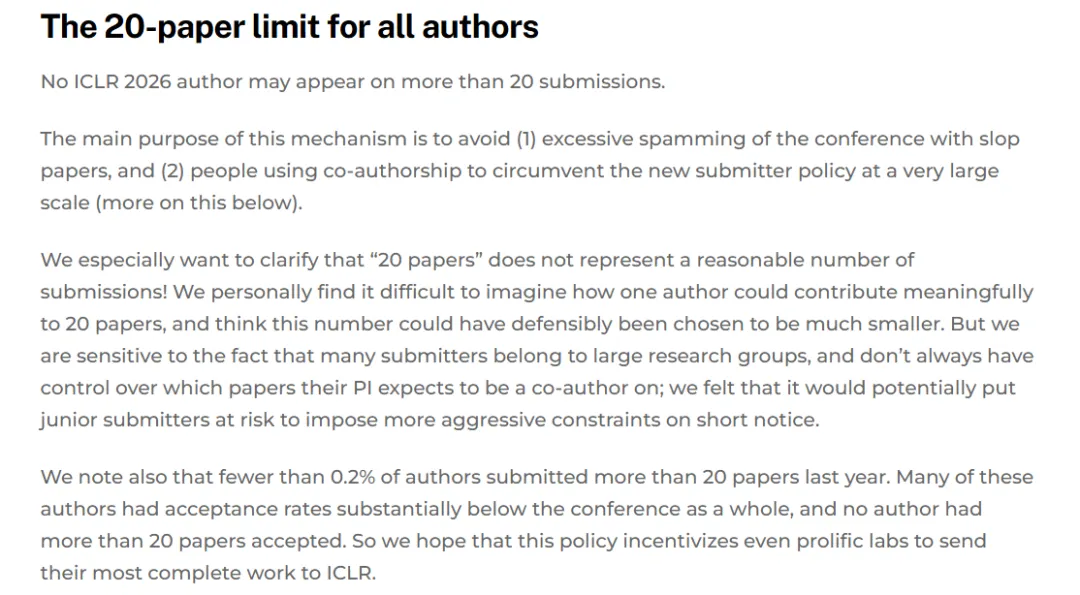
The background given by the ICLR is also interesting.
Program Chairs explicitly mention in their policy statements that AI and industry job competition are driving researchers to increase paper output, and AI tools are further accelerating this trend. They also mention that some conferences have observed a large number of new posts coming from authors with a lack of qualified reviewers; in ICLR 2026, about 20% of posts do not have a reciprocal reviewer.
This year's Call for Papers even wrote a reminder specifically for the authors of the first ICLR posts.
Officials say that better AI tools are expanding the research community; coding assistants, advances in theoretical research, improved research infrastructure, and the spread of machine learning to more disciplines are driving the rapid growth of research. At the same time, the organizing committee wants researchers to invest the saved time in more complete and ambitious research projects.
Even the pre-post checks have begun to be AIised.
On 10 September, ICLR officially announced that it is working with Google to open the Paper Assistant Tool, or PAT, to publishers. The authors can submit papers to the system prior to their official posting and receive automated feedback.
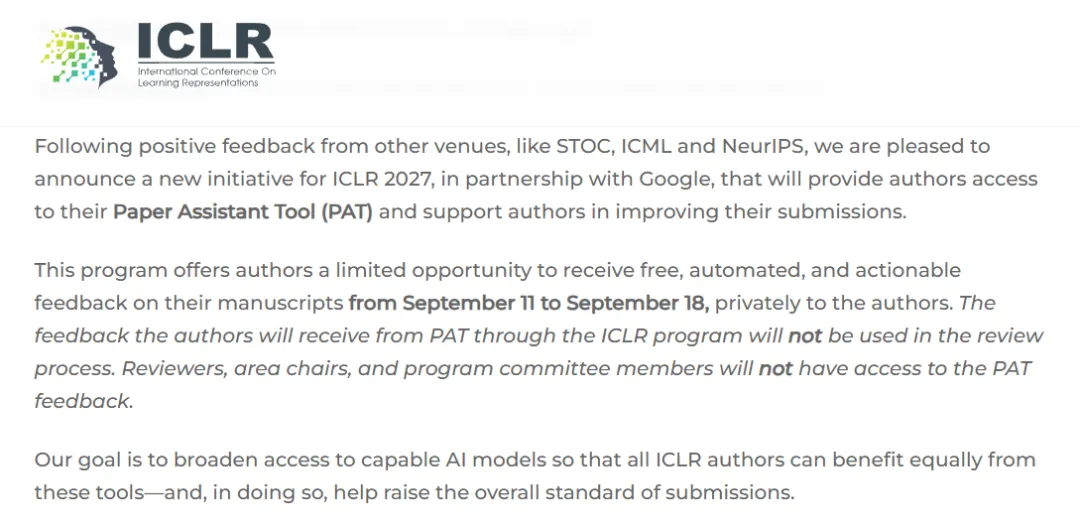
In a sense, this year's ICLR itself is like a major AI research productivity experiment.
Over the past two years, big models have been digging their way into the paper production chain -- searching for topics, writing code, running experiments, orange papers, writing rebuttal, reviewing -- and AI-assisted reviews have begun to emerge.
People have even spoken out about AI: AI writing papers, AI review papers, authors having AI write rebuttals.
There are more papers, more reviews, and more speculation in the community about "the top will get more water".
So when 60,000+ came out, we started collectively administering ICLR medicines.
It has been suggested to simply cancel the ICLR 2027 and redesign a set of mechanisms to restore the top to its original prestige.

More specific proposals have also been made: a maximum of 3 to 4 posts per author; the paper is squeezed to 3 to 4 pages, so that the critical results appear early; the code, data, and intermediate results are made public with the post, then submitted to the Agent to verify replicability; and finally, the reviewer receives real silver or really valuable academic credit.
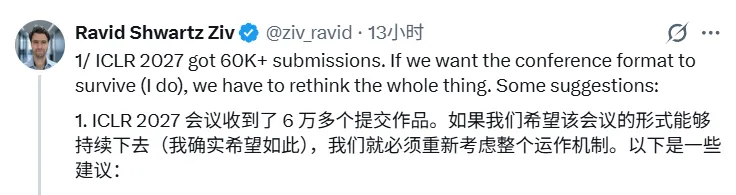


Another added: $10 for each post, and it doesn't go away. 60,000 posts is $600,000. At least the reviewer's coffee money seems to have fallen.
Have you posted an ICLR this year and how do you feel about the big bang?