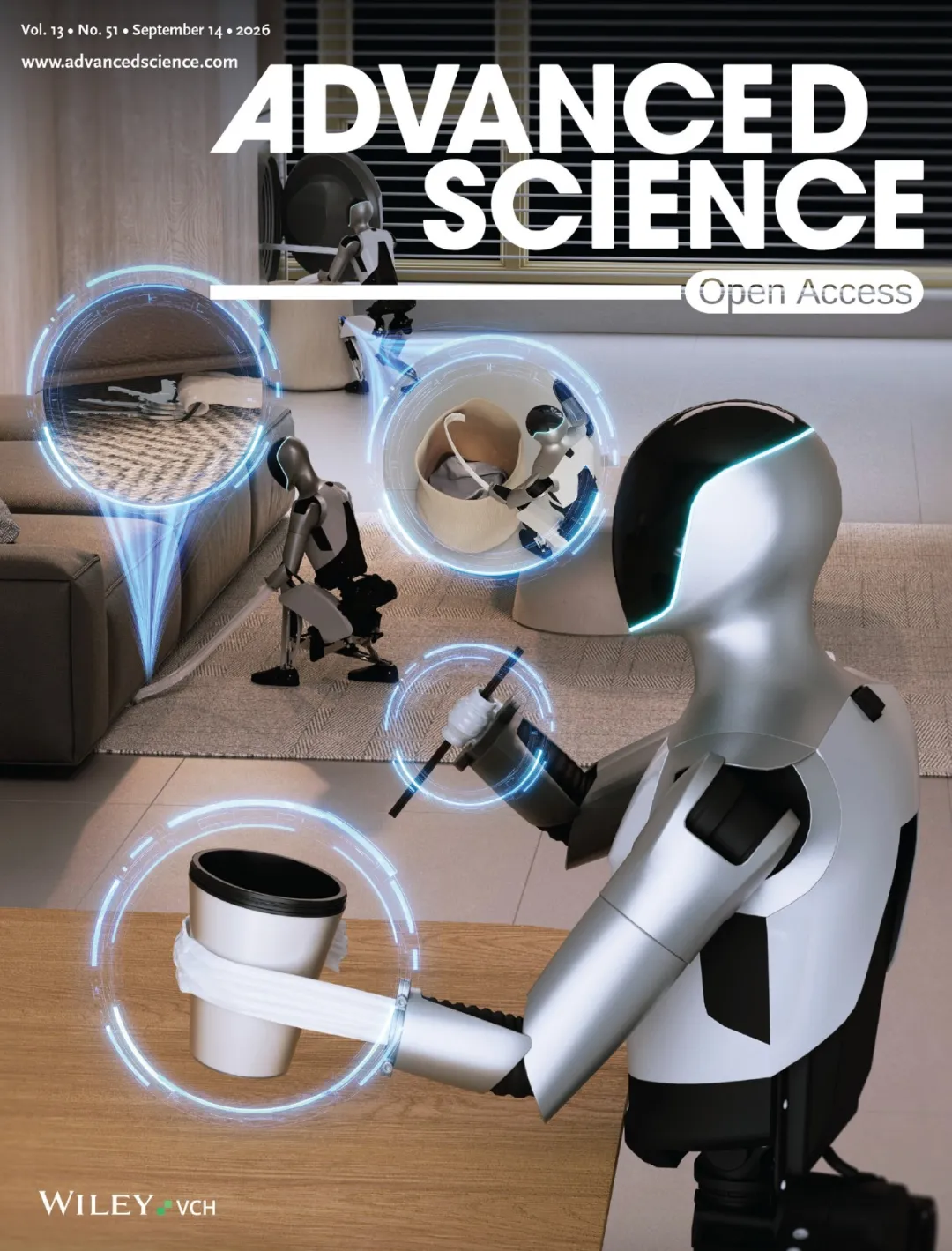
“ A simple, broad-shaped, lightweight and handy 9-gram robot, from a hair to a flying blade, can be used as both a hand and an arm, as well as a tool.
Why is a human hand so ingenious? It relies on the precise combination of the bones and a complex set of muscular systems. In order for machines to replicate this skill, the traditional practice is to imitate the structure of the nose, tortoise touch, human hands, etc. The more the pieces pile up, the more complex the structure and the more difficult it is to control.
Now, a team of researchers from the Shenzhen Institute of Advanced Technology, Nanjing University of Information Engineering, Jiangsu University, Chinese University of Hong Kong (Shenzhen) has chosen another path. They have proposed the BioflexBot, which no longer mimics the structure of organisms, but rather abstracts and realizes the core functions of human hands. This work recently appeared on the cover of the journal Advanced Science.
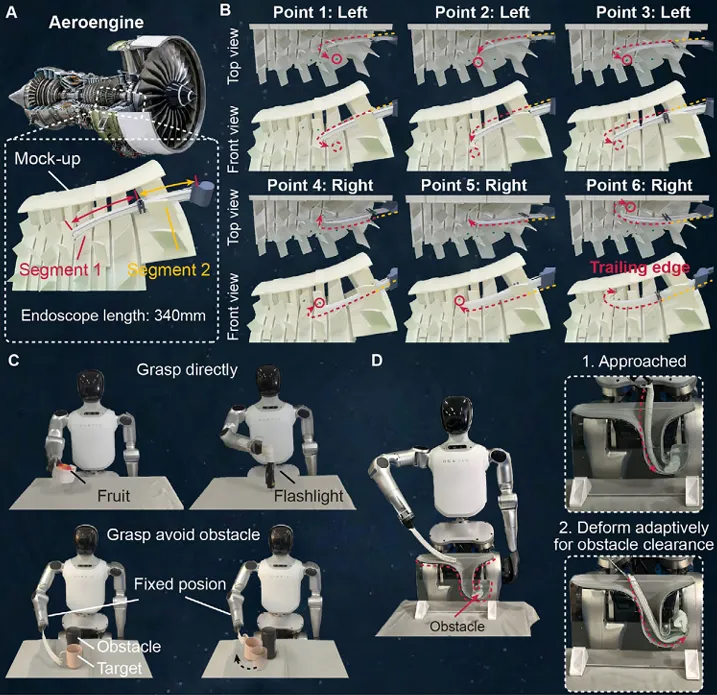
It can go inside an airplane engine to complete a leaf inspection, or it can work directly as a crawler for a humanoid robot to perform crawling, flip-flopping and confined-space operations; from lifting a hair 90 micrometers in diameter to crawling objects much larger than itself, the same robot can also go beyond fine-grained operations and large-scale crawling.
01.
Watch the app: Patrol aircraft engines can also be used by humanoid robots
As a lightweight module, the BioflexBot is well suited to be integrated into a variety of systems. The researchers synthesized the two modules into a self-growing cabinet robot: the near-end module is responsible for close inspection, the remote module is self-propelled, the near-end is sent deeper, successfully completing a circuit of six checkpoints in a series of 1:1 aerospace engine blades, and even the tail edges of the blades that are difficult to touch by traditional methods have been photographed.
It can also serve directly as the hands of a humanoid robot, complete daily crawling and obstruction crawling, and extend into a restricted pipe to clean the clogs. These are tasks that are difficult for a conventional humanoid hand due to work space constraints.
In addition to the use of aerial engine patrol and humanoid robots, the researchers also built an automated chemical experimentation platform that combined double-eye vision with YOLOv8 to allow the robot to autonomously perform operations such as removing burners, coatings, and tube drip sampling, successfully recovering the entire process from the sulfuric acid copper and ammonia reactions into light blue deposits and then dissolving into deep blue solutions.
02.
And look at the functionality: grabbing from a hair to a scale.
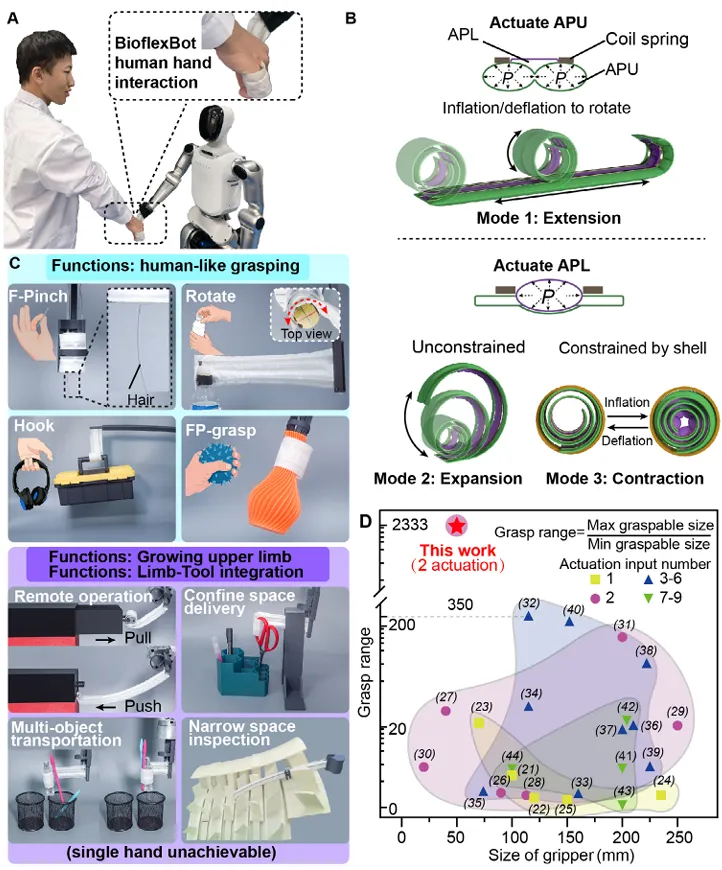
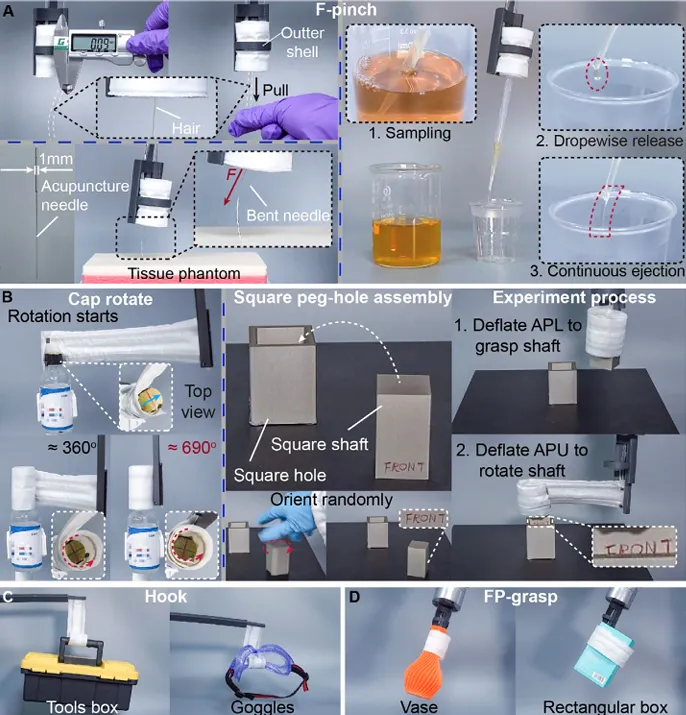
BioflexBot's complex hand-to-hand synchronization enabled it to pinch, rotate, pull, and grasp four basic functions.
In precise operation, it is able to stabilize the hair with a diameter of 90 micrometres, and reliably hold objects with a diameter of up to 15 mm; it has completed two test force control precision missions: pinching a 1.1 mm needle point into the tissue simulation for piercing simulation, and manipulating the liquid lifting gun to complete the absorption, lifting and distribution of the liquid. In rotation, it achieves a maximum of 690° of rotation in a continuous operation, approaching the human hand four times 180° in a single operation, can open the bottle cap, and can complete the directional installation of the square-shaped spinning nail.
It is actually more interesting than the human-sized part. With a 7:1 extension contraction ratio, the BioflexBot can grasp objects from 30mm to 210mm in diameter, about seven times its original size; it can be used as a remote-operating arm, pulling and pulling a pull while the base of the mechanical arm is stationary; it can cut through a narrow hole of 35mm with a 30mm contraction diameter; and it can also use a flat propeller structure to grab multiple objects at a time and drop them in sequence.
A set of comparisons are intuitive: the crawler size of the BioflexBot exceeds 2,300 times its minimum size, which is 12.9 times higher than existing systems with the same number of drives. It weighs about 9 grams overall, costs about $5, and is a lightweight, low-cost add-on to the $500 to $50,000 handset.
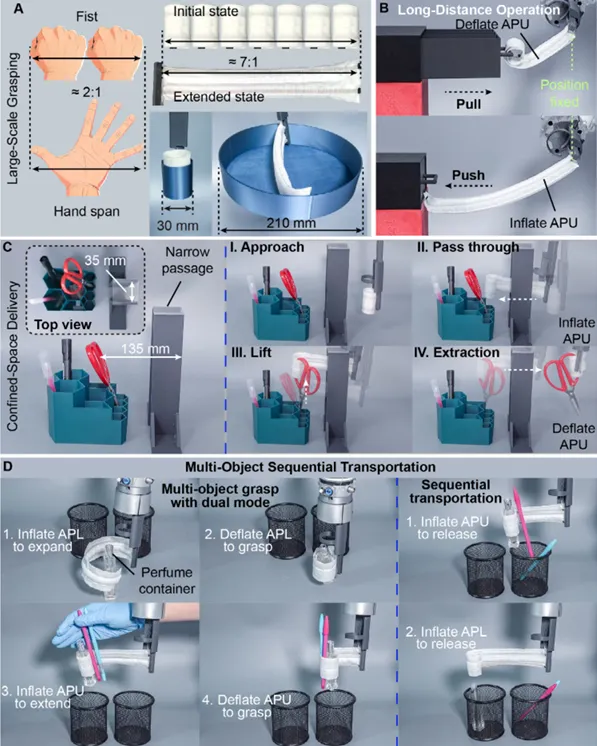
In terms of reliability, the robot is repeatedly air-filled, and the extension performance tends to be stable after about 2,000 times; the coil ruptures after more than 7,000 times, while the density test continues until 10,000 unseen leaks. Structural damage can also be quickly repaired by re-heat pressurization or replacement.
03.
So many functions, how do they fit into a set of structures?
The key is to compress complex capabilities into three basic shapes. The BioflexBot consists of two air cavities and a flexible cylinder, which can be extended, expanded, and shrunk using only two-way air intakes.
Three transformations can perform different tasks in the same module: extension for long-distance access and bypass, expansion for wrap-around clutching, and shrinkage for holding small-scale objects. By combining these movements, robots can clutch human beings, and integrate self-adjusting crutches and crutches into a single set of institutions.
04.
The Principle behind the Three Shapes
Why not directly replicate the structure of the human hand? The human hand is so delicate that it relies on the precise coordination of the bones and complex muscular systems. The complexity of copying and controlling parts and components by structure increases rapidly. The BioflexBot thus adopts a functional life simulation approach: to reproduce key functions with as few structural units as possible, rather than seeking a one-to-one correspondence.
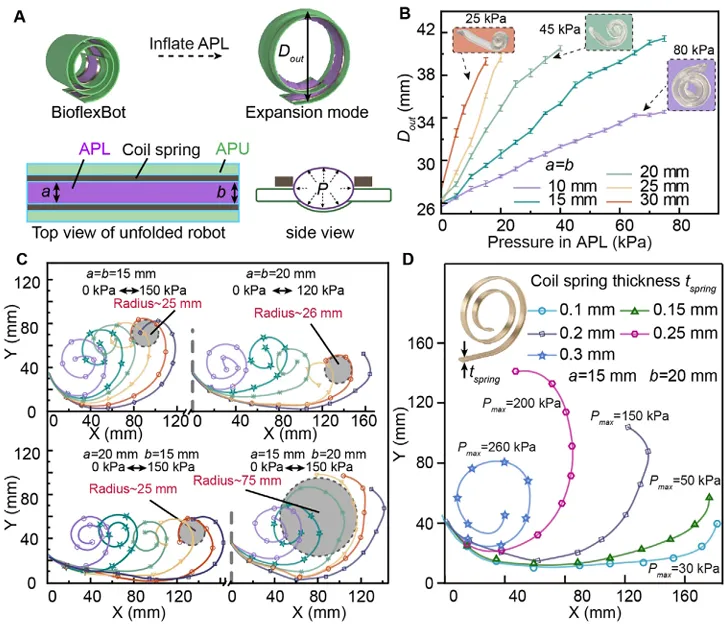
An old problem with the airbag structure is that the airbag inflation is often symmetrically inflated, making it difficult to perform the non-symmetrical transformations required for complex operations. The team's solution was to add a flexible cylinder to the airbag as a cylinder shell, using the contrasting relationship between the bulb's expansion and the cylinder's response force to introduce the non-symmetrical transformation into the structure.
Where the skeleton is placed determines how the robot moves. When the skeleton is evenly distributed along the surface of the airbag, the inflation results in a flattening, longitudinal extension, rotation, and curvature of the end, which is the extension pattern (called APU); when the skeleton is distributed on both sides of the airbag, the inflation produces a symmetrical radial expansion, which is the expansion pattern (called APL).
The team also finely optimized the structural parameters: the APL uses a 15mm, 20mm gradient intersection at the bottom, which increases the crawling diameter to about 75mm; the curve thickness after repeated testing, 0.2mm is the optimal choice; the APU is split into two channels to restrict the vertical expansion of the curve, and changes in volume and volume control to improve the consistency of the extension.
05.
The same idea extends to remote operation with quadruped robots.
This is not an isolated task. Recently, IEEE Robotics and Automation Letters published a multi-mode software claw that was inspired by a vacuum cleaner. It also uses a double-woven air cavity condensed spiral spring skeleton with a maximum depth of 210 mm and a maximum detachable capacity of 7.5 N.
Unlike the BioflexBot, this work focused on the design of point-to-point remote-operation interfaces: intuitively controlling the claw by bending fingers and mapping the amount of gas injected, and integrating end-pressure sensing to achieve contact detection and touch feedback.
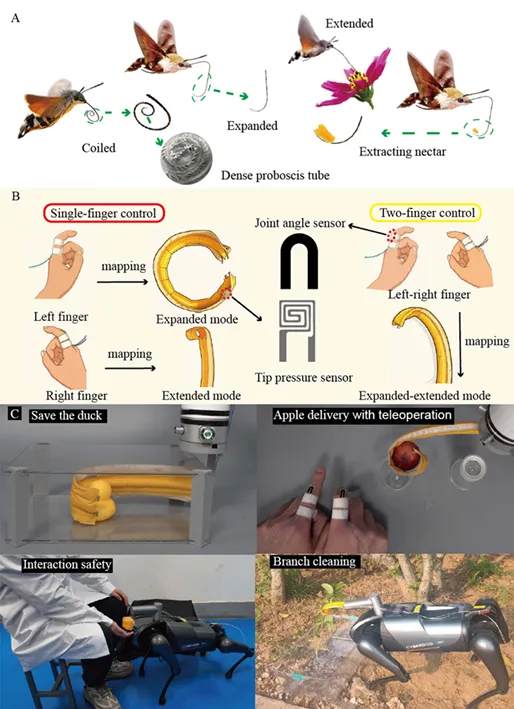
The common idea of the two works can be summarized in four key key phrases summarized by the BioflexBot: Drive Simple, Function Smart, Cost Reasonable, Sensitive, Performance Outstanding, Supreme. The core is not about stacking more drives, but about getting richer functionality with simpler mechanical structures and designs.
Of course, the team also pointed out that nonlinear modeling of aerodynamic shapes, as well as moving from a wired prototype to a fully wireless autonomous platform, are still the next step to be addressed.
06.
The research team behind the two works
The above two works were led by Li Ineda's team, Yang Yang's team. Li Ineda worked at the Shenzhen Institute of Advanced Technology of the Chinese Academy of Sciences and currently at the Chinese University of Hong Kong (Shenzhen); Yang's team is from Nanjing University of Information Engineering.
The following is a link to the relevant paper: