“ A decade of bird legs, changing people's legs
You must have posted something like this on social media.
In Hubei, a five-year-old girl watched a robot perform in a crowd, and the humanoid robot suddenly swirled around her face, dropping four of her fangs, and tearing her lips.

This kind of news is not uncommon across the country and around the world.
A robot performing martial arts in Xinjiang's amusement park is in the belly of a child; a service robot in a catering shop in California, without any sign of it, begins dancing, smashing over the table, cribs, and snacks, and the shopkeeper tries his best to disguise it.

These fragmented, uncontrollable moments are viral on the web because they accurately strike the public's deepest fear of physically intelligent people. The so-called "machine collaboration craze" is a dangerous rhetoric when machines have a grip and power close to humans, and we don't have a reliable security mechanism to restrain them.
Any small mistake can turn into a crisis of trust.
It's not that nobody in the industry is aware of this issue. But it's true that turning turmeric safety turmeric from a public relations term into an engineering architecture company can be done.
Agility Robotics' recently released Digit 5 is the most serious engineering response to this proposal to date, and it's fueling the industry's most painful nerve roots.
01.
Let robots learn to be afraid of humans first.
Prior to Digit 5, human-like robots in the industrial scene had an unheard-of industry practice of luring people outdoors.
Whether it's the isolation area that Agility itself operates in its Digit 4 warehouse at Amazon, or the display area surrounded by acrylic panels at major exhibitions, the existence of safety pads is itself a technical compromise.
Well, we're not sure robots can react correctly when humans get close, so we just don't let people get close.
And what Digit 5 is going to do is remove this physical barrier.
Agility's security architecture for Digit 5 is a layered, progressive perception and response system that runs through three levels of perception, decision-making, and execution.
The outermost layer is human body perception, with Digit 5 continuously monitoring the position and movement trajectory of the person around it at 360 degrees, using multi-modal sensor arrays and proprietary AI algorithms, and combining the direction, speed, and posture of the person to predict the risk of collision.
When detected, the response of the Digit 5 is graded and figurative. At long distances, it actively adjusts the path of diversion; at medium distances, it slows down or even stops locally, waiting for the person to pass; if the person continues to approach, it executes a human-like action that has almost never occurred in the industry.
According to Agility, the key to the movements of the saddle is that it drastically reduces the robot's weight from a standing height of 1.8 meters, while shifting all joints from an active-drive to a passive-compliant state.
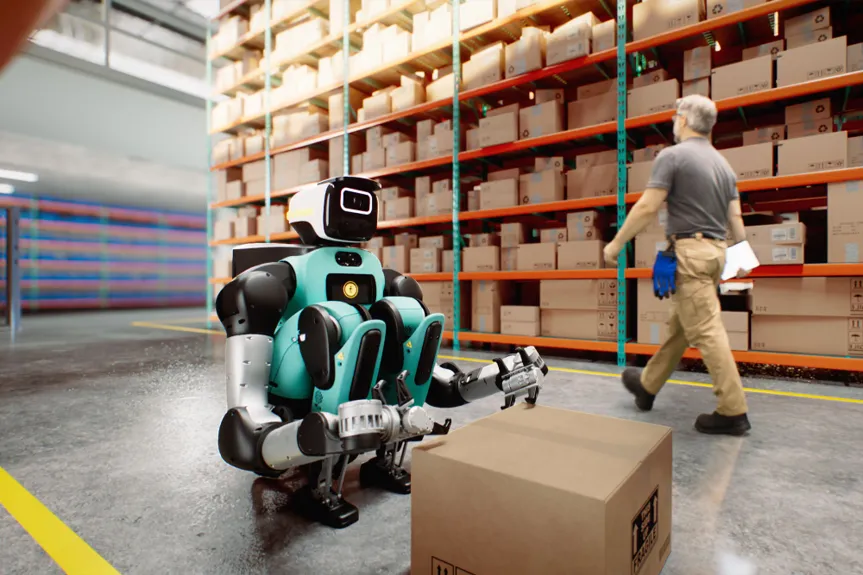
Digit, a downed and motor-powered disconnector, was unable to exert any meaningful force on humans even if it was struck.
Behind this sequence of actions is a security controller independent of the master control system running in real time. It is not involved in complex task planning or kinetic computation, but does only one thing: once a person is identified as being at risk, it bypasses the master system directly triggering the default security response.
The design idea for this type of safe passageway independent make-up is already well-established in aviation and autonomous driving, but the Digit 5 was the first to land on humanoid robots.
Digit 5 transmits its own motion intent through visual and auditory signals. For example, it sends forward-facing acoustic cues before moving, enabling human operators to predict the trajectory of the robot's motion and actively participate in security collaboration.
Safety in a nearby environment is never a one-sided obligation for robots, but a two-way coordination of information.
The architecture is backed by an in-depth collaboration between Agility and NVIDIA. Digit 5, an early partner of the NVIDIA Halos for Robotics platform, pairs Agility's security systems with the NVIDIA IGX Thor and Halos Core infrastructure.
02.
From bird legs to human legs: a decade of evolutionary chain
In order to understand the changes in Digit 5, we have to look back at the path that Agility has taken.
The story begins with Cassie, a two-legged robot born to run at a fast pace. In 2016, Agility walked out of the Dynamic Robot Lab at Oregon State University and took Cassie's first step. Its iconic reverse-joint leg structure makes it look like a bird.
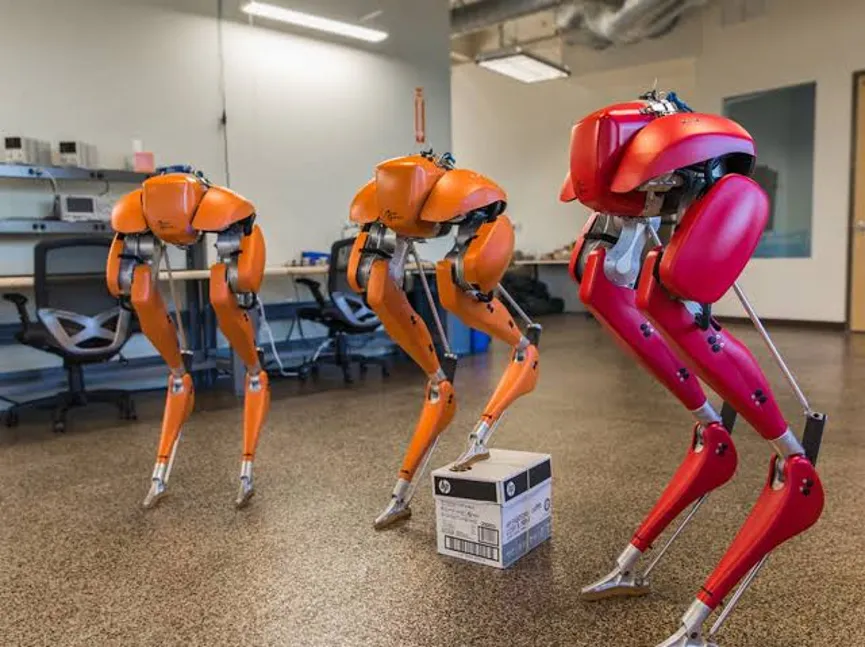
Co-founder Jonathan Hurst later explained that this seemingly bizarre design was entirely the result of engineering-oriented drives: An eagle can run 40 miles per hour, and it can last all day, and that's what we want. In 2022, Cassie finished the 100 meters in 24.73 seconds, setting the Guinness World Record for the two-legged robot.
But running and working are two things.
In 2017, with the launch of the first generation Digi, the company entered a multi-year phase of proof-of-concept. In 2019, Digit 3 made its first commercial attempt, at a time when agility's narrative was simple: it would deliver packages to the customer's door with two-legged robots. That year, Ford bought the first two robots on the production line, planning to explore the last kilometre of self-driving delivery trucks connected to robots.
Digit 4, released in 2023, is the last Agility robot to retain a bird's-legged design, and the company has shifted from a certified technology to a certified commercial certified hydraulic pump.
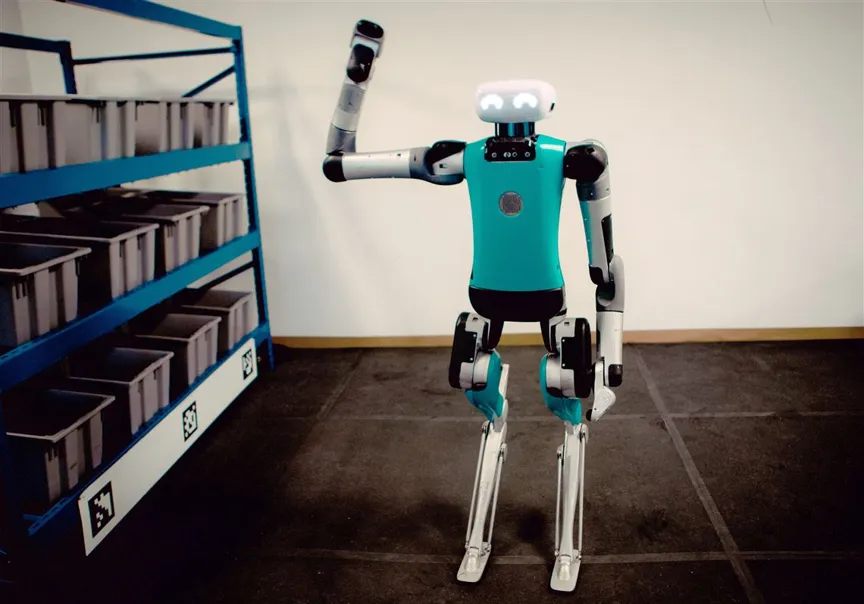
Digit 4 focused container transportation has been deployed in real life by companies such as Amazon, GXO, and Chevrolet. Public records show that it has collectively moved more than 100,000 containers at GXO's logistics facilities and has worked more than 65,000 hours at sites manufactured by Amazon, Chevrolet, and Toyota in Canada.
In these real deployments, the Agility team uncovered a cruel fact - moving the boxes from A to B, and allowing customers to be willing to deploy 100 robots on the production line, with a huge gap in the middle.
These barriers include FCC certification, UL certification, ISO standards, and a more fundamental issue of security.
In the field of dynamically balanced two-legged robots, there was virtually no existing regulatory framework. Although it achieved long service life and a load of 15.8 kg, it was still able to work only in isolated areas, with the number of commercial deployments remaining in the range of tens of tons.
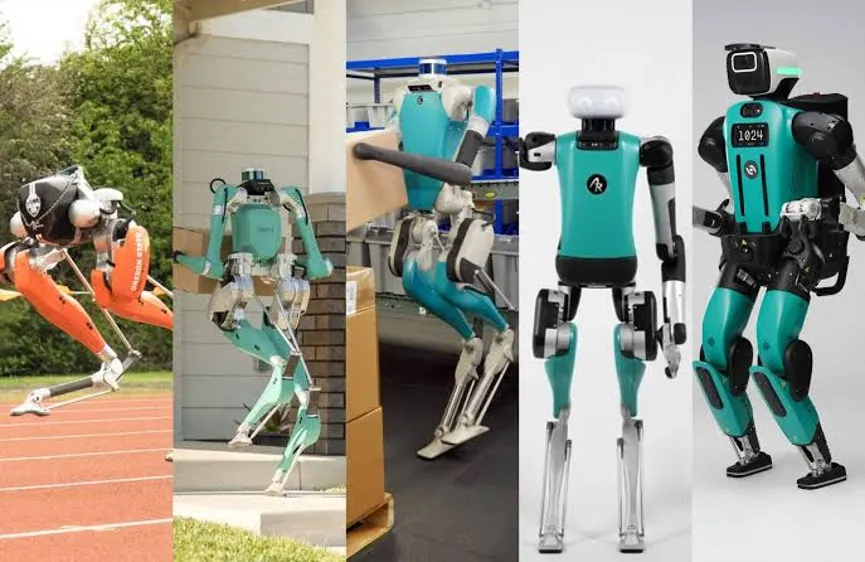
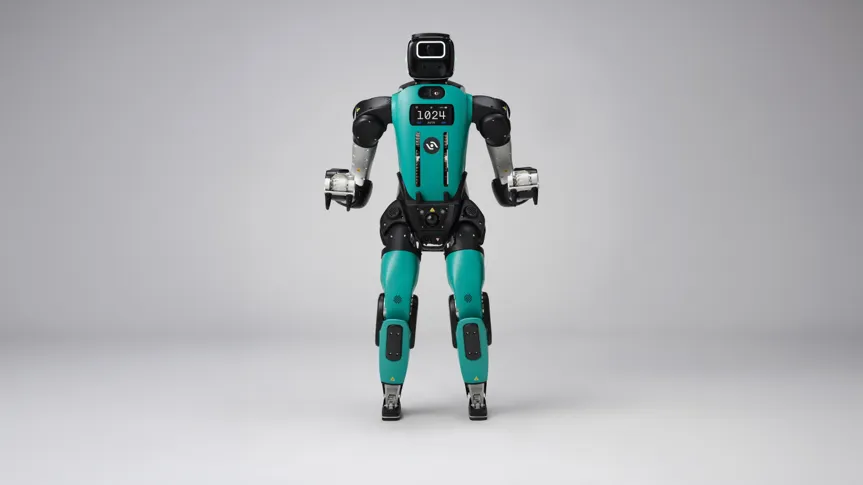
The most intuitive change is a complete reconstruction of the leg structure: from the iconic bird's leg design to a configuration closer to the human leg, with a self-developed swinging linear actuator, the knee joint attached to the collar, allowing the robot to kneel or sit steadily.
After the first comprehensive farewell, Digit 5's capability parameters were substantially improved. The load increased from around 16 kg of Digit 4 to 22.7 kg, an increase of 40%, to coincide with the OSHA single-carrying weight limit. The maximum operating height increased from 1.68 m to 2.2 m, which means it can reach the top of a standard storage shelf.
The upgrade of the energy system is equally critical. Digit 5 lasts 90 minutes, charging time is only 9 minutes, and the operating-to-charging ratio reaches 10:1, meaning it can work more than 20 hours every 24 hours, while Digit 4's ratio is only 2:1. This figure directly determines the economical feasibility of robots for the hourly storage and manufacturing scenarios.
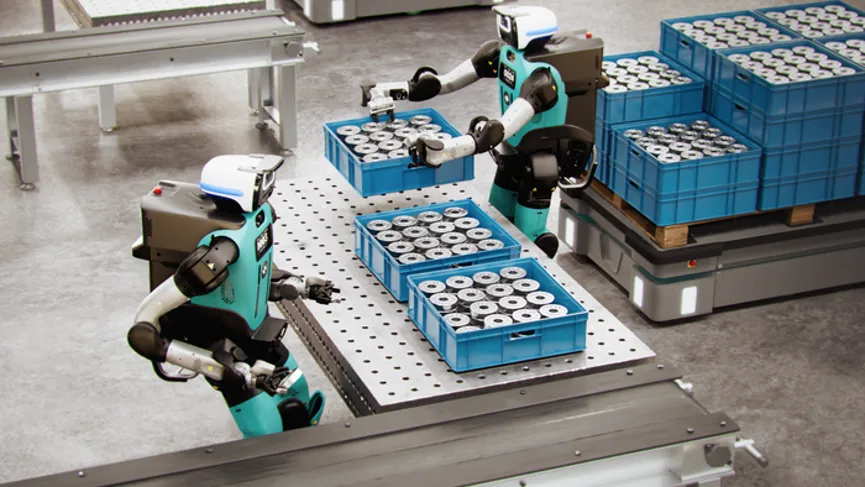
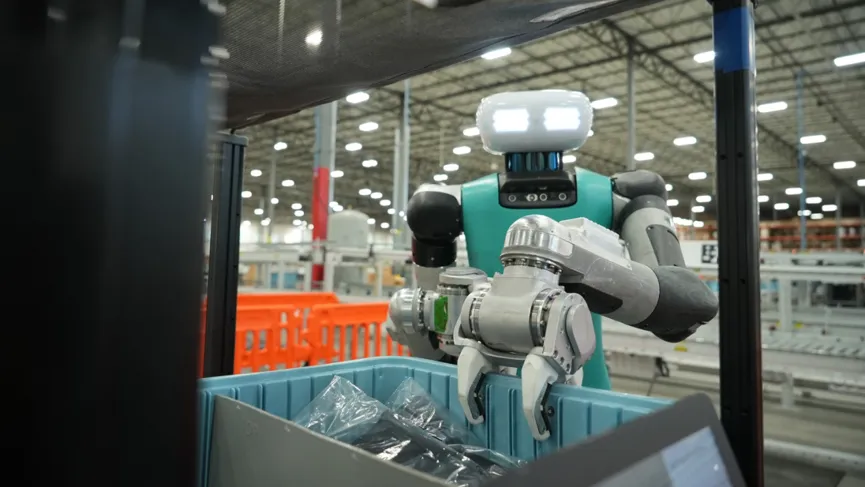
The workflow of Digit 5 also greatly expanded. The workflow of Digit 5 covers dismantling, machining, material assembly and sorting, quality inspection and stacking of pre-storage plates. The end executor is modified to a replaceable design, equipped with ISO-compliant installation ramps, and easy to switch by task tools. Hurst is very pragmatic about this: there are no truly mature general mechanics in the silicon market, so we focus more on schemes that can actually complete the work.
03.
$300 million in orders and the first batch of humanoid robots
The launch of Digit 5 marks a key juncture in the Agility Capital process.
In June, Agility announced an SPAC merger agreement with Churchill Capital Corp XI, with an overall valuation of $2.5 billion, which is expected to raise more than $620 million, including about $420 million in trust funds and about $200 million in PIPE financing from the free-market firm Foxconn.
Upon completion of the merger, the company will be listed on NASDAQ with the stock code AGLT, hoping to become the first publicly traded company in the U.S. with a human-robot core business. Shareholders include Amazon, NVIDIA, SoftBank Vision Fund 2, Foxconn, and Scheffler.
Recently, it submitted a joint S-4 form, disclosing its specific financial data.
In 2025, Agility reported net sales of $1.78 million, operating losses of about $140 million, and operating expenses increased from $71 million in 2024 to $111 million, with cash expenditures approaching $100 million.
With $1.78 million in revenue, which is equivalent to a $2.5 billion valuation, a multiple that can be seen as radical in any industry, but in the human-robot race, Agility's pricing logic can at least boast itself compared to its counterparts with billions valued without any paid deployment of data.
In support of this valuation, Agility has already locked in more than $300 million in multi-year orders from industry giants such as Scheffler, GXO, Toyota Canada Manufacturing. The structure of the order is worthwhile to unravel. According to the S-4 registration statement submitted by Agility, the $300 million order is mainly from one customer, involving 1,000 robots over three years.
TechRepublic's report directly highlights the catch-all: orders are highly focused on one customer protocol.
A $300 million order bundle means that customers have signed a deployment intent and verification agreement, but the confirmation of revenue depends on the actual delivery and deployment pace of the robot.
Digit 5's commercialization schedule is expected to begin early in the first half of 2027, complete supply to manufacturing, storage and distribution customers by the end of 2027, and enter markets outside North America for the first time, starting with CE certification from the EU and the UK.
04.
Link to the Future
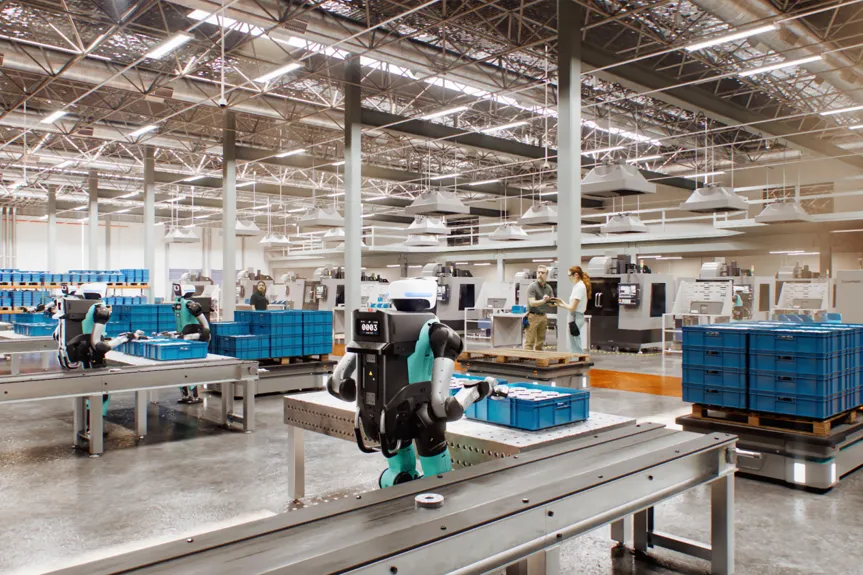
Back to the topic of security. Agility's chief business officer, Daniel Diez, told Bloomberg: "Well, you can't put 150 robots in a warehouse, each surrounded by a 10-by-20-foot wall of organic glass".
The cost structure of deploying humanoid robots without a physical shield can work with humans, meaning that you don't have to isolate the facility for each robot rebuilding plant, and you don't have to reassess the safety of each deployment. The deployment cycle ranges from a few months to a few days to compression of the production line, and deployment scenes extend from the sorting site within the shield to the entire warehouse's end-to-end flow process.
For the first time, Digit 5 has upgraded the security architecture of a humanoid robot from a silicon add-on to a silicon product base.
Of course, Agility's stake in security is even greater than the product itself. It is responsible for the ANSI/A3 TR R15.108 project. This technical report is developing safety standards for dynamically stable industrial mobile robots in the United States and Canada. At the same time, it is also an active contributor to ISO 25785-1, the first international safety standard for humanoid robots, which is still in the drafting stage.
Agility is not only making robots, but also participating in defining the rules of how a humanoid robot calculates the safety of a robot.
This is both an advantage and a risk. The impartiality of the standard is inevitably examined when a company is both a product manufacturer and a participant in the development of safety standards. But from an industry perspective, in a time when human robot safety standards are almost blank, the participation of companies with real data deployment in the development of standards is more pragmatic than keeping the standards in academic discussions.
This is also a consensus. Today's media and industry standards, large or small, cannot be separated from the involvement of the authorities and the promotion of the leading players.
Figure AI is valued at nearly $40 billion, while Tesla Optimus has a trillion-dollar market cap, but it's actually generating revenue on the consumer product line, with only Agility's Digit at the moment.