“ Is there a time for robots to test themselves naked?
The body-smart industry is going through a phony boom. Almost every week there are new demos, robots folding clothes, pouring coffee, sorting parts... music being combined between camera switches, enough to create an illusion for the outside world.
General robots seem to be coming soon.
But the reality is that the industry is starving at the evidence of the real world that is being overshadowed by high-light footage.
When a project fails, environmental mutations, and people intentionally disrupt it, are robots going to go through with autonomous intelligence, or do they go through with cuts to hide the failure?
In June 2026, Google DeepMind, a European robotics partner selected by Qualia, released a video of the robot washing bowl, with an astonishing stream of action. However, founder Fabian Kerj eventually admitted that the robot washer in the video was not a real robot washer, and that the company was building a training infrastructure, not a hardware washer.
When a demo can be polished using repetitive editing, script pre-set or even later editing, the amount of information it conveys is decreasing dramatically.
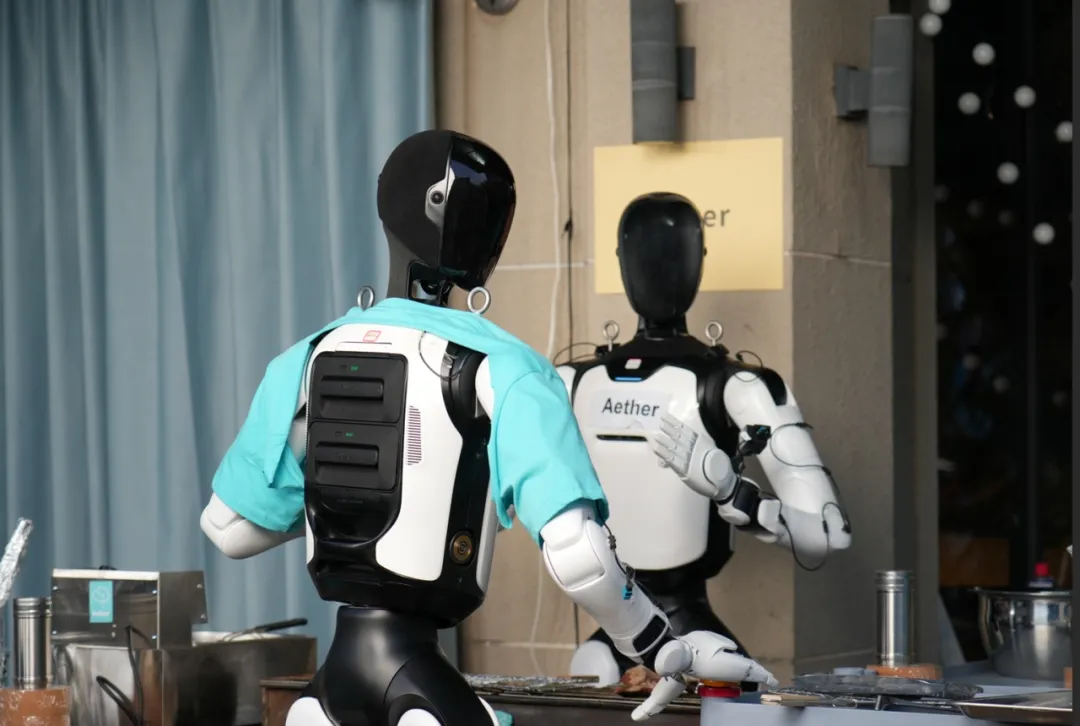
In this context, what they are doing with the technology seems somewhat out of date. They recently put the latest release of the large model of the ether in an outdoor live stream, with no cuts, no remote controls, no pre-set scripts, even allowing the live audience to interrupt, change needs, move things at any time.
01.
From demos to live broadcasts, from selective displays to full exposure verification
For the industry, a beautiful demo is far from enough.
As previously mentioned, demos naturally present information gaps. They show the results of the final task, where the audience can't see the failure, can't see the card, can't see the dozens of attempts that haven't been recorded in the video. More importantly, demos are often lab clips under the best of conditions, the best of times.
The environment is controllable, lighting is stable, interference is absent, you can come back.
As a result, the company opted to launch a positive take on the clutch gap clutch, putting the larger model into long-term outdoor public live broadcasting.
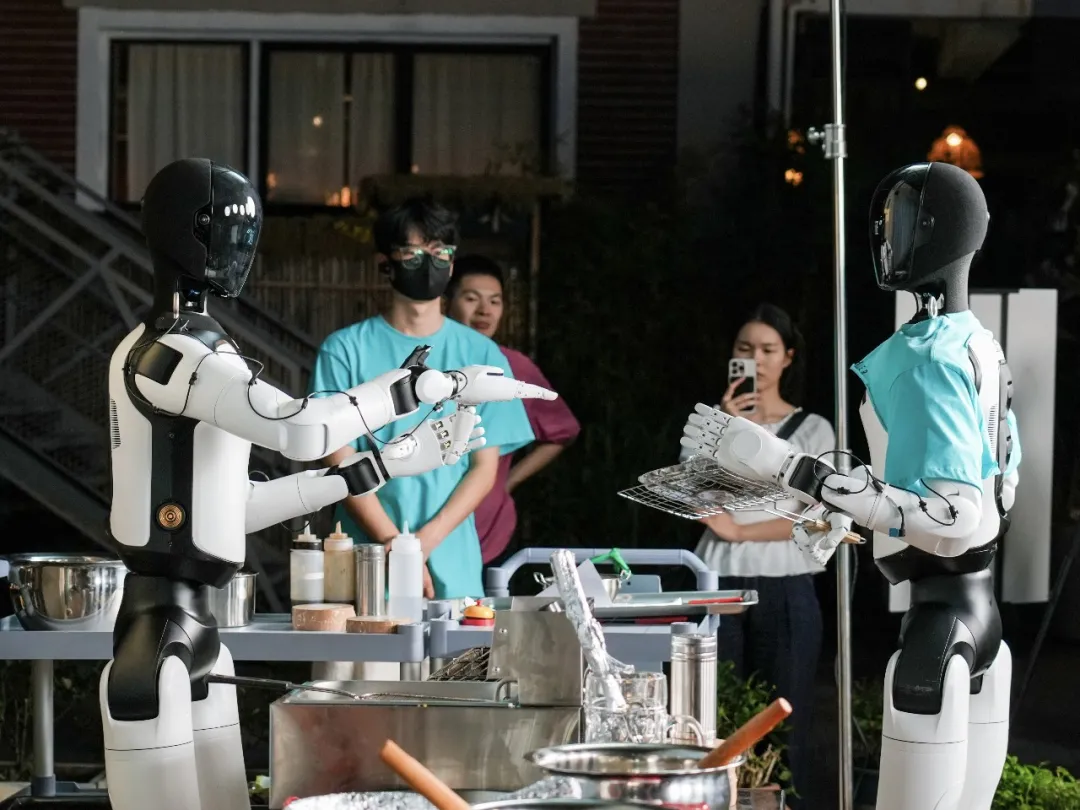
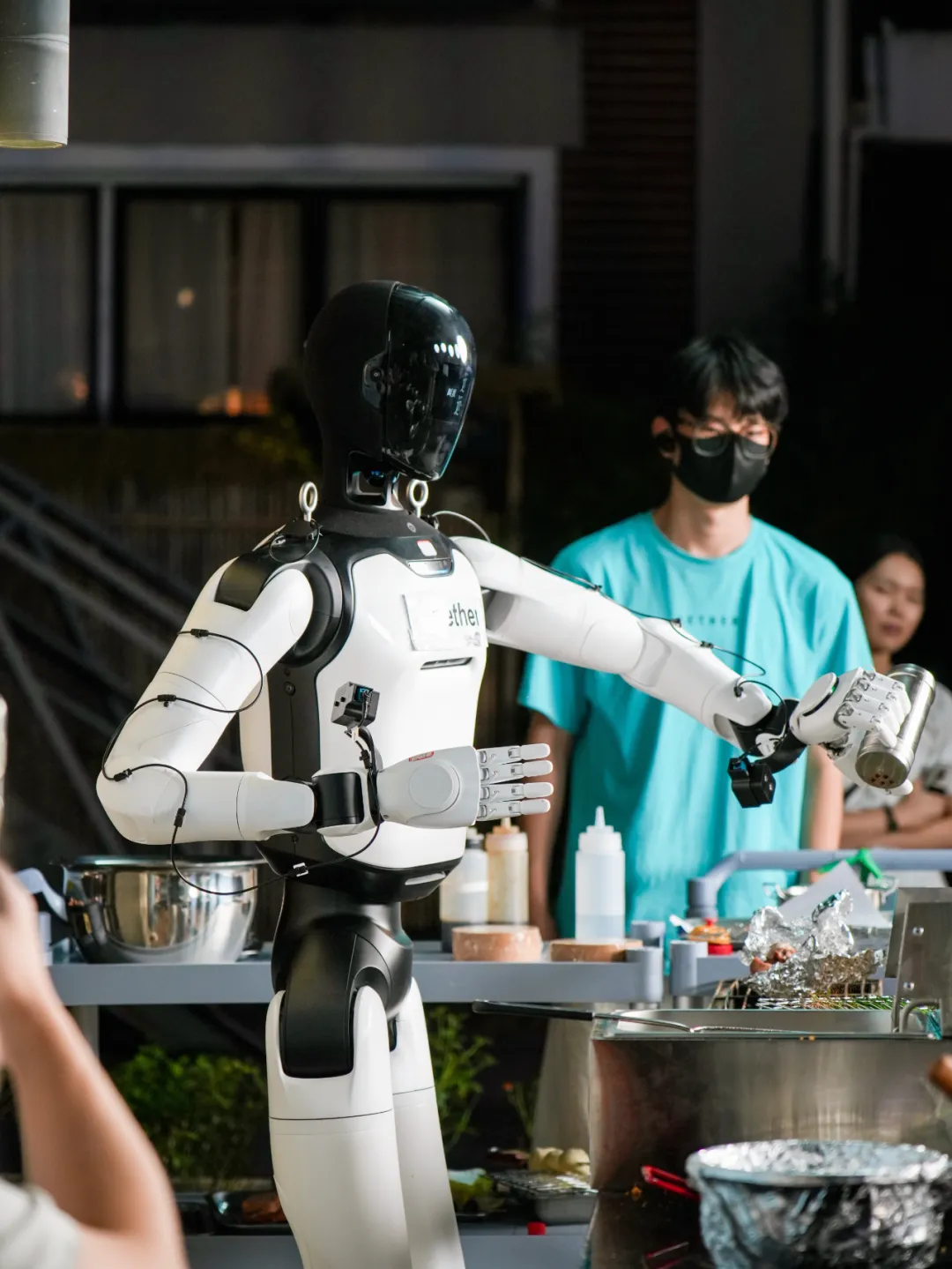
On the evening of 16 September, two robots equipped with a large model of the ether collaborated to complete a complete outdoor barbecue task.
On the ground, robots can complete the entire process from point-to-point, task planning, barbecuing to cooking on their own without artificial remote control, and are also subject to interference from guests, such as temporary changes in demand, disruption of the location of items, etc.
Despite the mistakes in the middle, this is the value of the challenge of live broadcasting. There are no clips, no re-opening opportunities, every twitch in the mechanical arm, every second of delay in decision making, all exposed nakedly in the public eye.
This full-blown exposure isn't about self-exposure to its short duration, nor is it about the certainty that technology wants to show that it's 100% complete with the task. Compared to the practice of choosing the best time to show in the lab, exposing a model that makes mistakes to everyone in real time, it's about self-development, continuous learning, and self-judging the hardest-core open truths that these technologies claim.
Specifically, there are five things that this barbecue agency has to verify.
First, long-range tasks. From receiving orders, understanding needs, to preparing, executing, completing deliveries, robots need to maintain a continuous mission status for minutes or longer.
Second, the real change in the environment. Outdoors means that the movement of light, wind, ground, surrounding crowds is completely uncontrollable; the location of objects, the needs of people can change at any time.
Third, failing to recover. Catch, grill, hit, get altered objects wrong, and after being disturbed, be unable to recognize the problem and continue the task, instead of returning the original error. For the robot, the robot realizes that it is wrong to make the robot closer to the boundary line of intelligence than the robot.
Fourth, autonomous decision-making. No one takes over the site via remote control. All decisions are made autonomously by the etheric model, which is perhaps the first time that the decision density and quality of decision-making in an open environment has been observed on a large scale in live broadcasting.
Fifth, continuous learning and evolution. The Ether model ultimately wants to verify not just the completion rate of a task, but whether the robot can continue to gain new experiences and capabilities as it interacts with the real world.
It is worth noting that the industry has not had similar long-term live-streaming attempts. Previously, Figure's F.03 robot had worked continuously for more than 100 hours sorting packages, and the Xiaowei G2 had completed 64 hours of full-transparent live-streaming on the real production line for 6 days, with a success rate of 99.99%.
Enjoying this challenge is a bold attempt to transition from a stable execution drive in a structured environment to an autonomous decision-making drive in a non-structured environment.
So what kind of technology is it that supports two robots that respond autonomously to interference in front of live footage?
02.
Reviewing the demo: Those moments of self-reflection are more valuable than the task itself.
In order to answer that question, we need to go back to the demos of the booming industry that preceded live broadcasting.
The narrative of being physically intelligent is mostly based on demos, but there is also a difference between demos and demos.
The 10-minute demo, released earlier by Entertainment Technology, featured several highly persuasive smart clips.
In the first demo, two completely different robots of different brands, hardware structure, freedom, and sensing systems, collecting rooms together in the same real-life home environment. They receive only one high-level instruction, complete the entire task autonomously without remote control, without cuts, without large-scale pre-training of the scene, and become a hot topic in the circle.
Note: This video is a 10 minute demo version of 1.5 times faster
There are three groups of moments worth reviewing.
First, the robot learns to actively modify the environment to actively search for tools. When it encounters situations where high-altitude objects cannot be picked up, it does not stop reporting errors, but instead turns around in the room to autonomously search for tools, moving objects around, and then reaching the target to complete tasks.
Second, the robot learns the problem of self-judgment. When scrubbing the glass, if the inside can't be cleaned repeatedly, it inferred that the stains may be on the outside of the glass and proactively extended the hand to the outside of the window to continue cleaning.
Finally, the robot learns to synchronize. When one robot encounters a problem that it cannot solve on its own, another robot detects the situation and intervenes actively.
To achieve all this, it is only necessary to give the robot an overall goal, where the two robots can work independently and advance tasks.
These moments point to the same core problem. When the original plan fails, the robot is unable to find the problem itself, re-judge, adjust the strategy, and then continue to do the work.
This is precisely a structural blind spot on the current mainstream technology route.
The VLA (Visual-Language-Movement) model follows the path of direct mapping of the VLA (Visual-Language-Movement) model, with advantages in semantic understanding and real-time response, but it skips physical environment modeling, and in the face of new scenarios where training data is not covered, generalization capabilities significantly deteriorate.
Both of these routes have a long way to go, but they are not enough in this dimension of self-recovering hydrogen when the hydrogen plan fails.
It integrates task completion, physical constraints, memory, and action feasibility into a unified energy system, allowing robots not to match patterns seen in the past, but to find the most appropriate current direction of action. At the same time, it introduces the Self Model to understand the external environment and the self model to understand itself.
It is this level of self-awareness that allows the same set of intelligent systems to be replaced by two completely different bodies that can still clearly judge the boundaries of their abilities.
All of this is backed up by a set of highly provocative data in the industry -- about 200 hours of human video, 0 hours of machine training data, 4B model sizes. In the context of the industry's widespread use of tens of millions of hours of machine data as a barrier to entry, this figure is itself a technical declaration.
It is a path of Physical AI that does not rely entirely on the stacking of quantum machine data and parameters. As an integral part of China's embedded intelligence camp, it has formed a technological closure at the level of model architecture, evolutionary mechanisms and real-world deployments, whereas the etheric model is the core carrier from conception to open verification and engineering landings.
03.
Path to the Ethiopian model: making brain-spinal-current physical AI
The key to understanding the etheric model is how it organizes intelligence.
The etheric model constitutes a complete synthetic neural pathway: one reaches higher-level scenario memory and intention cognition, corresponding to the human brain; the other reaches direct-force-bit control, instinctive reflection, corresponding to the human spinal cord.
The entire architecture provides a systematic functional mapping of the critical functional units of the human brain.
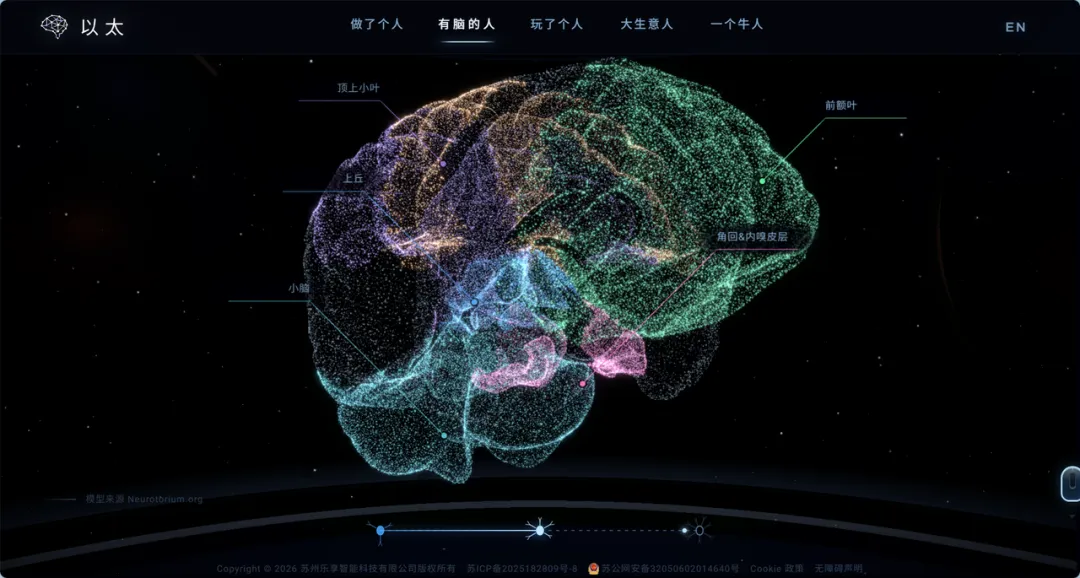
The frontal epitheliumAs a thought center, responsible for analyzing intentions, long-term planning, situational memory alignment and goal-driving, while assuming a metacognitive capacity to evaluate what you know, what you don't know, identify mission risks, and unblindly output unlockable scenarios;
Corner back and inner scalp: carrying flowing long-term memories and situational memories, embedding every real interaction into an adaptive, refreshable experience;
On top of the leaves and hills: constitutes the active perception center, as opposed to the passive photographic perception of the image being processed by the camera, the robot automatically rotates the viewpoint, adjusts the gesture of the observation, and actively fills the information blind area;
Motor cortex and small brain: Responsible for movement planning and dynamic regulation, the small brain unit continuously receives sensor feedback, compensating for disruption in the physical world in real time;
The spinal cord: the closest instinctive reflection layer to the body, the native processing force control, position closure, fall protection, touch avoidance, and other behaviours, encountering sudden collisions without the need for higher cognition, slow reasoning, and direct rapid response.
The key words of this architecture are "pass-through". From higher intention thinking, to memory manipulation, to environmental perception, to motion planning, and finally to reflection of corporeal instincts, the whole system flows end-to-end. The results of thinking flow directly to corporeal control, and feedback from corporeal sensors is transmitted back to higher cognition, achieving a two-way interaction between thought and action.
On top of this closed loop, the five great powers are deeply intertwined.
Active perception, allowing robots to cope with shadows and local perspectives when they are incomplete, actively seeking key clues. Multimodal understanding, allowing robots to unify the processing of visual, deep, gravitational, auditory and other real-world signals from multiple sources, understanding the size, material, spatial position and constraint relationships of objects.
Based on this brain-spinal cord-integrated biomechanical architecture, Aether attempts to give robots physical intuition and metacognition that is close to human level, to become a mind system that can understand the physical world, remember the past, evaluate itself, and continuously modify itself.
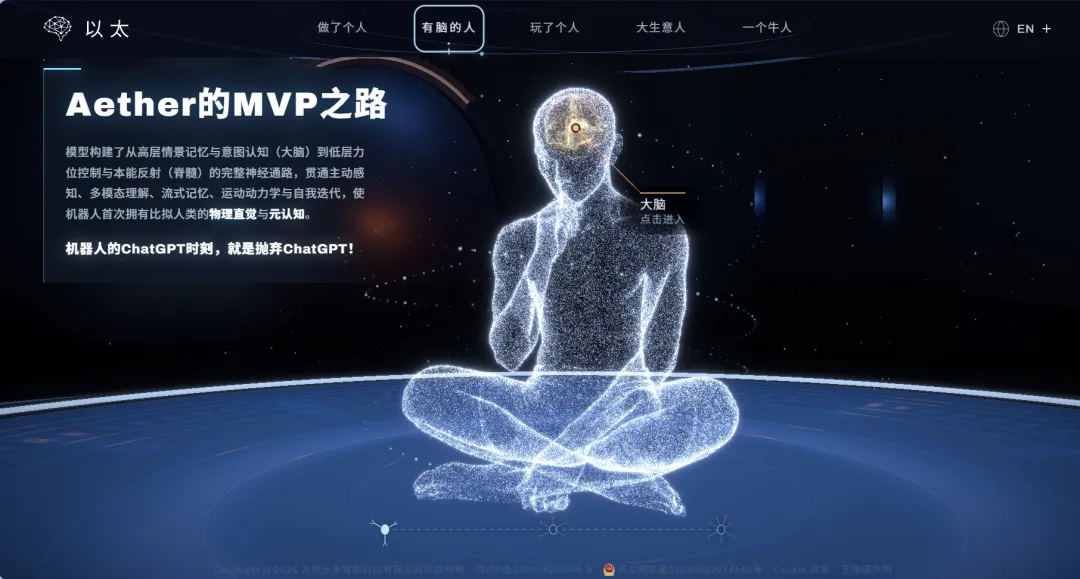
More importantly, Aether is not a special algorithm for binding chips to specific hardware, but rather a set of inter-body robotic intelligence base models. The same set of intelligent capabilities can enter different robot bodies, allowing different entities to continue to work and even collaborate autonomously on the basis of the same intelligent system.
From a matrix of consumer-grade robotic products, to a full-featured technology self-development system, to an open-source ecology and cross-body general-purpose model, the company is building a full-featured smart map of everything from brain-to-body-to-body-to-body-to-body-to-body-to-body ecology.
The strategic logic of this version is clear: the hardware determines which scenes the robot can enter, but the brain determines whether the robot can actually operate autonomously in the scene.
What Aether is going to do is build the underlying intelligence base that allows different hardware devices to grow their brains.
04.
Link to the Future
The smart industry is undergoing a subtle turnaround.
In an insight at the 2026 World Robotics Congress, IDC made it clear that the robotics industry's competitive divide is shifting from technological demo capabilities to stable delivery capabilities. In the first half of 2026, the shipments of Chinese humanoid robots exceeded 40,000 units, more than double that of last year's global shipments.
Hardware is no longer a bottleneck, and the real test is the ability of robots to function continuously, steadily, and independently in real environments.
At this turning point, AT&T opted for public live verification, which is essentially answering a question that hasn't been taken seriously: what is the standard for measuring physical intelligence, whether it should shift from what it can do to what it can't do?
Demo shows the upper limit of the capability, live broadcasting exposes the lower limit of the capability. While the upper limit can be embellished by modeling and clipping, the lower limit is an honest reflection of the real level of the model.
From the first demo to the outdoor live broadcast, there are two proofs of the same technical logic: first to prove that robots can solve problems themselves and then to put this ability into a truly imperfect predictable world. The former shows what is possible and the latter tests stability.
The final results of this live broadcast will need to be handed over to the industry, to the public to judge.
In an industry where demos are rampant, where the cost of trust is increasingly high, willingness to put models directly into an environment where they are open, uncut, and constantly interfered with is in itself a gesture worth seeing.
Because true autonomous intelligence is not about doing the right thing under the best conditions, but still deciding where to go next under the most uncertain conditions.